dsh-off-peak-hours
shadid516/dsh-off-peak-hours
DeepSeek Harness (dsh) plugin: an ambient pill under the composer showing whether your selected DeepSeek or z.ai plan is billed at peak or off-peak (half-price) rates right now, with a click-to-open schedule panel. PS: No human touched this code
Installation
dsh plugin --profile web add github:shadid516/dsh-off-peak-hoursREADME
Off-Peak Hours





A DeepSeek Harness (dsh)
bundle that puts one ambient pill under the composer while the Session's model
comes from a provider with a time-of-day price. The pill answers a single
question at a glance: is the next token billed at peak or off-peak rates?
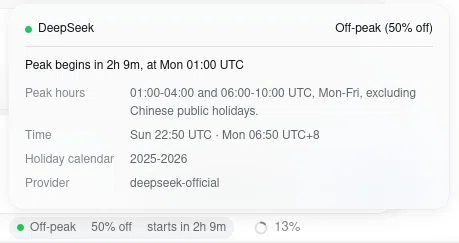
A live session on a Sunday evening. The weekend is off-peak, so the panel
names the change that ends it: Monday's 01:00 UTC window opening, 2h 9m away.
The pill sits beside the shipped stats pill — the one reading 13%.
● Off-peak · 50% off · starts in 6h 40m
● Peak · full rate · ends in 1h 12m
The countdown says how long the current state lasts, but not what it leads to. Clicking the pill — like the two stats pills beside it — opens a panel that does.
Install
Published on npm as
dsh-off-peak-hours. From a
shell with dsh on the PATH — a package that declares dsh.bundle is added
to the profile's bundle layers as soon as it is installed, so one command
enables it:
dsh plugin --profile web add dsh-off-peak-hours                    # from npm
dsh plugin --profile web add github:Shadid516/dsh-off-peak-hours   # latest main
From a DSH session:
plugin_manager install_bundle dsh-off-peak-hours
From a checkout, point install_bundle at the absolute directory:
plugin_manager install_bundle /absolute/path/to/dsh-off-peak-hours
The bundle is a client decoration with no config, no service, and no state, so there is nothing to set afterwards. Reload the page if the pill does not appear immediately.
What it shows
| State | Pill |
|---|---|
| Off-peak | green dot · Off-peak · 50% off · starts in … |
| Peak | amber dot · Peak · full rate · ends in … |
The dot colour is the only difference that survives a glance, so it carries the whole verdict; the words are there for the times a glance is not enough.
With a provider no plan claims, the entry renders nothing at all — no pill,
no placeholder. An unknown provider is hidden rather than guessed at, so a
custom route pointed at one of these vendors under a name the plan does not
claim shows nothing until that plan's matches is extended.
The panel
Clicking the pill opens a panel with the same chrome as the shipped stat dialogs:
DeepSeek                               Off-peak (50% off)
──────────────────────────────────────────────────────────────
Peak begins in 2h 9m, at Mon 01:00 UTC
Peak hours         01:00-04:00 and 06:00-10:00 UTC, Mon-Fri, excluding
                   Chinese public holidays.
Time               Sun 22:50 UTC · Mon 06:50 UTC+8
Holiday calendar   2025-2026
Provider           deepseek-official
- The header restates the pill's verdict in words.
- The answer line names the state that begins, rather than leaving "starts in 2h 9m" to be interpreted.
- A change less than a day away is stamped by weekday (
Mon 01:00 UTC); further out it gains a date, because a weekday alone stops identifying the day.
When a holiday or a campaign is in force, it leads the details list, above the schedule it overrides:
Holiday            National Day - off-peak all day
Campaign           50% off all day, 2026-09-25 to 2026-10-07
It behaves like the shipped panels: portaled to document.body, anchored above
the trigger and clamped into the viewport, dismissed by Escape or a
pointerdown outside itself and the trigger. The pill is a button carrying
aria-haspopup="dialog" and aria-expanded; the panel is a role="dialog"
labelled with the plan.
Plans
Each plan owns its own schedule, and the selected provider picks the plan. The same instant can be peak for one and off-peak for another, so the pill only ever reports the plan actually in force.
DeepSeek
| Window | Rate |
|---|---|
| 01:00–04:00 and 06:00–10:00 UTC, Monday–Friday, excluding Chinese public holidays | peak (full rate) |
| Every other instant — remaining hours, whole weekends, Chinese public holidays in full | off-peak (half rate) |
Weekends stay off-peak even when a holiday block designates them as makeup workdays (调休). The Chinese calendar decides "holiday" in China Standard Time (UTC+8); inside a peak window the UTC date, the China date, and the weekday always agree, so the two never conflict.
z.ai (GLM Coding Plan)
| Window | Rate |
|---|---|
| 14:00–18:00 Singapore time (UTC+8) = 06:00–10:00 UTC, Monday–Friday | peak (full rate) |
| Every other instant, weekends included | off-peak (half rate) |
The plan documents no holiday exclusion, so a weekday inside the window is peak even on a public holiday — unlike DeepSeek, which yields the whole holiday block. That asymmetry is deliberate and covered by tests.
Campaign. From 2026-09-25 to 2026-10-07 (UTC+8 days, inclusive) all-day
usage is charged at the off-peak rate. While a campaign is active the pill
appends a campaign note and the panel names its dates in a Campaign row.
Delete the entry from promotions once it ends; until then it is applied, not
assumed.
Both routes the pi-ai catalog ships for this plan — zai and zai-coding-cn —
resolve to the same schedule.
How the provider is resolved
The pill needs to know which plan is in force before it can say anything, and at the moment a Session opens there is no model selected yet. It therefore reads two sources in order:
- The model directory, keyed by session. This is authoritative and covers the blank-Session case, because it resolves the provider the next turn will use rather than waiting for one to arrive.
- The Session's projected model selection, as a fallback when the directory has not answered yet.
When neither yields a provider — the normal state for a Session whose model comes from somewhere no plan describes — the entry renders nothing.
Adding a plan
Everything lives in the PLANS table at the top of client.js. One entry is
enough:
{
  id: 'example',
  labelKey: 'plan.example',          // display name (dictionary key)
  scheduleKey: 'schedule.example',   // the vendor's own wording (dictionary key)
  source: '...',                     // the vendor's wording, kept next to the window
  peakWindowsUtc: [[9, 12]],         // `[startHour, endHour)` in UTC
  usesChinaHolidays: false,
  promotions: [],                    // optional dated all-day off-peak windows
  matches: (provider) => provider === 'example',
}
Add the matching plan.example and schedule.example strings to the EN and
ZH dictionaries — the test suite asserts the two dictionaries stay in step. A
window stated in a local time zone converts to UTC by a fixed shift, because
every zone these plans are written in is UTC+8 with no daylight saving.
Layout
| File | Role |
|---|---|
package.json | Bundle manifest: dsh.bundle.patch, the dsh.client browser declaration, exports["./client"], and the display metadata the Plugin Manager card reads. |
cordis.patch.yml | Inserts the single Host row. |
index.js | Host half. Empty on purpose — nothing is computed server-side. |
client.js | The whole feature: plans, holiday table, provider resolution, pill, panel. |
locale/en.json, locale/zh.json | Plugin-card title and description. |
icon.svg | Plugin-card artwork. |
test/schedule.test.mjs | 98 tests over the shipped client module. |
scripts/check-manifest.mjs | Validates the install and discovery contract. |
Updating the holiday calendar
HOLIDAY_RANGES in client.js is the only part that ages besides campaigns.
It holds the official days off, as continuous blocks, from the State Council
General Office notices:
- 2025 — 国办发明电〔2024〕12号
- 2026 — 国办发明电〔2025〕7号
The next year's arrangement is published around early November, so 2027 is
absent. Until it is added, years outside the table fall back to the
weekday/weekend rule alone and the pill appends calendar ends 2026 in the
warning colour rather than silently pretending the holidays are known. The
warning is scoped to the plans that consult the calendar; z.ai never shows it.
Makeup workdays are deliberately not listed: they are ordinary weekends here, and weekends are off-peak.
Developing
npm ci
npm run check     # manifest contract, then the test suite
npm test runs the suite alone. The tests load client.js exactly as the
browser does — through window.__ModuleLoader__.load — and drive the
registered component with a small React stand-in, so every expectation is
checked against shipped code rather than a re-implementation. The stand-in
supplies what the component actually reaches for: a hook store that defers
effects past the commit and enforces React's positional hook contract (a render
calling a different number of hooks is what retires a slot entry in the
browser), document/window event targets, refs bound to stand-in nodes with
settable geometry, and a react-dom createPortal that records where the panel
went.
npm run check:manifest validates the contract the ecosystem depends on: that
the patch is a top-level YAML array, that its rows name this package, and that
every file the manifest promises is published. See
CONTRIBUTING.md before changing schedule data.
Compatibility
The bundle needs a dsh that ships conversation.composer.dock and the
modelDirectories service. It is written against DSH 0.1.7-rc.2, and it
imports no Harness client package: a client bundle may not require
@deepseek-ai/dsh-client-ui-primitives, so the panel chrome is reimplemented
under this plugin's own opkh- prefix using the same theme tokens.
There is no persistent state and no migration, so upgrading is a package update.
License
Ähnliche Plugins
DeepSeek-Balance-Whale-Widget
meteornox/deepseek-balance-whale-widget
dsh-context
bowenliang123/dsh-context
dsh-cost-meter
han-1413141/dsh-cost-meter
dsh-damage-pulse
wssfk12138/dsh-damage-pulse