deja-vu
vshulcz/deja-vu
Bringt die Sitzungshistorie von neunzehn anderen Codieragenten in DeepSeek Harness: Abruf, Sitzungszusammenfassung und Pro-Datei-Historien-Tools über einen lokalen Index, plus optionaler automatischer Abruf vor jedem Schritt.
Installation
dsh plugin --profile web add github:vshulcz/deja-vuREADME

Memory for coding agents, starting with the history you already have.
Your agent is about to re-debug something you fixed in March. deja indexes the sessions Claude Code, Codex, Cursor and every other agent on this machine already wrote to disk, and hands the right one back when it is needed.

Nobody searched anything — the agent called deja itself. Every line is quoted from two real sessions.
Every memory tool starts empty and records forward. deja starts full.
85.3% hit@1 on LongMemEval-S · 69.6% on LoCoMo · sub-millisecond lookups over 5 GB of history
Both harnesses ship in this repo and run on the public datasets in minutes ·
check the numbers yourself




English | 中文
Docs · Benchmarks · How it compares
Install
curl -fsSL https://raw.githubusercontent.com/vshulcz/deja-vu/main/install.sh | sh
deja install --auto
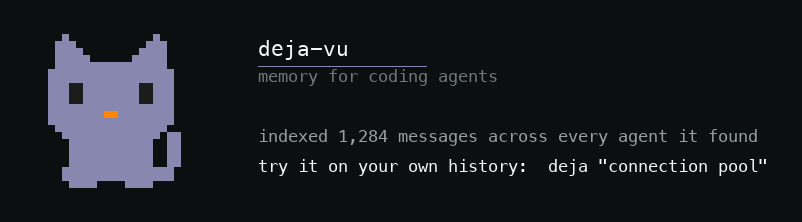
Ten seconds to install, about ten to index, and it is useful. The second command wires MCP recall into every agent it finds, turns on session-start recall where the agent supports it, and builds the first index so the next session does not pay for it.
Start a new agent session and ask it something you worked on months ago:
have we dealt with jwt refresh rotation before? check your memory
It does not have to be asked, either — with auto-recall the agent already knows what you solved in that project when the session opens.
Other ways to install, and what to do if you want less than all of it
brew install vshulcz/tap/deja-vu, go install github.com/vshulcz/deja-vu/cmd/deja@latest,
or npx @vshulcz/deja-vu "query" to try it without installing anything. Desktop apps that
take MCP servers as bundles can open the .mcpb from the
latest release; it carries the binary.
Claude Code, Codex, Cursor, Qwen, OpenClaw and Copilot can take the same plugin bundle from their own marketplaces instead:
claude plugin marketplace add vshulcz/deja-vu && claude plugin install deja-vu@deja-vu
On Windows the install script exits with unsupported OS — it is a shell script. Take
deja-vu_<version>_windows_amd64.zip from the
latest release and put deja.exe on
your PATH, e.g. in %USERPROFILE%\.local\bin.
The binary alone is a complete install for searching: index, search, show, ctx, blame,
--json and redaction need nothing else. deja install is what wires MCP into your agents
and turns on session-start recall — worth having, and optional. On a binary-only setup
deja doctor reports every MCP target as not-wired, which is that setup working as
intended. deja warmup also leaves a skill at ~/.agents/skills/deja-search/SKILL.md
that teaches an agent the CLI contract — deja search --json, ctx, blame, how to read
tier and total — so it knows history is searchable without MCP. The copy in the repo is
skills/deja-search/SKILL.md.
deja install --all is --auto without the session-start recall: agents answer from memory
when they decide to call it, rather than starting each session with it. The
agent setup guide covers what each
harness supports, aider's read-only context file, and the Windows cmd /c deja mcp wrapper.
What gets written into each agent's own guidance file
Install also writes user-level guidance for the harnesses it detects: Claude Code, Codex, opencode, Gemini CLI, Antigravity, Qwen, Kimi Code, pi, Copilot, Cursor, Goose, OpenClaw, Hermes, Roo Code, omp, DeepSeek Harness and Zed each get it in their own guidance file (or under the configured XDG_CONFIG_HOME). Re-run rewrites deja's skill or marked block without changing surrounding user content. Use deja install --all --no-guidance to opt out; Grok gets ~/.grok/GROK.md, which it reads only when a project has no .grok/GROK.md of its own. Cursor has no user-level instructions file, so it gets a skill at ~/.cursor/skills/ instead, read only when something looks relevant rather than every session.
What you get
Solve it in Codex. Claude remembers. Twenty coding agents write every conversation to local files, and deja turns those files into one memory layer all of them read.
| Retroactive search | deja "connection pool exhausted" over gigabytes, including everything from before you installed deja. Natural-language questions fall back to a relevance tier. Time is a hint, not a filter. |
| Cross-agent recall | The MCP recall tool answers "we fixed this three weeks ago" in whichever agent asks, whoever solved it originally. |
| It survives compaction | Measured over 43 compactions: the summary keeps 77% of the decisions and 0.2% of the commands you ran. deja hands back the other 99.8%. |
| Recall at the point of action | Before an agent edits a file or runs a command, deja names that file's prior decision or that command's working invocation, from a PreToolUse hook. When a command fails, a PostToolUse hook answers with what followed that same error here before — the pair an agent never thinks to ask for. |
| It indexes the work, not just the talk | The files each turn opened, the commands that ran with their exit status, and the exact spans an edit replaced. That is the part every summary throws away. |
Four more: rejected decisions, staleness, sync and handoff, redaction
| It knows what held | deja promote <id> --state rejected --note "why" marks a decision you reverted. Every later hit for that session shows it was tried and rejected, with the reason. Nothing is deleted, and --state accepted takes the mark back. |
| It says when the ground moved | A hit reports 4 files this session touched have changed since, and says nothing when it cannot tell. It never claims anything is unchanged. |
| Sync and handoff | deja sync ssh laptop moves memory between machines, append-only, no cloud in the middle. deja handoff --to codex packages the live context so you can continue in another agent. |
| Redaction | Keys, tokens, JWTs and private key blocks are stripped at index time, so the cache is safe to keep. |
Your own work, wrapped
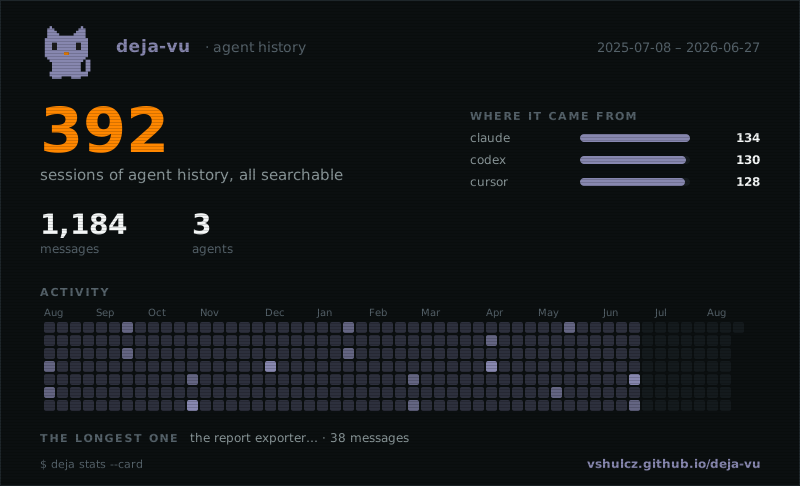
deja stats --card draws it in the terminal; give it a filename and it writes an
SVG for a profile README.
The full feature reference lives in the docs.
Privacy
Indexing and search are local. The network is used only by deja update, deja sync ssh,
and the version check in deja doctor.
Credentials are redacted at index time: AWS keys, api_key= and token= assignments,
bearer tokens and raw JWTs, PEM private key blocks, provider tokens, scheme://user:pass@host
URLs, and high-entropy values for shapes no pattern knows. The value becomes
[redacted:<kind>] and the surrounding text stays searchable. deja share and
deja sync export re-apply redaction on the way out.
deja forget removes sessions from a rebuilt index and writes tombstones, so a later
deja index cannot restore them from the source history. --unforget lifts a tombstone.
Project exclusions are one pattern per line in ~/.config/deja/exclude.
The security model documents data flows, redaction limits, trust assumptions and release verification.
CLI
$ deja "jwt refresh token"
[claude] api        · Jul 8 · 8f31c0a9 — 2 matches
  login started failing after refresh token rotation; jwt kid mismatch in tests
  fixed by reloading jwks cache after rotateKey and adding a clock-skew test
[codex]  web        · Jul 1 · b77d91e2 — 1 match
  refresh token cookie needed SameSite=Lax in local callback flow
Ask your history
| Command | What it does |
|---|---|
deja <query> | Search every history. Multi-word is AND and quoted phrases require contiguous text; a query with no exact match then tries word forms and close spellings, which is where a substring reaches its word (code finds opencode). |
deja | With an index and a terminal: today's sessions, recalls served, a question you asked in more than one session, and a wall your agents keep hitting. |
deja blame <path> | Which sessions discussed a file, what was decided, and why. |
deja files <topic> | The other direction: which files the work on a subject actually touched. |
deja how <tool> | How this machine actually runs a thing, with the real flags, from what agents ran before. |
deja fix <error> | What this machine ran after that same error before, when the error did not come back. |
deja friction | Errors that hit three or more separate sessions, with the harnesses named. |
Using what it finds, and moving it between machines
Use what it finds
| Command | What it does |
|---|---|
deja ctx <query> | Markdown digest of the best match, ready to pipe into a prompt. |
deja resume <id> | Reopen a found session in its native harness. |
deja restore <path> | Hand back a span an agent replaced, from the old_string its edit recorded. Never writes over the original. |
deja promote <id> | Distill a session into a curated note with provenance, tags and a lifecycle state. Notes outrank raw transcripts. |
deja share <id> | A sanitized session digest for a colleague, with secrets already scrubbed. |
Move it and check it
| Command | What it does |
|---|---|
deja sync export/import/ssh | Move memory between machines. Watermarked, append-only, idempotent. |
deja view | Your whole memory as one local HTML file. No server, nothing leaves the machine. |
deja stats | Your agent work, wrapped. --card draws it in the terminal, --card <file>.svg writes one for a profile, --html a browsable timeline. |
deja doctor [--deep] | Self-diagnosis, and with --deep, proof of the index against the sources. |
deja mcp | The stdio MCP server, which is what deja install wires in. |
Full reference: commands and JSON output.
MCP tools
The server exposes recall, recall_context, blame, fix, how and remember.
deja install wires them in, so this is only needed to configure an agent by hand.
Arguments and return shapes
| Tool | Arguments | Returns |
|---|---|---|
recall | query, harness?, limit?, offset? | Dense matching snippets, capped at 4KB. |
recall_context | query, harness? | Markdown digest of the best-matching session. |
blame | path, harness?, project?, since?, limit?, all? | Sessions that discussed a file. |
fix | error, project?, limit? | What this machine ran after that same error before. |
how | what, project?, limit? | The real invocation, from what agents ran here. |
remember | text, project?, tags? | Stores a durable decision for later recall. |
Supported harnesses
Claude Code · Cline · Codex CLI · opencode · aider · Gemini CLI · Cursor · Antigravity · Grok Build · Hermes · Goose · Qwen Code · Kimi Code · pi · omp (Oh My Pi) · OpenClaw · Copilot CLI · Roo Code · DeepSeek Harness · Zed.
What each one supports
| Harness | MCP recall | Auto-recall | Skill | Command | Resume | Handoff | Needs |
|---|---|---|---|---|---|---|---|
| Claude Code | ✅ | ✅ | ✅ | ✅ | ✅ | ✅ | — |
| Cline | ✅ | ✅ | ✅ | ✅ | ✅ | ✅ | — |
| Codex CLI | ✅ | ✅ | ✅ | ✅ | ✅ | ✅ | — |
| opencode | ✅ | ✅ | ✅ | ✅ | ✅ | ✅ | sqlite3 |
| aider | ⚠ | ✅ | ✕ | ⚠ | ✕ | ✅ | deja aider |
| Gemini CLI | ✅ | ✅ | ✅ | ✅ | ✅ | ✅ | — |
| Cursor | ✅ | ✅ | ✅ | ✅ | ✅ | ✅ | sqlite3 (IDE chats) |
| Antigravity | ✅ | ✅ | ✅ | ✅ | ✅ | ✅ | — |
| Grok Build | ✅ | ✅ | ✅ | ✅ | ? | ✅ | sqlite3 (grok-dev store) |
| Hermes | ✅ | ✅ | ✅ | ✅ | ✅ | paste | sqlite3 |
| Goose | ✅ | ✅ | ✅ | ✅ | ✅ | ✅ | deja goose |
| Qwen Code | ✅ | ✅ | ✅ | ✅ | ✅ | ✅ | — |
| Kimi Code | ✅ | ✅ | ✅ | ✅ | ✅ | ✅ | — |
| pi | ✅ | ✅ | ✅ | ✅ | ✅ | ✅ | — |
| omp (Oh My Pi) | ✅ | ✅ | ✅ | ✅ | ✅ | ✅ | — |
| OpenClaw | ✅ | ✅ | ✅ | ✅ | ✅ | paste | — |
| Copilot CLI | ✅ | ✕ | ✅ | ✅ | ✅ | ✅ | — |
| Roo Code | ✅ | ⚠ | ✅ | ✅ | ✕ | paste | — |
| DeepSeek Harness | ✅ | ✅ | ✅ | ✅ | ✕ | paste | zstd |
| Zed | ✅ | ✕ | ✅ | ✅ | ✕ | paste | sqlite3 + zstd |
✅ works · — possible, not built yet · ✕ the harness has no such mechanism · ⚠ blocked by an upstream bug · ? not investigated
Custom store locations go through DEJA_*_ROOT variables, and each agent's own relocation
variable is honored too. The
session format registry documents
the observed paths, record schemas and role mapping per harness, with synthetic fixtures
keeping those descriptions checked against the parsers.
Harnesses with a package of their own
deja install --auto wires all five of these like every other harness, and
that stays the shortest path. They also have a package in their own ecosystem,
for people who install extensions there rather than from a CLI:
| Harness | Package | Install |
|---|---|---|
| opencode | npm opencode-deja | opencode plugin opencode-deja |
| DeepSeek Harness | npm dsh-deja | dsh plugin add dsh-deja |
| Zed | deja-context-server | Zed → Extensions → deja |
| Kimi Code | plugin deja | /plugins install https://github.com/vshulcz/deja-vu |
| Codex CLI | plugin deja-vu | codex plugin marketplace add https://github.com/vshulcz/deja-vu then codex plugin add deja-vu@deja-vu |
Either path is enough on its own, and having both is not a problem: the
opencode, dsh, Kimi and Codex packages read what deja install wrote and
contribute only what is missing, and in Zed both halves use one server id, so
there is nothing to have twice whichever order you install in.
Each uses the deja you already have; the copy it bundles is only the fallback.
Semantic recall (optional)
Point deja embed at a local Ollama, LM Studio or OpenAI-compatible endpoint with
DEJA_EMBED_URL and rephrased queries still hit. Without a reachable runtime, lexical
search and MCP recall continue unchanged.
Where the vectors live and what they cost
The sidecar sits beside the index as .vectors.bin, not inside index.db. Float32 vectors
cost roughly 4 MB per 1k messages for a 1,024 dimension model. Embedding is local, and it
never sends raw source files, only the redacted indexed text truncated to about 2k
characters.
Proof
deja bench recall     # ranking regression floor, CI fails if recall drops
deja bench context    # 30 seeded task chains plus five negative controls
The context experiment compares deja-recall against full-history, naive grep and cold context. With the default seed:
| Arm | Median tokens | Median coverage | Negative-control tokens |
|---|---|---|---|
| deja-recall | 286 | 1.00 | 0 |
| full-history | 16,919 | 1.00 | 14,920 |
| naive-grep | 57,489 | 1.00 | 0 |
| cold | 0 | 0.00 | 0 |
Same fact coverage as grepping the raw logs for about 200x fewer tokens, and about 60x fewer than replaying the matched sessions in full, while injecting nothing on the chains where no prior fact is relevant. The corpus generator and the relevance labels are ordinary reviewed Go. Audit what "relevant" means before trusting any figure, ours included.
Measured on a real store of 1,551 sessions and 143k messages — 5.2 GB across nine harnesses:
| Measurement | Result |
|---|---|
| Lookup, in process | ~0.4 ms median (deja bench recall), ~25 ms on the LongMemEval-S haystacks |
deja <query>, end to end | ~0.2 s median on that store: process start, the freshness check over every store, ranking, printing |
| Freshness check alone | ~30 ms when nothing changed |
| Index size | 160 MB, ~3% of corpus |
The index is incremental. When a session file grows, only that file is re-read.
How it works
Local inverted index in ~/.cache/deja: parse the JSONL and SQLite stores, redact
credentials, write records.bin plus token buckets, and track per-file state in
manifest.gob so repeat runs only ingest what changed. The MCP server, stats, share and
sync all read that one index. Details in docs/ARCHITECTURE.md.
FAQ
Does anything leave my machine? No, unless you ask it to. See the data flows.
What about secrets already in my logs? They stay in the original harness files, which are your agent's data. They do not enter deja's index, digests, shares or sync exports.
Will it slow my agent down? A recall is a lexical lookup against a local index: ~0.4 ms median, and nothing waits on a model. A hook adds the process start and a freshness check over your stores on top of that — tens of milliseconds on a store of a few gigabytes.
Do I have to change how I work? No. The agent calls recall itself, and with auto-recall it already knows the project's prior decisions when the session opens.
How is this different from the other memory tools?
| deja | Memory platforms (Mem0, Letta, memU) | Session search (cass) | |
|---|---|---|---|
| Knows work from before you installed it | yes | no | yes |
| Capture step | none, the transcripts are the memory | the agent or your code writes facts | none |
| Needs an LLM or embedding key | no | yes | optional |
| Recalls without being asked | at session start and before a tool runs | no | no |
engram is the strongest of the record-forward tools and worth your time if that model fits you; it still starts empty and knows only what an agent chose to save. The full comparison covers eleven of them.
What about Windows? Builds exist and CI runs the suite there. macOS and Linux are the battle-tested paths. Field reports welcome in #9.
How do I wipe everything?
deja uninstall --all
rm -rf ~/.cache/deja
Try it on your own history
curl -fsSL https://raw.githubusercontent.com/vshulcz/deja-vu/main/install.sh | sh
deja install --auto
Ten seconds to install, about ten to index. The next session your agent opens, it already knows what you solved in that project — including everything from before you installed this.
Contributing
make build test lint, then CONTRIBUTING.md. Adding a harness starts in
the parser registry. Priorities and non-goals are in
ROADMAP.md. Good first issues are labeled.
License
MIT © Vladislav Shulcz
Ähnliche Plugins
reactive-resume
amruthpillai/reactive-resume
cloudbase-ai-toolkit
tencentcloudbase/cloudbase-ai-toolkit
sandbase-harness
sandbaseai/sandbase-harness
postiz-agent
gitroomhq/postiz-agent