dsh-provider-usage
wjw1-evan/dsh-provider-usage
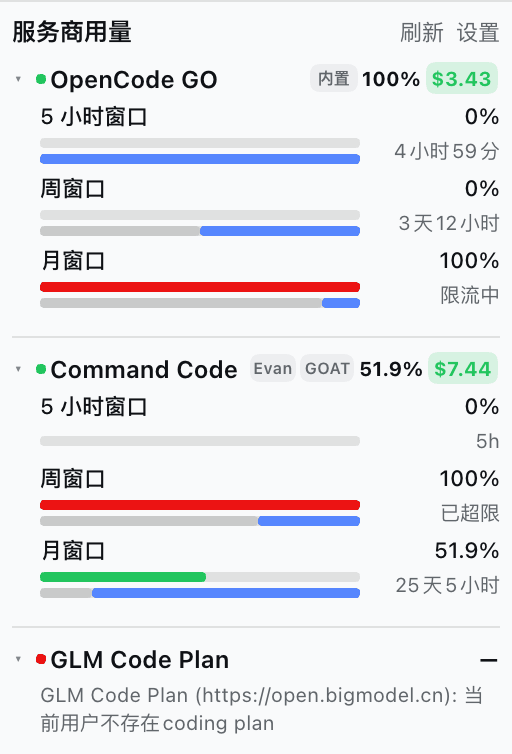
One collapsible sidebar widget stacking OpenCode GO, Command Code and GLM Code Plan quota windows, with reset countdowns, top-up balances, a settings page and a /provider-usage command.
Installation
dsh plugin --profile web add github:wjw1-evan/dsh-provider-usageREADME
dsh-multi-provider-usage
A DSH plugin that shows the
quotas of OpenCode GO, Command Code and GLM Code Plan in one sidebar
widget. It is modelled on
@astervolans/dsh-opencode-go-usage
— same dual-half package, same-origin proxy, same sidebar slot, same Plugins
panel settings page — extended from one provider to three.
The package name is
dsh-multi-provider-usagebecause the unscopeddsh-provider-usagename is already taken on npm by a different plugin. The HTTP routes (/provider-usage/*) and chat command (/provider-usage) stay short and stable.
Features
- Three providers, one column. All enabled providers are stacked vertically; each header carries a health dot, the provider's primary percentage and its top-up balance. Click a provider header to collapse/expand that provider's plan windows, quota bars and time bars; the collapse state is remembered locally, so any subset can stay folded.
- OpenCode GO — 5-hour, weekly and monthly windows (the API calls the 5-hour field
rolling). Prefers the livedsh-opencode-goplugin's active account through itsopencodeGoUsagehost service, then falls back to the officialGET /v1/usageendpoint. - Command Code — monthly credit pool, 5-hour window and weekly window from
the official billing/usage endpoints (
/alpha/billing/*,/alpha/usage/summary). - GLM Code Plan, international and China — 5-hour token window, weekly
token window and monthly MCP tool limit, read from the international Z.ai
host (
api.z.ai) or the China BigModel host (open.bigmodel.cn) at/api/monitor/usage/quota/limit.autoprobes both, the GLM card badges the version that answered (International / China), and the plugin settings can pin one version (or a custom endpoint). When neither version answers, the failure names each version's result instead of only the last probe. - Top-up balances — OpenCode GO shows the OpenCode Zen prepaid balance and
Command Code shows its purchased + free "Extra Credits" balance, both as a
badge next to the account/plan and in the
/provider-usagetext. The OpenCode console token is auto-discovered fromOPENCODE_CONSOLE_TOKEN, the OpenCode CLI auth file, or its localopencode.db; the token never leaves the host. When that token is missing, the balance slot becomes a clickable "Set up" chip that opens the plugin settings, where the OpenCode GO card renders a step-by-step setup guide, instead of silently showing nothing. Command Code's tooltip breaks its amount into purchased + free credits; a credits response without either pool renders a muted No top-up badge. - Auto-update — on boot and every configured interval the host checks the
npm registry, the npmmirror mirror and the GitHub release feed together and
trusts the newest version any of them reports. A local
link:/file:checkout is fast-forwarded when it is onmain, clean, and a strict fast-forward. An npm / market / tarball copy updates itself: the release tarball is downloaded from the first source that serves it (registry → mirror → GitHub, in turn) and each packaged file (lib/,package.json,cordis.patch.yml,docs/) is written to a temp file and renamed over the target, so pnpm's hardlinked store is never edited in place. Either way the running Host keeps the old module graph, so the widget/settings show "updated — restart DSH". The plugin never restarts DSH by itself. - Balance-change animation — the widget polls on its normal interval; when
a provider's balance differs from the previous poll, the number counts from
the old value to the refreshed one while a red/green delta chip (for example
-0.1) floats up and fades away. There is no popup and no turn-event tracking, so the animation may appear up to one poll interval later. - Low-balance tone — a balance at or below 5 renders amber and at or below 1 renders red (thresholds are in the currency unit and apply to USD and CNY plans alike), in both the sidebar and the settings page's live-usage sections.
- Click-to-retry failures — an error line in the widget is itself clickable (and keyboard-activatable) and forces one fresh upstream read.
- Same-origin proxy — the browser only talks to
/provider-usage/usageand/provider-usage/settings; API keys stay in the host process. - Failure isolation — one broken provider never hides the other two. The
route answers
200while any provider succeeds and502only when all enabled providers fail. Partial endpoint failures keep the provider's numbers but turn its health dot amber and name the failed calls in the tooltip. - Settings shortcut — the widget header's Settings button opens this bundle's page in the sidebar Plugins panel, directly on the configuration page below.
- Bundle settings page — sidebar Plugins panel → this bundle's card:
enable/disable each provider, edit credential refs and endpoints, choose the
GLM region, and see non-network detection status. Save applies immediately.
Each provider card embeds a live usage section — quota windows with
percentages, time-to-reset and the top-up balance, from the same canonical
snapshot the widget renders. While the page is open it follows the widget:
a 30-second poll (when the tab is visible) plus an "Updated HH:MM" stamp,
a Refresh usage control forces a re-read, and every save re-reads with
refresh=1, so a changed credential ref shows its own numbers immediately. The GLM card also carries the referral link (Z.ai "Invite Friends, Get Credits") as a clickable, copyable row. The URL is a bundle constant: it never goes through the settings route and a settings save cannot overwrite it. /provider-usagechat command — prints every enabled provider's numbers as text.- Time bars — under each quota bar, gray is time already elapsed and blue is time remaining, matching the reference widget's geometry. Each window also counts down to its reset on the right; an exhausted window keeps that countdown and gains a small exceeded/rate-limited chip right after the percentage, whose hover title also carries the absolute reset time.
x-opencode-sessionfix — injects the real per-conversation harness session id into OpenCode GO chat requests at runtime, without patching DSH.- Chinese and English UI through the DSH locale service.
Install
From npm:
dsh plugin --profile desktop add dsh-multi-provider-usage
or, for the web profile:
dsh plugin --profile web add dsh-multi-provider-usage
From a checkout (for development):
dsh plugin --profile desktop add /path/to/dsh-provider-usage
The package declares dsh.bundle.patch, so the CLI reconciles it into the
profile's bundle layer stack automatically. The widget and client bundle are
part of the profile's client-modules graph, so restart DSH once after
installing (a running host does not rebuild its window.__DSH_BOOT__ manifest
for a newly linked package).
For a local link: dependency pnpm prints a peer-dependency warning
(@deepseek-ai/schemastery, @deepseek-ai/dsh). That is expected: the linked
checkout resolves schemastery from its own node_modules in development; a
normal npm install resolves the peers from the DSH runtime.
Credentials
All values are resolved through the DSH credentials domain (the process
environment, $DSH_HOME/.credentials.yaml and .env layers). They are never
returned by the settings route and never reach the browser.
| Provider | Default ref | Resolution order | Fallback source |
|---|---|---|---|
| OpenCode GO | OPENCODE_GO_API_KEY | opencodeGoApiKeyEnv, the dsh-opencode-go active-account ref (only when that entry is enabled), OPENCODE_GO_API_KEY, OPENCODE_API_KEY | GET {baseUrl}/v1/usage |
| Command Code | COMMANDCODE_API_KEY | commandCodeApiKeyEnv, COMMANDCODE_API_KEY, then the CLI auth file | ~/.commandcode/auth.json (apiKey) |
| GLM Code Plan | ZAI_API_KEY | glmApiKeyEnv, ZAI_CODING_CN_API_KEY, ZAI_API_KEY, ZHIPU_API_KEY, GLM_API_KEY, BIGMODEL_API_KEY | — |
Set a ref in Plugins → dsh-multi-provider-usage → settings (or in the
auto-generated Settings → Plugins → Plugin configuration form). A ref is a
name such as OPENCODE_GO_API_KEY; the secret itself lives in DSH's credential
store.
OpenCode console balance
The GO quota API does not include the account's prepaid balance. That comes from
GET https://opencode.ai/console/api/billing/status, which needs the OpenCode
console OAuth token (the GO API key returns 403 there). The host resolves it
in this order:
opencodeConsoleApiKeyEnv(OPENCODE_CONSOLE_TOKENby default), resolved through DSH credentials;- the
credentialtable of~/.local/share/opencode/opencode.db(read vianode:sqlitewhen available; this is where current OpenCode releases keep the OAuth grant and rotate it); ~/.local/share/opencode/auth.json($XDG_DATA_HOME/opencode/auth.jsonwhen set), provideropencode— the legacy location kept by older releases.
The database is preferred deliberately: OpenCode migrated its grant there but
often leaves the old auth.json behind, and that stale token returns 401. Every
usable OAuth candidate is tried in turn (at most four), so one expired store
cannot hide the live one. Channel builds (opencode-beta.db, opencode-dev.db,
…) and $OPENCODE_DB are discovered too. The billing host comes from the grant's
metadata.server (so a self-hosted console works), falling back to the public
origin; opencodeConsoleBaseUrl overrides it.
An OpenCode API-key login (oc_sk_…, the service-account method) carries no
console session and is never sent to the billing endpoint. Such a login, a
missing token, or an expired/revoked grant renders a clickable Set up chip
(instead of a mute dash) that opens this bundle's page in the Plugins panel and
names the fix: run opencode auth login and choose the OpenCode Console
account, or store a console token as OPENCODE_CONSOLE_TOKEN.
When the balance is not configured (or the console login is fixable), the
OpenCode GO card in the plugin settings renders a step-by-step setup guide
in place of the static hint. The lead-in names the state-specific fix (nothing
configured, an API-key login, or an expired sign-in). Step ① shows the
opencode auth login CLI command with a Copy command button; step ② offers
a Re-check button that re-reads the sign-in state and forces one upstream
usage read, so a fresh login shows the balance without restarting DSH (unsaved
form edits are never discarded by the re-check). The /provider-usage command
gives the same state-specific guidance as text for all three fixable states.
The optional opencodeConsoleAuthFile overrides the auth file (and its
directory is used to locate opencode.db), opencodeConsoleOrgId supplies the
x-org-id header, and opencodeConsoleEnabled: false turns the whole balance
read off. Balance failures never hide the GO quota: the provider stays ok with
balance: null and a meta.balanceError (plus meta.balanceSetup when the
user can fix it). Any other balance failure renders a muted Balance — badge
whose tooltip carries the error.
Command Code balance
Command Code's quota and balance share one API key and one billing family, so
they cannot diverge the way OpenCode's do: a missing key (COMMANDCODE_API_KEY
or ~/.commandcode/auth.json) fails the whole provider with an explicit
no API key message rather than blanking only the balance. Two narrower gaps
are reported instead of hidden:
- when
/alpha/billing/creditsfails, that request carries every window, so the provider errors as well; its message now includes the underlying interface and status instead of only "no usable quota windows", andmeta.balanceErrorlets the header show a muted Balance — badge carrying the cause; - when the credits response succeeds but carries neither
purchasedCreditsnorfreeCredits,balancestaysnullwithmeta.balanceMissing: trueand the header shows a muted No top-up badge (a real0still renders$0.00).
OpenCode GO integration and fallback
When opencodeGoSource is opencode-go (the default), the host probes:
- a live loader entry named
opencode-go/dsh-opencode-go; - that entry is not disabled;
ctx.get("opencodeGoUsage")exposesread();read()returns validrolling/weekly/monthlydata;- the active account is read from that entry's
apiKeyEnv+accounts[].
If any step fails, the host reads the built-in endpoint and reports a fallback
object with one of: not-installed, entry-disabled, service-unavailable,
read-failed, invalid-response. The widget shows a Built-in badge with the
reason and message in its tooltip. opencodeGoSource: "builtin" pins the HTTP
path and never touches the other plugin.
Plan windows
| Provider | Windows | Window length |
|---|---|---|
| OpenCode GO | rolling, weekly, monthly | 5 h, 7 d, ~30 d |
| Command Code | five-hour, weekly, monthly | 5 h, 7 d, real billing period |
| GLM Code Plan | five-hour, weekly, mcp | 5 h, 7 d, monthly |
Percentages are used percentages and are clamped to [0, 100] for display.
Command Code monthly utilization is
totalCost / (totalCost + monthlyCredits); purchased and free credits are
reported separately in meta.monthly and do not change the plan bar, while
their sum is the visible top-up balance (balance.extra). The
5-hour/weekly bars use windowLimits.fiveHour / weekly (used, cap,
resetAt, exceeded).
Tiny usage (since 0.8.6): right after a 5-hour/weekly window resets, usage is often below 0.05%, which is under one pixel of bar width — the green fill disappeared entirely, making the card look like it had a single (blue time) bar or like usage was zero. Now:
- a non-zero percentage that rounds to zero renders as
<0.1%instead of0%; - any non-zero usage keeps at least a
2pxfill, so only a real0%is an empty bar; - the usage track keeps a 1px inset ring so it still reads as a bar on the light sidebar.
Command Code's card therefore always shows two bars per row (green usage + blue time) for the 5-hour, weekly and monthly windows; a just-reset window only has a very thin green part, rather than a missing bar.
Token usage on a window row (since 0.8.2): a window may carry tokensUsed,
the vendor's absolute token count for that window, and the widget renders it as
Token: <number> right after the window label, with a compact unit (亿/万 with
a Chinese locale, B/M/K otherwise; full grouped digits below the smallest unit).
Only Command Code provides one today — its billing-period summary.totalTokens rides on the monthly
window (falling back to totalTokensIn + totalTokensOut when the vendor omits
the combined field). No vendor reports tokens for the 5-hour or weekly windows
(Command Code's windowLimits.used/cap count credits, not tokens), so those
rows show no token count.
Billing context (since 0.8.3): the monthly token count's tooltip carries
the billing-period in/out split (meta.totals.tokensIn / tokensOut) and the
request totals with success rate (meta.totals.requests / successRate); the
projected exhaustion date (meta.projection.runsOutInDays, Command Code)
renders right after the token count in the monthly row's label. MCP tool calls (since 0.8.3): GLM's monthly TIME_LIMIT
counts ride on the mcp window as used/cap and render as "123 / 1,000"
after its label. Recharge link (since 0.8.3): a low OpenCode prepaid
balance that the console marks purchasable links straight to
opencode.ai/console from the badge.
A GLM account without a Coding Plan answers HTTP 200 with
{ "success": false, "msg": ... }; the adapter surfaces that message and the
widget shows the provider in an error state.
Configuration
The loader reads the exported Config schema; every field is .volatile(), so
the settings page and the auto-generated form hot-apply.
| Field | Default | Meaning |
|---|---|---|
opencodeGoEnabled | true | Show OpenCode GO |
opencodeGoSource | "opencode-go" | opencode-go or builtin |
opencodeGoApiKeyEnv | "OPENCODE_GO_API_KEY" | Credential ref |
opencodeGoBaseUrl | "https://opencode.ai/zen/go" | Gateway base |
opencodeConsoleEnabled | true | Read the Zen prepaid balance |
opencodeConsoleApiKeyEnv | "OPENCODE_CONSOLE_TOKEN" | Console token ref |
opencodeConsoleOrgId | "" | Optional x-org-id |
opencodeConsoleAuthFile | "" | Optional auth.json path; empty auto-discovers |
opencodeConsoleDbFile | "" | Optional opencode.db path; empty derives it |
opencodeConsoleBaseUrl | "https://opencode.ai" | Console origin |
commandCodeEnabled | true | Show Command Code |
commandCodeApiKeyEnv | "COMMANDCODE_API_KEY" | Credential ref |
commandCodeBaseUrl | "https://api.commandcode.ai" | API base |
commandCodeAuthFile | "" | Empty = ~/.commandcode/auth.json |
glmEnabled | true | Show GLM Code Plan |
glmApiKeyEnv | "ZAI_API_KEY" | Credential ref |
glmBaseUrl | "" | Optional base override |
glmRegion | "auto" | auto, zai, bigmodel, custom |
cacheMs | 30000 | Per-provider host cache TTL |
updateCheck | true | npm update check (24 h) |
autoUpdate | true | Check npm, npmmirror and GitHub together; fast-forward a clean checkout, otherwise replace an installed package from the first source that serves the tarball |
autoUpdateCheckHours | 6 | Hours between auto-update checks (1–168) |
injectSessionHeader | true | OpenCode GO session-header fix |
providerOrder | all three ids | Provider display order in the widget; drag the cards in the plugin settings to reorder |
glmRegion: "custom" requires glmBaseUrl; auto probes
https://api.z.ai first and then https://open.bigmodel.cn, and the widget
badges the version that answered.
HTTP API
GET /provider-usage/usage
?refresh=1 (or ?force=1) bypasses the host cache.
{
  "ok": true,
  "enabled": ["opencode-go", "command-code", "glm"],
  "providerOrder": ["opencode-go", "command-code", "glm"],
  "providers": [
    {
      "id": "opencode-go",
      "name": "OpenCode GO",
      "short": "GO",
      "status": "ok",
      "account": { "ref": "OPENCODE_GO_API_KEY", "id": null, "name": "" },
      "plan": null,
      "source": "builtin",
      "requested": "opencode-go",
      "fallback": {
        "from": "opencode-go",
        "reason": "not-installed",
        "message": "dsh-opencode-go is not installed, or its profile entry is inactive"
      },
      "balance": {
        "amount": 5.01495352,
        "currency": "USD",
        "labelKey": "balance.zen",
        "source": "opencode-db",
        "details": { "billingMode": "prepaid", "mode": "pay-as-you-go" }
      },
      "windows": [
        {
          "key": "rolling",
          "labelKey": "window.five-hour",
          "hintKey": "window.five-hour.hint",
          "percent": 0,
          "status": "ok",
          "resetsAt": "2026-11-05T13:50:46.363Z",
          "windowMs": 18000000
        }
      ],
      "meta": {}
    }
  ],
  "update": { "current": "0.1.0", "available": false, "latest": null },
  "sessionHeader": { "active": true, "count": 0, "diag": {} }
}
Failed providers have "status": "error", code, error and windows: [];
their siblings are still returned. A body with providers: [] means no provider
is enabled. meta.balanceError carries a tolerated balance failure (the
provider still answers ok); meta.balanceSetup (no-credential, api-key or
expired) marks a failure the user can fix by signing in again;
meta.balanceMissing marks a Command Code credits response without
purchased/free pools. meta.errors lists partial Command Code endpoint
failures: the numbers stay, the health dot turns amber, and the tooltip names
the failed calls. Error cards keep the plan they already resolved.
Caching and refresh semantics (since 0.8.1): the host keeps a TTL cache per
provider (cacheMs, default 30 s). Once a provider's entry has expired, the
next request answers instantly with the last-known value (top-level and
per-provider servedStale: true) while a background read refreshes upstream —
a slow provider (up to its 15 s fetch timeout) can no longer stall the sidebar
widget or the /provider-usage command; the widget follows up automatically a
few seconds later. ?refresh=1 still blocks on a fresh read (manual refresh
and post-save behavior are unchanged); an account/source switch never serves
the previous account's data. Responses carry an ETag; a request with
If-None-Match gets 304 with no body while the document is unchanged. The
sidebar widget stretches its poll gap while nothing changes (from 30 s up to
2 min).
GET /provider-usage/settings
Returns the settings descriptor (namespace, revision, value, base,
user) plus a non-network detection report:
{
  "ok": true,
  "namespace": "dsh-multi-provider-usage",
  "revision": 0,
  "value": { "opencodeGoEnabled": true },
  "detection": {
    "providerOrder": ["opencode-go", "command-code", "glm"],
    "enabled": ["opencode-go", "command-code", "glm"],
    "providers": {
      "opencode-go": { "configured": true, "entryFound": false, "fallback": { "...": "..." } },
      "command-code": { "configured": true, "source": "auth-file" },
      "glm": { "configured": true, "region": "auto" }
    }
  }
}
503 means the host has no settings service or the entry has no volatile
fields; the settings page explains how to fix it.
POST /provider-usage/settings
Only the fields in the table above are accepted; anything else is ignored.
expectedRevision gets 409 on a concurrent change.
{
  "patch": { "commandCodeEnabled": false, "providerOrder": ["glm", "opencode-go", "command-code"] },
  "expectedRevision": 0
}
Cross-origin writes are refused with 403. The usage route is read-only.
How it is put together
| Half | File | Role |
|---|---|---|
| host (Node) | lib/index.js | Config schema, routes, command, settings/detection, cache, session fix |
| host adapters | lib/providers.js | Canonical window shape and the three vendor adapters |
| console balance | lib/opencode-console.js | OpenCode console token discovery + billing status |
| session fix | lib/opencode-session.js | globalThis.fetch wrapper + llm/stream ALS context |
| browser | lib/client.js | Hand-authored window.__ModuleLoader__.load({ id, factory }) bundle: widget, settings page, locale dictionaries |
| bundle patch | cordis.patch.yml | Inserts the profile entry |
The browser bundle is composed by DSH's official client-modules scan from
dsh.client + exports["./client"]; it registers into
sidebar.footer.action and plugins.bundle.config, exactly like the reference
plugin.
The session fix wraps globalThis.fetch once and only adds
x-opencode-session when the request URL starts with the gateway base carried
by the current llm/stream call. The base comes from
llm-pi-ai.providers.<route>.baseURL, falling back to opencodeGoBaseUrl.
Compatibility
- DSH
0.1.7and above, with no upper bound (future DSH lines included); verified on0.2.1-rc.5. @deepseek-ai/schemastery^3.18.4(volatile fields / settings page).- Node.js ≥ 18 (global
fetch,AbortSignal.timeout). dsh-opencode-gois optional; its absence is a normal fallback.- Command Code's CLI auth file is optional if
COMMANDCODE_API_KEYis set. - A DSH runtime that does not expose
plugins.bundle.configloses only the settings page; the sidebar widget and/provider-usagekeep working. Set the config fields in the profile patch or the auto-generated form instead.
Development
npm install
npm test
The tests are hermetic: a fake globalThis.fetch and a stub Cordis context, no
network and no real keys. They cover the schema, all three adapters, OpenCode
GO service integration/fallback, aggregation and error isolation, caching and
forced refresh, settings conflicts/whitelisting, the client bundle contract,
top-up balance discovery (credential and local auth.json) and failure
isolation, and the session-header injection. 110 tests, all offline.
License
MIT.
Ähnliche Plugins
DeepSeek-Balance-Whale-Widget
meteornox/deepseek-balance-whale-widget
dsh-context
bowenliang123/dsh-context
dsh-cost-meter
han-1413141/dsh-cost-meter
dsh-damage-pulse
wssfk12138/dsh-damage-pulse