dsh-plan-lattice
1052326311/dsh-plan-lattice
Agrega contratos de ejecución persistentes, grafos de trabajo recursivos, aclaración crítica y compuertas de evidencia para tareas largas o poco especificadas de Harness.
Instalar
dsh plugin --profile web add github:1052326311/dsh-plan-latticeREADME
Plan Lattice
Execution-time drift control for long-running DeepSeek Harness agents.






Plan Lattice is a passive continuity layer over DeepSeek Harness's native plan,
Todo, Session, compaction, and subagent lifecycle. In default auto mode it
restores exact authority already recorded by DSH only when a committed
surfaceOp.replace removed its source from the model-visible Session. A cold
resume reuses DSH's restored surface, and a fresh child receives only DSH's
native standalone prompt. Auto adds no Lattice tools, state, contract, graph,
or guard.
A recursive graph and one-use action bases remain available only as explicit
full-Lattice control.
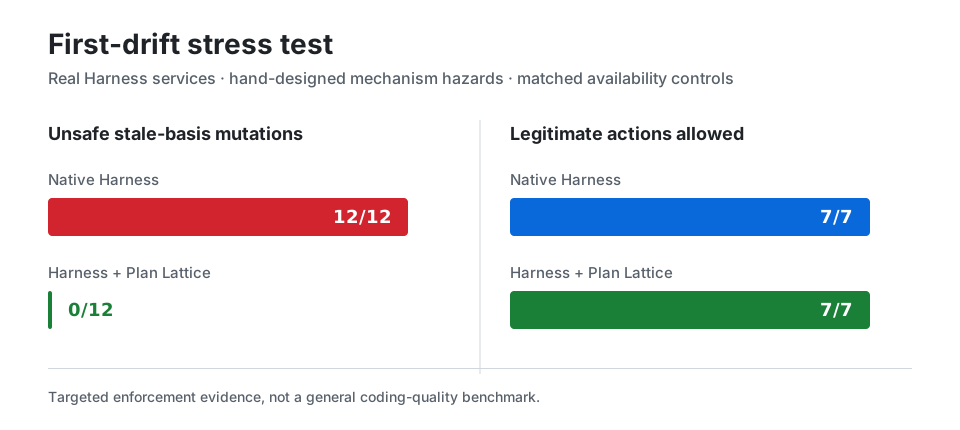
Hand-designed mechanism stress test using real Harness runtime services:
- Unsafe stale-basis mutations: native
12/12; Plan Lattice0/12. - Matched legitimate controls: native
7/7; Plan Lattice7/7. - Unsafe post-
SIGKILLcontinuations: native2/2; Plan Lattice0/2. - Matched post-restart controls: native
2/2; Plan Lattice2/2.
Benchmark ·
Raw results ·
Crash results ·
Executable driver ·
Field reports ·
CI
Status:
v0.3.0remains the latest stable release;v0.4.0-rc.6is the current public runtime candidate. This checkout contains unreleased rc.8 native-continuity work, not an evidence-backed stable release. Focused mechanism and lifecycle tests have passed. V20 is a retained negative result: both arms scored 100, but the candidate exceeded its 4M input-token budget and did not execute final integration, so no uplift claim or release is allowed. V18 is also a retained negative result: native scored 88 with one hard miss, while the candidate scored 75 with two hard misses. The V18 driver bypassed DSH's model-facing foreground subagent result path, so it is neither evidence of uplift nor a valid delegation-continuity comparison. It must not be rerun under the same identity. The earlier frozen V17 pair produced an exploratory 100 versus 84 score and zero versus one hard miss, but both arms exceeded the 4M-input-token budget and neither completed all five lifecycle stages. The result therefore fails its preregistered evidence gate and is not a quality or uplift claim. The crash-safev3 external-model studyis frozen but has not executed against this runtime, so no general coding-quality uplift or ranking is claimed.
Evidence At A Glance
| Claim | Current evidence | Status |
|---|---|---|
| Stale long-task mutations can be stopped without disabling valid work | Real Harness mechanism stress test: unsafe entries changed from native 12/12 to Plan Lattice 0/12; both arms executed 7/7 matched legitimate controls | Reproducible |
| A side effect without a settled tool result cannot be silently forgotten after process death | Two fixed hazards kill the worker with real SIGKILL before the mechanical receipt; native executes the later mutation in 2/2 cases and Plan Lattice in 0/2, while both arms pass 2/2 legitimate restart controls | Reproducible |
| Recent guarded dispatch facts remain visible to the agent during recovery | lattice_status returns at most three recent mechanical receipts and renders their exact attempt, call, argument, basis, and result identities through the real Harness ToolRuntime model-facing content path | Integration tested; receipts are explicitly not semantic completion evidence |
| Explicit full control fences quiet follow-ups against its accepted contract | Every durable human message is reviewed against the exact contract revision; implicit English and Chinese changes are covered | Covered by real Harness integration and stress tests; not an automatic-mode claim |
| Explicit full control fences old graph branches after reframe | Every non-archived node, including a previously complete node, is reconciled with the new contract | Covered by real Harness integration tests; not an automatic-mode claim |
| Clear tasks avoid automatic orchestration overhead | Default auto injects no Lattice policy or tools, creates no workspace .dsh state, and adds no controller model call | Integration tests; exploratory real-model repeats do not establish per-run overhead non-inferiority |
The published RC.6 artifact loads on official Harness rc.7 and the current installable 0.1.1-rc.2 | CI downloads the exact release tarball, verifies SHA-256 9e522d43877debcccbcad1e1ebb15916fbb35d50a9a98032bdc6149802c30082, installs it into fresh profiles, boots the real Web host, and observes all 16 lattice_* tool schemas | Continuously verified |
| Official Harness alpha.1 resolves Plan Lattice's exact package identity | CI runs the exact alpha.1 source-tag inventory implementation against ACTIVE Loader entries backed by the published RC.6 and current candidate manifests | Source-contract proof, not install compatibility or endorsement |
| The candidate improves a dynamic long system | V17 scored candidate 100 versus native 84 with zero versus one hard miss, but both arms exceeded 4M input tokens and stopped before the five-stage lifecycle completed | Retained invalid result, not evidence of uplift |
| Native passive continuity improves a dynamic long system | V18 scored candidate 75 versus native 88 and used an invalid external subagent lifecycle that did not return the child result through the parent Session | Retained negative result, not evidence of uplift and not rerunnable under the same identity |
| Boundary-scoped native continuity improves a dynamic long system | V20 scored both arms 100; candidate used five fewer turns and less wall time but exceeded the input budget before final integration | Retained negative result, not evidence of uplift and not rerunnable under the same identity |
| Native recovery preserves child prompts and remains bounded | V21 audits persisted DSH Session JSONL for own-event replacements, exact first child input, snapshot count/bytes, lifecycle completion, and paired input viability | Draft preregistration; execution disabled until code, driver, task, grader, and runtime freeze |
| The external benchmark driver uses the real frozen Harness path | Local end-to-end fixture verifies the credential proxy, exact model contract, durable Session JSONL, token accounting, timeout handling, and secret redaction | Driver verified; paid matrix not run |
| General software-task quality improves | Requires the frozen 90-run ICAE/EvoCode/simple-task matrix and releaseAllowed: true | Not established |
Try It
Try the public v0.4.0-rc.6 runtime candidate represented by the mechanism
evidence above:
gh release download v0.4.0-rc.6 --repo 1052326311/dsh-plan-lattice --pattern '*.tgz'
dsh plugin --profile web add ./dsh-plan-lattice-0.4.0-rc.6.tgz
For the stable v0.3.0 release:
gh release download v0.3.0 --repo 1052326311/dsh-plan-lattice --pattern '*.tgz'
dsh plugin --profile web add ./dsh-plan-lattice-0.3.0.tgz
The stable release is also listed in the community-maintained
Awesome DeepSeek Harness Plugin
catalog and its dsh-market
storefront. The catalog currently points to the audited v0.3.0 tarball;
RC.6 remains an explicit prerelease install until its external evaluation is
complete.
The package is an independent community plugin for DeepSeek Harness. To build
the current checkout from source, run pnpm install, pnpm pack, and install
the generated tarball with the same dsh plugin --profile web add command.
Current official-release evidence and its claim boundaries are tracked in
DeepSeek Harness release compatibility.
The First-Drift Test
A long task does not usually fail because its plan file vanished. It fails when one mutation finally executes from a basis that was incomplete, compacted away, superseded, or changed elsewhere. Explicit full-Lattice control makes that boundary executable: it joins the accepted contract, exact target bodies, live ownership, observable external preconditions, and, only in explicit full-Lattice mode, the current root-to-leaf address and required semantic evidence into a one-use authorization epoch.
The repository includes a deterministic stress test built on the real Harness context, session, agent-registry, compaction, and tool-runtime services. It deliberately invalidates one part of that basis immediately before a protected mutation. Each controlled arm must block before the protected tool body runs and match its preregistered enforcement mechanism; an unrelated exception does not count as a pass:
| Engineered hazard | Native Harness | Plan Lattice |
|---|---|---|
| Changed target file | unsafe mutation executed | prevented |
| Changed accepted background | unsafe mutation executed | prevented |
| Compacted model-visible context | unsafe mutation executed | prevented |
| Late material user input | unsafe mutation executed | prevented |
| Implicit acceptance change | unsafe mutation executed | prevented |
| Implicit truth-source change in Chinese | unsafe mutation executed | prevented |
| New input after review preparation | unsafe mutation executed | prevented |
| Unscoped shell mutation | unsafe mutation executed | prevented |
| Changed external precondition | unsafe mutation executed | prevented |
| Middleware argument rewrite | unsafe mutation executed | prevented |
| Self-consistent contract-file rewrite | unsafe mutation executed | prevented |
| Disappeared delegated parent | unsafe mutation executed | prevented |
Observed result on these 12 engineered hazards: native executed 12/12 unsafe mutations; Plan Lattice executed 0/12, a 100 percentage-point difference on the tested mechanism. Reproduce it locally:
pnpm install --frozen-lockfile
pnpm run demo:first-drift:check
This is intentionally a mechanism stress test, not a sampled benchmark of
software tasks. The 100% prevention rate applies only to the 12 hazards the
test was designed to trigger. It does not estimate general coding quality,
real-world task success, or production uplift. See the
machine-readable results,
rendered report, and
reproducible driver.
The stricter external protocol remains frozen separately. V1 through V5 failed
their first reveal; V6 failed annotation reliability; V7 lacked blind-stratum
capacity; V8/V9 were retired before router reveal during source isolation; and
V10 was retired before seed access when its frozen collector encountered an
unhandled empty GitHub repository. V11 was then retired before seed access when
live GitHub Search returned an object whose updated_at was later than the
frozen historical cutoff, proving that the search index could not replay a
trustworthy historical source frame. V13 replaces mutable search with 24
prospective, versioned GH Archive hour objects, freezes their raw gzip Merkle
root before parsing any body, and uses a future public drand round only after
three-annotator reliability and exact max-flow capacity pass. The complete
protocol and router source are bound by the public
router-v13-protocol-freeze-v2
release before source access. The original V13 tag was retired before source
access after a crash-recovery audit; v2 keeps the source, router, labels, and
gates unchanged while making its one reveal single-execution and crash-safe.
These negative and retired results remain in the repository and are not
repaired or relabelled as release evidence.
V13 has exactly one reveal and eight preregistered router gates. Passing it
would establish source-disjoint automatic-control accuracy on that frozen
sample only; it would not establish general coding-quality uplift. The
executable stages, raw evidence requirements, thresholds, and retirement rules
are in the
V13 preregistration. Run all
protocol controls locally with:
pnpm run router:v13:test
The RC.4 external-model study has a second, stricter evidence boundary. Its
candidate, 96-slot order, hidden graders, release thresholds, first public
runtime build, V13/V14 router gate, controller, preflight, analyzer, and retry
policy are frozen before any paid model call. A later execution envelope may
bind only the independently revealed router outcome, the preselected runtime
bytes, and a new signing identity. See the
preregistration and public
v3 protocol freeze.
Until its analyzer returns releaseAllowed: true, router accuracy and
mechanism tests do not support a general software-quality claim.
Automatic Control
New installations default to activationMode: auto. In this mode Plan Lattice
does not classify the request into a plugin-owned contract, graph, or read-only
probe. It exposes no lattice_* tools, installs no mutation guard, injects no
permanent Plan Lattice policy, and creates no workspace .dsh state. The native
DSH model request and tool set remain unchanged until DSH crosses a real
continuity boundary.
| Mode | Owner of planning and execution | Plan Lattice effect |
|---|---|---|
off | DSH | None |
auto | DSH | One boundary-frozen recovery delta after a native surface replacement actually hides an authority source |
always | DSH plus explicit Plan Lattice transaction control | Contract, graph, receipts, leases, checkpoints, evidence gates, and guarded mutations |
The automatic projection is assembled from DSH's append-only Session log. It
may contain exact anchored human messages, the latest successfully approved
native exit_plan_mode plan, and foreground subagent results already delivered
through native tool/result, but only when their exact source messages are no
longer in session.surface.nodes. The projection is frozen at the replacement
event seq. Later user messages and child results remain on DSH's normal wire
and cannot rebuild the old recovery payload. Native Todo remains current-turn
DSH state and is never promoted into cross-turn authority.
Only a committed surfaceOp.replace activates that projection. A
compaction/summary, process restart, fresh child, Todo update, tool result, or
ordinary user follow-up is not independently a continuity loss. Cold resume
reconstructs the durable replacement identity and retained runtime snapshot
without appending a duplicate. A fresh child receives the exact parent-authored
standalone prompt unchanged; only a later replacement in that child Session may
restore the delegated instruction it removed.
Full contract and graph control is opt-in through activationMode: always, an
explicit Use the full Lattice request, or resumed legacy graph state. This is
the only mode in which intake, reframe, refresh, receipts, leases, checkpoints,
tool restrictions, and mutation guards apply.
Root Invariant
Within the controlled long-task execution domain, drift has one precise form: a protected mutation executes from an intent or fact basis that is incomplete, no longer authoritative, or no longer current. If such drift occurs, the ordered execution has a first protected mutation with that invalid basis. This is a scoped invariant for that failure class, not a law about every model error or every task. Compaction, handoff, parallel agents, revised requirements, plan edits, and external state changes are mechanisms that can invalidate the basis.
The stable invariant is therefore not “keep a longer prompt” or “refresh before
every edit.” It is: after DSH loses model-visible continuity, the next model
request must be able to reconstruct the native execution basis that still
governs the task. Default auto mode restores that basis as passive runtime
context and does not authorize, guard, or intercept mutations. DSH continues to
own ordinary repository reads, writes, planning, tool results, and lifecycle.
Explicit contract and full-Lattice modes intentionally provide a stricter pre-action basis containing:
- the complete accepted execution contract;
- the exact current contents of every declared target file, or a digest-bound fact that the target does not yet exist;
- any proof still required from prior protected work; and
- host-observable preconditions for non-filesystem side effects.
Only explicit full-Lattice mode adds a checked-out leaf and full root-to-leaf plan to that basis. Default auto mode does not create graph nodes, leases, or semantic checkpoints; DSH's native Plan Mode and Todo remain the sole planning representations.
In explicit full control, lattice_refresh_context({ targetPaths }) rebuilds and
verifies that basis internally. In a stable native DSH conversation the
original user request is already visible, so the result projects only the new
receipt, exact target facts, and an optional full-Lattice leaf. It reprojects
the full immutable contract only after a real surface replacement, resume,
delegation, or material reframe. A built-in
write, edit, or mutating str_replace_editor call is accepted only when its
actual path is one of those targets and its body still matches the observed
digest. The joined authorization epoch is consumed before validation or
dispatch in explicit control, including failed attempts, so parallel or retried
mutations cannot reuse it. A prepared dispatch then binds and locks the call identity and exact
arguments; supported authority invalidation while an asynchronous dispatch
middleware waits aborts the call before tool-body entry. The guard compares the
contract revision and aggregate digest of every declared target, plus the graph
revision and root-to-leaf digest only in explicit full-Lattice mode. Surface
replacement, resume, reframe, plan mutation, handoff, disposal, or a concurrent
durable change invalidates the whole epoch. Read-only str_replace_editor view
calls do not.
The first accepted global definition for each guarded tool is pinned for the
process lifetime, including its execute function. Scoped same-name shadows and
later global replacements do not inherit trust, and any supported registry
change aborts an active guard-to-body dispatch. Plan Lattice also locks the name
and arguments of initially unguarded calls at its first dispatch middleware, so
a later middleware cannot upgrade a harmless call into write or edit after
the guard has run.
Non-filesystem guarded tools require a programmatic host precondition adapter.
An adapter can bind exact action arguments to observable external state, or it
can expose snapshotScope plus verifyScope for a host-observable scope such
as the complete writable workspace. Scope authority does not pre-approve raw
arguments: the guard still normalizes the eventual action, consumes one
authorization epoch, locks the complete call identity, and rechecks the scope
before tool-body entry. An explicit action binding suppresses broader automatic
scope authority for that tool. Without either proof mode the guard fails closed.
This includes strictBash: declaring files cannot prove that arbitrary shell
text has no other side effects.
An adapter may implement normalizeArguments when the host tool adds
display-only metadata after the context receipt is prepared. The normalized
identity must be a synchronous, finite, acyclic JSON value; promises, class
instances, sparse arrays, undefined, and non-finite numbers fail closed.
snapshot and verify still receive the complete raw arguments. The adapter
must reject every field omitted from the identity that can change execution
semantics; only presentation metadata may be ignored.
In explicit full-Lattice mode, the recursive tree is a persistent execution
address rather than a Todo display. Default auto mode does not add that address:
after replacement compaction, cold resume, or handoff, it re-projects the native
human authority, approved Plan, current Todo, returned child results, and Session
lineage that DSH already recorded. A summary, model memory, inherited message,
or parentSession does not replace those native records.
Inbox arrival and durable message append each invalidate authority. This closes
the interval in which a receipt could otherwise be reissued after a message was
queued but before it became model-visible. Every new human message after
contract commitment stays fenced until the root agent reads the complete
contract and exact pending messages with lattice_review_input, then durably
commits contract-unchanged or contract-changed with
lattice_commit_input_review. Another message consumes the prepared review.
Plugin-authored operational notices also revoke ephemeral action authority, but
they cannot revise the human product contract or raise reframePending.
Delegated agents revalidate every
live parent ownership edge when authority is issued, consumed, and dispatched;
a stale parentSession value cannot revive a dead handoff.
In explicit full-Lattice mode, structural plan changes obey the same rule. Adding, splitting, updating, archiving, or checking out a node requires a one-action receipt from a complete contract and exact current plan-neighborhood reread; the change consumes the receipt and advances the revision. An artifact edit additionally binds the current root-to-leaf plan to the exact target body. A compacted summary never substitutes for either read.
In explicit control, the accepted contract, invariants, and acceptance criteria are the current constants. Discovered facts, plans, declared mutation targets, executors, and external state may change; a trend never authorizes a mutation. Default auto mode has no such contract or action binding. It restores only the DSH-native basis lost at a continuity boundary while DSH owns planning and execution. An explicitly selected tree adds a durable root-to-leaf address without freezing changeable state.
The formal control domain, derivation, mutation protocol, and falsification
conditions are documented in docs/FIRST_PRINCIPLE.md.
The exact rc.7 request, compaction, plan/todo, and subagent integration boundary
is documented in docs/DSH_NATIVE_INTEGRATION.md.
Configuration
- id: plan-lattice
  config:
    activationMode: auto          # off | auto | always
    clarificationPolicy: critical # critical | always | never
    controlCeiling: lattice       # contract | lattice
    longTaskThreshold: 8
    maxTokenContinuations: 0      # opt-in; bounded per durable session
    guardedTools: [write, edit, str_replace_editor]
    strictBash: true             # v0.4 default; also guards pwsh
    maxContextBytes: 262144
    topLevelLimit: 2
    nestedLimit: 5
    snapshotEvery: 1024
    # Defaults below DSH_HOME; keep outside every agent-writable workspace.
    # contractAnchorRoot: /absolute/trusted/plan-lattice-anchors
longTaskThreshold, clarificationPolicy, controlCeiling, guardedTools, and
strictBash configure explicit full control. They do not activate contracts,
tools, or guards in default auto mode. Under activationMode: always,
controlCeiling: contract provides the contract-only tier and ablation arm;
strictBash: false weakens that tier's mutation-time guarantee. Function
adapters are host composition and therefore cannot be expressed in YAML.
When an explicitly controlled contract or lattice turn ends because the model reached
its output ceiling, maxTokenContinuations uses DSH's native followup() to
queue a clean next turn. It never runs for bypass, never uses same-turn
steer(), stops while a reframe is pending, and counts its own continuation
messages from the durable Session log. The default is zero, preserving DSH's
manual-continuation behavior; set a positive bound to opt in. This can prevent a
known terminal state from abandoning controlled work. It does not improve model
reasoning or turn a vague task into a well-defined one.
Task text can override configuration:
Do not use Plan Lattice/不要使用 Plan Latticeforcesbypass.Do not ask; make reasonable assumptions/不要提问,合理假设keeps the selected control level but changes clarification tonever.Use the full Lattice/使用完整 Latticeforces the configured maximum control level.
v0.3 Migration
An explicit legacy intakeMode keeps v0.3 behavior when none of the new fields
is present, including no automatic max-token continuation. Mixing old and new fields is a configuration error with migration
guidance. This compatibility path preserves v0.3 custom-tool behavior; the new
external-precondition guarantee applies to the v0.4 controller.
| Legacy | v0.4 equivalent |
|---|---|
intakeMode: off | activationMode: always, clarificationPolicy: never |
intakeMode: adaptive | activationMode: always, clarificationPolicy: critical |
intakeMode: guided | activationMode: always, clarificationPolicy: always |
Legacy graphs and intake records remain readable. New contracts are written to
v2 paths; old state is never rewritten in place. A resumed v1 graph is treated
as full lattice control.
Explicit Contract Protocol
This protocol is inactive in default activationMode: auto. It applies only to
activationMode: always, an explicit full-Lattice request, or compatible legacy
state. Automatic native continuity never calls these tools on the model's
behalf and never requires the model to call them.
lattice_intake records the system boundary, time horizon, observable outcome,
facts, decisions, invariants, changeable forms, directional forces, causal
variables, assumptions, unknowns, and acceptance readiness.
- With no critical questions, it atomically commits the contract immediately.
- With questions, it asks through the real Harness user-question channel and
returns a
pendingIntakeIdplus the answers. Nothing is persisted yet. lattice_commit_intakemust bind every answer exactly once as a confirmed fact, decision, invariant, or explicit unknown before the contract is committed.- Under contract control,
clarificationPolicy: neverrejects questions and requires visible, reversible assumptions in one compactlattice_intake. - Under full Lattice control, the same policy skips the separate intake model
turn: parameterless
lattice_open {}binds the exact human request from the durable Session log and creates a stable accepted-outcome root plus one refinable executable leaf. The agent inspects repository evidence after open and refines only the next path instead of spending a turn restating the contract or designing the entire graph. Explicit plans remain supported. - Delegated agents cannot question the user or establish the root contract; they return missing information to their parent.
Explicit contract control permits guarded work after commitment without
requiring a node checkout and can require a fresh contract and target-file basis
per mutation. Full Lattice control additionally requires
lattice_open, a current context receipt, an active leaf lease, the current
root-to-leaf plan, and semantic checkpoints for verified leaf progress,
blockers, and completion.
Every settled guarded action receives a controller-generated mechanical execution receipt
whether the tool succeeds or fails. Mechanical receipts record exact attempt
identity and the guarded tools/execute around-dispatch observation for crash
recovery. The observation is captured before DSH's private registry
normalization, tools/post-execute policy, and definition-owned
finalizeContent, because none can undo a potentially attempted side effect. A
downstream wrapper's authored result or thrown error may therefore differ from
the later normalized presentation. A wrapper may also short-circuit without
invoking the tool body, so the receipt proves durable admission and an observed
wrapper outcome, not body execution. Its digest covers the stable
isError/content/error/meta projection and deliberately excludes values,
additional contexts, and turn-control flags. Mechanical receipts never count
as acceptance evidence and do not complete a node.
lattice_status also renders up to three recent matching receipts into the
final model-facing tool content, so recovery can inspect those exact identities
without reading plugin-owned state files. The bounded status view remains an
operational trace, not evidence that a node's acceptance criteria were met.
Every human message supplied after contract commitment pauses guarded work,
including quiet follow-ups such as continue. The two-stage input review binds
the exact durable message sequence and accepted contract revision. If the
contract is unchanged, authority is rebuilt from a fresh context read. If it
changed, only lattice_reframe can resume work. Wording heuristics may fence an
obvious material change earlier but never classify input as harmless.
In explicit control, when a declared contract file changes or a
surfaceOp.replace event replaces model-visible history, guarded work also
pauses. compaction/summary and
compaction/prune are append-only audit records and do not create a boundary by
themselves; the replacement message emitted by the native compactor or pruner
does. Resumed sessions preserve that exact event. lattice_reframe commits a
new contract revision; explicit contract and full-Lattice modes may bind
targetPaths for the next mutation. Full-Lattice mode rereads its current plan.
Existing graph nodes remain visible in that
mode, but every non-archived node is marked
non-executable, including nodes that were complete under the old contract.
lattice_update explicitly reconciles one inspected node with the new
contract; checkout remains blocked until the complete root-to-leaf lineage has
been reconciled or stale leaves have been archived. Prior evidence remains as
history, not proof that the revised contract is complete.
Plan Lattice does not implement a second conversation compactor. DeepSeek
Harness owns summary compaction and model-free tool-result pruning, including
surface replacement and immutable event provenance. Deployments should compose
@deepseek-ai/dsh-compaction-basic with
@deepseek-ai/dsh-compaction-tool-result-pruner for large tool output. In
automatic mode, Plan Lattice consumes replacement events only to trigger a
passive native continuity projection. In explicit control, the same event also
revokes stale mutation authority and requires the configured contract, graph,
and target rereads.
The confirmed id, revision, digest, and full last accepted contract are also
stored in a session-keyed trust root below DSH_HOME (or
contractAnchorRoot). Rewriting CONTRACT.md and contract.json together does
not move that anchor. The mismatch survives process restart, blocks guarded
writes, and can be replaced only through lattice_reframe. The anchor root must
remain outside paths writable by the tested agent.
Multi-Agent Sessions
A one-shot child inherits its root task's control level only when
parentSession agrees with the Harness's live isOwnedBy relation. An rc.7
continuable child instead receives the same binding through DSH's exported,
exact-version-pinned registerContinuableSetup pre-publication extension,
because the continuation manager's private activation scope is its process-local
owner. Durable lineage metadata
alone never authorizes inheritance. Plan Lattice does not construct or replace
the delegation prompt: DSH fork, spawn, and continuable providers own the child
seed, user message, persona, policy, tool scope, scheduling, and result delivery.
Automatic mode preserves the model-authored child first message byte-for-byte
and separately projects native human authority, approved Plan, current Todo,
recent foreground child results from the current Session, Session lineage, and
the exact first-message identity through DSH's scoped runtime-context channel.
For a fork child, replacements contained in the inherited completed-turn seed
are already represented by DSH's current child surface and never activate a
fresh-child recovery snapshot. Only a later replacement in the child's own
event suffix is a child continuity boundary.
If replacement hides the child's own initial instruction, that exact native
message is re-projected from the anchored child Session event. Explicit
full-Lattice mode can also carry
the current outcome, decisions, invariants, node, acceptance, unknowns, and
graph revision. It does not give the child authority to ask the human. Missing
boundary information is a parent-facing result, not a reason for the child to
guess.
This boundary must be exercised through the published rc.7 model-facing
@deepseek-ai/dsh-tool-subagent plugin: its prompt argument remains the exact
first child user message, and its foreground result must return to the parent as
the matching native tool/result. The plugin does not maintain a second child
prompt template, scheduler, transport, or result channel.
DSH delivers the initial delegated task as the child's first own user-role message. In automatic mode Plan Lattice stores only the child, root, and parent Session IDs plus that exact first-message ID and digest outside the workspace; it does not copy the message text. This anchor verifies which native child input the continuity projection accompanies. Explicit control may additionally use live ownership and continuable setup evidence to enforce its scoped transaction rules.
Explicit full-Lattice and legacy control require DSH runtime context and every
tool in the selected phase's protocol. agent/pre-step is an early diagnostic.
When downstream native work changes model-visible state after assembly, the
plugin preserves already-claimed input and invalidates protected-mutation
authority rather than synthesizing a request. One llm/stream wrapper binds the
deep-frozen AgentLoop request to the exact rendered system prompt, latest
complete snapshot body, current authorization epoch, exact callable wire
schema, and the exact tool-definition identities visible to that Agent. It
validates before entering downstream middleware and again before accepting each
returned chunk. A global tools/change is revalidated against the affected
Agent's exact live definition view: an unrelated Agent's restriction does not
invalidate this request or an active guarded dispatch, while a changed local
definition, presentation mode, Code Mode SDK section, or final wire does. The
plugin never invokes the public prompt-assembly waterfall a second time.
Default automatic mode trusts DSH's native request assembly and has no protected
tool dispatch; request attestation and mutation enforcement apply only to
explicit full-Lattice and legacy control.
When DSH native plan mode is active, DSH owns the planning turn, review, and
exit_plan_mode. Automatic mode later recovers the latest successful
exit_plan_mode plan from the Session log only when continuity has been lost;
it never blocks or replaces native Plan Mode. Explicit full-Lattice mode may
project a current leaf and enforce its own transaction boundary without creating
a competing planning state machine.
rc.7 restores a complete persona after the public assembly waterfall and
does not publish the restored final assembly. Request-attested full Lattice therefore
fails closed with a complete persona instead of claiming to attest text it
never observed. Use an ordinary persona, or explicitly bypass Plan Lattice for
that task. rc.7 also has no load-order-independent pre-adapter hook or atomic
chunk-admission guard. If an asynchronous downstream checkpoint changes
authority after the initial check, the adapter request may already start; the
tested checkpoint ordering rejects its first chunk before Session append.
There remains a smaller host TOCTOU window between Plan Lattice yielding a
validated chunk and AgentLoop appending it. A stale terminal finish chunk in
that window can form a complete stale assistant message and re-enter the model
surface on a later step. Protected tool calls in that message still cannot
bypass the independent tool guard, but eliminating the stale event and message
requires an upstream atomic admission seam. The general upstream fix is a post-final-assembly observation plus a
synchronous adapter-dispatch and chunk-admission guard;
these rc.7 limits are detailed in
DSH_NATIVE_INTEGRATION.md. A preset that
suppresses runtime context or hides/replaces the required transport is rejected
before the initial downstream request.
Plan Lattice does not spawn or schedule agents and does not deliver their results. DSH owns those mechanisms. Automatic mode only restores native state that is already durable and model-relevant after a continuity boundary; explicit full control additionally maintains its opt-in contract and evidence state.
Storage And Privacy
.dsh/plan-lattice/v1/  # existing graph, ledger, history, and legacy intake
.dsh/plan-lattice/v2/  # new CONTRACT.md and digest-bound contract.json
.dsh/plan-lattice/execution-state/v1/  # stable path; schema v2 lease and exact pending-attempt identity
$DSH_HOME/plan-lattice/contract-anchors/v1/  # independent session trust anchors
Execution-state schema v2 continues to read schema v1 records without rewriting
them in place. A clean v1 lease can resume normally. A dirty v1 lease lacks an
exact attempt identity, so it becomes legacyIndeterminate and remains blocked
instead of guessing which action occurred. A release requested while an exact
attempt is dirty is also stored in this lease. Restart recovery can therefore
settle the matching mechanical receipt and release ownership atomically; a
failed release remains visible and retryable rather than disappearing from
in-memory status.
Default auto creates none of the workspace directories above. Its
Session-keyed authority and delegation anchors live below DSH_HOME and contain
message identities and digests, not copied prompt text. Explicit v2 contract
files contain the generated framing and bound human answers, so treat them as project-sensitive state.
Repository documents are referenced and hashed rather than copied into the
Lattice state, although complete document contents appear in model-visible tool
results after a continuity boundary or when a relevant document digest changes.
API credentials are never configuration fields. Evaluation and production providers must receive them through process environment variables or an equivalent host secret manager.
Guarantees And Limits
In explicit full control, the plugin can reject concrete stale-state transitions: writing before framing, writing while routing is unresolved, advancing a graph without a current receipt, continuing after compaction without rereading, using a contract whose digest changed, editing an undeclared target, editing a target changed after observation, reusing one pre-action basis for multiple mutations, or resuming after a process crash while a prior guarded action lacks its exact mechanical receipt. The graph receipt commits before durable execution-state settlement, so restart can reconcile that exact attempt. A legacy or unmatched dirty action remains indeterminate and blocks replay.
Durable execution ownership serializes Plan Lattice runtimes that use the same
workspace. It does not serialize unrelated processes that write directly to
the repository or .dsh state. Those processes remain inside the host trust
boundary and require OS, sandbox, or transactional isolation.
It cannot guarantee that a model understood every requirement, classify an arbitrary shell command as safe, or replace host sandbox and approval policies. Its digest check and the subsequent artifact tool dispatch are not a transaction with unrelated processes: another process can write between verification and the tool body. Cross-process isolation, rollback, locking, and atomic replacement must come from the host filesystem, sandbox, or transactional storage API. It also treats registered same-process plugins and tool implementations as part of the host trust boundary: arbitrary code that bypasses the tool registry or writes directly still requires process or OS isolation. It also adds unnecessary control to tasks a capable model can already solve in one bounded pass. That is why passive native continuity, not always-on planning, is the default. Automatic mode restores context; it does not make mutation-safety claims or replace host approval and sandbox policy.
Verification
The local suite exercises real Harness Context, agent scopes, first-inbox
events, system-prompt assembly, dynamic tool restrictions, session compaction,
the user-question service, and the tool runtime. It covers:
- zero-state automatic execution before a native continuity boundary;
- replacement compaction and cold-resume recovery from DSH Session events;
- recovery of the latest approved
exit_plan_modeplan, current-turn native Todo, and recent foreground subagent results; - exact child first-message identity without rewriting the model-authored prompt;
- no automatic Lattice prompt, tools, guards, controller calls, or workspace
.dshstate; - direct and two-stage contract commitment with typed answer binding;
- contract-only writes without artificial checkpoints;
- material-change and compaction fences;
- root-to-leaf plan rendering, exact target binding, missing-file binding, one-attempt consumption, and stale-target rejection;
- unguarded-call upgrade rejection, guarded definition pinning, scoped-shadow rejection, registry-change revocation, and commit-point epoch checks;
- v1 and v2 restart recovery, including pre-restart dual-file tampering;
- cross-process lease compare-and-swap, dead-owner takeover, dirty crash recovery by exact attempt identity, graph-first receipt ordering, v1 indeterminate migration, and release enforcement;
- controller-generated success/error mechanical receipts that remain separate from semantic evidence and cannot complete nodes;
- passive native runtime-context projection, including child continuity and restart recovery;
- native Todo folding as a current-turn projection rather than a second long-horizon authority;
- recovery of a successfully reviewed
exit_plan_modeplan without a second Plan Mode; - native replacement detection without a plugin-owned surface compactor;
- live-owner parent-child inheritance, forged-lineage rejection, and the delegated-agent question and ancestor-disposal boundaries;
- all v0.3 graph, receipt, reframe, scale, and compatibility behavior;
- recovery and bounded status projection for a 100,000-node durable graph; and
- a public development corpus, five immutable failed first-reveal archives, four immutable pre-reveal failure protocols, a source-grouped offline-model training report, and bilingual causal counterfactuals that change wording while preserving task invariants.
Router gates are: simple-task false activation at most 5%, complex critical-task recall at least 90%, no outcome-critical bypass, and 100% explicit override compliance.
The five retained first reveals all failed and are not reused as blind
evidence. V1 measured 57.5% simple-task false activation, 86.25% complex-task
recall, and 11 outcome-critical bypasses. V2 measured 20.69%, 59.68%, and 28;
V3 measured 31.48%, 59.09%, and 27. V4 measured 28.33%, 63.33%, and 21,
with only 20.83% Lattice recall. Their prompts and labels may be used for
development only. A previous post-reveal router reached 97.5% exact accuracy on
V4; that was regression fitting, not blind evidence, and it is not a release
claim. Tests preserve every original manifest and first reveal. V5 then measured 13.33%
simple-task false activation, 45% complex-task recall, 22 critical bypasses,
53.33% exact accuracy, and 12.5% Lattice recall on repositories and URLs absent
from V1-V4. It also failed. Post-reveal audit found A/B agreement on all three
causal axes in only 86/360 candidates; 35/36 frozen contract rows retained
conflicting supporter tuples because V5 voted the route separately from its
causes. V6 therefore froze primitive execution facts first and derived the route
with one deterministic function, but its annotators did not pass the frozen
reliability gates, so no blind set was created. V7 passed reliability but lacked
the required per-language contract, lattice, and probe capacity. V8 found
a duplicated associated commit during source isolation. V9 froze a 5,017-row
source frame but still lacked independently sourced decision and continuity
challenge capacity, especially in Chinese. All four stopped before router
reveal. Paid runs remain disabled until a new source-disjoint protocol passes
its preregistered router gate; no retired protocol is repaired after observing
its failure.
pnpm test
pnpm run check
pnpm run build
pnpm pack
The retired RC.3 controller is documented in EVAL_PROTOCOL.md and
eval/v0.4/; it now fails closed when invoked from current main. The
crash-safe RC.4 successor is frozen in
prospective/model-rc4-study.
Paid mode remains locked until the V13/V14 router evidence passes and a separate
execution freeze binds those outcomes, so the matrix is not current release
evidence. The design
freezes 90 statistical runs plus 6 excluded infrastructure
runs across simple tasks, ICAE-EVAL ambiguous product builds, and EvoCodeBench
dynamic requirements. Failures remain in the dataset. Only predefined
infrastructure faults may be rerun. The controller binds its own driver source
tree, executes a content-addressed Harness runtime built from the pinned Git
archive, and refuses statistical runs until all six infrastructure slots have
completed. ICAE model processes receive neither benchmark-root environment
variables nor host read access to hidden benchmark/controller roots, and cannot
connect directly to official Oracle/statistics ports. Paid execution uses a
credential-isolated local proxy, hash-chained results, exact attempt-artifact
receipts, request/session accounting, and arm-identified Linux runtimes whose
installed support, profile, and candidate-package bytes are re-hashed; the
upstream API key never enters the Harness or container process environment.
Final workspaces and grader artifacts remain attached to each attempt for
independent reproduction. ICAE intervals and the EvoCode finite-suite
robustness interval resample the independent task after averaging the two
repetitions within that task; repeated runs are not treated as additional
independent benchmark tasks. EvoCode has only three such tasks, so its interval
is not presented as population-calibrated confidence evidence.
The candidate can become a stable evidence-backed v0.4 release only if simple
tasks add zero model turns and stay within the overhead/non-inferiority bounds,
ambiguous-task hidden scores improve by at least 50% and 15 percentage points
with a positive paired-bootstrap lower bound, and dynamic requirement
regressions fall by at least 50%. Until those conditions are measured by the
frozen RC.4 v3 study and its analyzer returns releaseAllowed: true, this
repository makes no general v0.4 uplift or ranking claim.
License
MIT
Plugins relacionados
webnovel-writer
lingfengqaq/webnovel-writer
ouroboros (dsh-plugin)
q00/ouroboros
loopx (dsh-loopx-plugin)
loopx-project/loopx
loopx (dsh-loopx-plugin)
huangruiteng/loopx