dsh-supervision
btspoony/dsh-supervision
Conecta una sesión DSH en ejecución con cualquier supervisor de terminal: puede ver su estado e intervenir para dirigirla.
Instalar
dsh plugin --profile web add github:btspoony/dsh-supervisionREADME
dsh-supervision




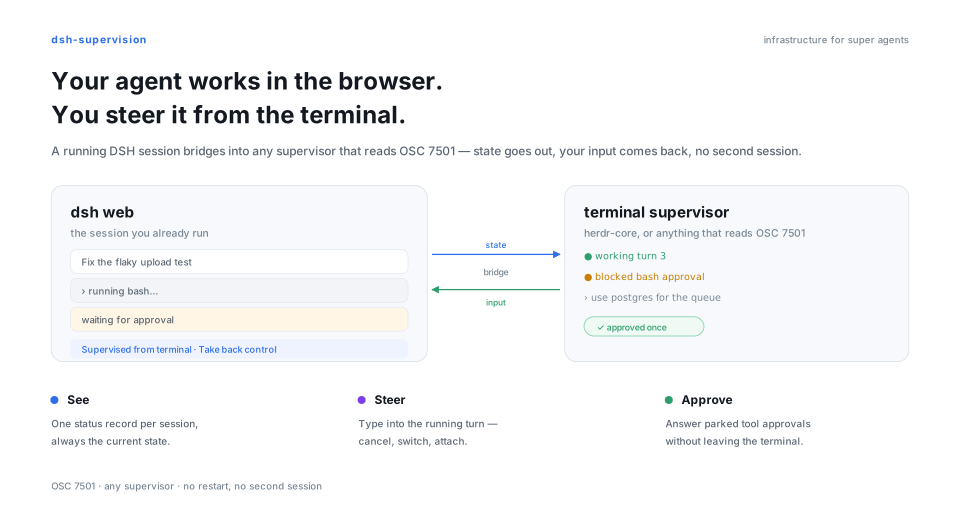
Bridge a running DSH session into any terminal supervisor — it sees the state, and it can steer. The plugin mounts inside the dsh web process you already run: OSC 7501 records go out on the terminal, and operator input comes back into that same session. herdr-core is one supported supervisor; any supervisor that reads OSC 7501 and can write lines back can drive a bridged session, with no changes to DSH or the supervisor.
What you get
- One status record per session. The bridged session is the root record —
idle,working,done,blockedorerror; other sessions in the same process are child records carryingid=. - Operator input goes back in. Bare text steers a running turn,
/cancelends it,/status,/newand/attachinspect and switch sessions, and/approveor/rejectsettle parked asks — all from the terminal. - Approvals stop living in another surface. A parked ask turns the root record into
blocked · kind=permission, is settled from the terminal, and the GUI shows a supervision banner with Take back control — so the person in the browser always sees who holds the session and has a way to take it back.
Works with
| Supervisor | How it connects | What it needs |
|---|---|---|
herdr-core (hc) | in-process tty via its own HC_TERMINAL_ID (or DSH_SUP_TERMINAL_ID when the host exports one) and the control socket with dsh-sup in its PTY; both are open at once | a dsh web started inside the supervised terminal, plus any PTY for the forwarder |
| Any supervisor that reads OSC 7501 | control socket + dsh-sup in its own PTY | it must read the PTY's OSC output and be able to write lines to that PTY's stdin |
| Another supervisor wanting in-process mode | set DSH_SUP_TERMINAL_ID | the variable is read, never written, by this package; any supervisor can set it |
GUI-only dsh web | nothing | the plugin exposes an inert socket and nothing else |
Quick start
Install
Plugins page — in DeepSeek Harness open the Plugins page, click Add plugin, enter dsh-supervision and install; then restart as the host asks. The GUI writes into the web profile, the same profile the command below targets.
CLI — for scripted setups:
dsh plugin --profile web add dsh-supervision   # the plugin, into the web profile
npm i -g dsh-sup                               # the forwarder, for the supervisor's PTY
dsh-sup is a separate package because it runs as its own program in the supervisor's PTY. Pin a version with @<version>.
Connect a session
dsh-sup                                  # create a session in the dsh web process's directory
dsh-sup --cwd ~/work/project             # create it elsewhere (resolved here, then sent absolute)
dsh-sup attach session-abc123            # attach an existing session (or: dsh-sup session-abc123)
dsh-sup --pid 4711 new                   # pick the backend when several dsh web processes run
dsh-sup list                             # list every session on every live backend
list prints one table for every live backend and binds nothing. PID names the dsh web process a row came from, so a multi-backend listing stays attributable:
SESSION            PID    CWD                LIVE  BRIDGED
session-4f2a…      4711   /Users/me/work     yes   -
Backends are found through $DSH_HOME/supervision (~/.dsh/supervision when DSH_HOME is unset). A bridge needs exactly one live backend; with several, the refusal names each candidate's pid and socket, and --pid picks one. --cwd applies to new and list only; list without it shows every session, with the CWD column naming where each one lives.
Answer an approval
Ask where the session stands, then answer the parked ask by id:
/status
session=session-4f2a… state=blocked turn=3 asks=3f9ac1

/approve 3f9ac1
[ask 3f9ac1] bash → allowed-once (source=supervisor)
/y and /n answer the only parked ask; with more than one parked they refuse and ask you to name it.
Take back control
While a session is bridged the GUI shows a supervision banner above the composer — Supervised from <terminal> (pid <n>) · approvals are answered there — with a Take back control button. It posts to the reclaim route; the bridge is dropped, the supervisor reports the clear record, and a dsh-sup forwarder exits 0.
How it reports
One dsh web process owns one session tree; the plugin mounts in it and opens its control socket, plus an in-process tty when the process runs inside a supervised terminal.
dsh web (the process you already run)
└── dsh-supervision plugin
      ├── control socket   $DSH_HOME/supervision/<pid>-<8hex>.sock   (0600)
      │     └── dsh-sup in the supervisor's PTY ── OSC 7501 + echo lines ──▶ supervisor (reads OSC 7501)
      └── in-process tty   (added when DSH_SUP_TERMINAL_ID or HC_TERMINAL_ID is set)
            └── OSC 7501 written to this process's own /dev/tty
Activation. The plugin always opens its socket discovery surface — the listener, the 0600 socket and the <pid>-<8hex>.json registry entry that names it — so a forwarder has something to connect to. The effect layer (session listeners, OSC reports, echo lines, stdin handling) mounts per bridge, which is the same fact as "a forwarder is connected". A GUI-only dsh web therefore exposes an inert socket and nothing else. With DSH_SUP_TERMINAL_ID non-empty (or herdr-core's HC_TERMINAL_ID) the process also supervises the terminal it runs in: the same records go to its own /dev/tty, while the socket stays open for a dsh-sup elsewhere. A session still has exactly one bridge across both surfaces, so a second attach is refused as busy. If the terminal cannot be opened — no /dev/tty and a non-TTY stdout, or a stdin that is not a terminal — the plugin writes the reason to stderr and keeps the socket surface.
For implementers & agents
This half is reference material for implementers and coding agents; if you only want to use the plugin, jump to Links.
Repo map
| Path | What lives there |
|---|---|
src/ | the host plugin and the browser supervision banner (src/client/) |
packages/protocol | the OSC 7501 encoder and the NDJSON frame codec |
packages/cli | the dsh-sup forwarder |
lib/ | build output |
docs/ | figures and their captions |
.agents/adr and .agents/knowledge | decisions and the architecture notes behind them |
.changes/ | release fragments |
locale/ | plugin-page strings |
Supervision protocol
The facts a supervisor needs, all of them on this repository's wire:
Socket and registry. One Unix socket per dsh web process, mode 0600, at $DSH_HOME/supervision/<pid>-<8hex>.sock, next to a <pid>-<8hex>.json entry {proto, pid, socket, startedAt, dshVersion} written atomically and mode 0600. A session has exactly one bridge: a second connection claiming it is refused with error code busy and closed. Frames are NDJSON, PROTO is 1, one frame is at most 64 KiB; the forwarder splits its own stdin on \r, \n or \r\n and sends one line frame per input line.
| Direction | Frames |
|---|---|
| forwarder → plugin | hello (attach a session, new {cwd}, or bare), line {text}, list {cwd?}, bye |
| plugin → forwarder | welcome, osc {data}, echo {text}, sessions {items}, error {code, message}, bye {reason} |
error.code is one of busy, unknown-session, create-failed, locked, protocol, internal.
OSC 7501 output. One record is replaced whole on every report, so every field is restated:
ESC ] 7501 ; state=<idle|working|done|blocked|error>[ :id=<child id>][ :kind=<permission|question|auth>][ :app=<word>][ :title=<base64>][ :msg=<base64>] ST
A clear is state=clear for the root, state=clear:id=<id> for one child record. kind is legal only on blocked; a parked approval is the root blocked:kind=permission record carrying msg=<tool> <reason> [ask <id>]. Caps: sequence under 4096 bytes, title 192 bytes, msg 2048 bytes, id 128 bytes as /-joined segments of at most 32 bytes each (8 segments). The root word is blocked > working > done / error / idle, and a parked approval outranks a live turn. The reporting surface is /dev/tty on both paths (stdout when it is a TTY); that is what the supervisor reads, not the plugin's or the forwarder's stdout.
Routes, served only when the host mounts a webserver:
| Route | Answer |
|---|---|
GET /dsh-supervision/state | {"proto":1,"sessions":{"<session id>":{"bridged":true,"terminal":"…","pid":<n>,"since":<ms>,"asks":["<ask id>"]}}}; 405 for another method |
POST /dsh-supervision/reclaim | content-type: application/json, body {"session":"<id>"} under 4 KiB → 200 {"reclaimed":true}; 409 {"reclaimed":false} when no bridge held it; 415 for another content type, 400 for a bad body |
Echo lines the supervisor reads, in the order they are written: [turn <n>] <state> on a state change, [ask <id>] <tool> parked (<session>), [ask <id>] <tool> → <outcome> (source=supervisor|attached), the /status answer above, refused: <n> approval(s) parked, new failed: …, attach failed: …, unknown command /<verb>.
Exit codes of dsh-sup: 0 clean bye, 1 backend lost, 2 usage or no live backend, 3 busy, 4 locked, 5 create-failed, 6 protocol (a frame this process refused, so the backend is alive).
Configuration
Six keys, all of them read by src/index.ts; an unknown shape is refused with a field-level issue instead of half-applying.
| Key | Default | What it does |
|---|---|---|
enabled | true | Mount anything at all. false is a hard off switch: no socket, no routes, no banner. |
programStatus | true | Emit OSC 7501 reports. Off leaves the socket answering list only. |
echo | true | Mirror state changes and approval decisions as echo lines for the supervisor. |
app | "dsh" | The program word every report restates. |
titleFrom | "cwd-basename" | Where the root title comes from: cwd-basename, session-title, or none. |
socketDir | $DSH_HOME/supervision | Registry and socket directory. |
Environment variables it reads:
| Variable | Read by | Effect |
|---|---|---|
DSH_HOME | plugin and dsh-sup | Registry directory base; defaults to ~/.dsh. |
DSH_SUP_TERMINAL_ID | plugin | Non-empty ⇒ an additional in-process tty transport; the control socket and registry stay open. |
DSH_SUP_TERMINAL_NAME | plugin | The supervisor label the state route reports; defaults to dsh-sup. |
HC_TERMINAL_ID | plugin | herdr-core compatibility: the same transport, read only when DSH_SUP_TERMINAL_ID is unset or empty. |
HC_TERMINAL_NAME | plugin | herdr-core compatibility: the label, read only when DSH_SUP_TERMINAL_NAME is unset or empty. |
Both DSH_SUP_* variables and their HC_* fallbacks are read, never written, by this package.
Invariants
A change must not break these:
- One bridge per session. A second connection claiming a bridged session is refused with
busy; the in-process path holds one binding per process, and/attachswitches it rather than adding a second. - A record is replaced whole. Every report restates every field that still applies; a field left out is a field cleared.
- A parked approval outranks a live turn. The root word order is
blocked>working>done/error/idle, and a session switch (/new,/attach) is refused while an ask is parked. - Teardown settles every parked ask before the socket closes. Disconnect, dispose, reclaim or an asker's withdrawal resolves each ask as
cancelled; fail closed, never leave one dangling. - The terminal variables are read only. The in-process transport and its label are chosen by the environment, never by configuration, and nothing writes those variables.
- Caps are hard limits. The encoder drops a record it cannot express within its caps rather than truncating it, and a frame over 64 KiB is refused locally.
Links
| Doc | Content |
|---|---|
| CHANGELOG.md | released changes |
License
Released under the MIT License — the license field in package.json is authoritative.
Plugins relacionados
dsh-web (dsh-ssh)
zhu1090093659/dsh-web
dsh-web (dsh-remote-web-ui)
zhu1090093659/dsh-web
dsh-web-ui (dsh-ssh)
zhu1090093659/dsh-web-ui
dsh-purge
kingcharleslzy-ai/dsh-purge