dsh-plugin-magic-context
elvisw/dsh-plugin-magic-context
Magic Context frees up context in long DSH sessions and carries project knowledge into the next conversation. It summarizes older exchanges and reclaims tool output that can still be retrieved by tag, so starting a new session means less explaining from scratch.
Instalar
dsh plugin --profile web add github:elvisw/dsh-plugin-magic-contextREADME
Magic Context for DeepSeek Harness — elvisw fork


English | 简体中文
Anyone who has run long sessions knows the symptoms: the project details you worked out yesterday are gone today, so the same pit gets re-dug; tool outputs bloat the context window; and every compaction busts the cache prefix, so the expensive part re-runs.
Magic Context's answer: knowledge should persist, context should be managed. This plugin gives DeepSeek Harness (DSH) sessions a persistent, project-aware memory — knowledge distilled from your sessions survives restarts, is searchable with hybrid full-text + local vector search, and is re-injected right where the model reads it — while the context window itself is run as an asset: tool results become tagged, reclaimable history, digests come back as four-level summaries, and none of it ever breaks the live KV-cache prefix.
- Memory that outlives the session — a project corpus in the plugin's own SQLite store;
historian facts auto-promote into it,
ctx_memoryreads/writes/maintains it, and project identity is auto-derived (git root or directory). - Local-first retrieval — MiniLM embeddings via WebAssembly (no native build, no API keys), hybrid full-text 0.7 / vector 0.3 ranking, fail-open to full-text on any failure.
- Sharing with a human gate — machine/org global domains: staging can be automated,
publishing is always yours (approval cards,
/ctx-global approve); a user-profile layer rides on top with read / collect / review as separate switches. - Reversible reclaim, cache-aware compaction —
ctx_reduceonly queues; drops land as[dropped §N§]placeholders andctx_expandreturns the original as a new result; history digests into p1–p4 summaries published as range replacements — never a spontaneous prefix bust. - Conservative by default — the host
compaction-basicengine stays in place unless you explicitly opt in; in DSH 0.2.2-rc.1, Web and Desktop agent presets own their own compaction engine, soregisterCompactionEngineis a flat/headless-host seam, not a Web/Desktop preset override.
Requires Node ≥ 22.19 and a DSH 0.2.x host with the Web client (the desktop app or
a web profile). The quick start below uses the Web profile; the Desktop profile is not
separately verified. The optional compaction takeover is for flat/headless compositions
and is not effective on DSH Web or Desktop. The package ships compiled — install
straight from the npm registry:
dsh plugin --profile web add @elvisw/dsh-magic-context
Package identity: the unscoped
dsh-magic-contexton npm is an unrelated implementation by another maintainer, not this fork or its upstream. This fork is published only as@elvisw/dsh-magic-context; keep the@elvisw/scope in every install command.
0.13.0 introduced this package name; the current release is 0.17.0, which adds
the manual /ctx-wrapup live-history command (0.16.0 added remote vector search
and the host-native Settings redesign; 0.15.0 added the telemetry v2 panel;
0.14.0 added the top-level Settings page). If you installed
@elvisw/dsh-plugin-magic-context (0.12.x) or the upstream
dsh-plugin-magic-context, remove it first: all three use the same loader row id
(magic-context-dsh), so co-install is unsupported: the loader keeps one row and
settings may disappear. Upgrading from 0.12.x also
needs the one-time profile patch migration described in
docs/independent-package-release.md; the helper is
shipped in the npm tarball and the hand-out bundle.
New to the plugin? A five-minute tour follows in Quick start; configuration, tools and architecture are covered in full below. A complete Chinese translation is at README.zh-CN.md. Contributions are welcome — see CONTRIBUTING.md and SECURITY.md.
Quick start
After installing, restart the profile unless it has HMR enabled; with HMR the new version hot-loads. In your next session:
- Tool results carry
§N§tags; a telemetry badge appears in the overlay showing live context occupancy, with a panel of host token composition, estimated message breakdown, localized sections and an operation record behind it. - A Settings → Magic Context page edits the options the card exposes. The legacy
Plugins-page card is removed; a host without the
settings.sectionslot has no Magic Context configuration card. - The
ctx_reduce/ctx_expand/ctx_memorytools are registered for the agent; project memory is on by default — facts distilled by the historian persist across sessions and surface where the model reads them.
Context reclaim, in one exchange (real parameter names):
you:   ctx_reduce {"drop": "4-7"}      # four tool outputs are no longer worth the tokens
agent: queued 4 item(s) — the drops land as placeholders in the next reclaim band
…later in the transcript…
[dropped §4§] [dropped §5§] [dropped §6§] [dropped §7§]
you:   ctx_expand {"tag": "5"}         # wait — what was in §5 again?
tool:  the original text of §5, as a new result — the §5 placeholder stays dropped
The only opt-in surface is the compaction takeover (registerCompactionEngine, off by
default — see Configuration); in DSH 0.2.2-rc.1 it applies to
flat/headless profiles whose root compaction-basic row is disabled, not to Web or Desktop
agent presets.
What it does
Memory first, context management second — the first five rows are the memory system, the last five manage the context window (full design in Architecture and PARITY.md):
| Capability | Mechanism |
|---|---|
| Project memory (own corpus) | Plugin's own SQLite store (memories.db), hard-split from upstream — no shared storage, no compatibility duty. Project identity auto-derived (git:<root-sha> / dir:<hash>); injected into the m[0] baseline and served to ctx_memory for read/write; historian facts auto-promote; FTS 0.7 / vector 0.3 hybrid retrieval |
| Local vector lane | MiniLM embeddings run locally via the bundled onnxruntime-web WASM backend — no native build, no API keys; the model download is pinned by revision + sha256 (mirror fallback), cached in the plugin data dir; retrieval candidates get inline + maintenance-tick backfill; any failure fails open to full-text search |
| m[0]/m[1] memory baseline | A synthetic notice node carries the frozen baseline plus incremental lanes (<new-memories> / <memory-updates> / <user-profile>); each lane keeps its own watermark, so new memory never rebuilds the cached prefix — unchanged content produces zero diff |
| Global domains + user profile | machine/org domains: staging can be automated (maintenance tick, LLM classification), publishing is always human (approval cards, /ctx-global approve); the user profile's render / collect / review are separate switches |
| Maintenance tick (MC dreamer slice) | Every 30 min: TTL archiving → batched LLM verify (keep / update / archive) → vector backfill → global-domain candidate staging |
| Reversible context reclaim | Tool results get §N§ tags; ctx_reduce only queues — drops land in the execute band as [dropped §N§] placeholders referencing the originals; ctx_expand returns the original text as a new result while the placeholder stays dropped. The cached prefix is never busted spontaneously |
| Pressure scheduling | Persistent usage (incl. cache reads/writes) → pressure score → execute/defer decisions (65% threshold, 5 min cache TTL, 85% force band); CONTEXT_WINDOW_EXCEEDED triggers emergency reclaim + retry; tiered reduce-guidance nudges |
| Historian (out-of-band digest) | One LLM call replays the real prefix (KV cache preserved) → four-tier p1–p4 summary + facts/events, writes the store only, never touches the wire; published in the execute band as a [compacted §C<n>§] range replacement; /ctx-recomp redoes compacted history in place |
| Compaction seam | registerCompactionEngine can take over root ctx.compaction (real compaction/start|summary|replace|end protocol); off by default — the host compaction-basic (root or preset) stays in place. Flat/headless only: in DSH 0.2.2-rc.1, Web and Desktop agent presets mount their own compaction engine, so this switch does not replace a preset engine |
| UI integration | Top-level Settings → Magic Context page (the legacy Plugins-page card is removed; volatile fields, save = live); catalog-backed Historian reasoning-effort picker; shell.overlay telemetry badge + capsule panel (host token composition, estimated message breakdown, localized sections, operation record); session-notice rows in the session stream; Chinese/English instant switching for card labels and panel section/empty-state copy (operation detail values stay as recorded) |
Installation
From the npm registry — recommended; the package ships compiled lib/ and vendor/, no
local build needed:
dsh plugin --profile web add @elvisw/dsh-magic-context
Registry versions are published automatically by tag pushes (with npm provenance signatures); see the "Releasing" section of CONTRIBUTING.
From source (development)
git clone https://github.com/elvisw/dsh-plugin-magic-context
cd dsh-plugin-magic-context
npm install
npm run build     # tsc → lib/ (multi-file ESM) + browser half copied to lib/client.js
dsh plugin --profile web add <path to this repo>   # the CLI ships with the app; the spec can be a Git URL, a local path, or a registry version
Installing does three things: pnpm add into the profile (link: for local paths),
appends the package name to dsh.profile.bundles, and the loader composes it. When the
profile has HMR enabled, changes take effect immediately (no restart; running sessions
start tagging right away); otherwise reload the page or restart the profile.
- All
@deepseek-ai/*inpeerDependenciesare declared"*"— the compatibility precheck passes on any DSH 0.2.x; the host packages actually imported at runtime are also listed as exact-version dependencies (resolved with the package;link:dev installs are served by this repo's own node_modules). - Node ≥ 22.19 required: the stores build on the built-in
node:sqlite, no native modules. A CLI/webprofile runs on Node; the desktop app supplies an Electron RunAsNode runtime; both need thenode:sqliteversion that Node 22.19 provides. - Tool-constructor resolution:
config.defineTool(host-injected, used by in-tree glue) first, then dynamicimport('@deepseek-ai/dsh-tools')(a hard dependency, physically resolvable in every install shape). If both are unavailable the mount fails loudly — the ctx_* tools are the only entry point for reclaim tags; no silent half-boot. - Two loading modes: patch-overlay / file URL (development: overlay yml +
config.defineToolinjection) and profile install (production: package-name line + link dependency). The production path is thedsh plugin addabove.
Uninstall / disable: disable the bundle on the GUI Plugins page (writes disabled into
the profile patch), or dsh plugin --profile web remove @elvisw/dsh-magic-context.
Configuration
Two ways to change configuration, with different semantics (see the Settings UI contract):
- GUI settings page (Settings → Magic Context): exposes
policy.*(incl. historian generation cap / ceiling / timeout),historianEnabled,registerCompactionEngine,journal.*,maintenance.*,historian.*,embedding.*and other volatile fields. The two provider/model route pins (maintenance verify, historian generation) prefer a dropdown fed by the host's configured model catalog (clientremote.session.modelCatalog()), with "Auto = follow the session route" and clearing; shells without that RPC fall back to plain text (values remain hand-editable). Theembeddingmodel list comes from the plugin's own/mc-embedding/modelsendpoint, not the host catalog. The Historian reasoning-effort field is the same catalog-backed picker:Default, the routed model's advertised ids, andCustomfor legacy/unknown values; an Auto route keeps the text input. Writes go through the settings chain: non-volatile keys are preserved untouched, untouched fields never materialize into override rows — saving takes effect immediately (the host side always reads throughliveNumber/liveBoolean/liveString/liveRouteat the decision point). - Hand-written profile override rows:
configreplaces the package patch's config wholesale — it is not a deep merge. Writing onlymemory:erasesregisterCompactionEngine: false. When hand-writing overrides you must spell out every key you want to keep.
The bundle's built-in config is one line: registerCompactionEngine: false — a
conservative first install that keeps the host compaction engine in place (memory, reclaim
and historian are on by default).
Scope: the GUI switch only controls the root
ctx.compactionseam. In DSH 0.2.2-rc.1, Web and Desktop agents run inside per-agent presets; each preset mounts its owncompactiongroup, so a profile-patch top-levelcompaction-basicrow does not replace the preset engine. The switch is therefore flat/headless-host only, and it only takes effect after the rootcompaction-basicrow in that composition is disabled. The upstream 0.11.2 README's two-row recipe has the same flat-only limitation; see upstream issue #16.
For a flat/headless profile that does not mount a preset-owned compaction engine, a manual profile override can take over compaction:
- id: magic-context-dsh
  name: '@elvisw/dsh-magic-context'
  config:
    registerCompactionEngine: true
- id: compaction-basic
  name: '@deepseek-ai/dsh-compaction-basic'
  disabled: true          # flat/headless only; not a DSH Web/Desktop preset override
Configuration reference (full types in src/dsh/config.ts; all keys writable as profile override rows unless noted):
| Group | Keys (defaults) | Notes |
|---|---|---|
| Master switches | enabled (true) · registerTools (true) · registerStatusCommand (true) · sessionNotices (true) · reduceGuidance (true) · searchHint (true) | enabled: false stays loaded but fully inert; sessionNotices controls the management notice rows in the session stream |
| Compaction seam | registerCompactionEngine (code default: mount when resolvable; ships false in the bundle) · compactionBase (host-injected base class) | Flat/headless root seam only; that composition must disable its root compaction-basic row. In DSH 0.2.2-rc.1, Web and Desktop agent presets own their own compaction engine, so this key does not replace a preset engine. Pre-step reconcileEngine mounts/unmounts dynamically every step |
| Pressure policy | policy.*: executeThreshold (65) · forceThreshold (85) · ttlMs (5 min) · assumedContextWindow (256k) · protectedToolResults (8) · historianTimeoutMs (120 s) · historianMaxTokens (8192, raised to 8192 if set lower) · historianMaxTokensCeiling (32768) · baselineTokens (2000) · memoryBudgetTokens (8000) · memoryLimit (40) · forceWaitReadyMs (0) | Thresholds take effect at the next decision point (incl. /ctx-status and the compaction-engine paths). compartmentGuardMode / compartmentEntrantTokens (publish guards) were retired and are no longer configurable |
| historian | historianEnabled (true) · historian.{provider, model} (pinned as a pair; empty = follow the session's last route) · historian.reasoningEffort (optional, blank = model default) | Generation route for out-of-band digests and /compact summaries; the GUI Settings page has "Historian provider/model" dropdowns (Auto = follow session, recommended) and a catalog-backed reasoning-effort picker: Default, the routed model's advertised ids, and Custom for legacy/unknown values. The Auto route keeps a text input because the session model is unknown there; an unadvertised id is never silently remapped or clamped. A provider-level OUTPUT_TOKEN_LIMIT empty completion is retried with the normal cap escalation. The only LLM spend besides verify |
| Project memory | memory.{}: enabled (true, on by default since 0.9.0 — opt out with enabled: false) · dbPath · project (omitted = session cwd) · domainProjects · shareCategories · autoPromote (true) · write (true) | write: false makes ctx_memory read-only |
| Retrieval / vectors | memory.embedBackfill (true, query-side inline backfill) · memory.vectorBackfill (true, maintenance-tick backfill) · memory.vectorBackfillLimit (24 rows/tick) | Any vector-lane failure fails open to FTS |
| Remote embeddings (T20) | embedding.provider (local) · embedding.preset (siliconflow) · embedding.endpoint · embedding.authHeader (authorization) · embedding.model · embedding.apiKeyEnv (empty = no auth for custom; SiliconFlow falls back to SILICONFLOW_API_KEY) · embedding.dimensions (0 = probe) · embedding.queryInstruction · embedding.documentPrefix · embedding.timeoutMs (8000) · embedding.queryTimeoutMs (2500) · embedding.batchSize (16) | Optional OpenAI-compatible remote space. Model IDs are discovered through /models or typed manually; dimensions are probed, never compiled in. The block is declared user-level; the current host does not expose a project/tier source, so project-level rejection is not enforced at runtime. The key is read from the named environment variable, and remote space is namespaced embedding-remote:…. Saving remote config does not spend quota; Start rebuild arms the target, Pause/Resume and rollback (via the normal Save) manage it. Remote search never mixes local vectors and fails open to FTS |
| S(t) decay | memory.scoring.{enabled (true), alpha (0.4), beta (0.2), archiveThreshold (2), halfLives} | Stats are always collected; the distribution default enabled=true takes over ranking; profile-JSON only, not on the settings card |
| Global domains | memory.global.machine.{enabled (true), excludeProjects, autoStage (true)} · memory.global.user.{render (true), collect (true), review (true)} · memory.global.review.batchLimit (50) | Defaults all on: staging can be automated (≤3/pass, paused at ≥10 pending candidates), publishing is always human; LLM classification failure is fail-closed |
| User profile | memory.global.user.{render (true), collect (false), review (false)} | Read / collect / review are independent halves; the two halves that write to the shared store are off by default |
| Domain resolution | memory.domains.source (adapter | contract) | contract is a fallback pole for comparison, not a supported end state |
| Maintenance | maintenance.{enabled, intervalMs (30 min), verifyProvider, verifyModel} | LLM verify needs an explicit route (unpinned = follow the conversation's latest route); the GUI card offers host-catalog dropdowns, Auto = unpinned (same picker for both pins) |
| Observability | journal.{enabled (true), level (info), retentionDays (30), mirror (true)} | level/mirror apply to the next write; a journal that was off at mount needs a restart to turn on at runtime; retentionDays has a min(1) floor against accidental pruning. §N§ tag rows have no age-based TTL; this adapter has no automatic message/session deletion path today |
Remote embedding (optional)
The default vector lane stays local MiniLM. To use an OpenAI-compatible embedding
API (for example SiliconFlow), open Settings → Magic Context → Embedding
search, choose OpenAI-compatible API, load the model list, select a model and
press Test connection. The server probes one short input to learn the
dimension; model IDs and dimensions are not compiled into the plugin. The API
key is read from the environment variable you name — the value is never written
to config, logs, the database or the browser.
Press Start rebuild to arm the target space and begin a bounded backfill.
Until then, remote search is full-text only and saving the config sends no
embedding request. Old local vectors are kept, and Roll back to local stages
the provider change through the normal revision-fenced Save. Remote failures
degrade to full-text search; they never fall back to local vectors. The target
space is namespaced, and coverage covers active plus permanent memories.
This is a local-first plugin: enabling a remote endpoint sends the memory text you search to that endpoint. Use a trusted or self-hosted endpoint, and prefer HTTPS (plain HTTP is only expected for localhost/LAN servers). Model availability and pricing change; check the vendor's current pages, for example the SiliconFlow API docs and embeddings docs.
Tools & commands
Agent tools (registered at mount; registerTools: false turns them off):
| Tool | What it does |
|---|---|
ctx_reduce | Parses MC range syntax ("3-5,8") → queues only; landing is a priced bust that waits for the reclaim band, never spontaneous |
ctx_expand | Returns the original text as a new result, read from the persisted log by tag (single), the deprecated tags alias, or message (a DSH log event seq in the current session for an already dropped item; [compacted §C…§] nodes are not accepted) — the old placeholder and its spent tag stay in place. Tag is primary; message is a fallback, not a general history browser. start/end (inclusive DSH log event seq, not upstream message ordinals) read a read-only user/assistant/tool/result transcript without requiring a drop; verbose previews 200 characters per part under the shared 15k budget. [compacted §C…§] bookkeeping is excluded while [dropped §N§] stays literal when the range reads raw history; a range whose readable events are all still live returns a live-surface sentence instead of duplicating them. No recovery is promised once the raw event is gone |
ctx_memory | The shared memory store's read/write port. Reads: list / search / get; writes: write / update / archive / merge (with MC's normalized content hashing, mutation log and authority guards in the loop throughout); review_global (surfaces machine/org domain candidates one by one as approval cards; publishes only on approval); promote (stages a single project memory instantly — a manual lane with no recurrence gate). Every action accepts project (absolute path or git root) to operate on another project |
Slash commands (registerStatusCommand: false disables this command surface):
| Command | What it does |
|---|---|
/ctx-status | pressure / decisions / reclaim ledger / compartments / baseline / policy |
/ctx-flush | mark this session's pending ctx_reduce drops for landing on the next message; reports requested/already/pending counts; when the queue is empty, reports the last landed drop count/time for this session; starts no historian, recomp, summary, or model call |
/ctx-recomp all | last:<n> | <startSeq>-<endSeq> | re-runs the historian and replaces the stored digest in place (ranges snap to compartments, never split; identity and landed placeholders unchanged, the next pre-step rebuilds the baseline) |
/ctx-wrapup [messages_to_keep] | queues a manual historian pass for the next pre-step; keeps the newest N eligible surface entries (default 20), lands pending drops first, and publishes through the normal execute lane with the force band skipped for that pass |
/ctx-profile confirm | reject | retire | confirm / reject / retire user-profile candidates; promotion into the shared profile happens at the next maintenance tick |
/ctx-global add | remove | status | promote | approve | reject | the manual lane for global-domain membership and candidate approval (same gate→publish path as the approval cards, source_type=user) |
Compared with cortexkit v0.49.59, /ctx-dream and /ctx-embed are not
registered. /ctx-dream needs the full dreamer task set; /ctx-embed targets
session-history compartments, memories and git commits, while this adapter's
embedding controls cover the memory vector lane. /ctx-wrapup is supported as
a queued manual pass over the live tail. The exact command-by-command
matrix is in PARITY.md.
UI & telemetry
Both UI capabilities ride the same browser half (src/client/index.js, copied verbatim to
lib/client.js at build time):
-
Settings → Magic Context (top-level Settings page): a five-section layout with a four-metric summary, jump row, advanced disclosures and a text-only status strip above the host footer. Volatile options are saved through the host footer. The legacy Plugins-page card is removed; a host without the
settings.sectionslot has no card.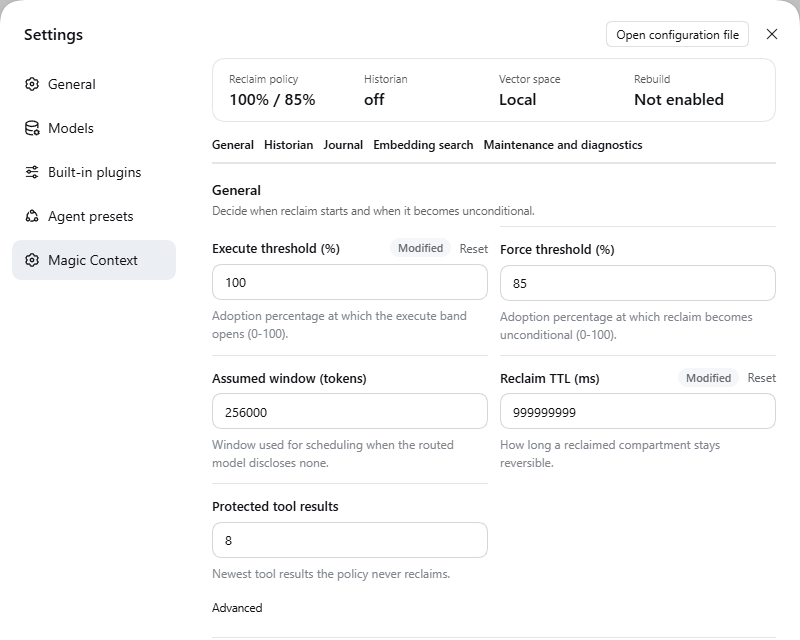
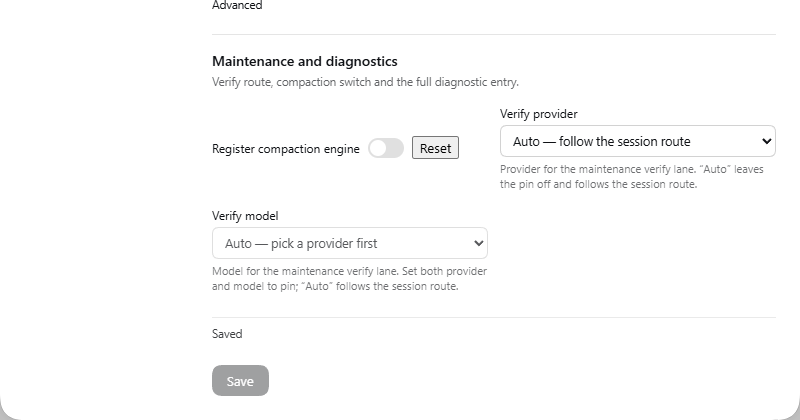
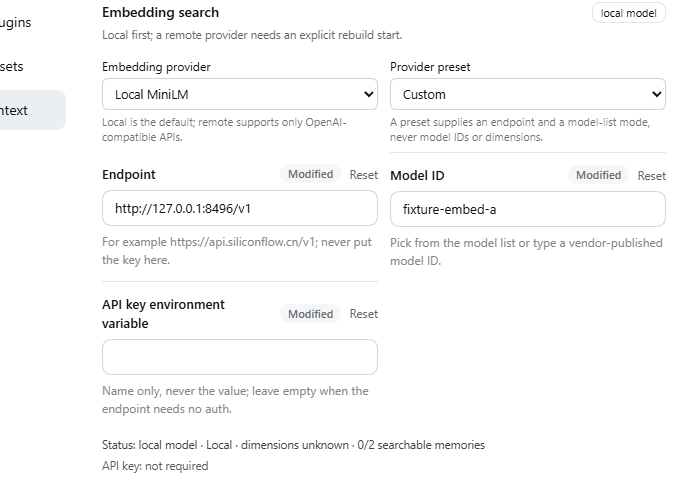
-
shell.overlaytelemetry badge + capsule panel: the collapsed pill keeps the live pressure, token pair, Historian state and reclaim queue (H/Q<n>) visible, and switches to an icon-width variant on narrow composers. The panel shows:- a 100% host token bar split into System / Tool definitions / Messages, with the
absolute token pair (
11.8k / 1M); - an estimated message composition (Conversation, Tool calls, Compartments, Memories,
Profile, Other); rows with no estimate are omitted rather than shown as
0; - Historian / Memory / Queue / Maintenance / Hygiene / Warnings sections, using
—/empty/never runfor values the host did not report; - the live operation record (up to 12 entries, adjacent identical operations folded
as
×N): 🧠 memory write · 🔎 memory load · 🗑️ reclaim queued · 🧭 original restored · ✂️ context compacted · 🗑️ context dropped · 🧭 archived-stored · 🧰 maintenance sweep · ⚠️ failure.
Focus stays inside the panel while it is open; clicking outside the panel/badge, Esc, window blur, or the close button closes it and returns focus to the pill. The footer offers
/ctx-statusfor the full diagnostic view.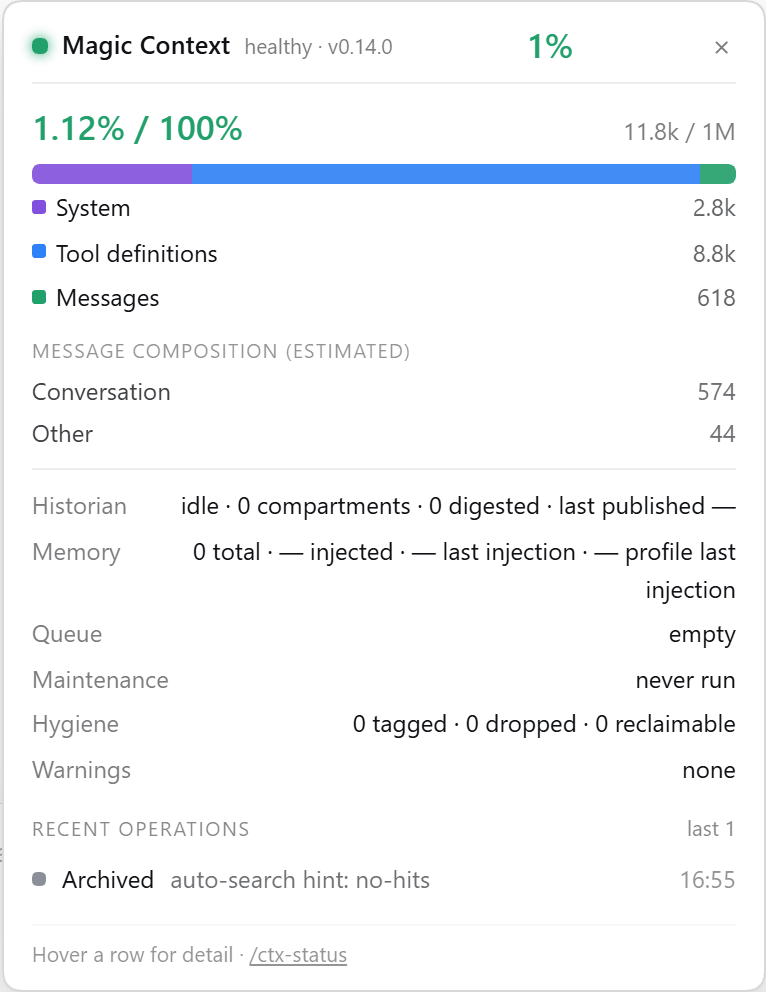
- a 100% host token bar split into System / Tool definitions / Messages, with the
absolute token pair (
-
Data comes from the plugin's own HTTP routes (the harness's Remote event whitelist is a compile-time constant; the supported seam for third-party bundles is
ctx.webServer.register):GET /mc-telemetry/summary— one-shot snapshot (adapter / project / health + recent events). The v2 payload addsadapterVersion,policy,contextBreakdown,messageComposition,historian,queue,memoryandsurface.GET /mc-telemetry/events— SSE live tail
-
Security: the routes are loopback-only with no token auth, so they emit counts and one-line summaries only — no message bodies, no file paths, no credentials.
-
Languages: browser-side
magic-contextnamespace dictionaries (zh/en); every card-owned label, hint, route placeholder, summary, form frame and picker caption follows Settings → General instantly without a refresh. The telemetry pill and panel use the same dictionary, so their labels, section names and empty-state copy switch with the host language too. Host catalog values (provider/model/effort names) stay as the host sends them. Thesession-noticerows written into the session stream (model-visible) stay English constants (to avoid cached-prefix churn from mid-session language switches). Mechanics in the Settings UI contract and the historical UI telemetry host analysis.
Observability & operations
Desktop does not persist ctx.logger output, so the plugin writes its decisions and
outcomes into its own append-only journal:
~/.local/share/cortexkit/magic-context-dsh-poc/dsh-magic-context.db→journaltable (structured, SQL-queryable)~/.local/share/cortexkit/magic-context-dsh-poc/activity.log→ single-line text mirror (tail/grep friendly, auto-rotates to.1past 5 MiB)
Privacy: message bodies are never logged. Only counts, tag numbers, token
estimates, reasons and durations; strings truncate at 300 chars, arrays cap at 20 items
(redactData as the backstop).
Journal coverage (by group): lifecycle (boot / config-drift / session-first-seen);
reclaim & compaction (pass — every execute recorded, with tokensBefore→After
net-reclaim proof and defer reasons, drop-landed, compartment-published/-recomp/
-guard, force-path, emergency-reclaim, context-pressure); historian & baseline
(historian — start/done/failed pairs with LLM usage, baseline, session-notice,
wire-repair); memory (memory-recall / profile-recall / memory-promote /
memory-stats / vector-lane / search-hint / project-drift / global-review);
maintenance (maintenance); tools & engine (tool-call / engine / error — every
exception swallowed fail-open).
Operations commands
npm test               # vitest run
npm run gate           # full gate: typecheck + suite + build + acceptance + memory audit + records
npm run doctor         # read-only health report: corpus fence / event-lane heartbeat / dangling runs / embedding lane

node scripts/mc-report.mjs --days 7 [--json] [--session <id>]   # journal retrospective report
node scripts/mc-acceptance.mjs [--hours 72 --json]              # corpus acceptance, exit 1 on failure
npm run phase          # phase gate: run one phase's suite with verdict and blind spots
The retrospective report includes: stores and status, per-kind/per-day counts, key metrics (execute/defer ratio and reason distribution, net reclaim, historian failure rate and duration, emergency reclaims, tool calls), recent event details and health hints ("no execute pass in the window" / "historian never ran" / "errors present" / "latest journal event older than 24h", …).
scripts/ specialists: retrieval-weight A/B (retrieval-eval), S(t) ranking offline diff
(score-diff), dilution & fold dashboard (report-dilution), domain-hit stats
(report-hits), historian failure classification (report-classify), embedding-model
precheck (embedder-precheck), reference-seed rebuild (npm run build:seeds),
panel-category validation (mc-records-check), i18n check (npm run check:i18n).
Architecture
src/
  dsh/     # ← the ONLY directory allowed to import @deepseek-ai/* (the
           #    anti-corruption layer). Event names, payload shapes and the
           #    surface vocabulary all live here; a DSH upgrade touches this
           #    directory only.
  core/    # Neutral logic and storage: policy/stores/journal/memory-*/domains.
           #    No DSH dependency.
  client/  # Browser half (settings card + telemetry badge), plain JS,
           #    copied verbatim to lib/client.js at build time.
  index.ts # Composition root: boot probe (fail-loud) → seam listeners →
           #    neutral stores.
Isolation discipline (DSH is in developer preview; breaking changes are expected — this package's structural answer):
- Fail-loud capability probing:
probeDshSeamsvalidates seam availability at boot and throws when absent — never silently pretends to manage context; - Version fences: the adapter DB schema chain is at v11 (forward migrations; a
newer DB refuses to open); the own corpus
memories.dbinherits the v95 starting point (switched 2026-10-13, numbering owned by this plugin;MEMORY_SCHEMA_MAX_VERSIONguards the migration line) — beyond it, reads refuse and writes degrade to read-only with a loud warning; - Tests as probes: the integration tests double as seam-contract tests — rerun after a
DSH upgrade and breakage localizes to
src/dsh/; - Two-database layout:
- Adapter DB
~/.local/share/cortexkit/magic-context-dsh-poc/dsh-magic-context.db(tags / usage / pending_drops / compartments / baseline / domains / queues / journal…, schema v11); - Own corpus
~/.local/share/cortexkit/magic-context-dsh-poc/memories.db(project memories + global-domain rows + profile + vectors; the legacycontext.dbis sealed and unread — the 2026-10-13 hard split; the upstream relationship is feature-following only, no storage-compat duty);
- Adapter DB
- Upstream parity ledger: effective-behavior alignment and deliberate differences against the OpenCode / Pi adapters are tracked in PARITY.md (aligned / host-imposed / intentional verdicts, each citing host files).
Documentation index
The linked documents are maintained in this repository; most are written in Chinese and a few are English.
Current documentation maintained by this fork
- Magic Context Settings UI contract (English) — the current top-level Settings page, zh/en copy, and catalog-backed effort picker.
- Operations runbook — daily/weekly checks, thresholds, recovery, and backup commands.
- Upgrade follow-up — the current re-alignment procedure. Its §1 baseline is v0.49.30 and is not a v0.49.55 parity claim.
- Independent package release — package identity, migration,
and release procedure for
@elvisw/dsh-magic-context.
Historical research and upstream snapshots
These are preserved for provenance. They are not current guarantees; each file has its own
> Status: header with the evidence baseline.
Historical contracts
- Memory write contract — mixed 2026-10 storage snapshot;
the current corpus is
memories.db, and §8 authority is historical. - Memory promotion contract — upstream promotion research.
- Memory acceptance — 2026-10 evidence (v6/v94 era).
- Config UI contract — historical; its plugin-specific conclusions are superseded by the current Settings UI contract.
- UI telemetry contract — historical host-seam analysis.
- Hooks coverage (2026-10-08) — historical coverage audit.
Design decisions
- Port feasibility (seam map)
- Platform takeover & global domains
- Dreamer vector decision
- Memory mechanisms inventory
- Upstream source analysis
- Global-domain source finding
- Memory architecture challenge
- Domain naming decision (2026-10-25)
Audits & retrospectives
Reports
Upstream handoffs
Known limits
- Historian triggering and budgeting use chars/4 estimates, not a real tokenizer (retrieval vectorization does use a real one); the four-tier digest is produced in one call (MC accumulates across calls);
review_globalapproval cards must be raised inside an agent turn; headless without a responder it refuses explicitly with zero state change;- A journal that was off at mount needs a restart to turn on at runtime (all other journal / threshold changes apply immediately);
- Desktop does not persist the harness logger — observability rests entirely on the self-kept journal.
Contributing
- Contributing guide: CONTRIBUTING.md (environment, code conventions, PR flow)
- Security reports go through the private channel: SECURITY.md
- Code of conduct: CODE_OF_CONDUCT.md
- Changelog: CHANGELOG.md
This repo uses npm as its only package manager (package-lock.json is the truth); CI runs
typecheck → test → build → check:i18n on Node 22.x / 24.x.
Provenance & license
Difference from the upstream DSH adapter
This repository is a fork of wk544863858/dsh-plugin-magic-context
(npm dsh-plugin-magic-context). The upstream's last public release is dsh-plugin-magic-context@0.11.2
(2026-11-11); this fork published as @elvisw/dsh-plugin-magic-context from 0.12.0 through 0.12.3,
and publishes as @elvisw/dsh-magic-context from 0.13.0. Its versions and tags belong to the
fork. The upstream repository and npm package remain under their original maintainer; this fork does
not modify them.
Differences from upstream 0.11.2, accumulated through 0.17.0:
- Recovery semantics:
ctx_expandno longer rewrites placeholders in place. It reads the persisted originaltool/result, returns it as a new tool result, and assigns a new tag. The old placeholder is unchanged, the old tag stays dropped, and reducing it again is a no-op (already dropped). This is a breaking change. - Raw reads after Historian:
ctx_expandaccepts amessagelocator (the current session's DSH log event seq, including an originaltool/resultshadowed by a Historian compartment). It does not rerun the original tool and does not rewrite summaries or compartments. - Manual flush:
/ctx-flushmarks the current session's pending drops for the next pre-step to land; it does not start Historian, recomp, summarization, or a model call. - Durable drop state:
ctx_reduce/ctx_expanddecide from thepending_dropsnone/pending/landedstate instead of whether a placeholder is still on the current surface; a restored old tag no longer produces a fake “Queued” receipt. - Tag retention: the mount-time 30-day tag prune, the
tags.retentionDaysconfig, andAdapterStores.pruneTagsare removed. An old profile's key is kept but ignored, with at most one warning per process. - Settings UI: the plugin registers only a top-level
settings.section(Magic Context) with zh/en copy and a catalog-backed Historian reasoning-effort picker. The legacy GUI Plugins-page card is removed; a host withoutsettings.sectionhas no card. - Telemetry v2: the overlay pill keeps pressure, the token pair, Historian state and queue
visible; the panel adds a 100% host token composition bar, an estimated message breakdown,
Historian/Memory/Queue/Maintenance/Hygiene/Warnings sections, and localized chrome. Missing
host values render as
—/empty/never run, never as fabricated zeroes. - Schema and package name: the plugin DB moves to v11 (
pending_drops.flush_requested, automatic v10 migration). The npm package was@elvisw/dsh-plugin-magic-contextin0.12.x;0.13.0renames it to@elvisw/dsh-magic-contextwithout changing the loader row idmagic-context-dsh, the settings namespace, the plugin data directorymagic-context-dsh-poc, the schema, or the stored format. - Upgrade migration: a
0.12.xprofile patch row still says the old package name; the DSH loader matches by bothidandnameand skips a mismatched row, so runtools/migrate-profile-package-name.mjs --patch <cordis.patch.yml>once before opening Settings. Plugin memories, journal, schema and a customdataDirstay at the same paths; the rename performs no data migration. The0.13.0host gate is config-effective only and did not open the old database.
Because the row id is shared, co-installing upstream dsh-plugin-magic-context, the 0.12.x fork
package, and this package is unsupported; remove the old package before installing the new one. The
gate observed only that a config dump accepts both rows and keeps both names. The loader keeping one
duplicate-id row and the settings editor hiding duplicate ids are source-level inferences, not
gate observations. This fork guarantees its own plugin behavior and data migration, not long-term
UX/API compatibility with upstream 0.11.x; compatibility semantics target the original
cortexkit/magic-context, with DSH as the host.
Copyright and third parties
- Upstream DSH adapter (
wk544863858/dsh-plugin-magic-context, npmdsh-plugin-magic-context@0.11.2, MIT, Copyright (c) 2026 wukai — the DeepSeek Harness adapter in this repository): the direct upstream of this fork. Fork modifications are Copyright (c) 2026 elvisw, also under MIT. - magic-context (MIT, Copyright (c) 2025 Ufuk Altinok — magic-context): the derivative origin of this
repo. Extracted from upstream tag v0.46.0 (
651c105a9); the adapter's own commits were replayed verbatim frome34eda955(2026-10-08) on the localdshbranch. - DeepSeek Harness (MIT): consumed as a dependency, not vendored. Code written against 0.2.1-rc.1
(checkout
1600d8a1e, npm dist-tagnext; note theirlatesttag trails a release line — exact pins are the devDependencies). - Vendored third-party:
vendor/onnx/(onnxruntime-web WASM subset, MIT © Microsoft),tests/helpers/mock-adapter.ts(DSH test tree, verbatim). Details in NOTICE; license in LICENSE.