gord-dsh-worktree
nightosong/gord-dsh-worktree
Git worktrees as five agent tools — list, create, inspect, remove, prune — plus a working-location picker on the New Session row; the repository is resolved from the session directory, removal refuses uncommitted or untracked work, and the main worktree is never removable.
Instalar
dsh plugin --profile web add github:nightosong/gord-dsh-worktreeREADME
gord-dsh-worktree
Git worktree management for DeepSeek Harness — isolate parallel work in its own directory and branch, from the agent or from Settings.

What it does
-
Agent tools —
worktree_list,worktree_create,worktree_status,worktree_remove,worktree_prune. An agent can branch off an isolated checkout for a task instead of doing everything in one working tree. -
Worktree selector — a dropdown on the New Session row, beside the workspace and preset controls: it defaults to the current workspace, and offers the project's other worktrees or creating a new one. It is present only while the session is still blank.
-
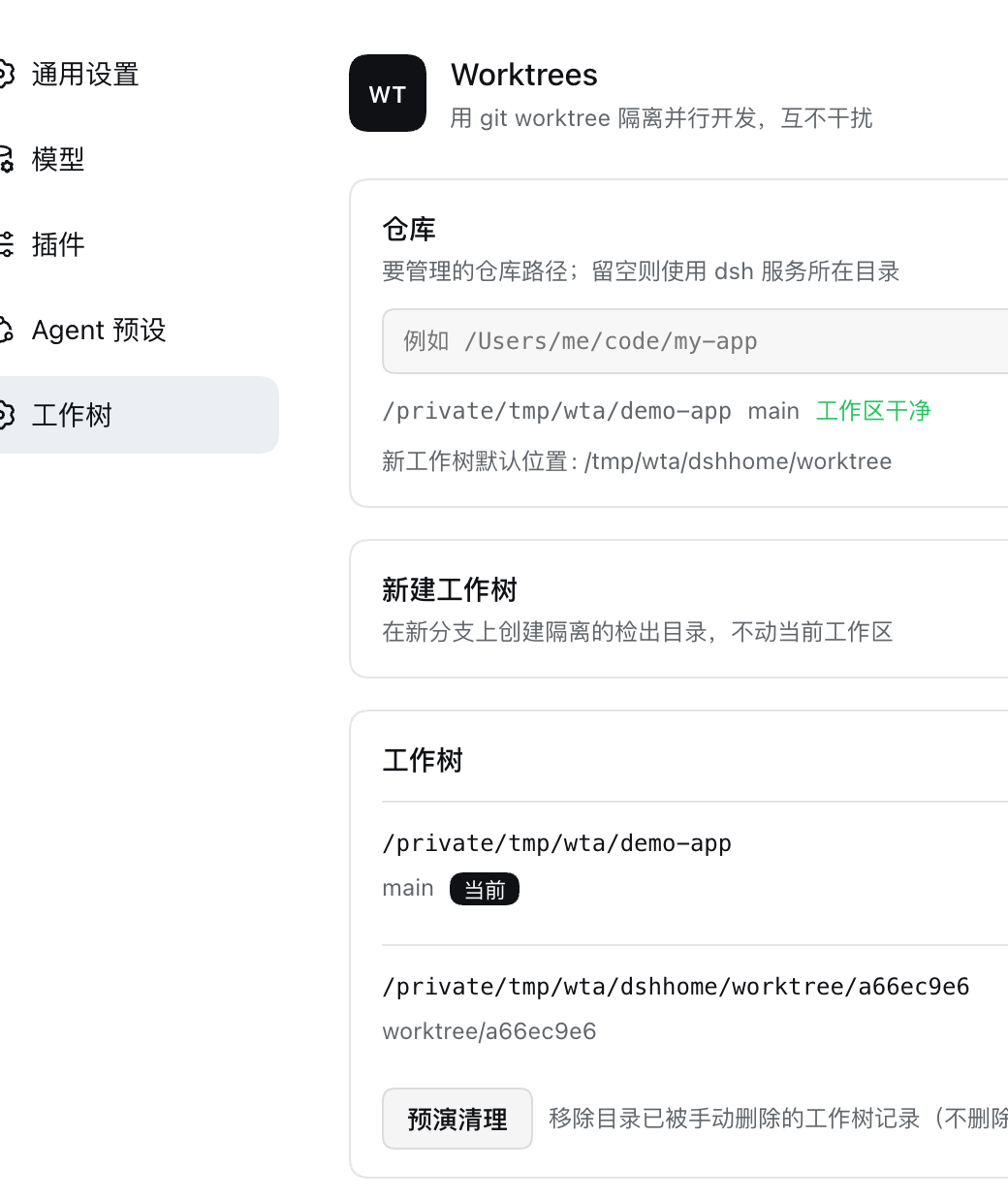
Settings page — Settings → Worktrees: the repository's worktrees with branch/HEAD and current/detached/locked/pruned badges, a create form (branch, base, directory), dry-run prune, and one-click Open as workspace so a new worktree becomes a sidebar workspace you can start a session in.
-
Remote branches are picked up, not shadowed — naming a branch that exists only on a remote checks that remote branch out from its real commit and sets it as upstream. If you name a base anyway, the shadowed remote is reported rather than silently ignored.
-
No manual git — creation is one atomic
git worktree add -b, and the new directory defaults to$DSH_HOME/worktree/, outside every repository: nothing to add to.gitignoreand forget, nothing for a build or a search to walk. The repository is unaffected either way — a worktree is linked from.git/worktrees, so its location never mattered to git.
Picking up someone else's branch
worktree_create with branch: colleague/feature and no base starts from
origin/colleague/feature and tracks it. This is the case that used to be quietly wrong: the branch
did not exist locally, so git created a fresh empty branch of the same name off the current one and
the caller believed they held the colleague's commits.
An explicit base is still honoured — a deliberate new branch from main has to stay possible — but
the result then carries shadowedRemote so the ambiguity is visible.
Working location for a New Session
The menu offers exactly two entries: Current worktree, where a session starts unless you ask otherwise, and New worktree. Existing worktrees are deliberately not listed — they are second checkouts of a project the session already belongs to, so a worktree is reached by its path rather than by a second sidebar entry.
New worktree takes no input and asks no questions. The branch is cut from the current one and named for the code that names the directory, so the whole decision is "a fresh checkout" versus "here". Pick it and you are in the new worktree: the worktree is made, registered, and a session is started and opened inside it, ready for your first message. Once there, the branch is yours — create or switch branches with ordinary git when the task calls for it; changing branch does not need a new worktree.
It has to happen on the click, not on the first message. A session's directory is fixed when the session is created, and the blank session in the composer is created before anything is typed, so there is no later moment at which a message could be aimed at a directory that does not exist yet. Creating the worktree and the session together is the only order that works; a version that created the worktree and left the session alone reported success and quietly ran the conversation in the project anyway.
A worktree is registered as a workspace, and that is not a choice. Workspace membership is exact
path equality (sessionPath(id) === record.path), attachSession rejects a session whose cwd differs
from its workspace path, and the record itself carries no hidden or archived flag. A session rooted in a
worktree therefore needs a workspace at that path — without one the shell has nowhere to draw it and
shows choose a workspace to start over a session that does exist. So each worktree you start a session
in appears in the sidebar beside the project, titled by its directory code, exactly as the core's own
new workspace flow would leave it. Registering on its own is also available as the explicit
Open as workspace action in Settings.
Only this route adopts. worktree_create does not: a worktree made mid-conversation leaves the session
where it is, so it needs no workspace, and adopting there would add a sidebar entry nobody asked for.
Showing a worktree under its project
The worktree's sessions can be shown under the project's own group, one level in from where they land by default. This needs a patch to DSH, and the patch is in this repository:
npm run patch:sidebar     # then restart dsh web
npm run unpatch:sidebar   # to restore the shipped bundle
It changes one small function — groupByWorkspace, the whole of the sidebar's grouping — so a worktree's
sessions fold into the project's group and the worktree stops being a group of its own. That is how Codex
reads, and for the same reason: it groups threads by project and treats the worktree as a thread
attribute, while DSH's grouping key is the directory and its records have no parent field. Two rules
decide the parent: a workspace whose directory is inside another's, and a parent map this plugin
publishes for worktrees kept outside the project — which is the default, $DSH_HOME/worktree/<code>.
The map is read from localStorage because the first render after a reload already needs the answer and
a fetch would land too late.
Why a patch and not the plugin: a client plugin can only nest by taking over the whole
sidebar.workspaces slot, which is single and owns the section header, the search box, every session
row and every workspace dialog — 14 components, with drag reordering, rename, archive and fork. Taking it
over would mean reimplementing all of it and drifting from core on every release. The grouping function
is a dozen lines.
A DSH upgrade replaces the file, so re-run npm run patch:sidebar after one. The script is
idempotent, keeps the shipped bundle at client.js.orig before the first patch, and refuses to guess if
the function is not in the shape it expects — a newer DSH needs the patch updated rather than forced.
npm run patch:sidebar -- --check reports whether a bundle is patched and exits non-zero when it is not.
Keeping the sidebar clean
The worktree's workspace is titled after its project — repo · 1dda6ec0, not a bare 1dda6ec0 — because
the title is the only place that relationship can be shown. The sidebar groups by workspace, one group per
directory, with no nesting and no hidden flag on the record, so a worktree is a group of its own whether or
not it looks like one. Codex reads cleanly here for a structural reason rather than a smarter trick: it
groups threads by project and treats the worktree as an attribute of a thread, so a worktree thread simply
lands under its project. DSH's grouping key is the directory, so there is nothing to nest into.
If you would rather not see the groups at all, the shell already has the mode for it: View options → Group by → In one list in the sidebar header. Sessions from every workspace become one recency-ordered list, so a worktree session sits beside the project's with no heading of its own. It is a saved preference, it applies immediately, and no plugin change is involved — it is the closest thing to Codex's sidebar that the current shell offers.
The menu dismisses on a pointer anywhere outside the control and on Escape (which also returns focus to
the trigger). The core selectors get that from the shared Menu primitive; this one cannot use it,
because this panel is not a flat {id, label} list — it carries a status line and a busy state — so the
behaviour is reproduced directly.
It sits on the Hero's own working-location row, beside the workspace and preset controls, and is styled
to match them exactly: the same borderless 16px-radius pill, the same 13px/500 type, the same shared
chevron and icon package. The icons come from @deepseek-ai/dsh-client-ui-primitives, which is
declared in dsh.client.inject — a client plugin can only require a package the boot graph wires in.
That row is
laid out by the core plugin and all three conversation.hero.* slots are single, where a second
occupant shadows the first instead of sitting beside it — so the control is rendered onto the row's
element with createPortal, which is how the core plugins place themselves inside surfaces they do
not own. The row is found from this plugin's own host outward via the conversation.hero.workspace
data-slot anchor, not by a document-wide query. If no row can be found the control renders in place
rather than disappearing.
Renamed from dsh-worktree
The package id, module id, HTTP routes, and settings namespace are all
gord-dsh-worktree now. If you installed under the old name:
dsh plugin --profile web remove dsh-worktree
dsh plugin --profile web add github:nightosong/gord-dsh-worktree
Install
dsh plugin --profile web add github:nightosong/gord-dsh-worktree
Then restart dsh web (a reload is enough once the bundle is on the layer stack) and open
Settings → Worktrees. Nothing else needs editing: the package declares dsh.bundle.patch, so the
CLI adds it to the profile's bundle stack itself.
Requires dsh 0.1.5-rc.1 or newer.
Tools
| Tool | What it does |
|---|---|
worktree_list | Every worktree of a repository: path, branch, HEAD, and current/detached/locked/pruned state — plus every local and remote-tracking branch, which is what to consult before naming a base. |
worktree_create | Creates the directory and its branch in one command; checks out an existing branch instead of recreating it, and starts from a remote-tracking branch of the same name when only that exists. |
worktree_status | One worktree's branch, upstream line, and changed files. |
worktree_remove | Removes a worktree. Refuses when it holds uncommitted or untracked changes; force discards them on purpose. |
worktree_prune | Drops records of worktrees whose directories are gone. Deletes no files. |
All five resolve the repository from the session directory by default and accept workdir (or repo) to
point at another one.
Safety rules
- The main worktree is never removable.
- A dirty worktree is never removed without
force— and "dirty" counts untracked files, becauseworktree remove --forcewould delete them. - A locked worktree is reported, not silently unlocked.
- Branch names are validated by
git check-ref-format, and every worktree path is passed to git as a positional argument, never through a shell, so a name can never become a flag. - The HTTP surface the panel uses runs git on this machine, so the mutating route accepts same-origin and loopback callers only. It is not a remote API.
Settings
| Field | Default | Meaning |
|---|---|---|
defaultParent | (empty) | Directory new worktrees are created in. Empty uses $DSH_HOME/worktree/. |
Development
The plugin is plain ESM with no build step: lib/index.js is the host half, lib/client.js is the
browser bundle loaded through window.__ModuleLoader__, and lib/service.js + lib/worktree.js hold the
git logic both halves share.
# install a checkout into a profile as a live dependency
dsh plugin --profile web add /absolute/path/to/gord-dsh-worktree
A checkout installed by path resolves Node imports from its own directory, while DSH's packages resolve
from the profile — so the host half cannot see @deepseek-ai/dsh-tools unless the checkout can reach
them. Link the peers once in a local checkout (they are gitignored):
mkdir -p node_modules/@deepseek-ai
SRC=$(dirname "$(readlink -f "$(which dsh)")")/../node_modules/@deepseek-ai
for p in schemastery dsh-tools dsh-settings cordis; do
  ln -sfn "$SRC/$p" "node_modules/@deepseek-ai/$p"
done
An install from GitHub or npm inside a profile needs none of this: there the peers resolve through the
profile's own node_modules, exactly as for every other plugin.
Because the host half is mounted as a bundle layer, host-side changes need a dsh web restart; client
changes reload with the GUI's normal module reload.
npm test runs both smoke suites — the host one against a throwaway git repository, the client one
against a minimal React runtime — with no test framework to install.
License
MIT
Plugins relacionados
dsh-web (dsh-git-graph)
zhu1090093659/dsh-web
dsh-web-ui (dsh-git-graph)
zhu1090093659/dsh-web-ui
codex-guard (dsh)
akimiya-z/codex-guard
dsh-file-review
left0ver/dsh-file-review