dsh-find-ideas
tianyao2003/dsh-find-ideas
Prior-art search for an idea: three tools find similar open-source projects on GitHub, rank them by a score computed in code from a relevance judgement and the star count, then read the chosen repositories (README, dependency manifest, directory tree, key files) and report the class and function declarations found in each file header; files_read lists what was actually fetched.
Instalar
dsh plugin --profile web add github:tianyao2003/dsh-find-ideasREADME
dsh-find-ideas








English | 中文
Before you build it, check whether it already exists.
Describe your idea in one sentence. The agent searches GitHub for similar projects, ranks them by relevance weighted with stars, and hands back a card. Pick a few repositories from the card and it reads their README, dependency manifest, directory tree and key files, then writes up an architecture you can borrow from.
Install
# from npm (recommended)
dsh plugin --profile web add dsh-find-ideas

# or from GitHub
dsh plugin --profile web add github:tianyao2003/dsh-find-ideas

# or from a local directory
dsh plugin --profile web add /path/to/dsh-find-ideas
Published on npm as dsh-find-ideas. Installing from GitHub runs the build once at install time and needs pnpm to allow build scripts; the npm package ships the compiled output, so there is no such step.
Configure a GitHub token (recommended)
GitHub limits unauthenticated search requests to 10 per minute per public IP, and everyone behind the same egress IP shares that quota. A token raises it to 30 per minute, counted per account.
The plugin reads GITHUB_TOKEN through DSH's credential store. Set it in the environment that launches DSH:
export GITHUB_TOKEN=ghp_...          # bash
$env:GITHUB_TOKEN = 'ghp_...'        # PowerShell, current session
Everything works without a token, but inspect_projects refuses an anonymous batch it estimates above 10 requests.
Usage
Restart dsh after installing, then describe your idea — the agent calls the three built-in tools on its own:
- "I want to build a local-first Markdown note app — what's out there on GitHub?"
- "I want to build a UI-enhancing DSH plugin. Which projects exist?"
scout_projects → rank_candidates → inspect_projects are independent and share no state. The 0–10 relevance is the agent's judgement; the tools only search, compute, sort and read, and never judge semantic similarity. The ranking formula is relevance × (1 + log10(max(stars, 10) + 1)) / 2. A ranked card always has eight columns: rank, project, last updated, relevance, stars, score, language, description.
How it works
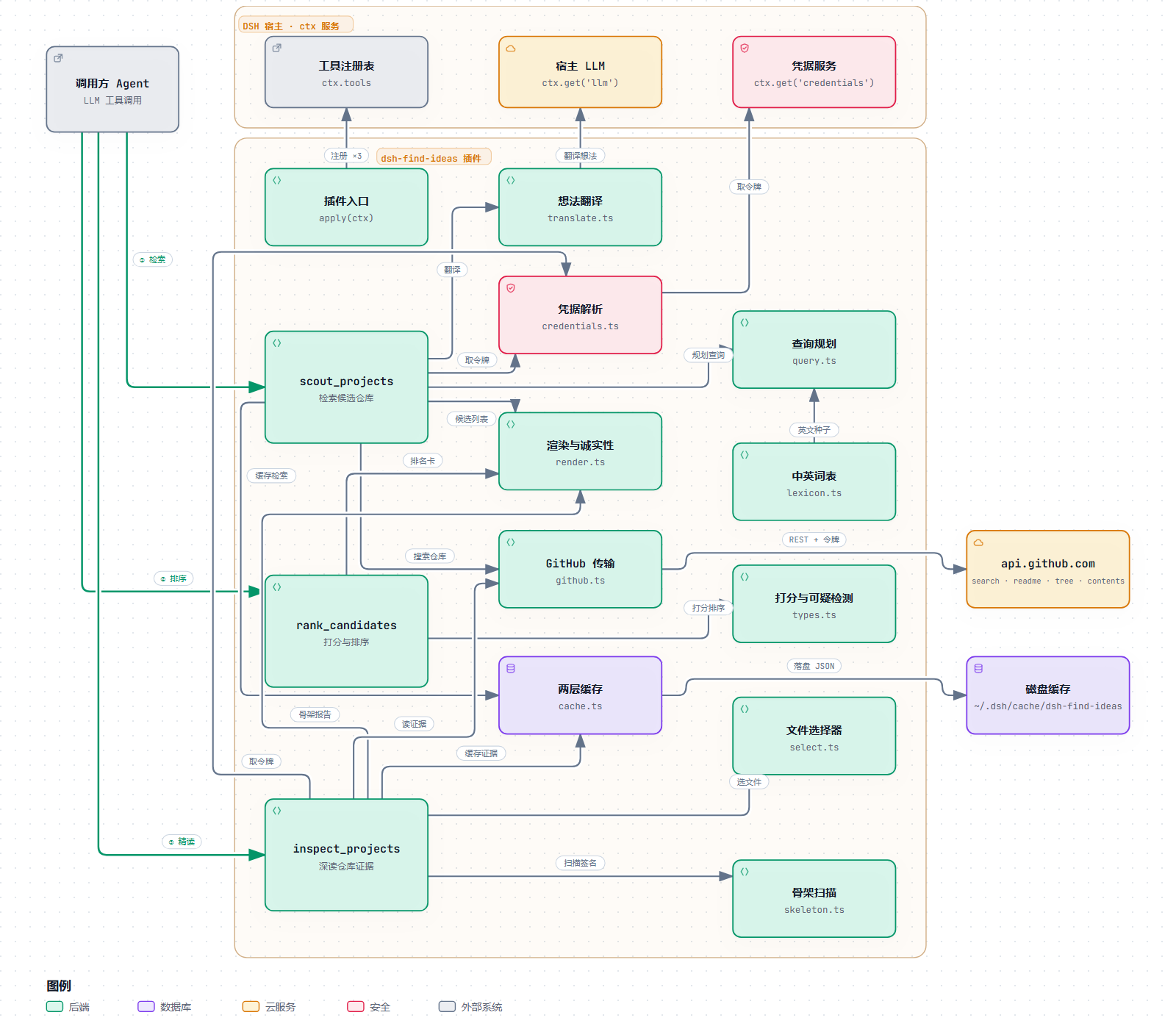
scout_projectsturns the idea into several GitHub search queries and returns a star-sorted pool — deliberately not ranked by relevance. When the idea contains no Latin letters it is translated into English search terms first; when that is impossible (the caller gave no Latinkeywordsand no LLM is available) it returnsplan_failed.rank_candidatesscores the pool withrelevance × (1 + log10(max(stars, 10) + 1)) / 2and produces the card.inspect_projectsreads up to 5 repositories — README, dependency manifest, tree summary and a few key files.
What the cards guarantee
- Computed and supplied stay apart. The ranked card declares which fields the code derived and which the caller (the agent invoking the tool) passed in. Caller text is truncated, escaped and labelled
[未验证], and never enters the arithmetic. - A count nobody measured is never rendered as 0. A query term that was never tested on its own reads 未知(未测得); an archived field that is missing says 数据缺失; when the pool size was never measured the card reports only the reserved-seat count and never invents a total.
- Third-party text is always data. Repository excerpts are wrapped in code blocks and escaped, so a line of README cannot impersonate card structure; the only hosts emitted as links are
github.comandraw.githubusercontent.com. - Failures come back as values. Nothing throws out of a tool: every failure returns a
reasonand adetailyou can act on, and a partial result says why it is partial. - A restatement keeps every column. The card says so itself: keep all eight columns when you restate it — dropping a row or a column is losing information, not shortening the table.
What leaves your machine
Search queries and repository paths go to api.github.com; inspect_projects only reads repository content on GitHub and never uploads your local code. The only other place data goes is the model that DSH itself uses, and only to translate an idea with no Latin letters when the caller supplied no Latin keywords — a purely English idea is never sent to a model for translation. Search results are cached for 24 hours and source reads for 10 minutes, both under $DSH_HOME/cache/dsh-find-ideas/ locally.
Compatibility
Requires Node ≥ 22. DSH plugin APIs are prerelease-versioned, and one range branch cannot reach across a minor version, so the @deepseek-ai/dsh-tools peer range names the versions it supports one minor line at a time (one entry per line); npm run check:peers resolves the dsh-tools version the current DSH host actually installs from the npm registry and fails when the range does not accept it. The Version section below lists which DSH versions each plugin release supports.
Version
| Version | Update | DSH versions supported |
|---|---|---|
| 0.2.1 (current) | Published to npm; the install section now leads with npm and demotes the GitHub route to an alternative. Same functionality as 0.2.0. | 0.1.0-rc.2 through 0.2.1-rc.1 |
| 0.2.0 | The card states how many query channels found each row and how many rows on the board are archived, and writes the "keep all eight columns when restating" rule into the card itself. | 0.1.0-rc.2 through 0.2.1-rc.1 |
| 0.1.0 | First usable version: the scout_projects → rank_candidates → inspect_projects chain, and the rule that keeps computed fields apart from caller-supplied ones. | 0.1.0-rc.2 through 0.2.0-rc.2 |
Development
npm install
npm run build         # tsc -> lib/ ; run this first, the tests import lib/
npm test              # node test/run-all.test.mjs
npm run typecheck     # tsc --noEmit
npm run check:peers   # check the peer range against the current DSH versions
test/ holds 27 *.test.mjs files. test/run-all.test.mjs runs the 26 that are not itself, and two of those (baseline, stage2) skip because the recorded test data under eval/runs/ was never ported — so a full local run verifies 24 files. Skips are listed under skipped (fixture absent, NOT verified) and never counted as passes.
Contributing
Issues and pull requests are both welcome.
- Report a problem or ask for a feature: open an issue with the idea you typed, the result you expected and the result you got. Tool output is in Chinese; paste the ranked card it returned.
- Change the code: fork, branch off
master, make the change with a test, runnpm run check && npm testuntil green, then open a pull request. CI runs the same two commands on Node 22 and 24. - One change per PR: a PR solves one problem; commit messages use prefixes such as
feat:/fix:/docs:/chore:. - Change the card's wording: the table header and the notes on the card are asserted word for word by tests (see
test/render-table.test.mjs), so the test changes along with the text;.trellis/spec/holds this project's development conventions (generated by Trellis, committed with the repo), and the relevant section needs updating too.
License
MIT. See LICENSE.
Plugins relacionados
archify (deepseek-harness)
tt-a1i/archify
WeKnora (dsh-weknora)
tencent/weknora
weknora
tencent/weknora
BrowserSkill (dsh-plugin-browserskill)
tencent/browserskill