dsh-smart-restart
edusrez/dsh-smart-restart
Réveille l'agent principal après tout redémarrage de DSH pour que le travail interrompu reprenne automatiquement — ajoute un outil de redémarrage et un canari optionnel qui valide le boot et annule avec une alerte avant un redémarrage cassé.
Installer
dsh plugin --profile web add github:edusrez/dsh-smart-restartREADME
dsh-smart-restart
English | 中文
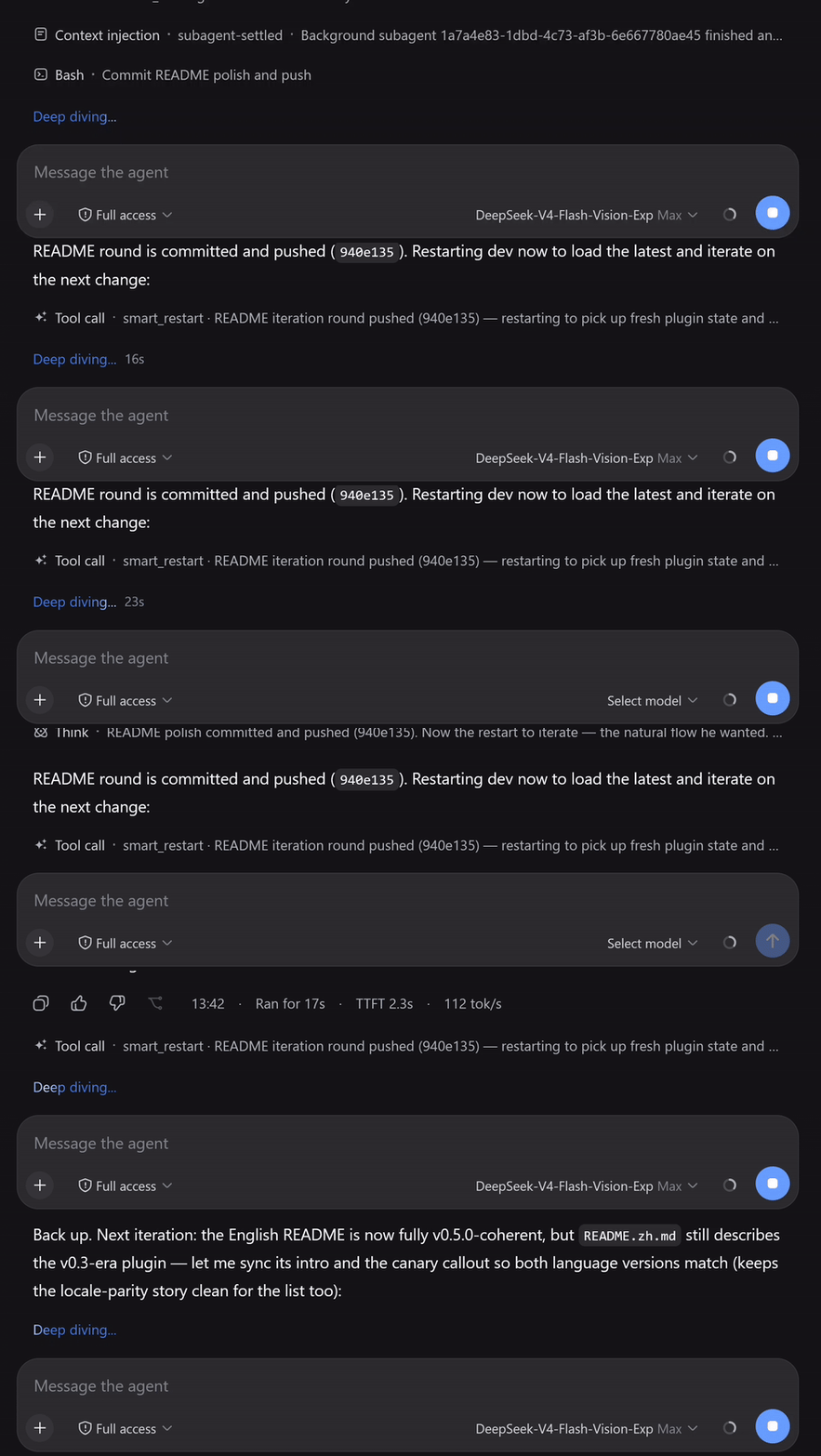
A real-time restart: the agent restarts the service (canary pre-flight passing, Canary: passed — restarting…), and the plugin's boot notification brings the very same session right back — the conversation continues automatically, no user prompt needed.
A DeepSeek Harness (DSH) host plugin that keeps the main agent aware of service restarts — without the user having to prompt it. On every boot it detects that a new process has taken over, wakes the target agent with a short "Smart-restart" notice (boot time, previous boot, downtime). New in v0.2.0 it added the smart_restart tool to restart DSH itself and return the notice to the exact session that asked; new in v0.3.0 it auto-detects when the service was stopped while an agent session was active, so even a plain systemctl restart the agent ran notifies that session at boot; new in v0.4.0 it can validate the launch first with an optional canary pre-restart gate that aborts the restart when an ephemeral boot fails. New in v0.5.0 it auto-detects the systemd unit from /proc/self/cgroup, so the tool and the canary work with zero config on systemd-managed installs.



Table of contents
- Overview
- How it works
- The
smart_restarttool - Canary pre-restart validation
- Requirements
- Install
- Configuration
- Behavior & lifecycle
- Limitations
- Development
- License
Overview
A long-lived DSH instance restarts for many reasons: the agent installs or reconfigures a plugin and triggers a reboot, the host machine reboots, or the service is restarted under systemd. After any such restart the agent is up and running again, but it has no idea that anything happened — the previous session is gone. Today, the only way to get the agent to pick back up is for the user to tell it, usually with something like "you restarted".
dsh-smart-restart closes that gap. It detects the restart itself and wakes the main agent at boot with a short, self-contained notice describing what happened, so the agent decides whether to resume interrupted work, note the downtime, or simply acknowledge — no user prompt needed.
New in v0.3.0, the plugin also covers the unplanned restart of an active agent. It tracks the last active session and, on shutdown (SIGTERM/SIGINT), persists a shutdown-notice.json; on boot it pins the notice back to that session (when it was active within shutdownGraceMs). So a plain systemctl restart the agent ran — or a restart that happened while an agent was mid-task — is auto-notified without the user prompting. v0.2.0 let the main agent cause restarts: the smart_restart tool records the calling session and restarts DSH through systemd, returning the notice to that exact session.
- Zero prompting — the user never has to tell the agent "you restarted".
- Self-restart — the main agent can restart DSH itself and resume its task automatically afterwards.
- Automatic wake — an idle main agent is woken and handed the notice on its own.
- Targeted delivery — the post-restart notice returns to the session that requested it; otherwise the
targetconfig decides where it lands. - Read-before-edit guard —
smart_restartreads the LIVE agent registry and refuses to restart while other sessions are mid-turn (unlessforce: true), so a blind interruption is structurally impossible. - Interrupted-head resume — heads whose turns were cut by a restart each get an automatic resume notice at boot, so the organization never hangs idle post-restart without knowing.
- Precise context — the notice carries the boot time, the previous boot time, the downtime, and an optional reason.
- Canary safety — an optional pre-restart gate boots an ephemeral DSH instance and aborts the restart when it fails (see below).
- Self-contained — a single host bundle; nothing to run, no external service.
How it works
On every boot the plugin:
- Reads the previous marker — a durable
marker.json({lastBootAt, pid, dshVersion?}) stored under<DSH_HOME>/<stateDir>/. - Detects a restart — a previous marker with a different
pidthan the currentprocess.pidmeans a new process has started, i.e. the service restarted; downtime isnow − previous lastBootAt, clamped to≥ 0. - Writes a new marker immediately, so the next boot can be compared against this one.
- Checks for a pending notice — if the
smart_restarttool left apending-notice.jsonbefore the previous restart, this boot pins delivery to that exact session (highest priority; the file is consumed once read). - Checks for a shutdown notice — if there was no pending notice, the plugin reads
shutdown-notice.json(written by the previous process onSIGTERM/SIGINT, recording the last active session). If that session was active withinshutdownGraceMs, this boot pins delivery to it (second priority); otherwise the pin is skipped and delivery falls back totarget. The file is consumed once read. - Delivers the notice — once per boot via the source-agnostic
agent/session-starthook (a pinned session is matched regardless of publication source, so a session that resumes withsource: 'resume'is caught too), backed by a bounded poll (750ms tick, ~15s cap) that picks up a pinned session which resumes lazily late.
There are three delivery paths, depending on how the restart happened:
(a) Agent-initiated restart (smart_restart tool)
The main agent calls smart_restart(reason?). The tool:
- validates the configured
restartUnittoken, - persists the pending notice synchronously (calling session + optional reason) to
pending-notice.jsonunder the state dir, before any spawn so it survives the imminent service kill, - spawns a detached
setsid bashprocess (a ~1s delay lets the tool's response be written) that runssystemctl restart <unit>and survives this process being killed by systemd, - returns
{ok: true, restarting: true, ...}.
On the next boot, step 4 above reads the pending notice, pins it to the calling session (highest priority), and the notice returns there — regardless of source — so the agent that asked resumes its interrupted task.
(b) Smart shutdown auto-detection (plain restart while an agent was active)
If there is no pending notice, the plugin looks for a shutdown-notice.json. This file is written synchronously by the previous process on SIGTERM/SIGINT, recording the last active session (tracked on agent/session-start and agent/pre-step) and its timestamp. On boot the plugin pins the notice to that session only if it was active within shutdownGraceMs of shutdown (recent activity ⇒ the user restarted while the agent was mid-task, so auto-notify). If the session was idle well before shutdown (the user probably restarted while idle), the pin is skipped and delivery falls back to target.
This is what makes a plain systemctl restart that the agent ran — or a restart that happened while an agent was active — auto-notify that session at boot, with no user prompt and no need to have called smart_restart.
Since v0.6.0 (unreleased — see CHANGELOG.md) the boot also auto-notifies the interrupted heads: every session of the recorded interrupted set that matches ignoredSessionPrefixes (Deepartments head-<postId> heads by default) receives its OWN resume notice once it comes live at boot — so after a restart that cut an active head turn, the organization is never left hanging in idle with no notice (fb-46). Heads are still never pinned as the single-session last-active target (the pin and the shutdownTarget gate keep ignoring head-*, preserving the v0.3.1 anti-spurious-notice behavior); only a head whose turn was genuinely cut is notified.
(c) External restart (systemd, host reboot, dev tools) — no active session
There is no pending notice and no usable shutdown notice (either none was written, or the last activity predates shutdownGraceMs). The boot falls back to the target config (primary | all | <session-id>) to decide which agent(s) get the notice. The source === 'startup' gate applies only to this non-pinned path.
Restart vs. HMR semantics
The detection is intentionally precise:
| Situation | Detected as a restart? |
|---|---|
| New OS process, previous marker exists | Yes — service (re)started. |
| Same OS process (in-process HMR / hot-reload) | No — ignored. |
| First-ever boot (no marker) | No — nothing to compare against. |
Marker present but stale/corrupt lastBootAt | Yes — downtime reported as 0. |
Only a genuinely new process counts as a restart. An in-process hot-reload keeps the same pid, so it is not treated as a service restart. Delivery happens once per boot: a deliveredIds set plus a primary guard (for the primary target) prevent the startup event and the fallback poll from double-sending.
Notice
The default notice (English) reads:
Smart-restart: the DSH service restarted at
<iso>. Previous boot:<iso>(downtime ~2m 9s). If a task was in progress, resume it; otherwise reply with a one-line acknowledgment.
When a reason was recorded by smart_restart, it is appended (… reason: <reason>.) before the resume instruction. The previous-boot/downtime segment is omitted when no previous boot time is known, and the whole text is fully customizable via the notice config (see below).
Since v0.6.0 (unreleased) the interrupted list is sealed per session. The list is composed by session, never by post, so a seat whose session rotated can legitimately appear twice — on 2026-09-22 the live notice carried both the then-current head-quality-head-a352f359-… and its rotated-out predecessor head-quality-head-9e1cc8b2-…, rendered identically as (main), which made it impossible to tell the seat's holder from the outgoing session. Each entry now carries a seat seal resolved from the catalog:
| Label | Meaning |
|---|---|
[seat <postId>] | This session is the current session of that catalog row. |
[seat <postId> superseded by <sessionId>] | This session is no longer the seat's holder; the named session superseded it. |
[seat <postId> (retired post)] | The row that lists this session is retired. |
[not a catalog incumbent] | No row of the measured catalog accounts for this session. |
The seal is additive, never a gate. A session that is no longer the incumbent is still notified and still delivered to — its write is made attributable, not blocked. (Blocking it would have destroyed the only channel that carried state across a rotated-out quality-head's incarnations — fb-2418/fb-2419.) The same seal is appended to the boot log's interrupted sessions at shutdown: and interrupted heads (resume recipients): lines.
Both catalog documents are consulted — posts.json (<postId> rows) and hosts.json (host-<id> rows). Resolving against posts.json alone would mis-seal the live host session as "not a catalog incumbent". When neither document can be read, no seal is produced at all and the labels keep their pre-v0.6.0 shape: "could not measure the catalog" is never rendered as the positive claim "this session is not a member".
The smart_restart tool
Registered via ctx.tools.register in apply (so it is available to agent sessions) when toolEnabled is true (the default). It lets the main agent restart DSH itself through systemd.
Parameters
| Param | Type | Required | Description |
|---|---|---|---|
reason | string | no | Optional human-readable note, e.g. "installed dshmarket in stable+dev". Included in the post-restart notice. |
cause | string | no | Optional intentional-restart family — one of canary, deploy or dshmarket (the FB-234 GRACE set). Before the kill the tool writes <runtimeStateDir>/restart-reason.json atomically (tmp + rename), so the next boot is treated as an intentional restart — the health sidecar's crash streak never rises over it and the restart registry attributes the row to this cause. Use it for an intentional restart of a HEALTHY process; omit it for any other restart (no marker — the usual crash semantics). A canary-gated call implies canary. (Unreleased, v0.6.0.) |
canary | boolean | no | Optional canary pre-restart validation for THIS call: boots an ephemeral DSH instance and aborts the restart on failure (see Canary pre-restart validation). Overrides the configured canary for this call. |
force | boolean | no | Explicit override of the read-before-edit guard: restart even when OTHER sessions are mid-turn. The tool refuses (and returns the in-flight session list) unless this is true; the override and the list are ALWAYS visible in the log. Use only after explicitly confirming the in-flight work is safe to interrupt. WINS over wait: with force: true the tool never waits. |
wait | boolean | no | DEFER the restart instead of refusing it: re-read the LIVE agent registry (the same in-process snapshot the guard uses — it sends no message and wakes nobody) until every OTHER session is idle, then restart. Bounded by waitMaxMs; once the cap is spent the tool returns the SAME loud in-flight refusal and states that the wait expired (nothing is spawned, nothing is persisted). |
waitMaxMs | number | no | Hard cap in milliseconds on a wait: true deferral. Default 120000 (2 minutes); an absent or invalid value falls back to the default, so a wait is never unbounded. Ignored without wait: true. It caps the waiting: the wait at the guard AND, when a canary gate runs, its post-canary re-check draw from the same budget — the re-check gets only what is left, so waitedMs (the accumulated guard + re-check wait) can never last 2x this cap. The canary window itself is charged against this budget while any is left; when it alone spends the budget, the re-check receives a bounded grace = the cap minus what the guard actually waited (the guard's unspent share, which is exactly what the window consumed), so the total waiting still never exceeds this cap. The canary window is NOT capped by this value: it keeps its own measured budget, because a short waitMaxMs must never blind the launch-token capture (fb-2309). |
Behavior
- Validates the configured
restartUnit— a single systemd unit token (/^[A-Za-z0-9_.@-]+$/, no spaces/slashes) to prevent shell injection into the detached command. - Fails fast when
restartUnitis not configured and auto-detection from/proc/self/cgroupfinds no unit either (ok: false, errorrestartUnit not configured) rather than guessing a unit — an emptyrestartUnitis auto-detected first, and only a failed detection produces that error. - Refuses to restart while other sessions are mid-turn (read-before-edit guard, see below) — the live registry check runs before anything is persisted or spawned, and runs AGAIN after a canary pass, right before the spawn.
- Persists
pending-notice.jsonsynchronously (before any spawn) so it survives the service kill and targets the restarting session. - Restarts via a detached
setsid bashprocess (sleep 1 && systemctl restart <unit>) that outlives this process, then unrefs it. - Returns
{ok: true, restarting: true, sessionId, reason}on success, or{ok: false, restarting: false, error}when it fails (a guard-blocked refusal also carriesinFlight: string[]).
Read-before-edit guard
Since v0.6.0 (unreleased), smart_restart implements the read-before-edit pattern (fb-168): BEFORE persisting the pending notice or spawning the restart, the tool reads the live agent registry inside the DSH process — ctx.agents, a session whose status === 'running' has an active turn in flight (the same in-process signal Deepartments derives its "running" state from, and the marker of the exact work a restart would cut). This registry is updated synchronously by the harness on every agent/status transition, so the check can never go stale the way file-based state (e.g. a previously taken posts.json snapshot) could.
- If any session other than the calling session is mid-turn, the tool returns
{ok: false, restarting: false, error: 'refusing to restart: N other session(s) mid-turn (…)' , inFlight: [<ids>]}— the caller is excluded because it restarts itself intentionally and is pinned for resume. - An explicit
force: trueis the only way through; the override and the in-flight list are always written to the log ([smart-restart] smart_restart: FORCE override — restarting with N other session(s) mid-turn: …). - Alternatively,
wait: trueinverts the refusal into a bounded deferral: the tool re-reads the SAME live registry snapshot in a sleep loop (default poll 1s) until every other session is idle, then restarts — it creates no turns and wakes nobody. The wait is capped bywaitMaxMs(default 120000); at the cap the tool returns the same refusal withwaitTimedOut: trueand anerrorstating that the wait expired, so a spent wait is never confused with the immediate block. The deferral runs at the guard point, BEFORE the calling-session flush and BEFORE the canary gate, andforce: truealways wins. waitMaxMsis ONE budget for the WAITING. The canary window is exactly when a session starts a turn again (the window closes while it is being checked), so the post-canary re-check does not get a fresh cap: it runs the samewaitForIdlewithmax(0, waitMaxMs − spent), wherespentis the deferral window since the wait opened (the guard-stage wait + the calling-session flush + the canary window).waitedMsin the result is the accumulated wait of both stages (guard + re-check), so the published figure is the real input of that arithmetic.- The grace (the canary window is not capped by
waitMaxMs). The window keeps its OWN measured budget: truncating the capture to a shortwaitMaxMswould leave it blind — no launch token, no cookie, a 401 on an auth-wall tree, and the canary would abort the restart of a healthy tree (the fb-2309 class). So when the canary window ALONE spends the wait budget (0ms left, stated as such in the log), the re-check does not get a zero-length wait: it disposes of a bounded grace =max(0, waitMaxMs − waited-at-the-guard)— the guard's UNSPENT share, which is exactly what the window consumed — announced in its own log line. Two honest facts, never one lie: the budget IS spent, and the grace is bounded. The invariant is about the waiting: guard + re-check ≤waitMaxMsalways (the normal path yieldsguard + (cap − spent), the grace path yieldsguard + (cap − guard) = cap). With a zero grace (the guard itself spent the cap) the behavior is unchanged: it decides on the CURRENT state and, with sessions still mid-turn, refuses immediately — never a zero-length wait. Either the restart happens, or there is a loud refusal — never a wait spent in silence. - The check runs at call entry and again after a canary pass (the canary window can be tens of seconds — the final gate reflects the current state, not the state at call entry).
- A blind interruption is thus structurally impossible: the tool cannot spawn while other agents are running unless the caller explicitly confirms it.
Intended agent flow
install/change a plugin
  → call smart_restart(reason)   # e.g. "installed dshmarket in stable+dev"
  → DSH restarts (detached, ~1s)
  → after boot, the notice returns to THIS session (pinned)
  → the task continues automatically — no user prompt needed
Safety notes
- The unit token is validated against a strict regex to block shell injection through
restartUnitinto the detached shell command. - The tool refuses to interrupt other sessions' live turns unless
force: trueis passed explicitly — a blind restart while agents are mid-turn is structurally impossible. - The tool targets a systemd-managed DSH install (
setsid/systemctl); it does not apply to a bare process without a systemd unit.
Canary pre-restart validation
New in v0.4.0. Optional, opt-in, and fully generic — it works on any DSH install:
restartUnitis the only tool config you may need to set (auto-detected since v0.5.0 when empty on systemd installs).
When enabled, the smart_restart tool can validate the launch before anything is persisted or restarted: it boots an ephemeral DSH instance from the same binary and profile as the systemd unit, verifies it starts, and only then proceeds with the real systemctl restart. A failed canary aborts the restart — no pending notice is written, nothing is spawned, and the calling session is alerted live (same plugin-source notice channel).
What it does, step by step
- Resolves the dsh binary/profile — an explicit
canaryBinary/canaryProfilewins; otherwise both are derived fromsystemctl show -p ExecStart <restartUnit>(binary falls back todshon PATH). The--profileflag is omitted when no profile resolves. - Creates a temp state dir and a temp patch overlay (
dsh --patch <tmp>/canary.patch.yml, applied after the profile layer): thesmart-restartrow itself is disabled in the canary (enabled: false) and everycanaryStateDirOverridesentry gets itsstateDirredirected into the temp dir — so the canary never writes a marker, notice, or live board state. - Pre-flights the launch with
--dump-config(20s timeout; a compose failure aborts the restart) and checks the dump is coherent — the composed tree must be a valid entry list and thesmart-restartrow must be DISABLED in the canary (the patch applied; an enabled row would let the ephemeral write into the live state dir). - Boots the ephemeral instance detached with the same overlay on an auto-picked free port (
canaryPortwhen set) and pollshttp://127.0.0.1:<port>/until HTTP 200 orcanaryTimeoutMselapses (per-attempt 800ms; a refused connection or non-200 is "not yet"). - Post-boot validation — with the instance up, the canary checks: the client boot graph (default ON — every
/plugins/<id>/client.jsmust register its graph row id); agent liveness (default ON — every non-retired member of the deepartments catalog must appear alive in the runtime's live agent registry); pooler health (default ON —/v1/models,/usageand/__keypool/status; a missing endpoint, e.g. the fb-75 pooler-capacity deploy pending, is a graceful skip) and the R8/R9 runtime markers (default ON —presence.json+toolset-audit.jsonlwell-formed). - Stops the ephemeral (process-group kill) and returns:
passed→ the restart proceeds;failed→ abort + alert the caller;skipped→ the restart proceeds (a skip is not a failure).
When it skips (never blocks) — if the dsh binary/profile cannot be derived (no systemctl lookup result AND no explicit canaryBinary/canaryProfile), the canary reports skipped and the restart proceeds unchanged. Generic installs are therefore always safe: a canary failure only ever aborts a restart when you opted in with an actual, resolvable launch target.
How to enable
- Per profile: add
canary: true(plus any overrides) to thesmart-restartrow. The per-profile patch row REPLACES the row's whole config, so restate your existing fields (see the example in Configuration). - Per call (agent-facing): call
smart_restart(canary: true, reason), which overrides the configured default for that single call.
Config fields
| Key | Type | Default | Description |
|---|---|---|---|
canary | boolean | false | Master opt-in for the canary gate. |
canaryTimeoutMs | number | 45000 | Hard window (ms) for the canary boot liveness probe; a timeout is a canary failure and aborts the restart. |
canaryPort | number | 0 | HTTP port for the ephemeral canary instance; 0 auto-picks a free port. |
canaryProfile | string | '' | Explicit dsh profile for the canary launch; empty derives from the unit's ExecStart (--profile). |
canaryBinary | string | '' | Explicit dsh binary for the canary launch; empty derives from the unit's ExecStart, else dsh on PATH. |
canaryStateDirOverrides | object | {} | Plugin-row id → temp dir: those rows get their stateDir redirected in the canary patch (e.g. deepartments: '' keeps the canary off live board state). Relative or empty values resolve under the canary temp dir; absolute values are used verbatim. |
Note on overrides and row replacement. Patch rows replace their row's WHOLE config (no merge) — and the canary is a throwaway instance, so a listed row gets only its
stateDiroverridden and its remaining config reverts to that plugin's own defaults. UsecanaryStateDirOverridesonly for rows that boot fine with defaulted config (the live profile's row is untouched). Rows that don't exist in the canary's composed tree are skipped with a loader warning.
Output — when a canary ran, the tool result carries canary (passed /
skipped / failed) plus canaryDetail, and the rendered response gains a
Canary: … line (Canary: passed — restarting…, Canary: failed — restart ABORTED: <detail>, or Canary: skipped — <detail>).
Requirements
- DSH
0.1.0-rc.7+/0.1.1-rc.x— a long-lived instance with a live main-agent session (the web / GUI profile). This plugin is designed for a continuously-running service whose main agent stays resident; it is not aimed at the one-shot headless CLI. - systemd-managed DSH install for the
smart_restarttool — v0.5.0 auto-detects the service unit from/proc/self/cgroup; setrestartUnitexplicitly when the unit differs or on non-systemd (where the tool fails safe). - Node.js / pnpm — the usual DSH toolchain for building and installing host bundles.
Install
dsh-smart-restart is a DSH host bundle: package.json carries dsh.bundle.patch = ./cordis.patch.yml, so installing the package lets the plugin layer auto-join the profile's dsh.profile.bundles.
# From a registry (npm)
dsh plugin --profile <name> add dsh-smart-restart

# Or link a local checkout while developing
dsh plugin --profile <name> add /path/to/dsh-smart-restart
A restart is required after add — which is exactly the scenario this plugin exists to surface. The bundled patch inserts the layer into the profile's layer stack:
# cordis.patch.yml (bundled with this package)
- insert:
    - id: smart-restart
      name: dsh-smart-restart
      config:
        enabled: true
        stateDir: .smart-restart
        target: primary
        wakeup: true
        notice: ''
        restartUnit: ''   # OPTIONAL since v0.5.0 — auto-detected on systemd installs; set explicitly when the unit differs
        toolEnabled: true
restartUnitis OPTIONAL since v0.5.0 on systemd installs. The plugin auto-detects its own systemd unit from/proc/self/cgroup, so thesmart_restarttool (and the canary'sExecStartderivation) work with zero config on a systemd-managed DSH install. SetrestartUnitexplicitly when the unit name differs from the auto-detected one or when detection is unavailable (e.g. a bare non-systemd process). If you DO set it, add acordis.patch.ymloverride on thesmart-restartrow — restating the full config (a partial override would drop the other keys) — with the unit for that profile. For example, for the stable instance and the dev instance respectively:
# Override on the smart-restart row — profile "stable" (dsh.service)
- insert:
    - id: smart-restart
      name: dsh-smart-restart
      config:
        enabled: true
        stateDir: .smart-restart
        target: primary
        wakeup: true
        notice: ''
        restartUnit: dsh.service
        toolEnabled: true

# Override on the smart-restart row — profile "deepartments-dev" (dsh-deepartments-dev.service)
- insert:
    - id: smart-restart
      name: dsh-smart-restart
      config:
        enabled: true
        stateDir: .smart-restart
        target: primary
        wakeup: true
        notice: ''
        restartUnit: dsh-deepartments-dev.service
        toolEnabled: true
Because the bundle declares dsh.bundle, the layer auto-joins dsh.profile.bundles on install — no manual profile edit required. restartUnit is usually auto-detected (v0.5.0); add the explicit override above only when the unit name differs or detection is unavailable.
Configuration
All behavior is controlled through the plugin row's config:
| Key | Type | Default | Description |
|---|---|---|---|
enabled | boolean | true | Master switch; false skips all processing. |
stateDir | string | .smart-restart | Sub-directory under <DSH_HOME> where marker.json, pending-notice.json and shutdown-notice.json are written. |
target | string | primary | Which agent(s) to notify when there is no pending/shutdown notice: primary | all | <session-id>. |
wakeup | boolean | true | true → agent.followup() wakes the agent and delivers; false → agent.inject() queues model-facing context only (no wake). |
notice | string | '' | Optional custom notice text; returned verbatim when non-empty, else the default. |
restartUnit | string | '' | Systemd unit to restart when smart_restart is invoked (e.g. dsh.service or dsh-deepartments-dev.service). Since v0.5.0 it is auto-detected from /proc/self/cgroup (the plugin's own unit) when empty; an explicit value always wins. Empty with no detectable unit → the tool fails safe with a clear error. |
toolEnabled | boolean | true | Whether the smart_restart tool is registered (available to agent sessions). |
shutdownGraceMs | number | 600000 | Grace window (ms, default 10 minutes) before shutdown within which last agent activity counts as "agent-involved" for the smart shutdown auto-notification. If the last-active session was idle beyond this window on shutdown, the pin is skipped and delivery falls back to target. |
ignoredSessionPrefixes | string[] | ['head-'] | Session-id prefixes that must never be selected as the single-session "last active" PIN for the smart-shutdown auto-notification — Deepartments department-head sessions (head-<postId>) never get a spurious pinned notice (the v0.3.1 regression). Since v0.6.0 (unreleased) the same prefixes identify the interrupted-head resume recipients: a head whose turn was genuinely cut by a restart still receives its own notice at boot (never a pin). Configurable list; default ON (heads skipped from the pin). |
canary | boolean | false | Opt-in canary pre-restart validation: boot an ephemeral DSH instance and abort the restart on failure. The per-call canary tool parameter overrides this for one call. |
canaryTimeoutMs | number | 45000 | Hard window (ms) for the canary boot liveness probe (default 45s); a timeout is a canary failure and aborts the restart. |
canaryPort | number | 0 | HTTP port for the ephemeral canary instance; 0 auto-picks a free port. |
canaryProfile | string | '' | Explicit dsh profile for the canary launch; empty derives it from the unit's ExecStart (--profile). |
canaryBinary | string | '' | Explicit dsh binary for the canary launch; empty derives it from the unit's ExecStart, else dsh on PATH. |
canaryStateDirOverrides | object | {} | Plugin-row id → temp dir; those rows get their stateDir redirected in the canary patch so the ephemeral never writes live state (e.g. deepartments: '' keeps the canary off live board state). Relative or empty values resolve under the canary temp dir; absolute values are used verbatim. |
canaryClientCheck | boolean | true | Post-boot client-graph validation (P1 lesson): after liveness, parse __DSH_BOOT__ from the served page and verify every row's /plugins/<id>/client.js bundle registers that row's id. A boot with no __DSH_BOOT__ (non-web surface) passes trivially. |
canaryClientTimeoutMs | number | 15000 | Whole-phase budget (ms) for the client-graph validation. |
canaryAgentCheck | boolean | true | Post-boot AGENT-LIVENESS check (R8 liveness family): every NON-RETIRED member of the deepartments catalog (posts.json) must appear alive in the runtime's live agent registry before the restart proceeds. A member registered but missing from the live registry fails the canary (a restart that lands with heads/workers missing hangs the org). No catalog (generic install) → skip. |
canaryCatalogPath | string | '/.deepartments/posts.json' | Catalog path the agent-liveness check reads (the deepartments runtime's durable registry). |
canaryRuntimeStateDir | string | '/.deepartments' | Runtime stateDir whose R8/R9 marker files the markers check reads. |
canaryPoolerCheck | boolean | true | Post-boot POOLER-HEALTH check: probes /v1/models, /usage and /__keypool/status on the ephemeral web port. A missing endpoint (HTTP 404/405 — e.g. the fb-75 pooler-capacity deploy pending) is a graceful skip, never a failure; a 5xx or unreachable endpoint fails. |
canaryPoolerTimeoutMs | number | 5000 | Whole-phase budget (ms) for the pooler-health probes. |
canaryMarkersCheck | boolean | true | Post-boot RUNTIME-MARKERS check: the R8 presence cache (presence.json) and the R9 toolset-audit sidecar (toolset-audit.jsonl) must exist and be well-formed. Absent files (generic install) skip; a malformed file fails. |
target semantics (fallback path only — a pending notice or a usable shutdown notice overrides target for that boot):
primary— the first root agent to start (the main agent). Delivery is guarded so exactly one primary is notified.all— every root agent.<session-id>— an exact session id, pinned to one specific agent.
Full example patch row, restating every key with a custom notice and an explicit restartUnit:
- insert:
    - id: smart-restart
      name: dsh-smart-restart
      config:
        enabled: true
        stateDir: .smart-restart
        target: primary
        wakeup: true
        notice: "The DSH service restarted. Please check for interrupted work and report your status in one line."
        restartUnit: dsh.service
        toolEnabled: true
        shutdownGraceMs: 600000
        ignoredSessionPrefixes:
          - head-
        canary: true
        canaryTimeoutMs: 45000
        canaryPort: 0
        canaryProfile: ''
        canaryBinary: ''
        canaryStateDirOverrides:
          deepartments: ''
Single delivery channel. When
wakeupis enabled the notice is delivered viaagent.followup(); when disabled, viaagent.inject(). It is never both with the same message — a followup that queues into the inbox and a parallel inject of the same message would collide with Inbox's "already pending" validation.
Behavior & lifecycle
- When woken, the main agent receives a plugin-source user message (
source.kind: 'plugin',form: 'notice') and typically acknowledges with a one-liner or resumes any interrupted task. - On success, the plugin logs
[smart-restart] notice delivered to <id>; when a pending notice is pinned on boot it logs[smart-restart] pinned restart notice to session <id>, and when a smart shutdown notice is pinned it logs[smart-restart] pinned restart notice to last-active session <id>. Interrupted heads are logged too —[smart-restart] interrupted sessions at shutdown: …,[smart-restart] interrupted heads (resume recipients): …and[smart-restart] resume notice delivered to interrupted head <id>— all observable boot evidence in the journal. - Once per boot — the startup-event delivery and the bounded poll cannot both fire, so a restart produces exactly one notice.
- Pinning priority — (1) a tool-caller
pending-notice.jsonwins; (2) a smart shutdownshutdown-notice.jsonpins to the last-active session when it was active withinshutdownGraceMs; (3) otherwisetargetdecides. - Reversible lifecycle — the event listeners, poll timer, tool registration, and
SIGTERM/SIGINThandlers are reversible viactx.effect(dropped on plugin unload / HMR). The only intentional exceptions are the marker and thepending-notice.json/shutdown-notice.jsonfiles, which must survive the restart they document.
Limitations
Be honest about what this plugin does not do:
- Agent-side awareness only. There is no desktop or browser toast — DSH currently has no notification service, so the notice surfaces only in the agent's own context (visible in the GUI session, not as an OS/browser notification).
- Not for the one-shot headless CLI. A boot-time wake may not exit cleanly in a single-shot headless run; this plugin targets long-lived GUI instances. The notice is still delivered and committed, but for headless one-shots it is of little use.
- Per-DSH-home marker. The marker lives under a single
<DSH_HOME>, so separate homes (e.g. your stable vs. dev instance) are tracked independently — a restart of one does not notify agents in the other. - Tool requires a systemd unit. Since v0.5.0 the
smart_restarttool auto-detects the plugin's own unit from/proc/self/cgroupon systemd-managed installs — norestartUnitconfig needed. On a host where no unit is detectable (a bare non-systemd process), the tool still fails safe: setrestartUnitexplicitly to override the auto-detected unit or to enable the tool there. Non-tool restarts are still auto-detected when an agent was active withinshutdownGraceMs, otherwise they fall back totarget. - Canary adds latency. A canary-gated call blocks the tool for up to
canaryTimeoutMs(default 45s) while the ephemeral instance boots and is probed; disable the canary (or lower the timeout) for fast, low-risk restarts. The canary validates config/compose + boot health, not thesystemctl restartcommand itself (the restart remains fire-and-forget). - Existing sessions may lack the tool. A session whose toolset was created before the plugin was installed won't have
smart_restart— start a new chat after installing to pick it up. - rc-era API. The plugin targets DSH
0.1.0-rc.7+/0.1.1-rc.x; pre-1.0 APIs (events, session ids, message forms) may change in later releases.
Development
src/
  index.ts   — apply() wiring: marker + pending/shutdown-notice I/O, restart detection, activity tracking + SIGTERM/SIGINT hook, smart_restart tool (incl. the read-before-edit active-agent guard (fb-168) with the bounded `wait` deferral, the optional canary gate + abort alert, restartUnit auto-detection — resolveRestartUnit reads /proc/self/cgroup when config empty), the FB-234 intentional-restart marker writer, delivery (followup/inject), interrupted-head resume notices (fb-168)
  boot.ts    — pure, deterministic restart + notice logic (I/O-free, unit-testable), incl. parseShutdownNotice / shutdownTarget / activeAgentGuard / guardRefusalMessage / waitForIdle / interruptedHeads
  canary.ts  — optional canary pre-restart validation: ExecStart derivation, temp patch build, free-port pick, dump-config pre-flight, boot + liveness probe (all IO injectable via CanaryHooks)
  restart-reason.ts — the FB-234 intentional-restart MARKER WRITER: writes <runtimeStateDir>/restart-reason.json atomically before an intentional kill so the health sidecar excuses that boot instead of counting a crash streak (mirrors the sidecar's convention by code, never imports it)
test/
  marker.test.js  — detectRestart / parsePendingNotice / parseShutdownNotice / shutdownTarget / activeAgentGuard / interruptedHeads / parseCgroupUnit / selectsAgent / targetsAgent / compiled exports
  notice.test.js  — buildNotice / humanizeDowntime
  canary.test.js  — deriveExecStartParams / buildPatchContent / pickFreePort / probeStatusHealthy / resolveExecTarget / runCanary with injected hooks
  wait.test.js    — waitForIdle / guardRefusalMessage (scripted registry + virtual clock) + the smart_restart wait-path harness (fixtures/smart-restart-wait-topology.js)
  restart-reason.test.js — RESTART_REASON_CAUSES / resolveRestartCause / readCurrentBootId + the marker kill-path harness (fixtures/restart-reason-topology.js)
  signal.test.js  — shouldReRaiseSignal + the host/bare SIGTERM topology smokes (fixtures/signal-topology.js)
fixtures/
  smart-restart-wait-topology.js / restart-reason-topology.js / signal-topology.js — child-process harnesses that boot the REAL plugin (apply + stub ctx) with the kill path replaced by a FAKE `setsid`: no systemd, no service, no /opt/dsh
pnpm install— install dependencies.pnpm build— compilesrc/tolib/withtsc.pnpm test— run the unit tests intest/(node:test) against the builtlib/.
The unit tests cover pure logic only (restart detection, pending-notice parsing, targeting, humanized downtime, notice building) plus a small check of the compiled plugin exports. A real reboot smoke — install into an isolated development profile, trigger a service restart, and confirm the notice is delivered — is performed against a dev profile, since a true process restart cannot be exercised inside a unit-test process.
License
MIT
Plugins associés
deepseek-harness
deepseek-ai/deepseek-harness
dsh-web (dsh-plugin-manager)
zhu1090093659/dsh-web
dsh-web
zhu1090093659/dsh-web
dsh-web-ui (dsh-plugin-manager)
zhu1090093659/dsh-web-ui