dsh-github-ops
goodandready/dsh-github-ops
GitHub operations for DeepSeek Harness: releases, tags, a guarded generic API pass-through, workflow runs, secrets and sanitized mirror publication.
Installer
dsh plugin --profile web add github:goodandready/dsh-github-opsREADME
📦 @goodandready/dsh-github-ops
Advanced GitHub Operations, Releases, CI Runs, Secrets & Sanitized Mirrors for DeepSeek Harness





🇬🇧 English • 🇨🇳 中文说明 • 🇷🇺 Русский
|
⭐ If you like this plugin, please star it on GitHub — it shows me that the plugin is useful to you and motivates me to keep developing it.
🐛 If you find a bug or would like to request a feature, open a GitHub issue in any language — I will review your proposal and implement useful suggestions in a future plugin version. |
GitHub operations for DeepSeek Harness: releases, tags, a guarded generic API pass-through, workflow runs, secrets and sanitized mirror publication.
The plugin exists because the release pipeline needs operations the existing GitHub plugin does not provide — releases and tags first, then a way to publish a GitHub mirror that carries the product and not the whole development tree.
Status: work in progress, not released. The public release happens only after the plugin carries the full tool set (see Roadmap).
Install
dsh plugin --profile web add @goodandready/dsh-github-ops
Requires a GitHub token in the DSH credential service. Store the token under a name
(default GITHUB_TOKEN) and put only that name in the plugin settings.
Settings
| Setting | Default | Meaning |
|---|---|---|
tokenEnv | GITHUB_TOKEN | Name looked up in the DSH credentials, then the environment, then the gh CLI. The value is never stored in settings. |
tokenSource | auto | Where access comes from: auto tries the DSH credential, then the environment variable, then the gh CLI session; pin it to credentials, env or gh. |
defaultRepository | (empty) | owner/repo used by tools that omit repository. |
baseUrl | https://api.github.com | API base; change it for GitHub Enterprise. |
timeoutMs | 30000 | Per-request timeout. |
maxRetries | 2 | Retries for a failed read (never for a write). |
reviewRulesJson | (empty) | Review-rule overrides as JSON: sensitivePaths, sensitiveSeverity, attentionPaths, migrationPaths, testsRequired, sourcePatterns, testPatterns, largeDiffLines. |
reviewJobTimeoutMs | 120000 | How long a background review job may run. |
cacheTtlMs | 60000 | How long a read is served from the in-memory cache. Writes always go to the network and clear it. Set 0 to switch the cache off. |
interceptLinks | false | Let a github.com link clicked in the conversation record which repository the Source Control tab and the panel should follow. The link always opens in the browser either way. |
guidance | true | Add a short paragraph about this plugin to the system prompt. |
guidanceText | (empty) | Replace that paragraph with your own text. |
oauthClientId | the public gh CLI application | OAuth application used by gh_auth_login. |
oauthScope | repo workflow gist read:org | Scope requested by gh_auth_login. |
oauthClientSecretRef | (empty) | Optional credential name holding the OAuth client secret. |
accessFile | $DSH_HOME/github-ops-auth.json | Where gh_auth_login stores the sign-in (written 0600). |
Tools
Releases
| Tool | What it does |
|---|---|
gh_release_list | List releases, newest first (read-only). |
gh_release_view | Read one release by tag: flags, notes, assets (read-only). |
gh_release_create | Create a release for a tag, optionally on a specific commit. |
gh_release_edit | Edit title, notes, draft/prerelease, and which release is latest. |
gh_release_delete | Delete a release (requires confirm: true). |
gh_release_edit with makeLatest: true is the step that keeps the repository badge on
the current version: creating older releases afterwards otherwise moves “Latest” back.
Tags
| Tool | What it does |
|---|---|
gh_tag_list | List tags with their commit SHAs (read-only). |
gh_tag_create | Create a tag — lightweight, or annotated when message is given. |
gh_tag_delete | Delete a tag (requires confirm: true). |
Generic API
gh_api reaches anything the typed tools do not cover (refs, rulesets, organizations,
gists). Reads are free. POST/PATCH/PUT/DELETE require confirm: true. Deleting a
repository, transferring a repository or deleting an organization is refused outright —
a single confirmation cannot make those safe.
Issues and pull requests
| Tool | What it does |
|---|---|
gh_issue | List or read issues (action: list|get|comments); pull requests come back as kind: "pr". |
issue_open, issue_comment, issue_close | Create an issue, comment on an issue or PR, close it (optionally with a state reason). |
gh_search | Search issues and PRs with GitHub search syntax (separate quota). |
pr_create, pr_update | Open a pull request from a head branch; edit title, body, state or base. |
pr_merge | Merge a PR (merge/squash/rebase), optionally deleting the head branch. |
gh_review | One review pack: metadata, areas, capped diff, comments, CI rollup and deterministic findings (secrets, migrations, CI config, source without tests, large diff). |
review_post | Publish a review as one summary comment, or as line-anchored inline comments. |
gh_checks | Check runs, legacy statuses and one rollup verdict for a commit. |
ci_run | One-shot review of a PR with a rule-based verdict. |
Mirror publication
| Tool | What it does |
|---|---|
gh_mirror_check | Read-only plan: which product files would reach the mirror, how many stay behind, and why a publication must be refused. |
gh_mirror_publish | Publish the sanitized tree: one commit on top of the mirror branch, fast-forward, never a force. dryRun: true previews; writing needs confirm: true. |
The allowlist is the package manifest's own files plus .gitignore, LICENSE,
README trio, CHANGELOG.md and cordis.patch.yml. docs/** and agent instructions are
forbidden even when a manifest lists them; shipped tooling such as scripts/** is
published because it is part of the package.
Workflow runs
| Tool | What it does |
|---|---|
gh_run_list, gh_run_view | List runs (branch, workflow, status filters) and read one run. |
gh_run_jobs | Jobs with their steps, and the steps that failed — usually enough to diagnose a failure. |
gh_run_rerun, gh_run_cancel | Re-run all or only failed jobs; cancel an in-progress run (needs confirm: true). |
gh_run_logs | Returns the logs archive URL: GitHub answers with a redirect to a zip, which is not pulled into the conversation. |
Repository settings
| Tool | What it does |
|---|---|
gh_variable_list/set/delete | Actions variables, repository-wide or per environment. |
gh_secret_list/set/delete | Actions secrets. Setting one uses sealed-box encryption through the optional tweetnacl package; without it the tool says what to install instead of writing a broken value. |
gh_ruleset_list/view/apply/delete | Repository rulesets: read, create, update, delete. |
gh_branch_protection_get/set/delete | Classic branch protection: required reviews, status checks, admin enforcement, force-push and deletion flags. |
Reports
| Tool | What it does |
|---|---|
gh_repo_report | Everything about a repository in one call: overview, latest release, open issues, recent commits, top contributors. A failing part degrades that part instead of failing the report. |
gh_weekly_digest | What happened inside a window: releases, new issues, merged or closed pull requests, commits. Pull requests are reported separately, not as “new issues”. |
gh_notifications | The attention queue for the account — mentions, review requests, assignments — grouped by reason. |
gh_repo_health | A transparent maintenance score: five weighted dimensions, each with its evidence, plus the risks found and concrete next actions. A heuristic over public signals, not a security audit. |
gh_compare | Two repositories side by side with numeric deltas for stars, forks and open issues. |
gh_contributors | Top contributors of a repository by commit count. |
gh_user_repos | A user's or organization's repositories sorted by stars. |
gh_trending | Recently created repositories by stars, optionally filtered by language (uses the search quota). |
gh_commits | Recent commits, optionally since a timestamp and on a specific branch. |
gh_help | Every tool of this plugin, grouped by area, built from the registrations so it cannot go stale. |
Files and branches
These publish content without a local checkout: the client builds a commit the way git does.
| Tool | What it does |
|---|---|
gh_repo_tree | The file tree at a ref, recursively by default, with the truncation flag — far cheaper than walking directories. |
gh_push_files | Commit files to a branch: blobs, a tree on top of the branch tree, a commit, then the ref moves. Creates the branch when it does not exist. force is never implied and needs confirm: true. |
gh_upload_project | Create a repository, publish files into it and optionally open a pull request — one call. An existing repository is used as is instead of failing. |
gh_delete_file | Delete one file (the blob sha is resolved first). Requires confirm: true. |
gh_delete_branch | Delete a branch. Requires confirm: true. |
Account and sign-in
| Tool | What it does |
|---|---|
gh_auth_login | Start a GitHub device-flow sign-in: returns a short code and a URL for the human. |
gh_auth_finish | Collect a started sign-in. The granted value is written to this plugin's own file with mode 0600 and is never returned in a result. |
gh_auth_status | Where the access comes from (credential, environment, this plugin's sign-in, gh CLI), the account, the reported scopes and the remaining rate limit. |
gh_auth_logout | Forget the sign-in stored by this plugin; other sources are untouched. Requires confirm: true. |
Background reviews and commands
gh_review_job starts a review and returns a job id immediately; gh_review_job_status
reports it. With a host job registry the work is visible and cancellable in the UI; without
one it runs inside the plugin.
Slash commands are the fast path for a human:
| Command | What it does |
|---|---|
/pr create [title] | Reads the current branch and origin, then instructs the model to call pr_create. |
/review [number] | Reviews a pull request (or the one for the current branch). |
/issue new <title> | /issue list | /issue show <number> | Opens, lists or reads issues. |
/gh [group|tool] | Points at the tools for releases, tags, mirror, runs, secrets, variables, rulesets or branch protection. |
A command never writes to GitHub itself: it hands the model an instruction, so the write still passes through the approval gate.
Reliability
- Reads are cached for
cacheTtlMs, so a composed report or a repeated listing does not spend the rate limit twice. Writes always reach the network and clear the cache. - A cancelled turn cancels the request in flight, and the failure says so instead of pretending to be a timeout.
- Reads retry on a network failure, a timeout or a server error. Writes never retry: a repeated write is a decision, not an accident.
- Every list is also cut locally, because the API sometimes ignores the requested page size.
- A failure says what to do next: a missing credential, a missing scope, an object that is
invisible (a draft release is only reachable by id), a conflict to re-read, a payload to
fix, a timeout to retry — and a broken
/etc/hostsentry when the network is unreachable.
User interface
The plugin contributes four small surfaces, all read-only except the two documented confirmations:
- Access status in the plugin card. Source, account, scopes, remaining rate limit and cache state. It is loaded from a local-only host route, so the access value never enters the conversation. States: loading, not configured (with guidance), ok, error.
- Source Control tab in the session view ring: repository path and branch with ahead/behind, change groups (conflicts, staged, changes, untracked), a diff pane for the selected file, an in-progress merge/rebase banner, and branches, tags and stashes. Reading only for now: the commit bar and the branch/stash actions are the next step.
- GitHub panel in the sidebar — it registers in better-sidebar and in the built-in right sidebar. Repository switcher with public search, a Code tree with a file preview, and Issues, Pull requests, Actions and Inbox tabs.
- Pull request bar above the composer. It appears when the branch has commits the upstream does not, and its buttons put an instruction on the clipboard instead of writing: the call still goes through the normal approval contour.
A short paragraph about the plugin is added to the system prompt (guidance), and a
github.com link clicked in the conversation can record which repository to follow
(interceptLinks, off by default).
Safety
- The token lives in the DSH credential service; settings hold only its name.
- Read operations never change state. A state-changing tool needs an explicit
confirmflag, deleting a repository, transferring one or deleting an organization is refused outright, and whether a prompt is shown is the host approval contour — the plugin does not run an approval gate of its own. - The client never logs the token, and every failure is reported as a value
(
ok: falsewithstatus,code,rateLimit) instead of an exception. - Findings from
gh_revieware deterministic rules: they point at what needs attention and are never presented as a verdict on correctness.
Roadmap
Everything planned for the first release is implemented. What remains is the release process itself:
- Preflight (
dsh-plugin-preflight) and the package check. - Verification of the exact
.tgzon the isolated DSH test server. - Acceptance of the same candidate on production.
- Translation notes for
dsh-russian-lang. - Public release (npm + GitHub) after an explicit go-ahead.
Development
npm test # node --test, no harness and no network: fetch is injected
Tests live next to the code they cover and never touch the network: the transport is a parameter, so failure modes (404, rate limit, timeout, non-JSON body, short pages) are exercised directly.
Visual verification
The settings card, rendered by this release candidate on an isolated test server and captured from the real interface in both themes:
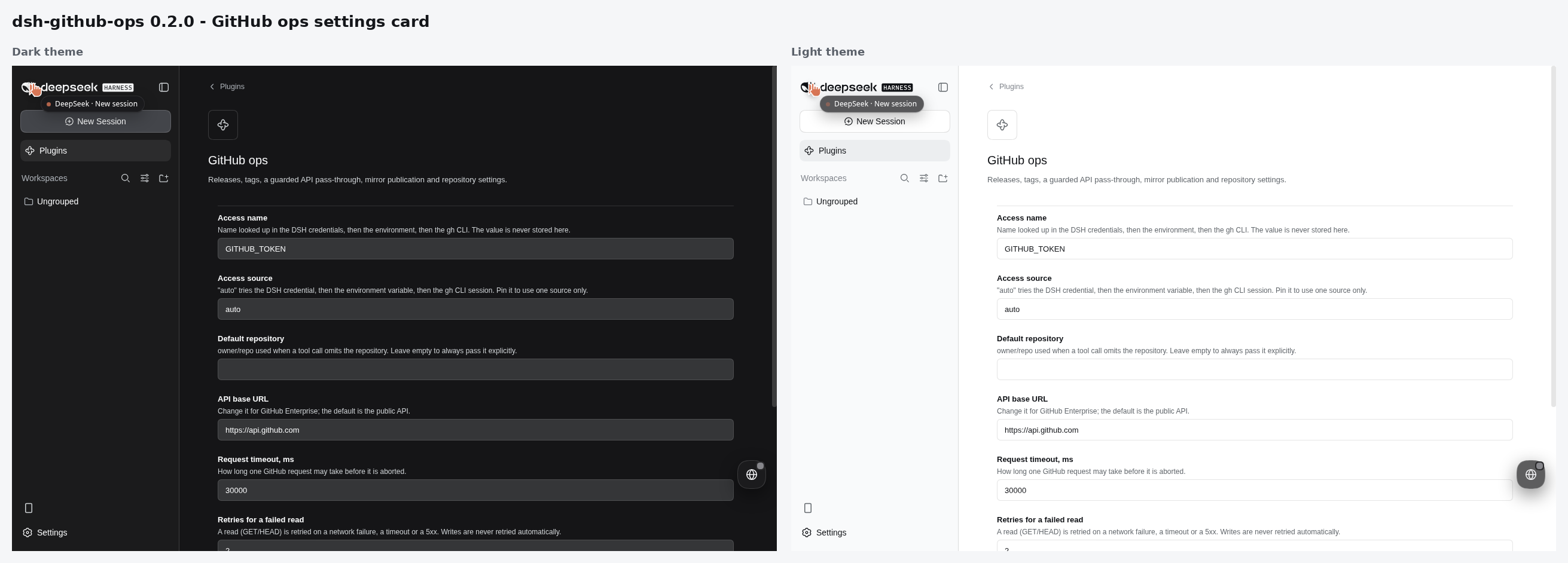
What the picture shows: the plugin card with its title and description, the credential-name and access-source fields with their hints, and the access block the card loads from the host route. Both frames come from the same candidate and the same data.
License
MIT — see LICENSE.
Plugins associés
dsh-web (dsh-git-graph)
zhu1090093659/dsh-web
dsh-web-ui (dsh-git-graph)
zhu1090093659/dsh-web-ui
codex-guard (dsh)
akimiya-z/codex-guard
dsh-file-review
left0ver/dsh-file-review