dsh-sseye
jhuanxx44/dsh-sseye
Console de débogage LLM pour DeepSeek Harness : capture tout le contenu de chaque appel de modèle à la cascade llm/stream (options, chunks de stream, usage, protocole filaire) et l'affiche dans un panneau ancré façon DevTools, avec diffing de contexte à préfixe partagé, reconstruction JSON filaire, export JSON et politique de capture réglable à l'exécution.
Installer
dsh plugin --profile web add github:jhuanxx44/dsh-sseyeREADME
dsh-sseye
The LLM debug console inside DeepSeek Harness — capture every model call, see everything.
English | 简体中文
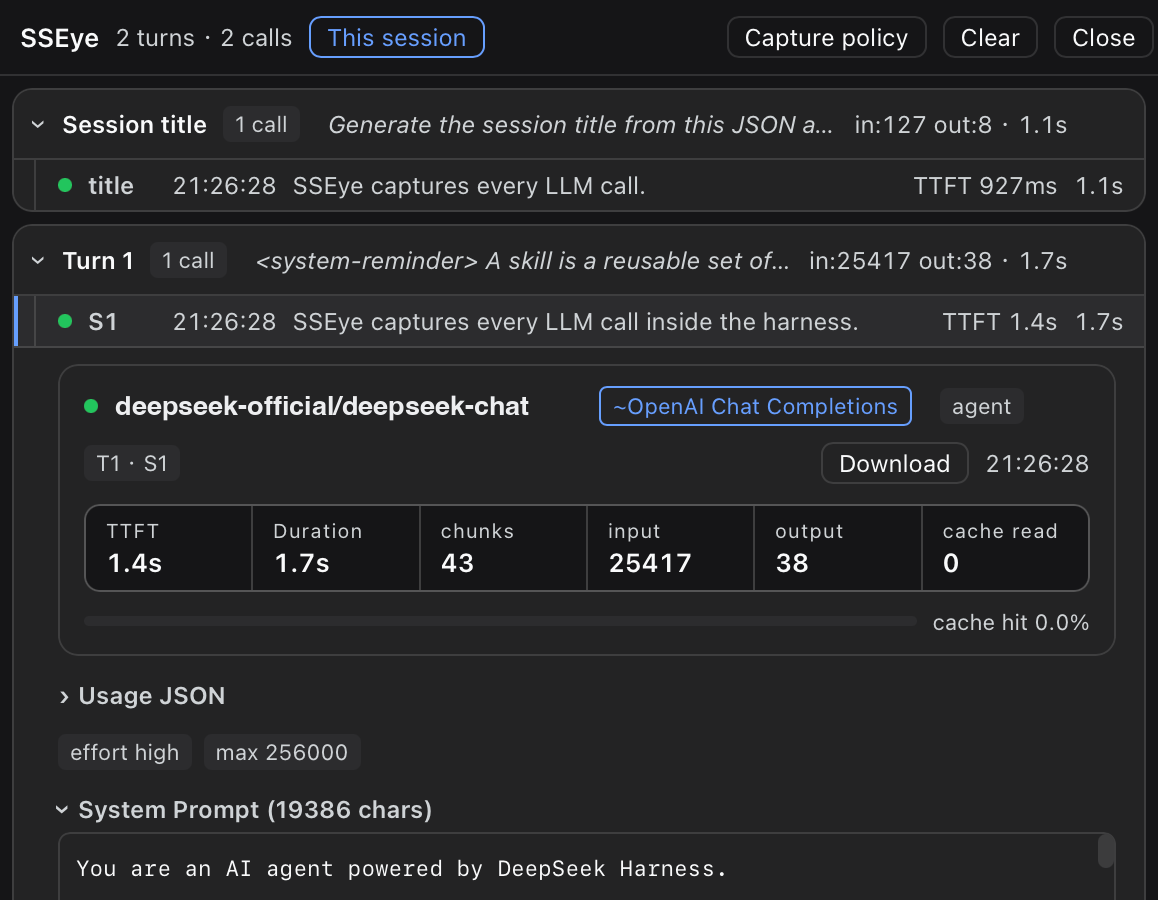
dsh-sseye is a DSH plugin that taps the harness-native llm/stream waterfall to capture the full content of every LLM call — complete messages, system prompt, tool schemas, streaming response blocks, usage, the real wire protocol and endpoint — and presents it in a DevTools-style viewer docked inside the harness. No proxy, no certificates, no extra setup, and full agent semantics: every capture carries turn / step / session / compaction attribution.
It is the harness-internal sibling of SSEye — same diagnostic philosophy, different observation layer.
Installation
From npm (prebuilt — no build-approval step):
dsh plugin --profile web add dsh-sseye
Or straight from the source repo:
dsh plugin --profile web add github:jhuanxx44/dsh-sseye
Restart the harness; the SSEye button appears in the session header. (Git-hosted installs build via the package's prepare script; allow the build key pnpm prints if it blocks, then re-run. Pre-built lib/ is committed, so a blocked build is harmless.)
Uninstall:
dsh plugin --profile web remove dsh-sseye
Configuration
The UI is English by default. To switch the panel (and the truncation
markers embedded in captured content) to Chinese, override the plugin row's
config in your profile's patch layer — ~/.dsh/profiles/<profile>/cordis.patch.yml:
- id: sseye
  config:
    locale: zh-CN
Restart the harness after editing. Any value starting with zh selects
Chinese; everything else (or no config) is English.
What you get
Capture — full content, zero intrusion
- Every call's complete
GenerateOptions(system prompt, messages, tools, sampling params) plus every stream chunk of the response — captured at thellm/streamwaterfall and tapped through unchanged: chunk identity, ordering, backpressure, cancellation and thrown errors are preserved. - Agent semantics for free: calls correlate with
agent/requestturn/step coordinates (sharedAbortSignalidentity) and are classified by source — agent loop / compaction / session-title / other. - The real wire protocol and endpoint (
openai-completions,anthropic-messages,google-generative-ai, …) resolved from the provider's settings profile; routes without a declared protocol fall back to a guess table, clearly marked with~. - Timing and cost signals: TTFT, total duration, chunk count, usage including cache-read tokens, finish reason, errors.
- Image content is dropped at capture (placeholder kept); everything else is captured whole.
Viewer — DevTools-style, docked in the harness
- Turn-grouped list: the consecutive calls of one turn group under a header aggregating call count, in/out tokens and total duration; compaction / title / other sources group separately. Collapsible.
- Step rows with status dot, step number, content preview, TTFT / duration / usage — metrics progressively hide as the column narrows (container queries), so content always wins.
- Inline accordion detail: click a row and the full detail expands right below it — one scroll flow, no second pane.
- Detail view: hero with provider/model, protocol chip, endpoint, stats grid and a cache-hit ratio bar; system prompt; messages; tool names; response blocks (text / reasoning / tool-call args); finish reason.
- Context diffing, first degree: each call's messages are compared with the previous call of the same session — the shared prefix collapses behind one click, and only the newly-added messages render highlighted.
- Wire JSON reconstruction mirroring the DeepSeek adapter's serialization: tool results expand to standalone
role:"tool"messages, reasoning replays asreasoning_contenton tool-call turns, reasoning effort resolves to thethinkingobject. - Copy buttons on every block; syntax-colored JSON trees with in-place expansion for large arrays/objects.
- JSON export: per call (row hover / hero button) or per turn group (bundle); versioned, self-describing payload.
- Live streaming view: while a call is running, only the settling fields are polled and merged into the open detail; the loop backs off when idle and pauses completely while the panel is closed or the tab is hidden.
- 本会话 / 全部 session filter; one-click clear.
- i18n: English UI by default; Chinese via
config.locale(see above).
The panel is a tab in the shell's right column. Since DSH 0.1.5-rc that column is a tabbed dock (dsh-client-ui-sidebar-right), so SSEye registers a tab type plus a body and opens it with ctx.sidebarRight.openTab('sseye'); the shell draws the strip, divider, collapse rail, and float/dock controls around it. A stock install opens the column at 45% of the frame (drag ceiling 70%); that width belongs to the shell and is shared by every occupant, so this repo narrows the default with a one-line harness patch — docs/harness-patches.md §1.
Capture policy — runtime-tunable
- Source toggles (agent / compaction / session-title / other) and field toggles (system / messages / tools / reasoning / answer text / tool args). Omissions are marked honestly in the record (
N messages, not captured), never silently blank. - Redaction: a regex list, precompiled per policy change, applied before anything enters the buffer (
sk-…→***). - Capacity: ring-buffer size (default 100, max 5000), request-field truncation, response-block truncation — clamped to sane bounds; shrinking the buffer trims the oldest records immediately.
- Defaults are full capture. The policy panel sits collapsed at the top of the viewer, never in the way.
Privacy posture
Full visibility, zero persistence by default. Captures live in a bounded in-memory ring buffer; process exit burns them. Export happens only on explicit user action. The llm/stream layer never sees API keys — they live inside the adapters — and redaction applies before buffering.
Roadmap
Observation is the base; the differentiators come next:
- Replay & Mutate — clone a captured request, edit it, re-issue it through
ctx.llm.stream(), compare responses side by side. - Semantic diffs between consecutive calls, beyond the shared prefix.
- Token anatomy — per-message context-cost breakdown.
- Cross-subagent fan-out aggregation; route (provider/model) filters.
Relationship to SSEye
| SSEye | dsh-sseye | |
|---|---|---|
| Observation point | Network (mitmproxy) | Inside the harness (llm/stream waterfall) |
| Sees | Any SDK / app on the machine | The DSH process only, but with full agent semantics |
| Setup cost | Proxy + CA trust | One plugin install |
Development
pnpm install
pnpm build        # tsdown → lib/
pnpm test         # node --test
├── src/
│   ├── index.ts          # Host half: llm/stream capture, ring buffer, /__sseye/* HTTP routes
│   └── client/           # Client half: session-header trigger + right-column tab body (React)
├── lib/                  # committed build artifacts (rebuilt by `prepare` on git installs)
├── docs/                 # platform field notes + local harness patches
├── cordis.patch.yml      # bundle patch: inserts the `sseye` plugin row into the profile
└── tsdown.config.ts      # client bundle contract
Host ↔ Client transport is same-origin HTTP on the webServer service (/__sseye/*). See AGENTS.md for the behavior contract and architecture invariants, and docs/prototype-field-notes.md for DSH platform field notes.
Local install from a checkout: dsh plugin --profile web add .. Releases are tag-triggered: bump version → commit → tag v* → push the tag.
License
MIT
Plugins associés
deepseek-harness
deepseek-ai/deepseek-harness
dsh-web (dsh-plugin-manager)
zhu1090093659/dsh-web
dsh-web
zhu1090093659/dsh-web
dsh-web-ui (dsh-plugin-manager)
zhu1090093659/dsh-web-ui