DSH-PDR-Plugin
kipozannaki/dsh-pdr-plugin
Runtime plugin firewall for sessions started through its launcher (the DSH Desktop app cannot be injected and is not covered): filesystem, network and subprocess calls plugins make are attributed to the plugin that made them and judged against what that plugin declares, so a plugin doing its declared job stays silent and leaving it is recorded. Attribution is best-effort, not a guarantee - uncovered calls fall back to host, never to another plugin. Also adds a pre-install health card (capability surface, red-line combinations, PASS/WARN/BLOCK), boundary judging, opt-in pre-execution blocking with a credential-exfil rule, update diff with a trial install in an isolated child process, SARIF/CSV audit export, and multi-source aggregation. Local-only storage, no telemetry; the optional webhook is off by default.
Installer
dsh plugin --profile web add github:kipozannaki/dsh-pdr-pluginREADME
DSH-PDR
Plugin Detection and Response for DeepSeek Harness.


English · 中文
Every plugin you install runs with the same privileges as the host: it can read your credentials, open sockets, and spawn processes. Reviewing its source answers what it could do — and only until the next update.
DSH-PDR answers a different question: what did it actually do?
When the host is started through its launcher, it observes the running process, attributes the
fs / network / subprocess calls plugins make to the plugin that made them, judges those calls
against what the plugin claims to need, and shows you the result. Everything stays on your
machine. Attribution is best-effort, not a guarantee — see Limitations.
- 🔍 Pre-install health card — static capability surface, red-line combinations, PASS / WARN / BLOCK
- 👁 Runtime firewall — per-plugin timeline of filesystem, network and subprocess activity
- ⚖️ Boundary judge — declared contract × path class × behaviour baseline, graded normal / observe / suspicious / boundary
- 🛑 Block mode (opt-in) — stops a declared-violating call before it executes;
credential-exfilcatches a credential read followed by egress in the same breath - 🔄 Update guard — capability / red-line / dependency diff, plus a trial install in an isolated child process (temp
DSH_HOME, hardened timeout — a separate process, not a sandbox) - 📄 Audit export — JSON, Markdown, SARIF 2.1.0, CSV; generated offline from the event log, no host required
- 🔔 Webhook alerts (off by default) — red-line events only, deduplicated and rate-limited; supports
json, Slack and DingTalk payload formats - 📊 Multi-source aggregation — merge event logs from several profiles or machines, with cross-source dedup and per-event provenance
- 🔒 Local-first — no telemetry, ever
Install
# 1. install into a profile
dsh plugin --profile <profile> add file:/path/to/dsh-pdr-plugin
#    or, directly from this repository:
dsh plugin --profile <profile> add github:kipozannaki/DSH-PDR-Plugin

# 2. start the host through the launcher (not `dsh` directly — see below)
dsh-pdr --profile <profile> web

# 3. confirm the preload is in place
dsh-pdr --pdr-check
Requirements: Node ≥ 22.12 (for require(esm)), DSH ≥ 0.1.7, pnpm (used by
dsh plugin add).
Why the launcher? A DSH host formalises several
node:*ESM facades very early, so a probe installed from inside a plugin misses a large slice of calls. Measured on one real session:earlyInstallalone attributed 0 of 3 target-plugin calls (926 events, all fell back tohost); adding the preload attributed 3 of 3 (5 192 events). The preload is a requirement, not an optimisation —docs/DESIGN.md.Where the launcher comes from, and where it works.
dsh plugin addlinks the package'sbininto<profile>/node_modules/.bin/, so after installing you can call it asnpx dsh-pdr …from that profile's context, ornode <profile>/node_modules/dsh-pdr-plugin/bin/dsh-pdr.cjs …directly — either way it setsNODE_OPTIONS=--require …/preload.cjsand forwards everything else todsh. The DSH Desktop app does not go through a shell, so the launcher cannot inject into it; for Desktop, attribute nothing rather than assume this plugin is watching — the health card and the offlineaudit/aggregatecommands still work, and a--import-based hook (host-level, no launcher) is the tracked next step (#1).
Nothing installed? The UI runs on demo data:
node src/client/serve.js # http://127.0.0.1:3123/firewall/
What it does
| Stage | Capability | Where |
|---|---|---|
| Before install | Health card: capability surface, red-line combinations, PASS / WARN / BLOCK | src/inspector/ |
| Before install | Trust score: weighted, auditable formula (red lines −30 each, credential access −5, network −3, subprocess −2) → bands 良好 / 注意 / 谨慎 / 高危 | src/inspector/trust-score.js |
| Runtime | Behaviour probe: network / fs / subprocess, attributed per plugin | src/probe/ |
| Runtime | Red-line alerts: credentials+network, credentials+subprocess, cleartext egress | src/probe/ |
| Runtime | Boundary judge: contract × path class × baseline → normal / observe / suspicious / boundary | src/judge/ |
| Runtime | Contract inference: observe a cold start → draft → human confirmation; an inference never launders an observed red line | src/judge/infer.js |
| Runtime | Block mode: pre-execution check, violation stopped in place (opt-in; alarm is the default) | src/guard/ |
| On change | Snapshot & rollback of the profile manifest trio (package.json, pnpm-lock.yaml, cordis.patch.yml) | src/store/snapshot.js |
| On change | Update guard: capability diff + trial install in an isolated child process | src/update/ |
| Overview | Security-centre UI: plugin list, trust score, red-line banner, filterable timeline | src/client/ |
| Overview | Audit report, SARIF 2.1.0 / CSV compliance export, multi-source aggregation | src/report/ |
| Overview | Red-line webhook push — off by default, deduped, rate-limited, never self-recording | src/alert/ |
Screenshot
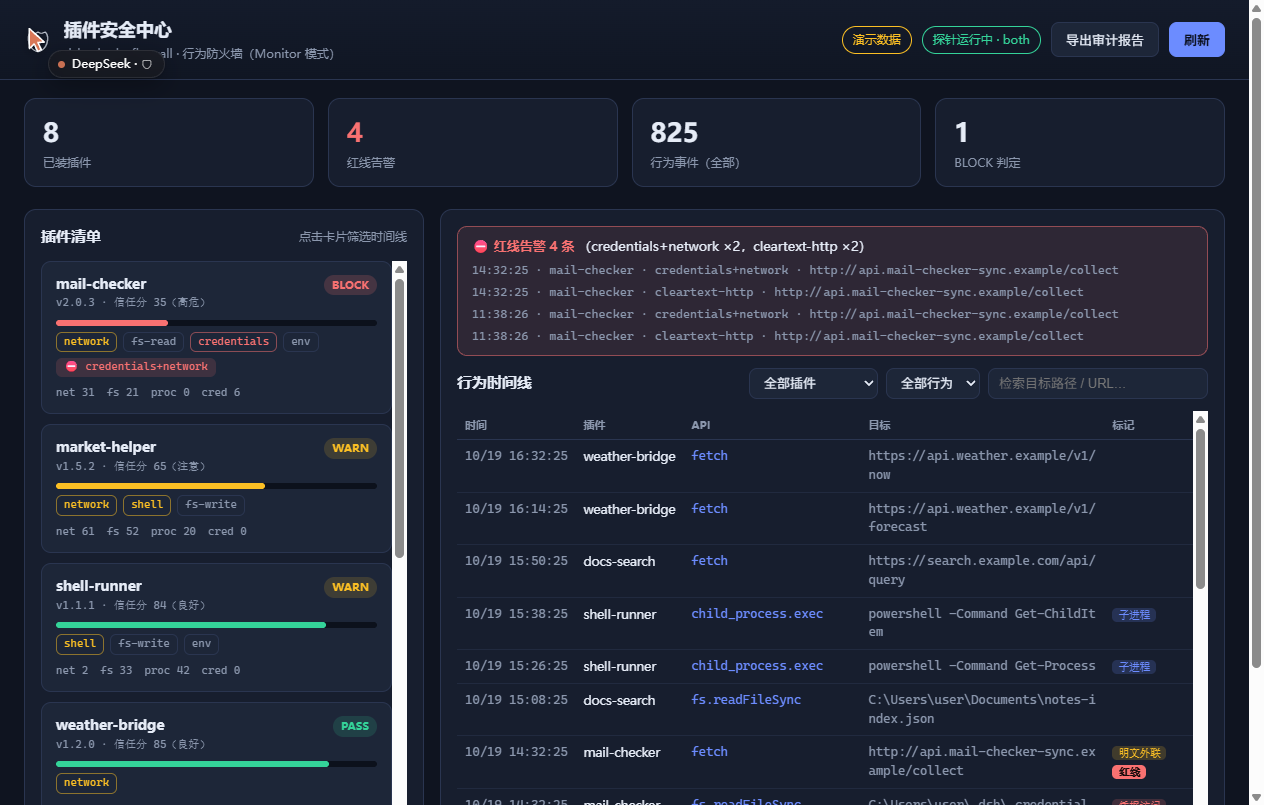
node src/client/serve.js                     # demo data
node src/client/serve.js --jsonl <path>      # replay a real probe log ($DSH_HOME/firewall/events.jsonl)
Plain index.html + app.js + style.css — no framework, no build step. The standalone server and
the in-host mount share one route table (src/client/api-handlers.mjs), so the preview behaves
exactly like the mounted panel.
How it works
config materialises ── earlyInstall expression installs the probe
        │
preload ────────────── dsh-pdr sets NODE_OPTIONS=--require …/preload.cjs  ← beats ESM facades
        │
probe ──────────────── layer 1 property patch + layer 2 binding patch
        │             attribution: ALS → stack walk → 'host'
judge / guard ──────── contract × path class × baseline → allow / alarm / block
        │
store / report ─────── JSONL on disk, audit export, optional webhook
The probe wraps RegistryService.prototype.plugin before any plugin is instantiated, so plugin
entry points run inside an AsyncLocalStorage context and the calls they start are attributed —
including calls made through injected host services. This is the cheap path: measured on a real
session (~5 600 hooks), stack-based attribution costs ≈ 1.9 % of wall clock against ALS's
≈ 0.05 % (per-op: 114 µs vs 2.9 µs), so als is the default. What als does not cover —
calls that never cross a wrapped entry point, the named-import gaps listed under
Limitations — falls back to host rather than being silently misattributed.
Full architecture, hook-coverage matrix and the honest list of residual gaps:
docs/DESIGN.md.
Configuration
# the profile's cordis.patch.yml
- id: dsh-pdr-plugin
  config:
    dataDir: ~/.dsh/firewall     # default
    probeMode: als               # als (default) | stack (slower) | both
    maxBytes: 8388608            # rotate events.jsonl at 8 MB, keep 3
    policy:
      mode: alarm                # alarm (default) | block
      rules:
        credential-exfil: block
    alerts:
      enabled: false             # off: not one byte leaves the machine
      url: https://your-webhook.example/hook
      rules: []                  # empty = every red line
      format: json               # json | slack | dingtalk
Declaring a contract (optional, for plugin authors)
// package.json
"firewall": {
  "hosts": ["api.example.com"],     // declared destinations; going outside → scope violation
  "grants": ["global-credentials"]  // explicit authorisation for sensitive targets
}
A contract is declared freedom: staying inside it is silent, leaving it is recorded. When nothing is declared, the contract is derived from the health card's capability surface.
CLI
dsh-pdr web                        # = dsh web, with the preload
dsh-pdr headless "run tests"       # any dsh subcommand
dsh-pdr --pdr-check                # print which preload is in use

# offline export — no host, no hooks, just reads the JSONL
dsh-pdr audit --format md
dsh-pdr audit --format sarif --out audit.sarif
dsh-pdr audit --format csv   --out audit.csv
dsh-pdr audit --format json  --out audit.json

# multi-source aggregation (several profiles / machines / archives)
dsh-pdr aggregate --format md
dsh-pdr aggregate --source prod=/m1/.dsh/firewall --source dev=/m2/.dsh/firewall
aggregate reads rotated files too (events.jsonl.1/.2/.3), de-duplicates across sources and
reports the counts, and counts unparsable lines instead of dropping them silently. Measured on 4
files / 127 000 events: 1 252 duplicates found.
API
Other plugins can inject the firewall service:
const api = ctx.firewall;

api.getEvents({ actor: 'some-plugin', flag: 'credentials-access', limit: 100 });
api.getRedFlags();                 // red-line alerts
api.getSummary();                  // per-plugin counts + red lines + probe health
api.healthCard(pluginDir);         // static card: PASS / WARN / BLOCK
api.getVerdicts();                 // boundary verdicts + contracts
api.inferContracts();              // drafts from observed behaviour (never auto-applied)
api.adoptContract(name);           // confirm a draft
api.setPolicy({ rules: { 'credential-exfil': 'block' } });
api.getUpdateDiff(before, after);  // what changed in this update
api.trialInstall(pluginDir);       // isolated trial, crash/hang contained
api.getAuditReport();              // JSON report
api.getSarif(); api.getCsv();      // compliance formats
api.eventLogPath;                  // local JSONL — nothing is uploaded
Privacy
- Events, snapshots, contracts and health cards live in
$DSH_HOME/firewall/. No telemetry. - The only outbound path is a webhook you configure. It is off by default, sends red-line events only — never the full timeline, never file contents, never credentials. The audit report records only the webhook's origin (scheme + host), never the URL with any token in it.
- The plugin holds itself to its own standard: no credential access, no silent network. Its own capability surface, as scanned by its own health card, is part of the test suite.
Limitations
Stated plainly, because a security tool that overstates its coverage is worse than none:
- Heuristic, not a proof. A static scan cannot see credentials injected at runtime; that is what the runtime layer is for. On 154 real ecosystem plugins the static pass recalls 66.1 % at 17.2 % false positives. Being listed on a plugin marketplace is not a security review, and neither is this README: treat every plugin, including this one, as untrusted until observed.
- Not an adversarial sandbox. A plugin that deliberately targets the instrumentation
(native modules,
process.binding, patching the probe) can evade it. The goal is continuous, attributable visibility. - Attribution needs the launcher. Without
dsh-pdr(or another host-level preload), the in-plugin probe installs too late and attribution collapses — measured 0 of 3 on a real session with everything falling back tohost. The DSH Desktop app cannot be launched through the launcher, so its sessions are currently outside attribution; the health card and the offlineaudit/aggregatecommands are unaffected. A host-level--importhook is the tracked next step. - Known gaps — named imports of
child_process/http/netwhen the facade predates the probe.fsis covered on both hook layers. - The trial install is an isolated child process, not a sandbox. It gets a temp
DSH_HOME, a hard timeout and SIGKILL on hang, so a crashing or hung plugin cannot take the host down — but a plugin is still running with your user's privileges inside it. - In-host web mount is unverified. The
dsh-h3adapter follows a contract measured on a live community plugin and is covered by 11 injected-runtime assertions, butdsh-h3is a Typert virtual module that cannot be resolved offline. Until it is verified in a live host the panel falls back toserve.js. - upstream-radar integration is not done. We emit
dsh-pdr-compat/1; their schema is not public, so mapping it is still outstanding.
Development
npm test              # all 22 suites (PASS / SKIP / FAIL; any failure exits 1)
npm run test:list     # what would run
node test/smoke.mjs   # one suite
Suites that need a real environment (a real plugin, a profile, an external baseline) print
SKIP: <reason> and how to restore them, and exit 0. They never pretend to pass. Any failing
assertion exits 1.
What each suite covers: docs/TESTING.md.
Updating an installed copy
file: dependencies are copied into the profile, not symlinked — changing code or bumping the
version does not reach it, and add answers "Already up to date". Remove then add:
dsh plugin --profile <p> remove dsh-pdr-plugin
dsh plugin --profile <p> add file:/path/to/dsh-pdr-plugin
Documentation
| Document | Contents |
|---|---|
docs/DESIGN.md | architecture, attribution, hook coverage, residual gaps |
docs/TESTING.md | every suite, what it asserts, environment variables |
docs/LESSONS.md | findings that changed the implementation |
CHANGELOG.md | what changed, when |
Listing metadata
For plugin marketplaces: screenshots are declared in
screenshots.json and shipped in assets/. The package publishes no
postinstall / prepare script, so a source install never needs a pnpm build approval.
License
MIT — see LICENSE.
Plugins associés
dsh-infinite-gen-4
minglink/dsh-infinite-gen-4
dsh-purge
mmparko/dsh-purge
cc-safety-net
kenryu42/cc-safety-net
api-relay-audit
toby-bridges/api-relay-audit