dsh-subagent-profile
muzylink/dsh-subagent-profile
Dépêche des subagents avec des profils nommés (modèle, effort de raisonnement et périmètre d’outils par tâche), contrôles de sécurité, estimation des coûts avec comparaison des économies, et un registre complet des décisions de dispatch.
Installer
dsh plugin --profile web add github:muzylink/dsh-subagent-profileREADME
dsh-subagent-profile




For DeepSeek Harness (DSH).
Dispatch subagents in DeepSeek Harness: pick model, reasoning effort, and tool scope per task; save common combos as named profiles for reuse. Built-in safety checks, cost estimation with savings analysis, and a full decision ledger.
Why this plugin
Built-in subagent | dsh-subagent-profile | |
|---|---|---|
| Per-subtask model / preset | ✅ optional provider / model / reasoning_effort (after enabling model selection) | ✅ one profile bundles preset + model + effort + tool scope + budget; overridable per call |
| Reusable named setups | ❌ | ✅ profiles |
| Tool-scope narrowing | ❌ | ✅ whitelist ∩ parent, run_code always removed |
| Safety checks | ❌ | ✅ whitelist / cost / intersection / approval / budget, all recorded |
| Cost visibility | ❌ | ✅ per-dispatch estimate + savings comparison |
| Decision ledger | ❌ | ✅ full trace: request vs. effective, checks, execution, settlement |
| GUI management | ❌ | ✅ settings page + per-session ledger tab |
| Performance-based suggestions | ❌ | ✅ confirm to apply, undo anytime |
| Official model-selection interplay | ✅ enforced natively once enabled | ✅ dispatch follows the same whitelist (out-of-range routes are rejected) |
Installation
dsh plugin --profile web add dsh-subagent-profile        # published package
dsh plugin --profile web add ./dsh-subagent-profile      # from a local checkout
Restart dsh web. This is a standard bundle plugin: it provides the dispatch tool, the profile provider, the subagent-profiles service, the /subagent-profiles/* loopback management routes, the settings page (「子 Agent 方案」), the per-session ledger tab, and the dispatch tool-call card in the web GUI. On startup it also self-installs an agent preset — orchestrator-v2 (「编排者模式 V2」) — pick it in the new-session preset picker. The sync is idempotent and re-runs on every startup, so upgrading the plugin updates the preset.
Usage
1. Configure sub-agent profiles
Profiles are managed in the settings page — each one bundles preset + model + reasoning effort + tool scope (and optionally a persona), and can be enabled, disabled, edited, or reset individually. Two built-ins ship:
| Profile | Purpose |
|---|---|
swap-standard | switch the child to the full standard coding toolkit |
researcher | deep reasoning off, search-only tools |
Profiles live in ~/.dsh/subagent-profiles.json and take effect immediately (edits are made from the settings page).
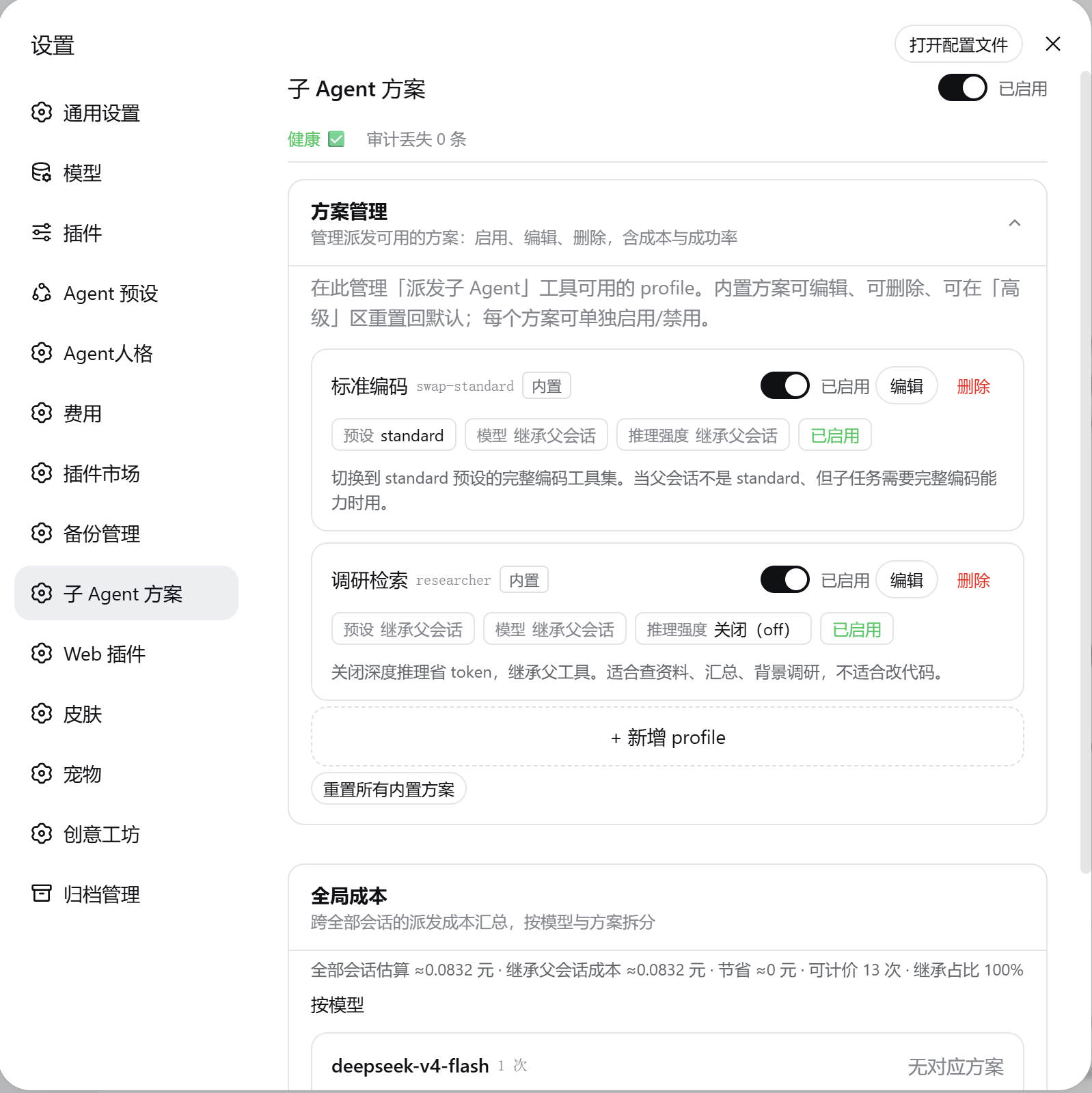
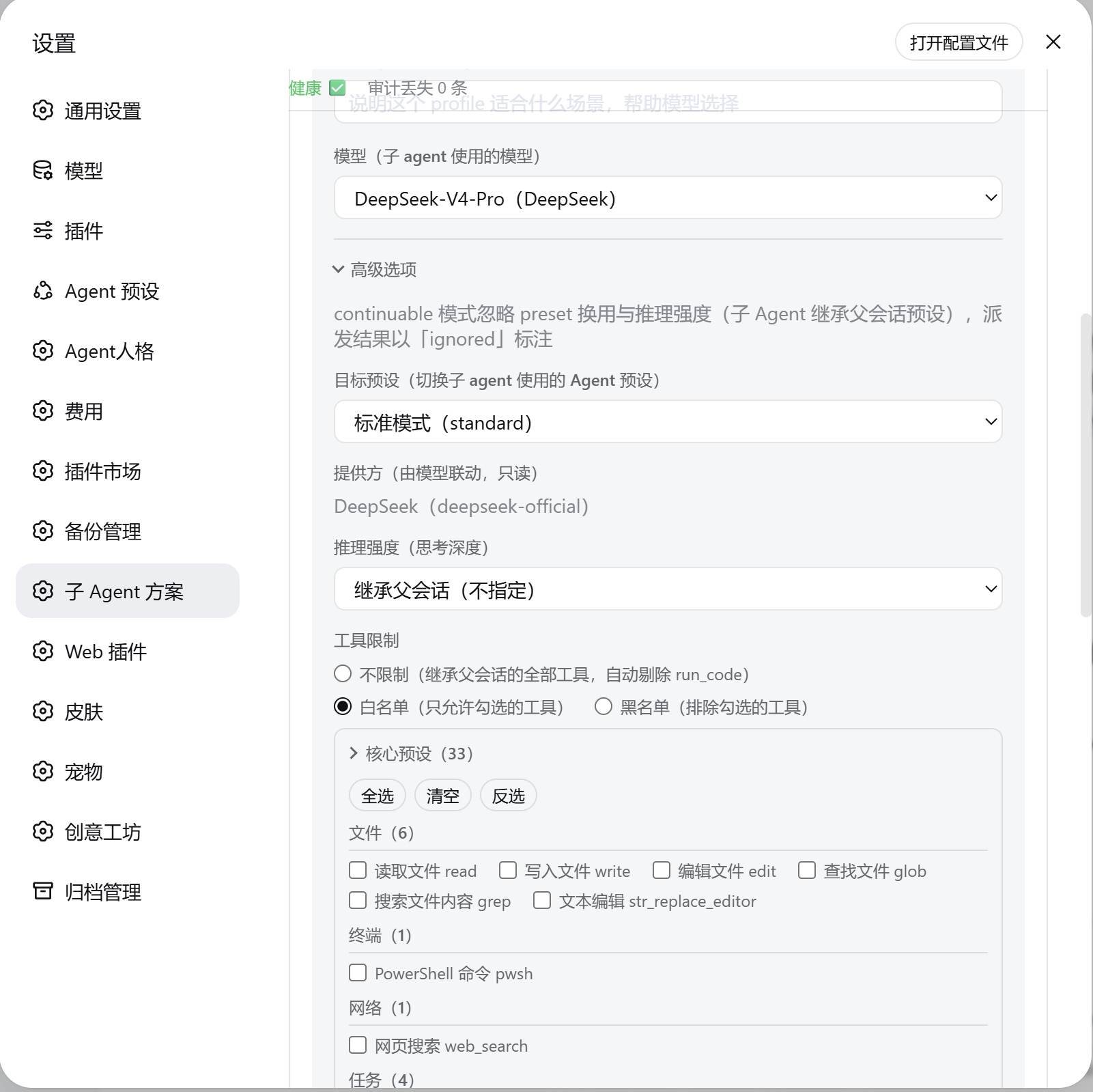
2. Dispatch per subtask — the dispatch tool
dispatch(
  profile: "researcher",        // preset + model + reasoning effort + tool scope
  prompt: "Survey the DSH plugin ecosystem and compare direct competitors",
  run_in_background: true
)
3. Review in the decision ledger
Every session has a ledger tab that records each dispatch decision: what the parent saw and requested, what actually took effect (with ignored-request highlights), which tools were removed and why, how execution went (including stalls and parent interventions), and what it cost. Safety-check failures are surfaced with fix directions.
Safety model
Delegation never lets a subagent gain more power than you already have — this is the default, with no configuration:
- Tools only shrink. A child's tool set is the intersection of the profile's tools and the parent's tools, and
run_codeis always removed. - Approval is never bypassed. Delegation does not waive the host's approval requirements; operations that need approval are rejected automatically.
- Cost is capped. Model, reasoning effort, tokens, and recursion depth are all bounded; out-of-range values fail loudly instead of silently downgrading.
- An escape hatch, explicitly. Non-official presets can be allowed per-preset (default off, each allowance audited).
Observability & notifications
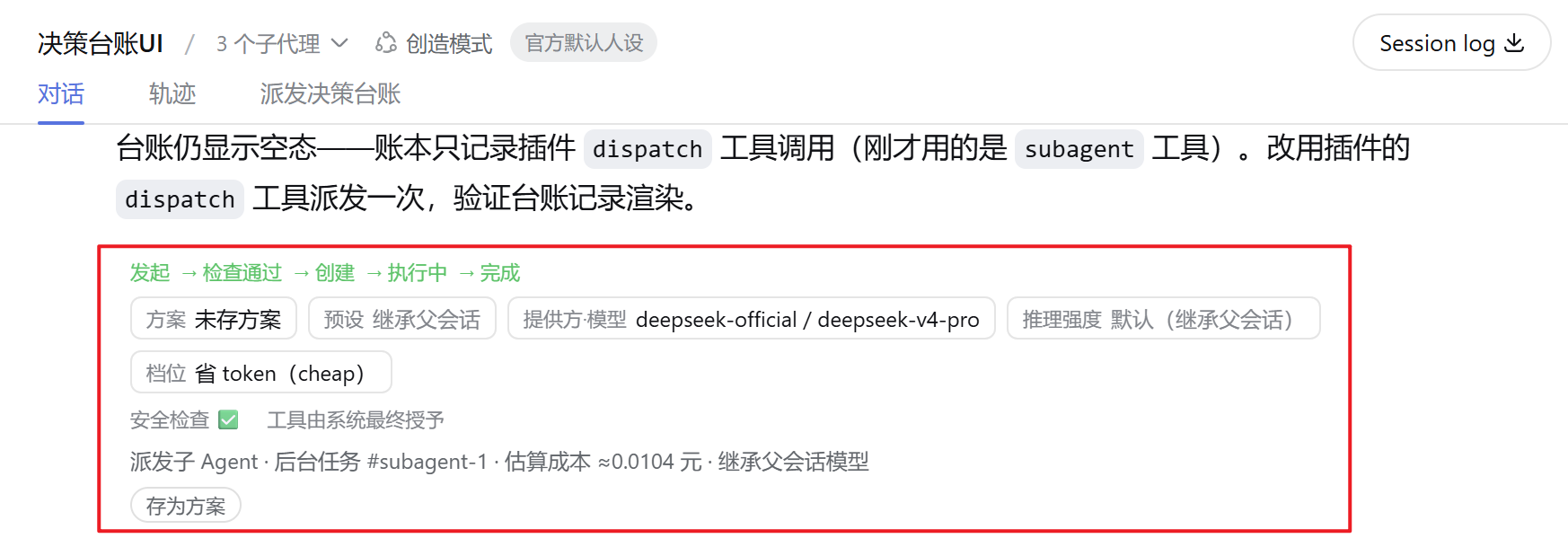
- Live status. Background dispatches show live phase badges (start / gate / create / running / settled), driven by host job events with polling fallback.
- Reminder center. Urgent events (escape-hatch allowances, audit degradation, budget anomalies) raise a persistent badge; the notification center keeps every reminder with full context — parent session, child session, task summary, and outcome — plus one-click jumps to the related sessions. Normal orchestration events (e.g. a parent not adopting a child's result) are recorded in the audit ledger without interrupting you.
- Dispatch suggestions. Based on historical dispatch statistics, the plugin can inject read-only optimization hints for the parent agent (e.g. "this profile has a low recent success rate, consider switching") — hints only, nothing is changed automatically.
- Subagent header badge. Child sessions show a compact summary badge (e.g.
继承父会话 · 前台— "inherits the parent session, foreground"); hover for the full detail (model / effort / preset / mode / origin).
Data
~/.dsh/subagent-profiles.json— the profile registry (edited from the settings page).~/.dsh/subagent-profiles.state.json— the plugin's enable/disable switch (default enabled).~/.dsh/subagent-profiles.failed-traces.json— the failure ledger (dispatch failure traces).~/.dsh/subagent-evolution/— the decision ledger and statistics:dispatch.jsonl— per-dispatch decision records (no prompt content).summaries.json— aggregated per-profile statistics (versioned, rebuilt on corruption).adopted-state.json— adoption verdict state for child results (cross-restart).reminders.json— reminder store (one reminder = one audit record).
~/.dsh/.agent-presets/orchestrator-v2/— the self-installedorchestrator-v2agent preset (synced from the bundledpresets/orchestrator-v2/on every startup).
DSH_HOME is respected and defaults to ~/.dsh. Uninstalling the plugin removes the data files above and the self-installed orchestrator-v2 preset directory (other plugins' presets are left untouched); re-installing or re-launching re-syncs the preset and regenerates the data files.
Known limitations
- Background dispatch requires
@deepseek-ai/dsh-jobsand@deepseek-ai/dsh-tool-jobsto be loaded; otherwise it fails with "dispatch: 后台派发不可用:缺少 jobs 服务". - Continuable mode goes through the DSH standard composition path, so the
presetswap andreasoningEffortare ignored (the child inherits the parent preset at the default reasoning effort). - Continuable follow-ups are delivered through the official
send_messagechannel (the plugin drives the child via the official child handle). - Official model selection is a web-line feature: the session policy for the built-in subagent tools ships with the web app and is not available in headless deployments. In production it is off by default and must be enabled before it takes effect.
- Who decides the child's final tool set depends on the mode:
- Continuable: narrowed by this plugin up front — the child's
allow= (parent tool set −run_code−deny) ∩allow. Assumption: continuable inherits the parent preset, so the child's tool set ≈ the parent's; if dsh's behavior changes so the two differ (e.g. a future preset swap composing a different tool set), tool narrowing fails with a hard error (conservatively safe — never silently granting more), to be replaced with a true parent ∩ child intersection once dsh provides an official seam. - One-shot: decided by dsh; the plugin cannot read the final restricted result and the card reports "tools are finally granted by the system".
- Continuable: narrowed by this plugin up front — the child's
- Cost figures are estimates: computed from an average per-dispatch price (measured once per model); fine-grained per-token pricing is on the roadmap. The UI labels estimates as such and shows a note when the sample size is small.
Repository structure
dsh-subagent-profile/
├── index.mjs          # plugin entry: dispatch tool, profile provider, services, HTTP routes
├── lib/
│   ├── client.js      # browser side: settings page, per-session ledger, dispatch tool-call card
│   └── core/          # host-side modules by domain: gates, ledger, evolution, profiles, query, sync
├── presets/           # bundled agent presets (e.g. orchestrator-v2)
├── test/              # node:test suite (pure and junction tiers)
└── docs/              # screenshots
Contributing
Found a bug or have an idea? Open an issue or submit a pull request — all contributions are welcome.
If this plugin has been useful to you, please give it a ⭐ on GitHub — it helps others find it.
Credits
The bundled orchestrator-v2 agent preset was inspired by dsh-liangshen (梁神模式) from dsh-web-ui, licensed under Apache-2.0. Thanks to its author for the great work.
License
MIT — Copyright (c) 2026 muzyLink
Plugins associés
ouroboros (dsh-plugin)
q00/ouroboros
loopx (dsh-loopx-plugin)
huangruiteng/loopx
dashi-taskboard (deepseek-harness)
chuspeeism/dashi-taskboard
dsh-agent-teams
nanmicoder/dsh-agent-teams