dsh-open-obsidian
noobnoob163/dsh-open-obsidian
Opens the Obsidian vault a DSH session is working in, on the first human message — so your sync plugin (Nutstore sync, Obsidian Sync, Obsidian Git, …) starts running and the files the agent edits actually get synced. Skips a vault that is already open, and opens a new window behind the current one instead of stealing focus. Windows only.
Installer
dsh plugin --profile web add github:noobnoob163/dsh-open-obsidianREADME
dsh-open-obsidian
这是一个给 DeepSeek Harness(简称 DSH)用的插件,不是 Obsidian 插件。 装进 Obsidian 里没有任何作用,Obsidian 也不会加载它。
English speakers: jump to the English version.
它做什么
两件事,都是为了同一个目的:让 AI 写进库里的东西真的落盘、真的同步出去。
一、库会被自动打开。 当一个 DSH 会话的工作目录位于某个 Obsidian 库文件夹内时,你在那个会话里 发出第一条消息的那一刻,插件会帮你在 Obsidian 里打开这个库。因为同步插件(坚果云同步、 Obsidian Sync、Git 插件)只有在 Obsidian 开着的时候才会跑。
这是它解决的实际问题:AI 在库里写了东西,可 Obsidian 没开着,同步就不会跑——等到 你哪天自己打开 Obsidian,改动才姗姗来迟。现在库会在对话开始时就打开,同步从那一刻起就在走。
它尽可能不打扰你:
- 库已经开着 → 什么都不做(不新开窗口,也不抢焦点);
- Obsidian 已经在运行 → 新窗口压到后面,焦点立刻还给你;
- Obsidian 没在运行 → 正常启动(这时候窗口弹出来正是你要的)。
二、同一个库同一时刻只让一个对话写。 两个对话同时往一个库里写,同步客户端会把两边的改动 拼在一起,结果是同一段话出现两遍、两个标题粘成一个。插件为此加了一把写锁:别的对话想写时, 那一次写入会被真正拦下(工具不执行、一个字节不写),等前一个写完才放行。详见下面 写锁。
全程在 DSH 进程内完成、不经过模型:零 token、零轮询。
这个插件的设置面板是中文界面(本来就是给中文用户做的),所以这份说明也以中文为主。
关于作者:本插件的作者没有编程背景,代码是在 DSH 的 AI 助手协助下完成的。
运行要求
| 系统 | 仅支持 Windows。 它依赖 Windows 的进程/窗口接口、%APPDATA%\obsidian 注册表,以及 Obsidian 注册的 URL 协议;在 macOS / Linux 上无法工作。 |
| DSH | 需要暴露了本插件所用内部接口的 DSH 版本(见下面「已知限制」)。写锁还要求宿主提供 tools/pre-execute 钩子。 |
| Obsidian | 桌面版 1.x。开发与实测用的是 1.14.4。 |
安装
一条命令装好(--profile 是必填的,填你实际在用的 profile 名,默认是 desktop):
dsh plugin --profile desktop add github:NOOBnoob163/dsh-open-obsidian
dsh命令不在 PATH 里时,先在应用标题栏的 应用 菜单点 管理 dsh 命令… → 安装。 它只是在桌面创建一个指向 DSH 自带命令行的小快捷方式,不会安装别的东西。
本包声明了 dsh.bundle,所以 DSH 装完会自动启用它,不需要手工改任何配置。
装好后冷启动一次 DSH(刷新页面不够),然后到 设置 → Obsidian 助手 里勾选你要管的库。
也可以手工装(不进 bundle 机制)
把仓库放进 profile 的插件目录:
# 如果你用的不是默认的 "desktop" profile,把 <profile> 换成你自己的
git clone https://github.com/NOOBnoob163/dsh-open-obsidian.git \
  "%USERPROFILE%\.dsh\profiles\<profile>\plugins\dsh-open-obsidian"
然后二选一:
-
走标准方式:把
dsh-open-obsidian加进 profilepackage.json的dsh.profile.bundles列表,由它自带的cordis.patch.yml负责挂载;或者 -
手工挂载:在
%USERPROFILE%\.dsh\profiles\<profile>\cordis.patch.yml里加一段:# Obsidian 助手(本地插件 plugins/dsh-open-obsidian) - insert: - id: obsidian-launch name: 'dsh-open-obsidian'(
config段可以省略——实际设置存在%USERPROFILE%\.dsh\storages\dsh-open-obsidian.json,面板上改的就是它。)
配置
打开 设置 → Obsidian 助手,勾选你想让它管的库。 一个都不勾 = 完全不触发。
长这样
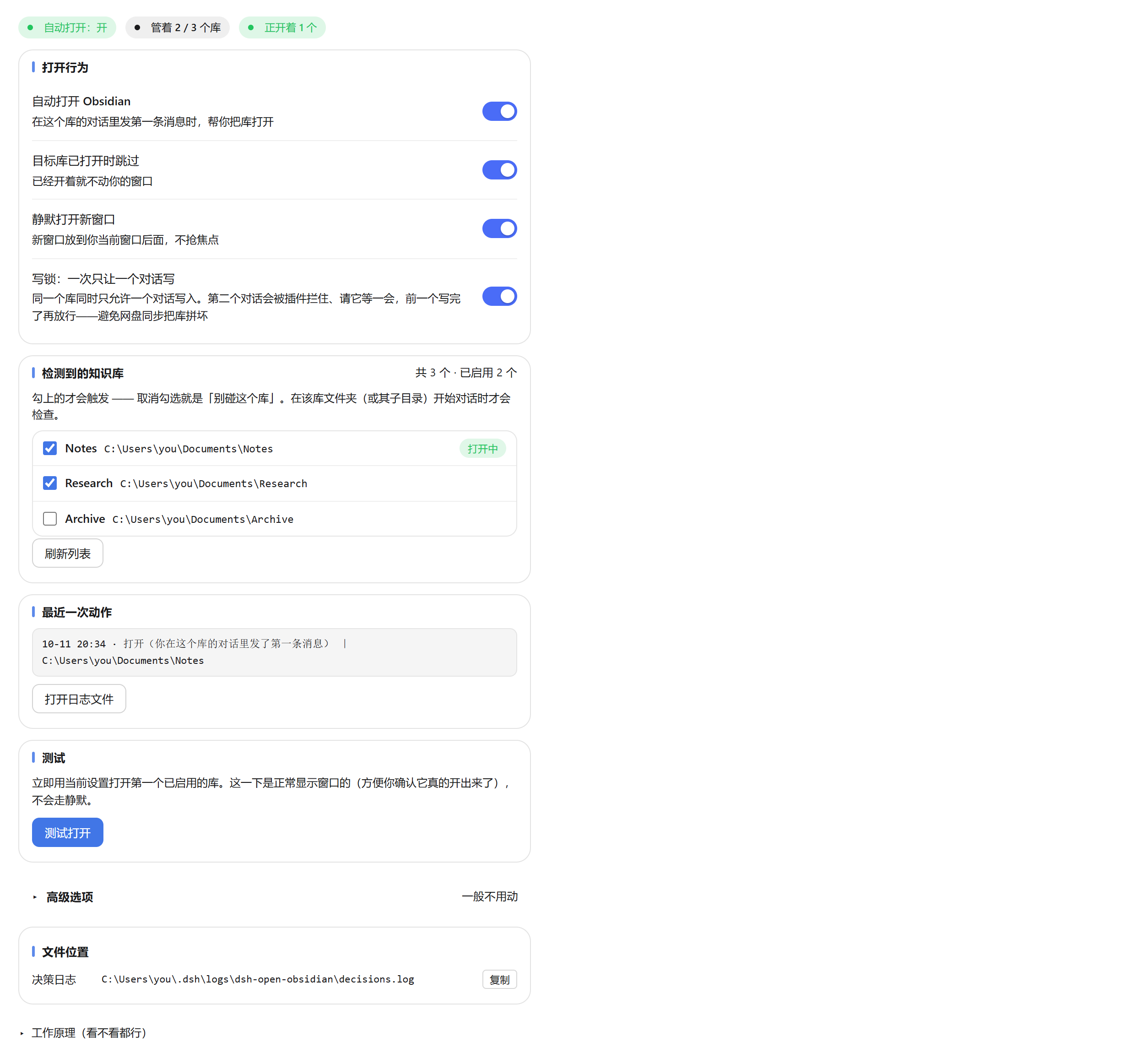
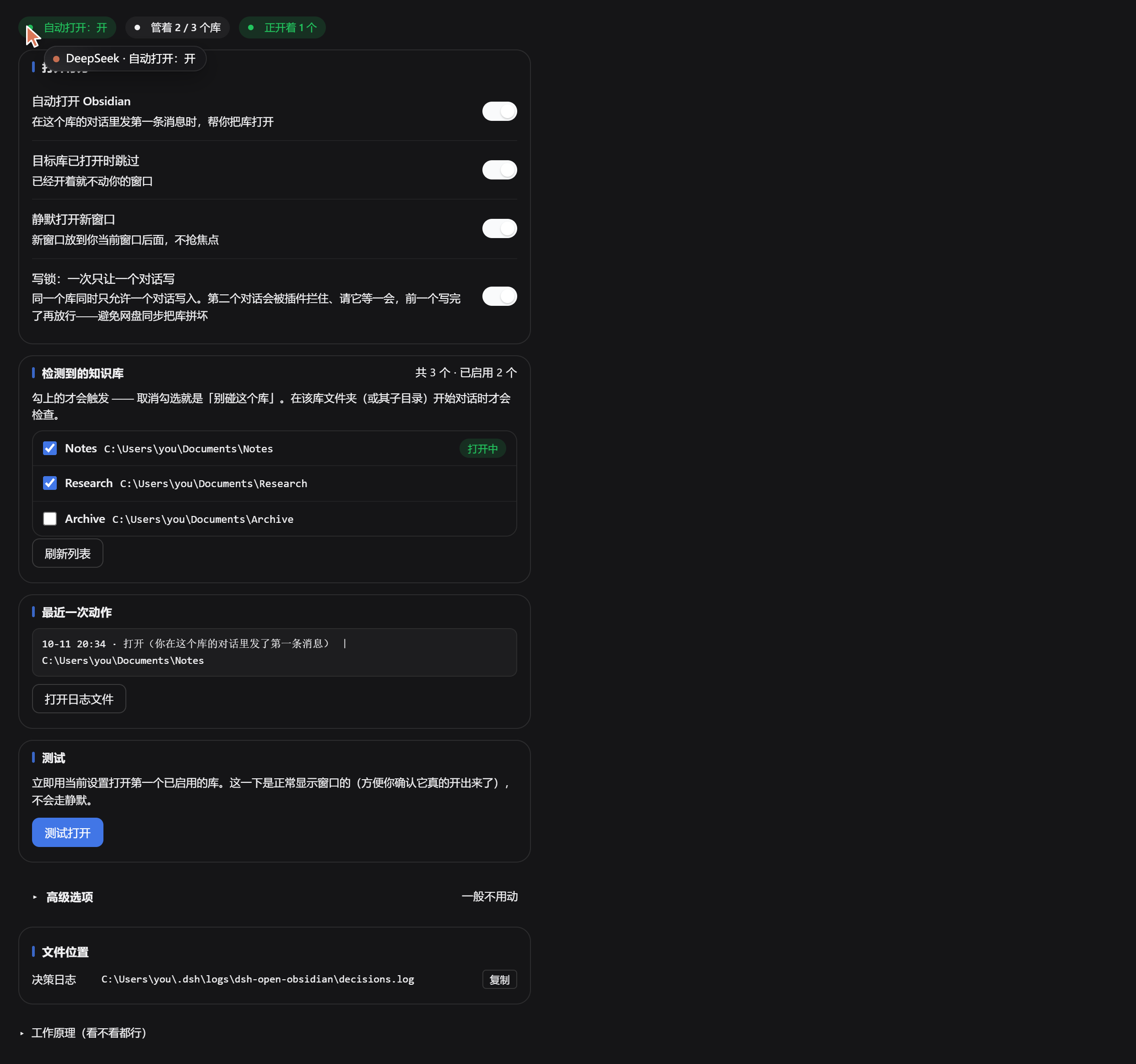
设置项
所有开关改一下就立即保存,没有"保存"按钮。
| 设置项 | 默认 | 作用 |
|---|---|---|
| 自动打开 Obsidian | 开 | 总开关。关掉 = 插件永远不打开任何东西。 |
| 检测到的知识库(逐个库) | 全不勾 | 勾选要管的库。每个库的「已打开」状态都会拿正在运行的 Obsidian 核实,所以关着的库不会被显示成开着。 |
| 目标库已打开时跳过 | 开 | 已经在屏幕上的库,完全不碰。 |
| 静默打开新窗口 | 开 | 新开的窗口压到后面,而不是让它抢走焦点。 |
| 写锁:一次只让一个对话写 | 开 | 同一个库同时只允许一个对话写入,其他对话的写入会被拦下、排队。见下文写锁。 |
| 高级选项 | — | 可选的自定义启动命令。{vault} 会替换成解析出的库文件夹路径。留空 = 用 Obsidian 自己的 obsidian:// 协议。 |
每一次"打开"和"跳过"都会记进 %USERPROFILE%\.dsh\logs\dsh-open-obsidian\decisions.log
(有大小上限),所以插件但凡动过手,事后都能查是哪次触发的。面板上有按钮直接打开它。
写锁的每一次抢锁、拦下、放行也都记在同一份日志里(行首 writelock),排查"为什么这次没写进去"时
就靠它。
写锁:一个库同时只让一个对话写
为什么要这个:库如果交给网盘同步(坚果云、Obsidian Sync 之类),两个对话同时往里写的时候, 同步客户端会把两边的改动拼在一起——结果就是同一段话出现两遍、两个标题粘成一个、 数字被接成一串乱码。不是丢文件,是文件被拼坏,而且不容易发现。
它怎么管:
- 一个库,同一时刻只有一个对话能写。锁按一整轮对话持有,不是按一次写入——一轮里 AI 要写很多次, 中间放开就会让两边混着写。
- 第二个对话想写的时候,这一次写入会被直接拦下:工具根本不会执行,一个字节都不会写进去。 它会收到一句普通的工具报错,说明"现在另一个对话在写"。
- 被拦下的对话才会排进队列,等前一个写完。
- 前一个放锁后,会当场通知排在最前面的那个"轮到你了"。
几条你可能想知道的:
- 通知有可能过时,所以通知里写的是"先自己核对一下,别急着重做":如果你看到工作区是干净的、 改动已经在文件里了,就别再写一遍(不然就变成重复写入了)。
- 只有当 AI 正在这个库里干活时才会被管;开个对话只在搜索资料、读文件、一个字没写, 不会被排队,也不会被打扰。
- 子代理不参与——它是它所在那一轮的一部分,不能被自己的助手挡住。
- 一个对话卡死不动超过 30 分钟,锁会自动判定为"人已经不在了",让下一个接手。
这个时间可以在设置里改(
writeLockStaleMinutes),设成 0 就是永不接管。 - 判断不清楚的时候一律放行:认不出的工具、解析不了的调用、插件内部出错,都会让这次调用过去。 宁可偶尔漏拦一次(锁还会照常记录),也不要把正常的工作卡住。
- 不想要的话,把设置里的**「写锁:一次只让一个对话写」**关掉就行。
触发时机
插件只在两种时机打开 Obsidian,且都带去重和节流:
- 会话的第一条真人消息(工作目录在已启用的库内)。每个会话只判定一次。
- 写入时兜底 —— 已启用的库里有文件变动,但必须满足"代理(AI)最近确实在这个库里干活" 且"Obsidian 没在运行"。
DSH 的生命周期事件故意不作为触发条件。0.7.0 之前的版本会在 session/created 时也尝试打开,
而这个事件在每次会话发布时都会触发(界面加载、断线重连、宿主启动恢复上次工作区),
结果就是你什么都没干、Obsidian 自己弹出来了。0.7.0 已移除。无关的文件变动
(同步客户端、编辑器、git 维护)同样不会触发。
已知限制
1.「打开一个没开的库、同时完全不打扰你」做不到。
Obsidian 自己没有实现这个能力:它新建窗口用的是会抢焦点的 show(),而不是不抢焦点的
showInactive(),并且全程序没有任何跟焦点相关的开关(这是读它自己的 app.asar 确认的,
showInactive 出现 0 次)。
插件的做法是"新窗口压到后面 + 把焦点抢回来"。所以当被打开的库原本没开着时,大约三次里 有两次会闪一下,约 0.1 秒。没有第三条路——外部程序拦不住 Obsidian 自己激活窗口,只能事后纠正。
接受不了可以关掉「静默打开」,就变回"正常打开、会跳到前台"。
2. 插件用了 DSH 的内部接口(Web 路由注册、会话事件、设置页插槽、__ModuleLoader__)。
DSH 迭代很快,它一升级,插件有可能失效,需要跟着更新。欢迎提 issue。
目录说明
package.json                        插件清单(简介保持一句话,版本历史在 CHANGELOG.md)
lib/index.js                        宿主半 —— 库识别、触发判定、启动、写锁与写入闸门
lib/client.js                       浏览器半 —— 设置页的「Obsidian 助手」面板
bin/dsh-open-obsidian-silent.exe    编译好的助手程序:枚举窗口 + 静默打开
src/silent-open-helper.cs           上面那个 exe 的 C# 源码
test/behaviour.mjs                  行为回归测试(12 项)
test/panel.mjs                      设置面板测试(28 项)
test/writelock.mjs                  写锁测试(19 项)
test/writelock-gate.mjs             写入闸门测试(32 项)
bin\*.exe 是故意一起提交的——多数人没有 C# 编译器,而"静默打开"和"枚举 Obsidian 窗口"
都离不开它。源码一并在库里,方便审计和自行重新编译。
重新编译那个助手程序(Windows,用 .NET Framework 自带的 csc.exe):
& "$env:WINDIR\Microsoft.NET\Framework64\v4.0.30319\csc.exe" /nologo /optimize+ /target:winexe `
  /out:bin\dsh-open-obsidian-silent.exe src\silent-open-helper.cs
测试
node test/behaviour.mjs        # 12 项
node test/panel.mjs            # 28 项
node test/writelock.mjs        # 19 项
node test/writelock-gate.mjs   # 32 项
四套测试都用假的宿主和假的 Obsidian,不需要真的开 Obsidian,也不联网。但需要先
npm install(宿主那半要 @deepseek-ai/schemastery 来定义配置项)。
测试要在装好依赖的地方跑。从源码仓库直接
node test/...会找不到@deepseek-ai/schemastery——先npm install,或者把仓库放进 profile 的plugins/里再跑。
许可证
MIT —— 见 LICENSE。
设计上的一点说明:插件的设置面板只有中文界面,没有做多语言支持。这个插件主要是为 中文用户做的,说明文档因此也以中文为主。
English
This is a DeepSeek Harness (DSH) plugin — NOT an Obsidian plugin. Installing it inside Obsidian does nothing, and Obsidian will not load it.
Note: the plugin's own settings panel is Chinese-only (it was built for Chinese users first). The English documentation below is kept complete, but the UI you see after installing will be in Chinese.
What it does
Two things, both for the same reason: so that what the agent writes into a vault actually lands on disk and actually gets synced.
1. The vault gets opened. When a DSH conversation's working directory sits inside an Obsidian vault folder, this plugin opens that vault in Obsidian for you — automatically, once per conversation, when you send your first message. Because a sync plugin (Nutstore sync, Obsidian Sync, Obsidian Git) only runs while Obsidian is open.
Why that matters: without it, the agent writes into the vault while Obsidian is closed, nothing syncs, and the changes only travel the next time you happen to open Obsidian yourself.
It is deliberately quiet about it:
- If the vault is already open, nothing happens — no new window, no focus jump.
- If Obsidian is already running, the new window is pushed to the back and focus is handed straight back to whatever you were doing.
- If Obsidian is not running, it starts normally (the window appearing is the point).
2. Only one conversation may write a vault at a time. Two conversations writing at once get their edits spliced together by the sync client — the same paragraph twice, two headings glued into one. The plugin keeps a write lock: another conversation's write is actually refused (the tool never runs, not a byte is written) until the holder is done. See Write lock.
Everything runs inside the DSH process, outside the model loop: zero tokens, zero polling.
About the author: the author has no programming background; the code was written with the help of DSH's own AI assistant.
Requirements
| OS | Windows only. It relies on Windows process/window APIs, %APPDATA%\obsidian, and Obsidian's registered URL protocol. It will not work on macOS or Linux. |
| DSH | A DSH build that exposes the internal APIs this plugin uses (see Known limitations). The write lock additionally needs the tools/pre-execute hook. |
| Obsidian | Desktop 1.x. Developed and tested against 1.14.4. |
Install
One command — --profile is required; use the profile you actually run (often desktop):
dsh plugin --profile desktop add github:NOOBnoob163/dsh-open-obsidian
If
dshis not on your PATH, add it from the app's title bar: 应用 (Application) menu → 管理 dsh 命令… (Manage dsh Command…) → 安装 (Install). It only drops a small shortcut to the CLI bundled with DSH; it installs nothing else.
This package declares dsh.bundle, so DSH activates it automatically — no manual config
editing. Cold-restart DSH once afterwards (reloading the window is not enough), then pick
your vaults under Settings → Obsidian 助手.
Manual install (bypassing the bundle mechanism)
Put the repo in your profile's plugins folder:
# adjust <profile> if you are not on the default "desktop" profile
git clone https://github.com/NOOBnoob163/dsh-open-obsidian.git \
  "%USERPROFILE%\.dsh\profiles\<profile>\plugins\dsh-open-obsidian"
Then either add dsh-open-obsidian to dsh.profile.bundles in your profile package.json
(its own cordis.patch.yml then mounts it), or mount it by hand in
%USERPROFILE%\.dsh\profiles\<profile>\cordis.patch.yml:
  # Obsidian launcher (local plugin plugins/dsh-open-obsidian)
  - insert:
      - id: obsidian-launch
        name: 'dsh-open-obsidian'
(The config: block can be omitted — the real settings live in
%USERPROFILE%\.dsh\storages\dsh-open-obsidian.json, which is what the panel edits.)
Configure
Open Settings → Obsidian 助手 and tick the vaults you want this plugin to manage. Until you tick at least one vault, the plugin never triggers.
What it looks like
Settings
All controls save the moment you change them — there is no Save button.
| Setting (as shown in the Chinese UI) | Default | What it does |
|---|---|---|
| 自动打开 Obsidian | on | Master switch. Off = the plugin never opens anything. |
| 检测到的知识库 (per vault) | all off | Tick the vaults to manage. Each vault's open state is confirmed against a running Obsidian, so a closed vault is never shown as open. |
| 目标库已打开时跳过 | on | A vault that is already on screen is left completely untouched. |
| 静默打开新窗口 | on | Push a newly created vault window to the back instead of letting it steal focus. |
| 写锁:一次只让一个对话写 | on | One writer per vault at a time; other conversations' writes are refused and queued. See Write lock. |
| 高级选项 | — | Optional custom launch command. {vault} is replaced with the resolved vault folder path. Empty = use Obsidian's own obsidian:// URI. |
Every launch and every skip is appended to %USERPROFILE%\.dsh\logs\dsh-open-obsidian\decisions.log
(bounded), so an unexpected launch can always be traced back to its trigger. The panel has a
button to open that log. The write lock logs its own events there too (lines starting with
writelock), which is what to read when asking "why did that write not land?".
Write lock: one conversation per vault at a time
Why it exists. A vault synced by a file-sync client (Nutstore, Obsidian Sync, …) loses data when two writers touch it at once — the client splices the two versions together, which surfaces as the same paragraph twice, two headings glued into one, or counts concatenated into nonsense. It is not a lost file; it is a corrupted one, and quietly so.
How it works:
- One writer per vault at a time. The lock is held for a whole turn, not per file write — a conversation writes many times within one turn, and releasing between those writes would let two conversations interleave.
- When a second conversation tries to write, that write is refused outright: the tool never runs, so not a single byte is written. The caller sees an ordinary tool error saying another conversation is writing.
- Only a conversation that was actually refused is queued, to go next.
- When the holder releases, the head of the queue is told immediately that it is its turn.
Worth knowing:
- A notice can go stale, which is why it says "check first, don't just redo": if the working tree is clean and the change is already on disk, do not write it a second time.
- Only a conversation that is actually working in that vault is affected. Opening a session that just searches and reads, writing nothing, neither queues nor gets disturbed.
- Subagents never participate — a subagent is part of its parent's turn, and a conversation must not be blocked by its own helper.
- A holder that goes quiet for 30 minutes is treated as abandoned so one stuck conversation
cannot freeze a vault. That window is settable (
writeLockStaleMinutes); 0 disables takeover. - The gate fails open on anything it cannot parse — unknown tool, unparseable call, internal error. Missing one guard is better than stalling real work; the lock still logs it either way.
- Turn the lock off entirely with 「写锁:一次只让一个对话写」 in Settings.
Trigger rules
The plugin opens Obsidian on exactly two occasions, both throttled and deduplicated:
- The first direct human message of a session whose working directory is inside an enabled vault. Decided once per session.
- Write-time ensure — a file change inside an enabled vault, but only while the agent has been actively working in that vault recently, and only if Obsidian is not running.
DSH lifecycle events are deliberately not triggers. An earlier version also fired on
session/created, which fires on every session publication — GUI load, reconnect, harness boot
restoring the last workspace — so Obsidian would open although the user had touched nothing.
Removed in 0.7.0. Unrelated file churn (sync clients, editors, git maintenance) can never
open Obsidian by itself either.
Known limitations
1. "Open a closed vault without disturbing me" is not fully achievable.
Obsidian itself does not support this: it creates a new vault window with Electron's show()
(which activates) rather than showInactive(), and ships no focus-related flag anywhere
(verified by reading its own app.asar; showInactive appears zero times).
What this plugin does instead is push the new window to the back and take the foreground back. In practice you may still see a ~0.1 s flicker about two times out of three when opening a vault that was not already open. There is no third option — an external process cannot prevent Obsidian's own window from activating, only correct it afterwards.
Turn off 静默打开 if you would rather have the window come to the front normally.
2. It uses DSH internal APIs — the web-server route registration, session events, the settings
slot, and __ModuleLoader__. DSH is evolving quickly; a DSH upgrade can break this plugin until
it is updated. Issues are welcome.
Repository layout
package.json                        plugin manifest (short description; history in CHANGELOG.md)
lib/index.js                        host half — vault detection, triggers, launching, write lock + gate
lib/client.js                       browser half — the Settings → Obsidian 助手 panel
bin/dsh-open-obsidian-silent.exe    compiled helper: window listing + silent open
src/silent-open-helper.cs           C# source of the helper above
test/behaviour.mjs                  behaviour regression suite   (12 assertions)
test/panel.mjs                      settings-panel suite         (28 assertions)
test/writelock.mjs                  write-lock suite             (19 assertions)
test/writelock-gate.mjs             write-gate suite             (32 assertions)
bin\*.exe is committed on purpose — most users have no C# compiler, and the helper is
needed for both silently opening a vault and enumerating Obsidian's windows. Its source is
committed alongside it so it can be audited and rebuilt.
To rebuild the helper (Windows, .NET Framework's csc.exe):
& "$env:WINDIR\Microsoft.NET\Framework64\v4.0.30319\csc.exe" /nologo /optimize+ /target:winexe `
  /out:bin\dsh-open-obsidian-silent.exe src\silent-open-helper.cs
Tests
node test/behaviour.mjs        # 12 assertions
node test/panel.mjs            # 28 assertions
node test/writelock.mjs        # 19 assertions
node test/writelock-gate.mjs   # 32 assertions
All four suites run against a fake DSH host and a fake Obsidian; they need no running Obsidian
and no DSH network access. They do need the package dependencies (npm install) because the host
half imports @deepseek-ai/schemastery for its config schema.
Run them where dependencies are installed. From a bare source checkout
node test/...will fail to resolve@deepseek-ai/schemastery— eithernpm installfirst, or run them from inside a profile'splugins/directory.
License
MIT — see LICENSE.
Plugins associés
dsh-web (dsh-ssh)
zhu1090093659/dsh-web
dsh-web (dsh-remote-web-ui)
zhu1090093659/dsh-web
dsh-web-ui (dsh-ssh)
zhu1090093659/dsh-web-ui
dsh-web-ui (dsh-remote-web-ui)
zhu1090093659/dsh-web-ui