- Accueil
- Plugins
- Sessions et messages
- dsh-chat-import
dsh-chat-import
nwflower/dsh-chat-import
Importez fidèlement l'historique de chat de 13 agents de code (Claude Code, Codex, ChatGPT, Cursor, Gemini, opencode et bien d'autres) en tant que sessions DeepSeek Harness reprenables, avec export inverse vers Claude Code.
Installer
dsh plugin --profile web add github:nwflower/dsh-chat-importREADME
📥 DSH Chat Import
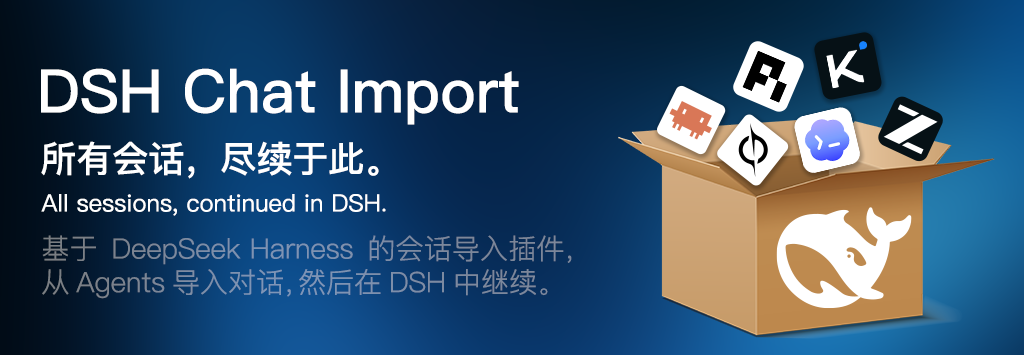
Import 15+ external agent conversation histories into DeepSeek Harness as full-fidelity, resumable sessions — and export / sync back to Claude Code, Codex, Kimi, or a portable interchange bundle.
💡 Intro · 🚀 Install · ✨ Features · 🗂 Supported sources · 🛠 Usage · 🔑 Key behaviors · 📚 Docs · ⭐ Star History · 🤝 Contributing
16+ agent sources, one plugin — full-fidelity import into DeepSeek Harness, seamless resume, matrix interop / backup / handoff on the way out.
Changelog: CHANGELOG.md · Roadmap: ROADMAP.md · Interchange protocol: docs/INTERCHANGE.md
💡 Intro
dsh-chat-import imports conversation histories from Claude Code, Codex, ChatGPT, Cursor, Gemini, Reasonix, opencode, MiMo Code, ZCode, Grok Build, OpenClaw, Pi Coding Agent, Hermes, Kimi CLI / Kimi Code, Qoder CLI and DSH session logs — tool calls, reasoning and all — as full-fidelity, resumable DeepSeek Harness sessions. Source files are read read-only (never rewritten), the DSH engine is never touched, and every import becomes a fresh session grouped into the workspace of its source cwd.
The reverse direction is covered too: export_claude serializes a DSH session back into a Claude Code JSONL transcript that Claude Code can load with --resume (read-only — your DSH log is never modified), sync_to_claude incrementally appends a session's new turns back to a Claude Code file — guarded, never silently overwriting — and the same matrix extends to Codex rollouts (export_codex) and Kimi wire files (export_kimi), plus a portable interchange bundle (export_bundle / restore_bundle) with SHA-256 fingerprints and cross-machine restore.
Requires Node.js ≥ 22.13, targets dsh 0.1.x (tested on 0.1.0-rc.6 / 0.1.0-rc.7).
🚀 Install
dsh plugin --profile web add dsh-chat-import # npm package
dsh plugin --profile web add -w link:/path/to/dsh-chat-import # local checkout (symlink)
Then:
- Import — call any
import_*tool in a DSH session:
import_claude({ path: "~/.claude/projects" })
import_chatgpt({ path: "~/Downloads/chatgpt-export/conversations.json" })
import_local_jsonl({ path: "D:\downloads\session.jsonl" })
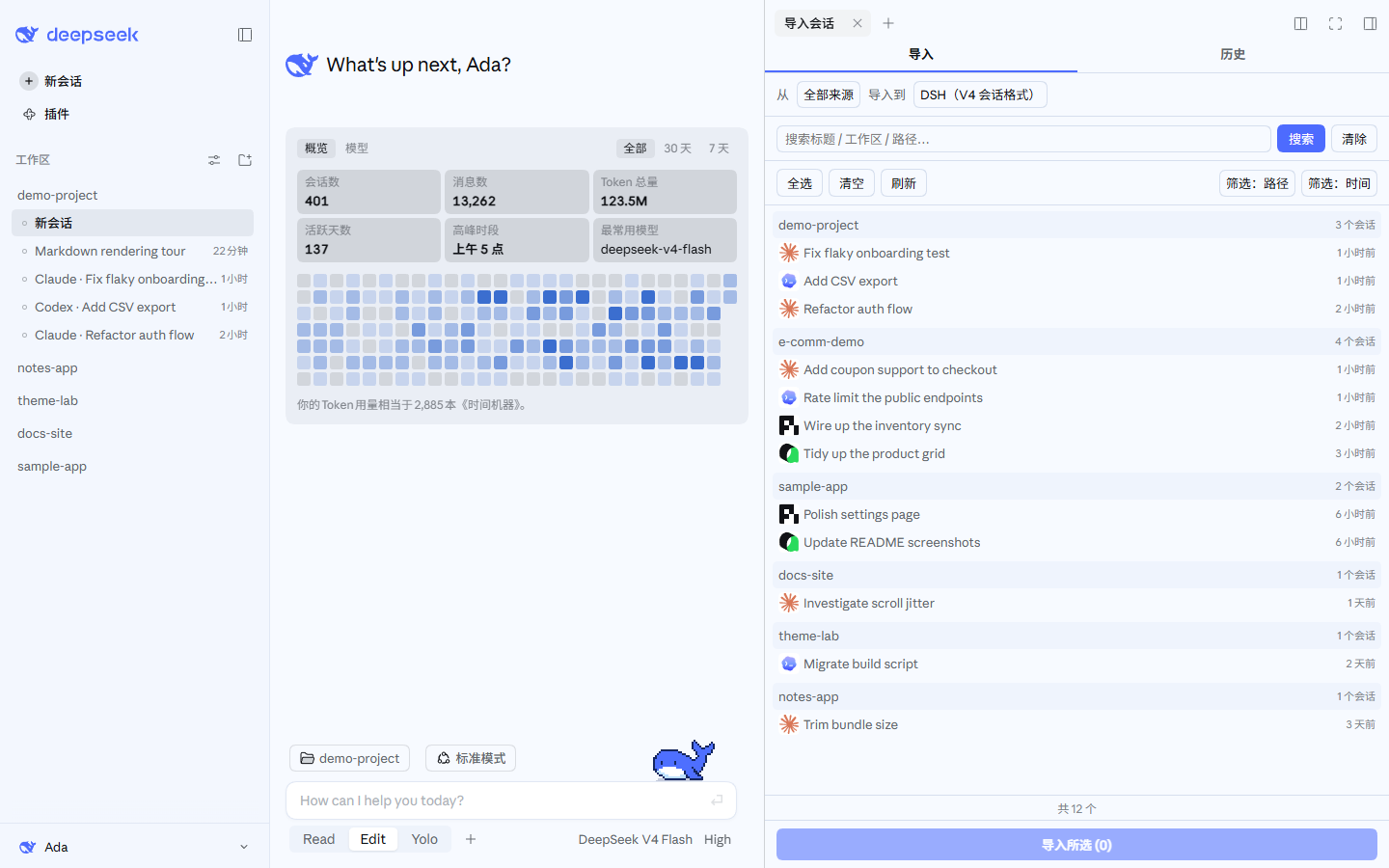
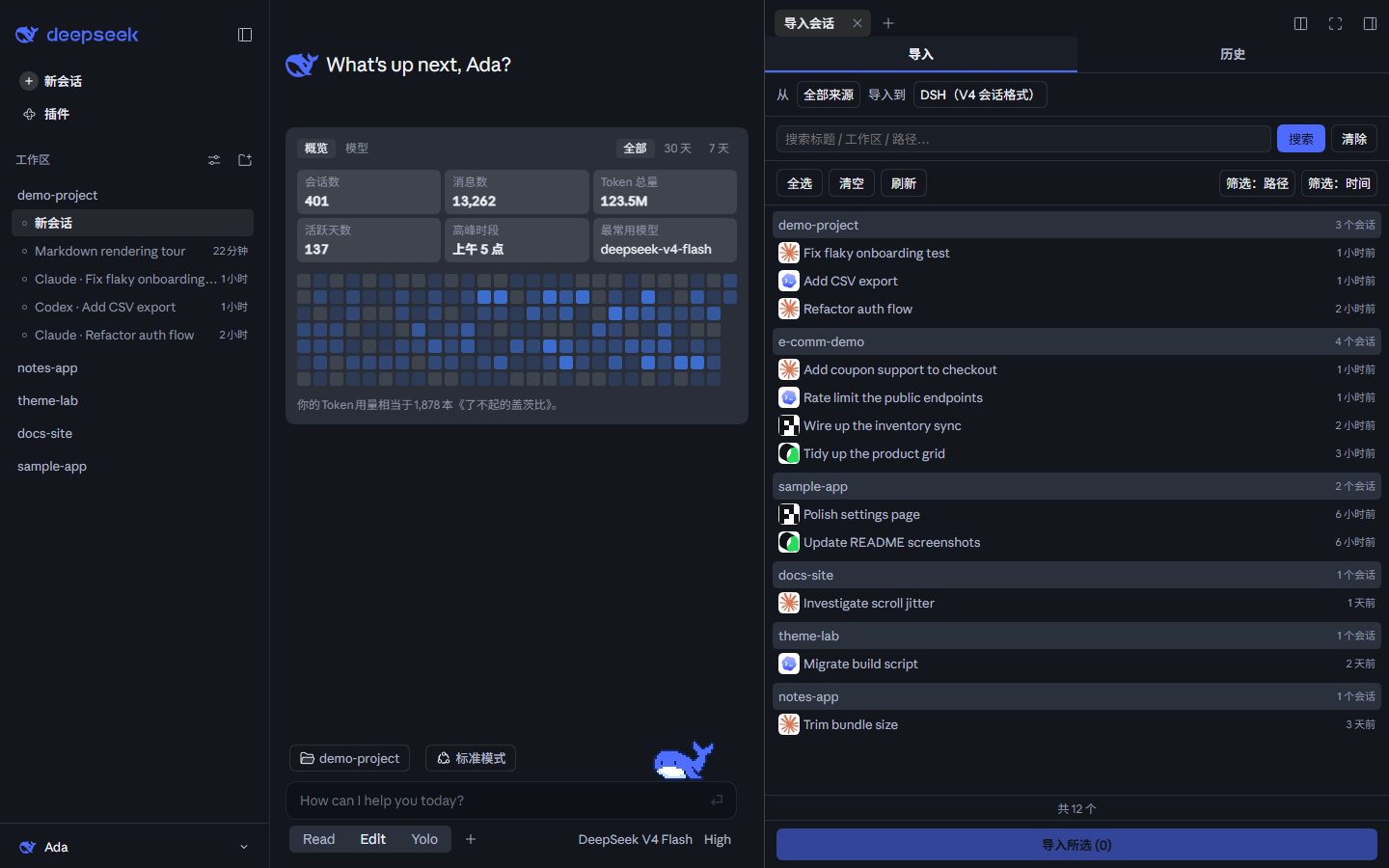
- Resume — refresh the session list, open the imported session, and keep chatting from where the source left off.
- Discover & batch —
scan_discover()previews read-only; the sidebar "Import sessions" panel browses by workspace and supports multi-select import;/import-allbatch-imports everything. - Sync (optional) — the panel's "Sync" tab offers bidirectional incremental sync (external → DSH, DSH → external), default off.
Uninstall: remove the
import-claudeinsert line from your profile's bundles and restart dsh; imported sessions stay untouched and the plugin never auto-deletes.
✨ Features
| Capability | Entry points | Description |
|---|---|---|
| Batch import from 16+ sources | import_* (17 tools) · scan_discover · sidebar panel · /import | A file, a directory or a whole database — each conversation becomes its own session |
| Full-fidelity resume | Imported sessions | Tool calls & results, reasoning, titles, models and timestamps carry over; sessions group into the source cwd workspace |
| Matrix export | export_claude / export_codex / export_kimi | Serialize DSH sessions back to Claude / Codex / Kimi formats; every lossy item is reported |
| Portable backup | export_bundle / restore_bundle | Interchange bundle with dual SHA-256 fingerprints, restorable across machines |
| Incremental write-back | sync_to_claude | Appends new complete turns back to a Claude Code file — guarded, never overwriting |
| Agent asset migration | import_agents | Converts pi / opencode / Claude / Codex agents, prompts, skills, instructions into persistent DSH skills |
| MCP mirror plan | import_mcp / /mcp-status | Reads Claude / Codex MCP servers and generates a reviewable DSH MCP client YAML snippet |
| Settings translation | import_settings / /settings-suggest | Turns Claude settings / Codex config into DSH migration suggestions (read-only) |
| Handoff summaries | /resume-claude / /resume-codex | Treats external transcripts as untrusted history and injects a handoff summary into the current session |
| Read-only audit / checkup | verify_session / doctor / CLI dsh-chat-import doctor | Structural audit and migration health check |
| Idempotency & protection | All import tools | expectedHash / restamp / context-budget protection; unchanged sources skip, grown sources append |
| Preset mode + system prompt | Settings tab in the Plugins section | Imported sessions record the default preset; optional "import system prompt" as a context injection (off by default) |
🗂 Supported sources
| Source | Storage location | Import tool |
|---|---|---|
| Claude Code | ~/.claude/projects/<slug>/<sessionId>.jsonl | import_claude |
| Claude-3p (new client) | %LOCALAPPDATA%\Claude-3p\claude-code-sessions (metadata → JSONL via cliSessionId) | import_claude |
| Codex / ChatGPT CLI | ~/.codex/sessions/YYYY/MM/DD/rollout-*.jsonl | import_codex |
| ChatGPT (web export) | anywhere you saved the export — conversations.json | import_chatgpt |
| Cursor | ~/.cursor/projects/<slug>/agent-transcripts/<id>/<id>.jsonl | import_cursor |
| Gemini CLI | ~/.gemini/history/<slot>/chats/session-*.json | import_gemini |
| Reasonix (CLI + desktop) | ~/.reasonix/sessions/desktop-*.jsonl · %APPDATA%\reasonix\projects\<slug>\sessions\*.jsonl | import_reasonix |
| opencode | ~/.local/share/opencode/opencode.db | import_opencode |
| MiMo Code (opencode fork) | ~/.local/share/mimocode/mimocode.db | import_mimocode |
| ZCode (z.ai CLI) | ~/.zcode/cli/db/db.sqlite | import_zcode |
| Grok Build | ~/.grok/sessions/<project>/<session_id>/ | import_grokbuild |
| OpenClaw | ~/.openclaw/agents/<agent>/sessions/*.jsonl | import_openclaw |
| Pi Coding Agent | ~/.pi/agent/sessions/--<cwd>--/<timestamp>_<uuid>.jsonl | import_pi |
| Hermes | ~/.hermes/ (Windows %LOCALAPPDATA%\hermes) | import_hermes |
| Kimi CLI / Kimi Code | ~/.kimi/sessions/<workdir-md5>/<sessionId>/wire.jsonl · ~/.kimi-code/sessions/<workspaceId>/<sessionId>/agents/main/wire.jsonl | import_kimi |
| Qoder CLI | ~/.qoder/projects/<encoded-project>/<sessionId>.jsonl (subagents in <sessionId>/subagents/*.jsonl) | import_qoder |
| DSH session logs | ~/.dsh/sessions/<encoded-workspace>/<sessionId>/session.jsonl(.zstd) | import_dsh |
| Any local JSONL | any .jsonl file / directory (auto-detected) | import_local_jsonl |
Each import preserves what the source actually records; anything a format cannot preserve is explicitly flagged in the import report. Per-format details and edge cases live in Usage Reference.
🛠 Usage
All import_* tools share the same path semantics: a single file becomes one session, a directory is scanned recursively for batch import. Common options: preview (zero side effects), force (new full copy), sessionId (override target id), expectedHash (SHA-256 verification), restamp (shift timestamps to now), workspaceMode / workspaceDir (grouping control).
import_claude({ path: "C:\Users\<you>\.claude\projects\<slug>\<sessionId>.jsonl" })
import_opencode({ path: "C:\Users\<you>\.local\share\opencode\opencode.db" })
import_local_jsonl({ path: "D:\downloads\session.jsonl", format: "claude" })
import_chatgpt / import_opencode / import_zcode / import_hermes always return batch results — one file / database contains every session, and each conversation becomes its own session in a single call.
Full per-tool / per-command usage lives in docs/USAGE.md.
🔑 Key behaviors
- Read-only import — source transcripts and databases are never rewritten; imported DSH history is append-only.
- Idempotent + incremental — unchanged sources skip without re-reading; grown sources append only new turns; shrinking is detected and reported.
- Auto workspace grouping — sessions land in the workspace of their source
cwd(authoritative mapping → slug decode → home-directory sandbox guard; falls back to the source file's directory when the path does not exist locally). - Preset mode — imported sessions mount the default preset scope via
agents.createand write the default preset id back toSessionHeader.agentPreset, so the UI shows the preset-mode chip exactly like a normal session. - System prompt (optional, off by default) — the "Import system prompt" setting (a tab in the settings Plugins section) preserves the source transcript's
system/developerprompt as a "context injection" collapsed row, prefixed with a note that the environment changed and tools / permissions / instructions now follow DSH. Claude Code transcripts do not persist a system prompt, so the toggle is a no-op for that source. - Fail loudly — malformed lines, suspected secrets, format limitations and export degradations are all reported; every persisted session gets a structural self-check.
- Sandbox — reading sources or writing exports outside the workspace requires the session sandbox to allow that path.
📚 Docs
| Document | Description |
|---|---|
| Usage Reference | Full parameters, examples and edge cases for every tool / command |
| Interchange protocol | Interchange v1 protocol and bundle format |
| Changelog | Version history |
| Roadmap | Shipped / planned |
| Contributing | Development setup, commit rules, security & privacy |
⭐ Star History
🤝 Contributing
Contributions welcome — fork the repo, create a feature/<name> branch, and open a PR. Full guide: CONTRIBUTING.md.
- Tests:
npm test· Cross-platform guard:npm run check:linux - Repo conventions: AGENTS.md — conventional commits, bilingual READMEs must stay in sync, plugin consumes public dsh host services only, multi-session file-claim protocol.
📄 License
MIT — see LICENSE.
Plugins associés
dsh-turn-rewind
anionex/dsh-turn-rewind
dsh-suite (plugin-session-export)
whyihaveyou/dsh-suite
dsh-interconnect
chinesezjc/dsh-interconnect
dsh-message-edit
moeblack/dsh-message-edit