dsh-approval-hotkeys
sirilee/dsh-approval-hotkeys
Raccourcis clavier de panneaux pour la Web UI : Entrée déclenche l’action de confirmation et Échap l’action d’annulation sur chaque panneau d’interaction (approbation, question, revue de plan).
Installer
dsh plugin --profile web add github:sirilee/dsh-approval-hotkeysREADME
dsh-approval-hotkeys


Approval-panel hotkeys for DeepSeek Harness, for every approval source — not just edits.
English | 中文
A deliberately minimal plugin with one generic rule: Enter always presses the confirm button (the primary, right-most action); Esc always presses the cancel button — on every button-bearing interaction panel the harness renders.
| Panel | Enter → confirm | Esc → cancel |
|---|---|---|
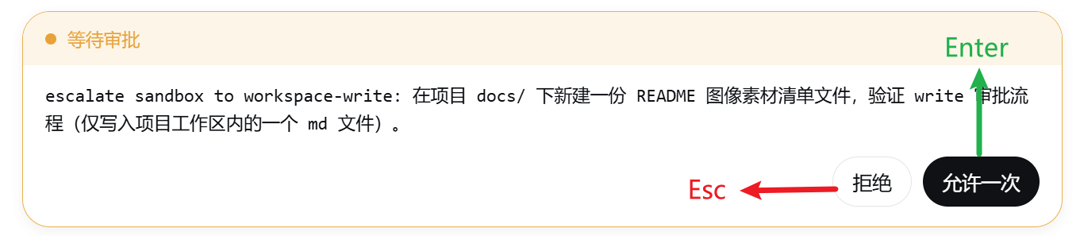
Approval ([data-approval-key]) | Allow once | Reject |
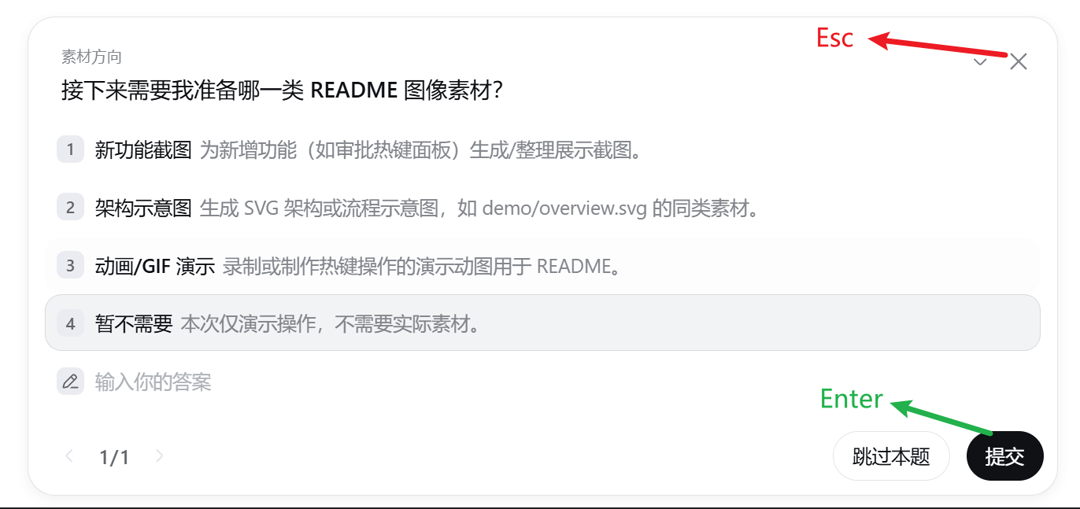
Question / choice ([data-question-key]) | Submit / Next | Discard the group |
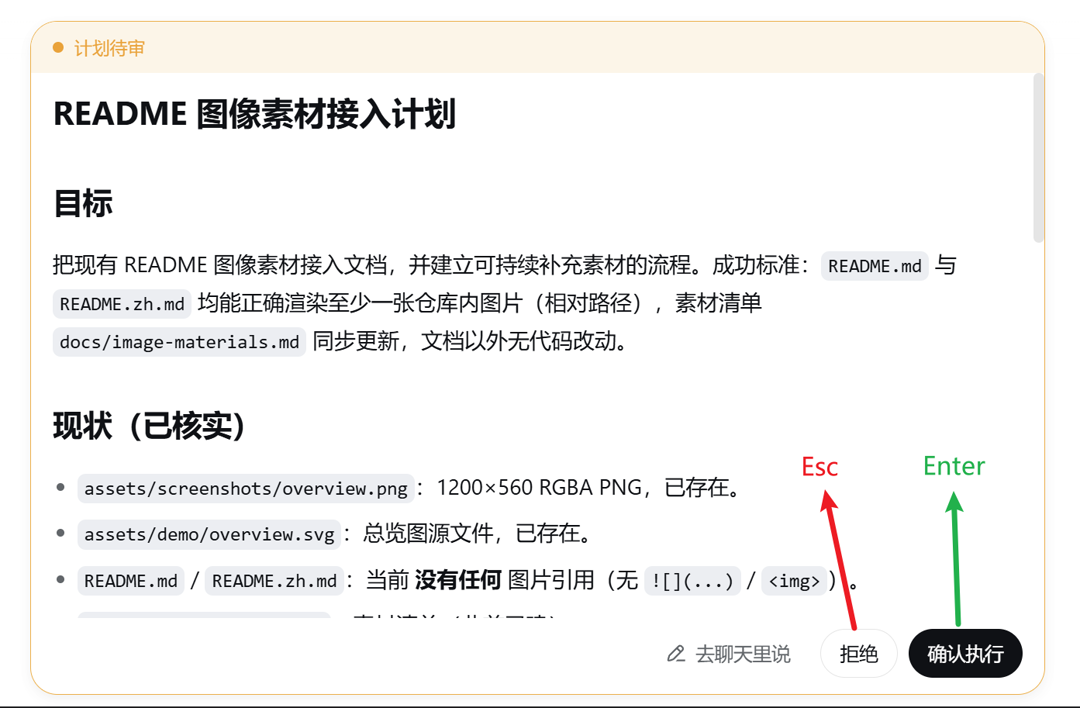
Plan review ([data-plan-review-key]) | Approve | Decline (or discuss) |
The panel anchors are harness-generic, so the hotkeys work on every interaction the GUI shows — edit approvals, permission escalations, tool questions, plan reviews. This is the Claude Code habit: confirm with Enter, refuse with Esc.
Approval panel
Every approval — edits, permission escalations, anything routed through the ApprovalPanel. Enter presses Allow once, Esc presses Reject.
Question / choice panel
Tool questions (ask_user_question). Enter presses Submit / Next,
Esc presses Discard the group.
Plan review panel
Enter presses Approve, Esc presses Decline (or Discuss when the panel has no decline action).
Install
dsh plugin --profile web add dsh-approval-hotkeys
Restart dsh web — or, since this plugin is pure browser-side, just refresh the page when the host side did not change. No configuration, no settings page.
Supported harness versions: DSH 0.1.7-rc.1 and later on the 0.1 line, declared as optional peers on the two services the client half reads (@deepseek-ai/dsh-api-session-controller, @deepseek-ai/dsh-client-ui-session) plus dsh.engines.dsh. One release targets one DSH line: the harness has removed client APIs inside a line before (SessionListState.current, uiSession.pendingInteractions), and older lines are served by the release frozen on them. Note that since 0.1.7-rc.1 the harness checks a profile bundle's own @deepseek-ai/dsh-* peers against the running version at startup and skips the whole bundle when one does not satisfy it — a stale peer range now costs the plugin its load instead of printing a warning. See docs/release.md.
For contributors: install from a local checkout or a pinned commit — dsh plugin --profile web add /path/to/dsh-approval-hotkeys or dsh plugin --profile web add github:SiriLee/dsh-approval-hotkeys#<sha>. A git install fails on first run until you add an allowBuilds key to the profile's pnpm-workspace.yaml (pnpm blocks git dependencies from running build scripts); after that it runs the plugin's prepare and installs it.
How it works
- Enter → confirm: clicks the panel's primary button — the last button
of its action row ("Allow once", "Submit/Next", "Approve"). The harness's
Buttoncomponent has no stabledata-variantattribute (variants are CSS-Modules hash classes), so the plugin anchors on the layout contract that the confirm action always renders last — which is exactly the primary-colored button. - Esc → cancel: clicks the panel's cancel button — Reject (first), Discard (header), Decline (footer second-last, or Discuss when the panel has no decline action). Without a panel, Esc is left alone (no pause/stop binding — the GUI's own stop button and shortcuts own that).
Guards (what the plugin deliberately does NOT do)
- Never while typing: keydown inside an input / textarea / select /
contentEditable (the composer owns
Enter/Escthere — e.g.Shift+Enternewline,Escdismisses suggestions). - Enter with focus on a button: left to the browser (it activates the focused button natively) and to the panel itself (the question composer's options submit on Enter) — acting again would double-fire.
- Never on chords or repeats:
Ctrl/Meta/Alt+keycombinations and held-key repeats are left alone. - Never mid-composition: an IME-confirming
Enter(isComposing, or the legacykeyCode229) is a candidate pick, not an answer. - Esc with no panel: left alone — the plugin never stops or pauses the agent; panels are the only surface it acts on.
- Never on a panel the runtime does not vouch for: when the runtime reports what is awaiting an answer here, that request is the only thing the hotkeys answer — a settled or foreign panel left in the DOM is not clicked through a positional guess.
Button resolution contract (data-hotkey="none")
Enter/Esc resolve their buttons by position (first / last / header-last /
footer-last), not by a stable semantic attribute — the harness's Button
component exposes no reliable data-role/data-variant, so position is the
only stable signal available to a client plugin that does not own the panel
DOM. That makes button order the single coupling point to the harness layout.
To keep that coupling safe when other plugins inject buttons into a panel
(utility toggles, decorative controls), this plugin skips any button marked
data-hotkey="none" when resolving the confirm/cancel action. Any plugin that
adds a non-action button into an interaction panel should mark it:
<button data-hotkey="none">Collapse diff</button>
This is a cooperative, opt-out contract, not a hard guarantee. It reliably covers "a plugin inserts an extra non-action button ahead of the action row" (such as dsh-edit-approval's diff collapse toggle). It does not cover:
- a plugin that injects a button without the marker (contract ignored), or
- a plugin that reorders / inserts a genuinely actionable button among the real confirm/cancel buttons (the semantics changed, not just a decoration added), or
- a change to the harness's own panel layout.
Those cases need a stable semantic anchor in the harness panel DOM (e.g.
data-role="confirm" / data-role="cancel") — a harness-repo change, not a
client-plugin fix. File an issue / PR against deepseek-harness if it bites.
Design notes
- Pure browser (client) plugin: the host half is a no-op stub. All behavior
is a single
documentkeydownlistener registered inside onectx.effect, torn down on unload/HMR. - Relies on the stable ApprovalPanel DOM contract: reject renders first,
allow-once last, both
disabledafter an answer — so a double-answer is impossible and the button-order dependency is the only harness coupling. - The panel lookup asks the runtime first:
uiSession.sessionStatusnames the request awaiting an answer for the session the main view retains (sessions.list→retainedBy.mainView, the signal that replacedSessionListState.current), and the panel is then located by that request key. A readable runtime that reports nothing awaiting an answer means the hotkeys stay out of the way; only an unreadable runtime (nouiSession, a renamed snapshot field — i.e. an older or newer host) falls back to the first visible panel in DOM order. - Panels are only answerable when actually on screen: a panel inside an
inertorhiddensubtree, or hidden throughvisibility: hidden, is never clicked. (inertandvisibilityboth leaveoffsetParentset, so those cases need explicit checks rather than the usual visibility test.) src/client/contract.tspins the harness shapes this reads at compile time. Without it,skipLibCheckwould silently turn a moved or renamed type intoanyand the typecheck would keep passing while every read went unchecked.
Development
npm install
npm run typecheck   # tsc --noEmit (host + client + the contract pins)
npm test            # vitest (dispatch + target-resolution unit tests)
npm run build       # esbuild: lib/index.js + lib/client.js + .d.ts
node scripts/verify-host.mjs   # exercises the built artifacts
npm run check       # all of the above + npm pack --dry-run
Release
The first publish is manual (npm publish --access public), then the
GitHub Actions Trusted Publishing workflow takes over — push a v<semver>
tag and CI publishes with provenance. Full steps: docs/release.md.
Security
Pure browser-side plugin: the host half is an empty stub, and all behavior is a document-level keydown listener that clicks existing panel buttons. No network requests, no file access, no credentials.
License
Plugins associés
dsh-web (dsh-task-board)
zhu1090093659/dsh-web
dsh-web (dsh-web-all)
zhu1090093659/dsh-web
dsh-web-ui (dsh-task-board)
zhu1090093659/dsh-web-ui
dsh-web-ui (dsh-web-ui-all)
zhu1090093659/dsh-web-ui