dsh-openrouter-live
boomerangz/dsh-openrouter-live
OpenRouter provider that reads the live /models list, so new models appear without a harness release: models sorted by name with input/output prices, per-model reasoning levels, image input, reasoning_details replay, Anthropic prompt caching, and actual spend per session including subagents from OpenRouter usage.cost, shown under the Web UI composer and by /cost.
Installazione
dsh plugin --profile web add github:boomerangz/dsh-openrouter-liveREADME
dsh-openrouter-live
An OpenRouter provider for DeepSeek Harness (dsh) that reads OpenRouter's live model list, so a model shows up in the picker as soon as OpenRouter serves it.
The harness's built-in openrouter route lists models from a catalog bundled with each release. A model released after that snapshot, such as deepseek/deepseek-v4.1-flash, does not appear in the picker until the next harness release. This plugin adds a second route, OpenRouter (live). It reads OpenRouter's /models endpoint and takes each model's metadata from there.
What it does
-
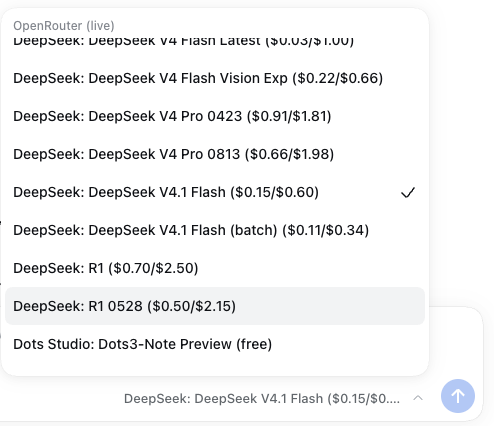
Live model list. It lists every OpenRouter model that accepts tools, sorted by name, so models from one vendor stay together. Each name ends with the input/output price per million tokens. The list is refreshed every 10 minutes. If a refresh fails, the previous list stays in use.
-
Per-model metadata. The context window and output cap come from OpenRouter. The reasoning levels come from the model's own
reasoning.supported_efforts, so the composer offers only levels the model accepts, including Off when reasoning is optional. -
Image input. It inlines images for models whose
/modelsentry listsimageinput. It follows the harness image budget: images are downscaled, and the oldest images are offloaded when a request grows too large. -
Reasoning continuity. It sends
reasoning_detailsback on later requests, including signed and encrypted entries. This lets models such as Claude and DeepSeek keep their reasoning across tool calls. -
Prompt caching.
- Anthropic models get cache breakpoints on the system prompt and the newest message. In a live check, a second request read 7209 of 7223 prompt tokens from cache.
- Other providers cache automatically. The
x-session-idheader keeps each conversation on one upstream provider, so its cache stays warm.
-
Classified failures. Errors map to the harness failure codes, so the harness retry plugin retries only what is worth retrying:
- Retried: rate limits, with OpenRouter's
Retry-Afterhonored; upstream 5xx errors; idle streams; truncated streams; empty responses. - Not retried: bad keys, exhausted credits, and context overflow.
- Retried: rate limits, with OpenRouter's
-
Actual spend, including subagents. The plugin records the charge OpenRouter reports for every response (
usage.cost), so these are real charges, not token estimates. Each charge is attributed to the session that made the request and to every session it was delegated from. Type/costin the CLI or Web UI:OpenRouter spend in this session: $0.0022 (5 requests) this agent: $0.0011 (3 requests) subagents: $0.0011 (2 requests in 1 session) All recorded sessions: $0.0022 (5 requests).In the Web UI the session total is always visible under the composer, next to the built-in statistics and context meter. It updates during a turn, including subagent charges, and its tooltip splits the total between the agent and its subagents. It is hidden in sessions with no OpenRouter charges.

Charges are appended to
~/.dsh/openrouter-live/costs.jsonl, one JSON line per response, so totals survive restarts. Each line carries the OpenRouter generation id, so any charge can be matched against your OpenRouter activity page. -
Shared credential. By default the route reads the same
OPENROUTER_API_KEYcredential as the built-inopenrouterroute, so a key you already stored works without extra setup.
Requirements
- DeepSeek Harness
0.1.6-alpha.2through0.1.7. It has been tested on0.1.6-alpha.2and0.1.7-alpha.2. The harness API is pre-stable, so later harness versions are added to the peer range after they are tested. - Node.js
^22.19 || >=24. - An OpenRouter API key.
Install
From npm:
dsh plugin --profile web add dsh-openrouter-live
From a local checkout:
git clone https://github.com/Boomerangz/dsh-openrouter-live.git
cd dsh-openrouter-live
npm install
npm pack --pack-destination dist          # runs typecheck and tests first
dsh plugin --profile web add "$PWD/dist/dsh-openrouter-live-0.2.0.tgz"
[!IMPORTANT] Install the packed
.tgz, not the directory. When you add a directory, pnpm links it, Node resolves the link to its real path outside the profile, and the harness packages (@deepseek-ai/*) can't be found there. The whole profile then fails to boot.
Restart the profile after installing. OpenRouter (live) then appears in the model picker. If you haven't stored a key yet, choose one of these:
- Enter it on the built-in OpenRouter card under Settings → Models. It is stored as
OPENROUTER_API_KEY, which both routes read. - Export
OPENROUTER_API_KEYbefore launchingdsh.
To choose it as the default model, pick it in the composer's model picker. You can also set it in ~/.dsh/settings.yaml:
agent-default-model:
  provider: openrouter-live
  model: deepseek/deepseek-v4.1-flash
Configuration
Every field is optional. Set fields in the profile's patch layer, ~/.dsh/profiles/<profile>/cordis.patch.yml, under the plugin's entry id openrouter-live:
- id: openrouter-live
  config:
    models: ['deepseek/*', 'anthropic/claude-*', 'openai/gpt-5*']
    extraBody:
      provider:
        sort: throughput
| Field | Default | Meaning |
|---|---|---|
models | [] | Glob patterns over model ids. An empty list lists every model. Ids outside the filter still work when typed. |
toolsOnly | true | List only models whose OpenRouter entry accepts tools. Agent turns need tools. |
priceInName | true | Append input/output prices per 1M tokens to model names, such as DeepSeek: DeepSeek V4.1 Flash ($0.15/$0.60), because the pickers show names but not descriptions. The price then also appears in the composer's model button. |
apiKeyEnv | OPENROUTER_API_KEY | Credential reference: a credential-store entry or environment variable. |
provider | openrouter-live | Route id. Give each instance its own id to run several side by side, for example one with a *:free filter. |
displayName | OpenRouter (live) | Provider name in the picker. |
baseURL | https://openrouter.ai/api/v1 | API root. |
modelListTtlMs | 600000 | How long one fetched model list is reused. |
maxTokens | 32768 | Output cap for requests that set none. A lower model limit wins. |
defaultContextWindow | 262144 | Context size assumed for an id the list does not describe. |
streamIdleTimeoutMs | 300000 | Longest silence inside a response stream before failing with TIMEOUT. |
maxRequestImageBytes | 20971520 | Base64 image budget per request. Older images are offloaded beyond it. |
requestImagePixelBudget | 4194304 | Pixel budget of one request image. |
requestImageMaxBytes | 1048576 | Encoded-byte target of one request image. |
appTitle / appUrl | DeepSeek Harness / unset | OpenRouter app attribution headers (X-OpenRouter-Title, HTTP-Referer). |
extraBody | {} | Fields merged into every request body, such as provider routing. Fields the plugin sets take precedence. |
costLedgerPath | $DSH_HOME/openrouter-live/costs.jsonl | Spend ledger file. An empty string keeps spend in memory for the current process only. |
costCommand | cost | Slash command that reports spend. Leave it empty on a second instance that shares the ledger, so the command is registered once. |
costIndicator | true | Serve the Web UI spend indicator's data route (/openrouter-live/spend). Disable it on a second instance, which would otherwise claim the same route. |
retryPolicy | harness default | The harness's provider retry policy for this route: {mode: normal, maxRetries, retryableCodes, backoff} or {mode: always}. |
How it maps onto OpenRouter
| Harness | OpenRouter chat completions |
|---|---|
| System prompt, user and assistant text | system, user and assistant messages |
| Tool definitions and tool calls | tools (function type) and tool_calls |
| Tool results | tool messages. Images returned by a tool follow in a user message, because tool messages carry text only. |
| Images | image_url data URLs, each preceded by the harness's image handle line |
| Reasoning effort | reasoning.effort |
| Reasoning output | The reasoning stream becomes reasoning blocks. reasoning_details is kept for replay. |
| Usage | prompt_tokens is split into uncached input, cache reads and cache writes. Reasoning tokens are reported separately. |
Development
npm install
npm run check                          # tsc --checkJs (strict) + node:test suite
OPENROUTER_API_KEY=... npm run smoke   # live checks against OpenRouter; costs a few cents
The plugin is plain ESM JavaScript with JSDoc types, so no build step is needed to run it. npm pack generates the .d.ts files in types/. The test suite includes a composition test that boots the real LlmRuntime from @deepseek-ai/dsh-llm in a Cordis context and streams through it.
Known limitations
-
Spend covers only requests through this plugin's routes. The built-in
openrouteranddeepseek-officialroutes are not counted. -
A charge is recorded when OpenRouter reports it at the end of a response. A request that is cancelled or fails mid-stream may still be billed by OpenRouter, but it does not appear in
/cost. -
The Web UI indicator reads a route that answers only same-origin requests to a loopback address (
127.0.0.1,localhost), because the harness web server does not authenticate plugin routes. When the Web UI is opened over the network, the indicator stays hidden;/coststill works. -
/costneeds the harness command service, which the CLI and Web profiles mount. Headless runs still write the ledger. -
Only OpenRouter's text output is used. Image generation and audio models are listed only when they also accept tools, and their non-text output is ignored.
-
Prices in the picker are OpenRouter's base prices. Time-of-day price overrides are not shown.
-
Explicit cache breakpoints are sent only for
anthropic/*models. Every other model relies on its provider's automatic caching. -
A model that reasons but publishes no
supported_effortsgets no reasoning selector, so OpenRouter's default applies.
License
MIT
Plugin correlati
dsh-routing-suite
yjh051108/dsh-routing-suite
dsh-plugin-subscriptions
v1ki/dsh-plugin-subscriptions
dsh-commandcode-provider
mars-sea/dsh-commandcode-provider
dsh-workbuddy-connect
corrinehu/dsh-workbuddy-connect