dsh-claude-provider
dsh-plugins/dsh-claude-provider
Custom Claude provider support for DeepSeek Harness 0.2.2-rc.2 and 0.2.2-rc.3
Installazione
dsh plugin --profile web add github:dsh-plugins/dsh-claude-providerREADME
DSH Claude Provider
English | 简体中文
DSH Claude Provider adds a dedicated Claude configuration interface to DeepSeek Harness. You can add multiple Claude providers, choose reasoning levels for each model, and automatically fetch model lists and fill in capacity settings and reasoning presets for common Claude models, without editing configuration files manually.
Compared with the official generic custom provider form, the plugin adds a dedicated Claude entry, a per-model adaptive thinking toggle, and automatic defaults for known Claude models. DeepSeek Harness handles the saved reasoning configuration natively.
This release targets DeepSeek Harness 0.2.2-rc.2 and 0.2.2-rc.3. Those versions rewrote the Models settings page — retry policies, the Gemini protocol, and the settings.models.provider-card / settings.models.footer extension slots — so the plugin now builds its browser half from the upstream page sources: npm run build stages the installed @deepseek-ai/dsh-client-ui-settings-models sources, applies the anchored patches in scripts/client-patches.ts, and bundles the result. A DSH release that moves an anchor fails the build instead of silently dropping the Claude controls.
What this plugin does
-
Adds a dedicated Claude provider type
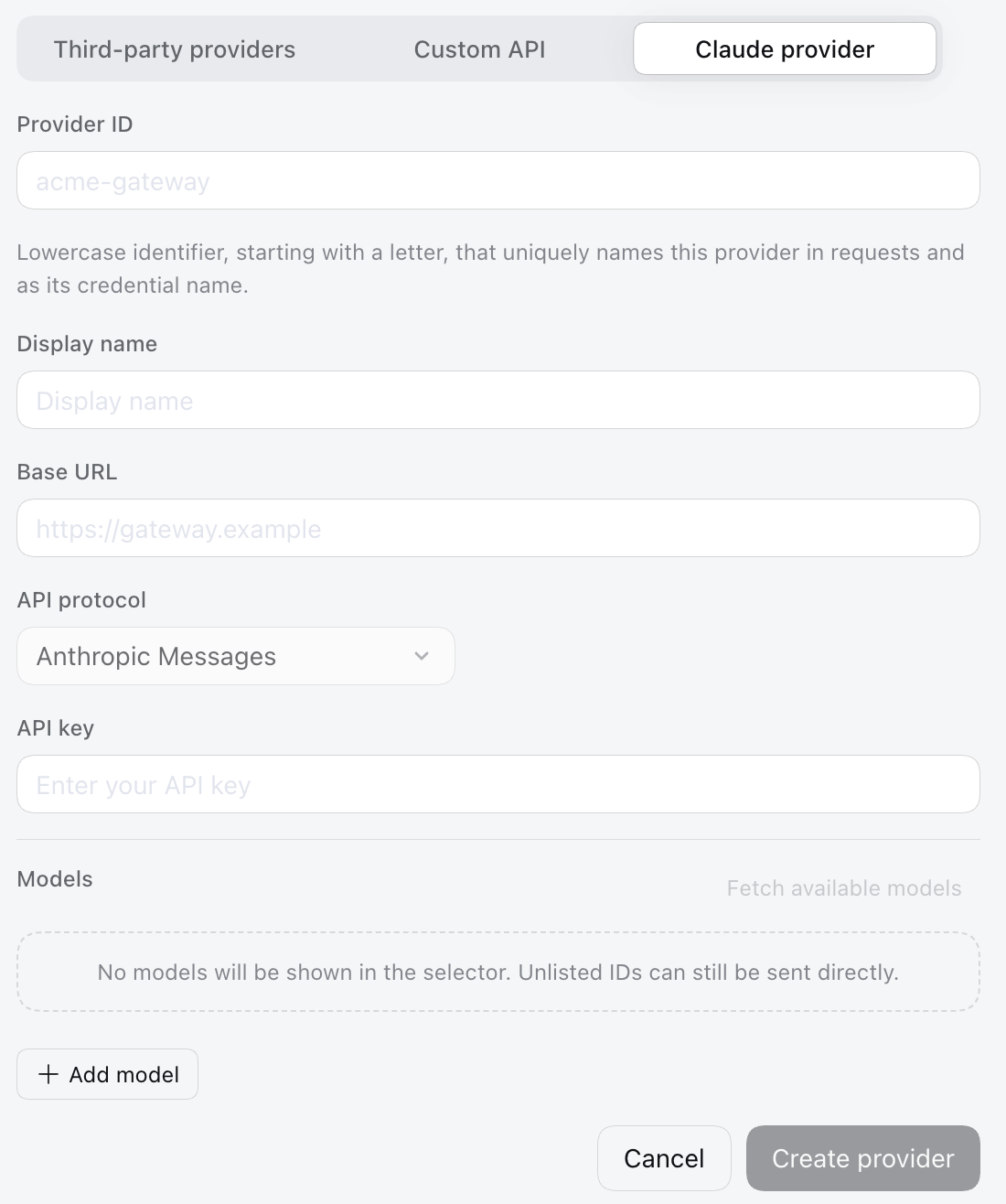
Open Settings → Models → Add model provider → Claude provider to use the dedicated Anthropic Messages form.
-
Adds a per-model adaptive thinking toggle
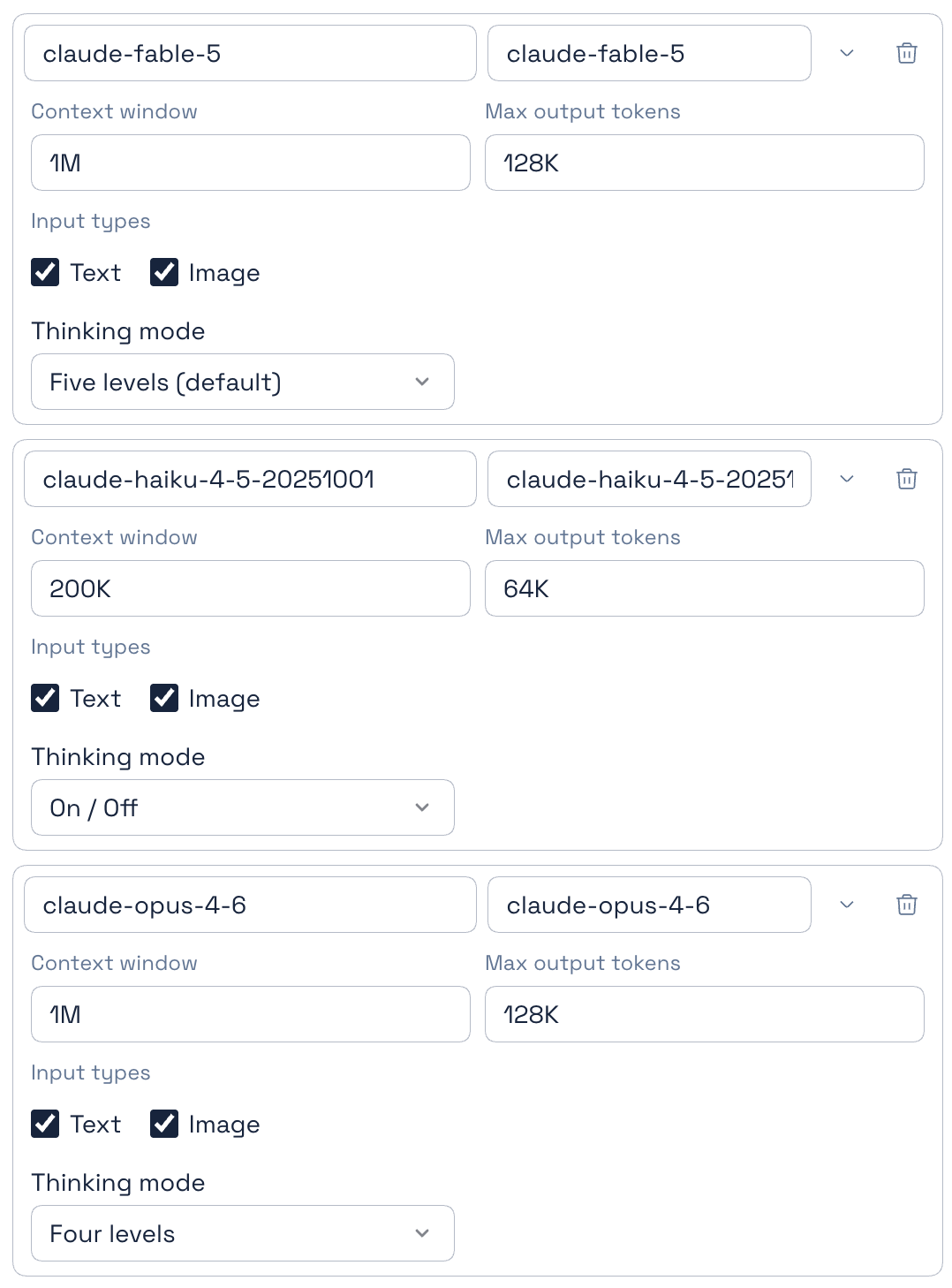
Adds an Adaptive thinking toggle for each model alongside DSH's existing reasoning-level settings. Reasoning levels and their corresponding API parameter values remain customizable.
For Anthropic-compatible models that support adaptive thinking. When enabled, the model adjusts its thinking based on task complexity and your selected reasoning level. When disabled, it uses the thinking token limit associated with that level. A model that always reasons keeps the toggle on and locked.
Each recorded Claude model carries its own reasoning levels and mode; a model ID outside the recorded table is classified by its family and version, and an ID naming no Claude family falls back to budget thinking. A route holding at least one budget-thinking model also records the thinking token budgets those models spend (1024 for low, 4096 for medium, 32000 for high).
On save, the plugin writes each model's reasoning levels and adaptive thinking settings to DeepSeek Harness's native configuration.
2b. Accepts empty thinking signatures for gateways that need them
Some Anthropic-compatible endpoints emit and accept a thinking block whose signature is empty. The Accept empty thinking signatures switch records that preference on the route, so such a block is replayed as thinking instead of being converted to plain text. It is off by default because the official Anthropic API rejects an empty signature.
2c. Configures prompt-cache lifetimes per section
The Claude form gains a Prompt cache lifetime select: provider default, off (no cache), five minutes, or one hour. Provider default writes nothing and leaves the choice to the adapter, which normally means five minutes; off records cacheRetention: none, so the route emits no cache breakpoints at all; the two durations record their own value, and an hour still needs an adapter that allows the long lifetime.
After choosing one hour, open the Claude provider entry on the Plugins page and expand the Claude prompt cache card to give tools, system prompt, and messages their own five-minute or one-hour lifetime. The Anthropic API requires every one-hour breakpoint to precede the five-minute ones, so the plugin validates the combination: when it is one the API would refuse, the card says so and names the reason, and the affected requests keep the provider's own lifetimes instead of being sent.
One-hour cache writes cost 2× base input, so they only pay off for prefixes reused across turns. The defaults therefore give tools and the system prompt an hour and keep messages on five minutes.
The card ends with a read-only summary of the lifetimes a save would send. It matters because a combination the API refuses does not fail loudly: those requests keep the provider's own lifetime instead.
Mixed lifetimes need @dsh-plugin/dsh-loader. A profile without it keeps the plugin's original behavior: routes still carry cacheRetention, and request bodies are left untouched.
-
Supports paginated Anthropic model discovery
The plugin fetches model lists through an Anthropic-compatible
GET /v1/modelsendpoint, follows the returned cursors to retrieve subsequent pages, and deduplicates the results. -
Fills known Claude model defaults after discovery
When a discovered model matches a recorded Claude model ID, the plugin automatically fills its context window, maximum output length, and reasoning-mode set. Models entered manually remain fully editable and are not overwritten by this lookup.
-
Leaves every other provider unchanged
Discovery, defaults, and reasoning controls are limited to Provider IDs explicitly created as Claude Providers. DeepSeek Harness's built-in providers and ordinary custom providers keep their original behavior, even when they use
anthropic-messagesor expose aclaude-*model ID.
Install
Published package
For the browser interface, install the plugin into the Web profile:
npx @deepseek-ai/dsh plugin --profile web add @dsh-plugin/dsh-claude-provider
Restart the corresponding DeepSeek Harness process after installation.
From source
Clone, build, and package the repository first:
git clone https://github.com/dsh-plugins/dsh-claude-provider.git
cd dsh-claude-provider
npm ci
npm run build
mkdir -p dist
npm pack --pack-destination dist
The build compiles the host half with tsc and patches the browser half from the installed @deepseek-ai/dsh-client-ui-settings-models sources, so the DSH version in devDependencies decides which page the client half targets. npm run typecheck and npm test verify both halves.
Install the generated package into the Web profile:
npx @deepseek-ai/dsh plugin --profile web add ./dist/dsh-plugin-dsh-claude-provider-*.tgz
Uninstall
npx @deepseek-ai/dsh plugin --profile web remove @dsh-plugin/dsh-claude-provider
Uninstalling the plugin does not delete official model settings or stored credentials. Existing Claude providers remain ordinary custom anthropic-messages providers, and their saved reasoning levels and adaptive thinking settings remain effective. The dedicated Claude add/edit interface, paginated model discovery, and automatic defaults are no longer available; the official model discovery feature remains available.
Settings migration
This plugin stores its Claude provider type markers in its own profile patch entry, so a DSH upgrade that migrates settings.yaml can leave them behind. src/migrate-legacy-types.ts recovers only those markers, and only for providers whose profile still declares anthropic-messages.
1. The new DSH version is not installed yet
Stop DSH, update DSH and the Claude plugin, then start DSH. On its first launch, the new DSH version attempts to migrate the old settings.yaml into the current Profile.
2. The new DSH version is installed but has not been run
Migration has not started yet. Update the Claude plugin and any other plugins requiring compatibility updates before starting DSH. DSH attempts to migrate the old Settings configuration on its first launch.
3. The new DSH version has already been run
DSH has already attempted automatic Settings migration, and some settings may have migration issues.
Run the recovery once against the affected profile, which writes the missing markers back and leaves a timestamped backup beside the patch file:
npx @deepseek-ai/dsh-plugin/dsh-claude-provider/migrate-legacy-types
For this plugin, the possible impact is limited to missing Claude provider type markers. Model configuration and operation are unaffected by the missing markers.
License
Plugin correlati
dsh-our-free-model
ebony-vinyl/dsh-our-free-model
dsh-routing-suite
yjh051108/dsh-routing-suite
dsh-connect-workbuddy
dingminhua/dsh-connect-workbuddy
dsh-workbuddy-connect
corrinehu/dsh-workbuddy-connect