dsh-plugin-ideas-manager
eiffelbs/dsh-plugin-ideas-manager
Generic idea manager for the DSH Web GUI: Host-authoritative /api/ideas ledger, capture, 4-column kanban (open / under review / archived / declined), optional TaskBoard mirror; mounted without DSH source changes.
Installazione
dsh plugin --profile web add github:eiffelbs/dsh-plugin-ideas-managerREADME
dsh-plugin-ideas-manager
The Ideas manager brings an idea backlog straight into the DSH Web GUI. It's
a generic, self-contained backlog: an AI agent captures ideas, each one
becomes a card on a kanban, gets scored and ranked, and flows through a
lifecycle until it's delivered or declined. It also bridges to the
TaskBoard plugin
(@linxin666/dsh-client-ui-task-board,
by linxin666 — third-party, not affiliated) when present.
A Host-authoritative /api/ideas ledger keeps everything consistent and lets
an agent write cards directly over HTTP — no UI needed. Fully usable without
TaskBoard: zero hard dependency on it.
What it does for you
Capture ideas, anywhere
- A sidebar entry (New Session → Ideas) opens the panel.
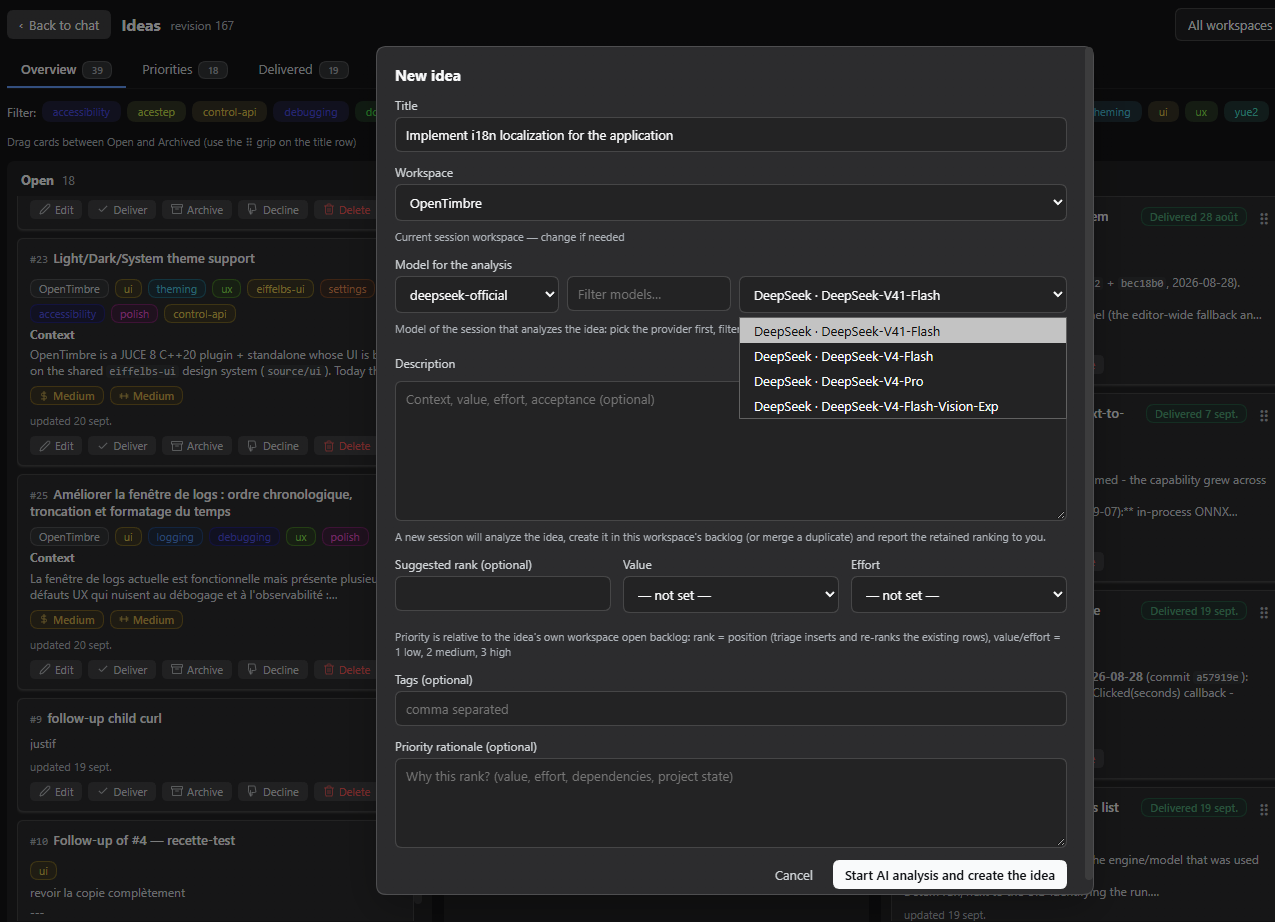
- Capture an idea with the New idea button or the quick-add row at the top of the Open column — a Title is the only required field.
- Optional description (markdown), tags, workspace and a Suggested rank.
- The AI capture button opens a fresh session that analyzes the draft, creates/merges the idea in the backlog, and reports the retained ranking.
A 4-column kanban
Open · Under review · Archived · Declined.
- Drag & drop moves cards between columns and reorders them; the columns auto-scroll when you drag toward an edge (vertically and horizontally when Archived/Declined are off-screen on a narrow window).
- Search and a conjunctive tag filter narrow the columns.
- Single click on a card title or body opens the edit modal (raw text or rendered markdown).
- Every card shows its stable
#Nnumber, workspace chip, tags, value/effort badges and update date.
Scoring & ranking
- Each idea carries Value and Effort (low / medium / high), shown as color-coded badges.
- The Suggested rank is the position in the open backlog of its workspace; entering one re-ranks the backlog transactionally (existing rows shift).
- A dedicated Priorities tab ranks the open ideas per workspace, with ↑/↓ buttons and drag & drop to re-rank.
The lifecycle
- Deliver ✓ archives the idea with a green Delivered {date} stamp.
- Under review is the recette gate: finished work lands there, and each card offers Recette OK (deliver), Follow-up needed (creates a linked open child plus justification, archives the parent) and Decline.
- Delivered tab shows the exit log (delivered vs. manually archived).
- Restore, archive and delete are one click away on each card.
Workspaces
- A header selector scopes the board to one workspace (or all / none).
- New ideas default to the current session's workspace when not scoped.
- The New/Edit modal carries a workspace field so a capture lands in the right place and an idea can be moved to another workspace.
TaskBoard integration
When the TaskBoard plugin
(@linxin666/dsh-client-ui-task-board,
repo: zhu1090093659/dsh-web) is
present, the Ideas manager mirrors its ledger onto TaskBoard's backlog so
both tools stay in sync — one-way (Ideas → TaskBoard).
The mirror is detected at runtime (GET /api/task-board/state); if TaskBoard is
absent the Ideas manager simply works standalone.
| Ideas action | TaskBoard mirror |
|---|---|
| Create idea | New read-only card in backlog (bound to the idea id) |
| Update idea | Card updated |
| Decline / drag to Archived | Card archived |
| Restore | Card restored |
| Delete | No-op (closing to done stays manual) |
Task-Board card reaches done | Idea auto-moves to Under review (the recette gate) |
Triage (scores, rationale, rank) is ideas-only and is never mirrored — it's a backlog opinion, not a board state.
Card weight: the card description carries the idea's summary (<= 300
chars, produced by the ideas-analyst; a derived body excerpt otherwise) while
the full analysis rides the card prompt (the run instruction) and the ledger
— the body is never stored twice in the snapshot.
Duplicate guard (exactly one card per idea)
Card ids are deterministic (idea- + the idea id), so re-running any
mirror path re-touches the same card instead of minting a twin. A bound idea's
card is only rebuilt when a non-empty task-board snapshot proves it was
deleted out-of-band — every ensureTask decision (idea id, binding, snapshot
size, branch) is logged, and an empty or unreadable snapshot keeps the binding
and attempts the patch, never a create. Mirror operations are serialized per
idea id, so a create always completes (and binds) before a following update
runs — "update" can never silently mean "create".
Two scripts close the loop:
node scripts/reconcile-taskboard-mirror.mjs [--url …] [--apply]— detects orphan duplicates (unbound card whose exact title matches a bound idea) and archives them, always keeping the bound card; dry-run by default.node scripts/validate-mirror-cycle.mjs [--base …]— live recette against a test instance: create → re-analyze → analyst rewrite → decline must end with exactly one card.
Note for agent-driven workflows: the capture → triage → lifecycle protocol and the full wire contract are documented in
SKILL.md, so an agent can author cards directly over the HTTP API without the UI.
Host API (agents)
The Host exposes a REST API so scripts and agents can read the board and write
ideas. Prefix /api/ideas, same-origin fence (loopback socket + browser
markers), JSON envelopes { requestId, action, initiator? }.
| Route | Purpose |
|---|---|
GET /api/ideas/state | { schemaVersion: 1, revision, ideas[] } |
POST /api/ideas/action | create, update, move, decline, deliver, followUp, triage, restore, delete, reanalyze, reorder, import, export |
GET /api/ideas/events | SSE { revision } |
Every action is deduplicated by requestId (fresh id per call), and a
mutating action returns the whole board so the caller can confirm the result.
Full contract (verb table, mirror mapping, PowerShell gotchas) lives in
SKILL.md.
Host compatibility
- Requires Host >= 0.1.5 (see
dsh.engines.dshinpackage.json). - On Host >= 0.1.7 the client retains the agent scope before prompting:
sessions.scope(id)became a pure read there (a just-created session is no longer visible through it until its scope is retained), so the AI capture / re-analyze launcher first callsretainAgentScope(id)— which materializes the scope — takes the context from the reference'sbinding.ctx, prompts, and always releases the retention (success, prompt rejection or missing session face). - On Host <= 0.1.5 the method does not exist and the launcher keeps the
exact previous call sequence (
scope(id)materializes the scope on demand).
Install & update
From npm (recommended):
dsh plugin --profile web add dsh-plugin-ideas-manager
Pinned to a version:
dsh plugin --profile web add dsh-plugin-ideas-manager@0.2.6
From a local checkout (no registry needed):
dsh plugin --profile web add link:/path/to/dsh-plugin-ideas-manager
From a git URL (fallback, pinned to a released tag):
dsh plugin --profile web add github:EiffelBS/dsh-plugin-ideas-manager#v0.2.6
dsh plugin runs pnpm add in the profile directory, then reconciles
dsh.profile.bundles: because this package declares a dsh.bundle, it is
auto-appended as a profile layer. Restart the web instance (or open a fresh
page session) for the bundle change to take effect.
Verify installation:
dsh web --profile web --no-open # then look for the Ideas entry in the sidebar
To pick up a newer revision after a release (versions follow the package's
version field; releases are tagged, e.g. v0.2.6):
dsh plugin --profile web add dsh-plugin-ideas-manager@latest
then restart the web instance.
Uninstall / disable:
dsh plugin --profile web remove dsh-plugin-ideas-manager
Maintainers: bump
versioninpackage.jsonon each meaningful push so an installed profile's version stays observable (e.g. viadsh plugin lsorpnpm listin the profile directory).
Build, test & install (dev)
pnpm run typecheck   # tsc --noEmit
pnpm test            # vitest (protocol gate, ledger persistence, export golden, mirror, markdown parser)
pnpm run build       # tsc -p tsconfig.build.json (types -> lib/types) && tsdown (lib/index.js + lib/client.js)

# isolated test profile (never the production profile of a live instance)
dsh --profile ideas-test --from-default-profile web --dump-config
dsh plugin --profile ideas-test add link:C:/path/to/dsh-plugin-ideas-manager
dsh --profile ideas-test --port 3099                # omitting --no-open opens the browser with the token URL
The browser half is served at /plugins/<id>/client.js (re-resolved per
request); the host half registers the /api/ideas routes at boot.
Architecture
src/
  index.ts            # apply + mountOnce + Config + guidance section
  protocol.ts         # /api/ideas prefix, types, parseActionEnvelope (exactKeys)
  host-service.ts     # apply + mirror scheduling
  host-ledger.ts      # persisted ledger, dedupe cache, lock, internal bind
  host-routes.ts      # state / action / events + loopback guard
  taskboard-bridge.ts # runtime feature-detect + one-way mirror (no hard import)
  export-markdown.ts  # unidirectional ledger -> markdown (golden-tested)
  http.ts / loopback.ts / mount-once.ts   # shared discipline
  core/ideas.ts       # IdeaRecord, statuses, tag validation
  client/             # sidebar entry + kanban + Priorities/Delivered + workspace scoping
tests/                # vitest suites per module
  SKILL.md / README.md
Persistence lives in ~/.dsh/ideas/ledger-v2.json (atomic tmp+rename writes,
corruption quarantine, single-writer lock, restart-safe request-id dedupe).
License
MIT — see LICENSE.
Plugin correlati
archify (deepseek-harness)
tt-a1i/archify
WeKnora (dsh-weknora)
tencent/weknora
weknora
tencent/weknora
BrowserSkill (dsh-plugin-browserskill)
tencent/browserskill