deep-projects
joblessjoe/deep-projects
Project rooms for the web GUI: each project is a plain folder with a goal, a memory list, AGENTS.md instructions and knowledge files, shown on a Projects page and pinnable in the sidebar; chats started from a project run in its folder, so dsh loads the goal and memory from AGENTS.local.md natively, and 8 agent tools (projects_*) let agents read and maintain projects.
Installazione
dsh plugin --profile web add github:joblessjoe/deep-projectsREADME
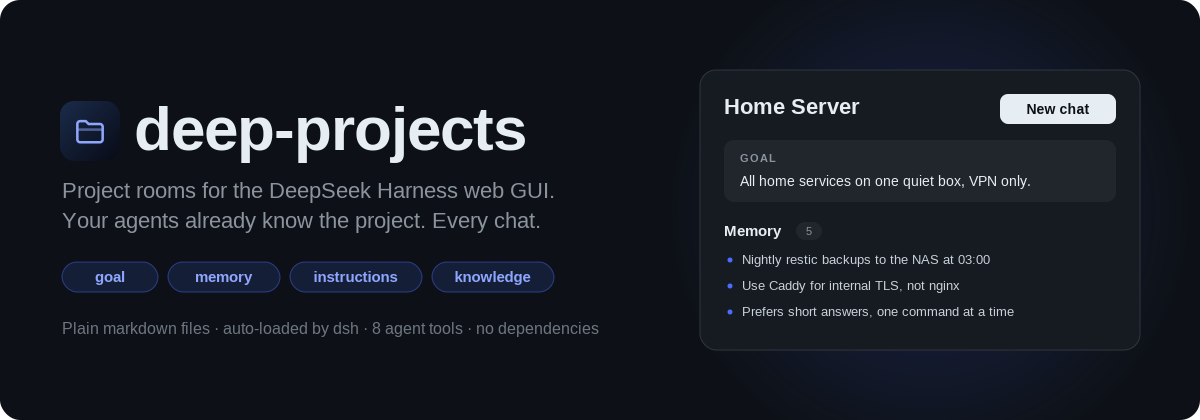






A DeepSeek Harness (dsh) web GUI plugin that gives every project its own room: a goal, custom instructions, knowledge files and a memory your agents keep up to date. Start a chat in the room and the agent already knows the project. You never explain it twice. Think Claude Desktop's Projects, built for dsh and your local models.
npx @deepseek-ai/dsh plugin --profile web add deep-projects
Then restart your dsh web server and reload the tab. Projects appears in the sidebar. Full details under Install.
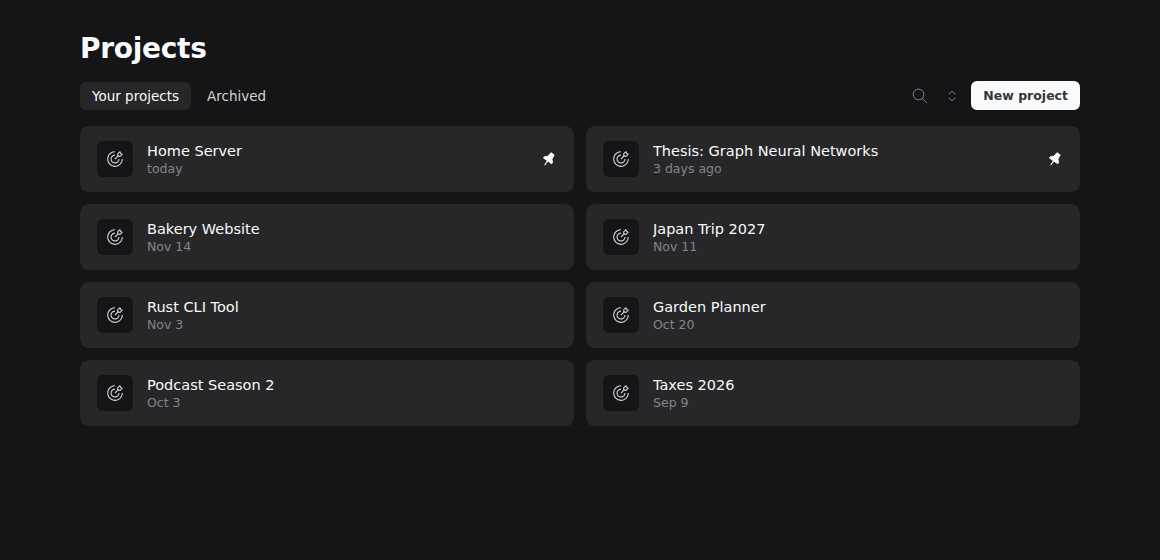
All projects as tiles. Pinned first, then by last activity.
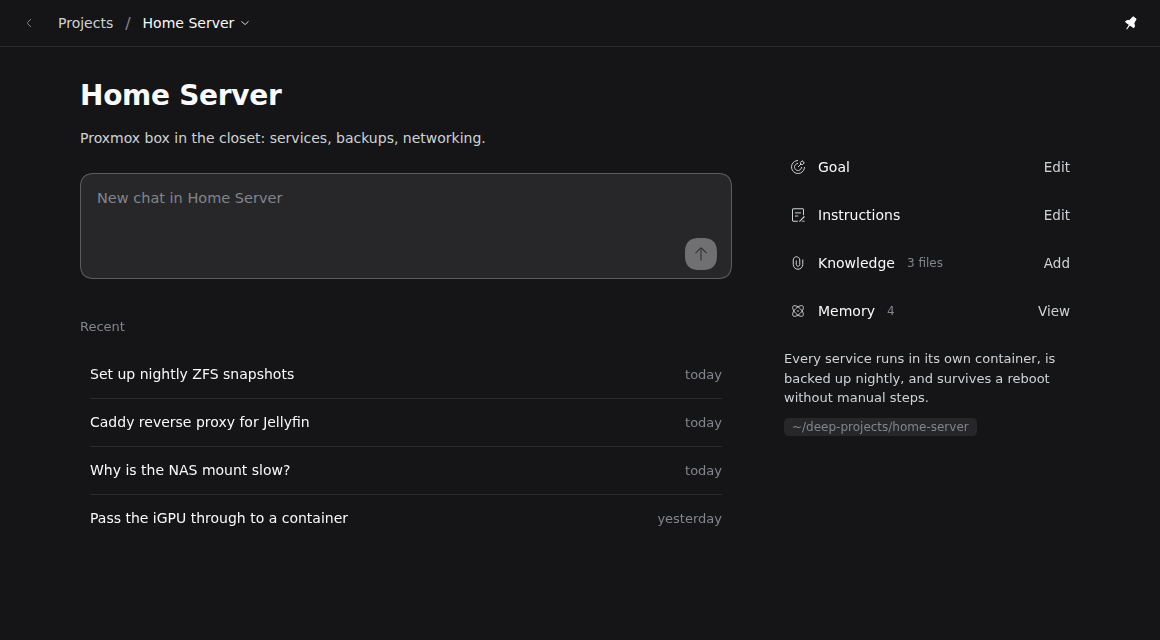
One page per project: type to start a chat right away, reopen recent chats, edit goal, instructions, knowledge and memory.
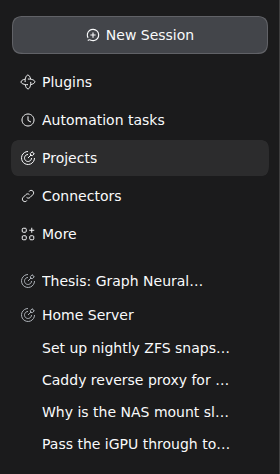
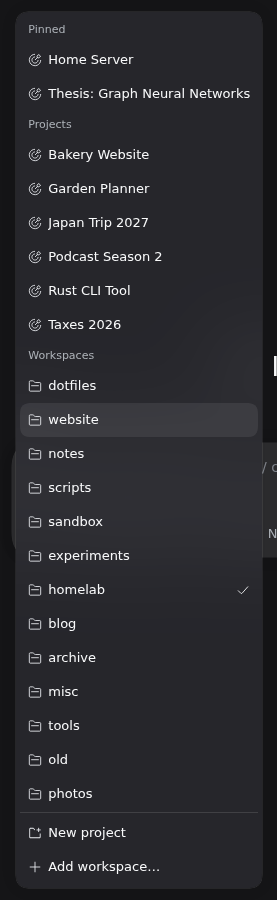
Left: pinned projects in the sidebar. Right: one picker for projects and workspaces on dsh's new chat screen.
What's in a room
- Goal: what the project is for and what done looks like. Every chat sees it.
- Memory: facts, decisions and preferences, one bullet each. You add and edit them; agents add new ones as they learn and fix stale ones. Every chat sees it.
- Custom instructions: the project's
AGENTS.md, edited in place. - Knowledge files: drag and drop docs, specs and references for the agent to read.
- Chats: every chat started from the project runs in its folder and shows up under "Recent" on the project page.
Features
- Projects page in the style of Claude Desktop: a grid of project tiles with search, sort, and tabs for active and archived projects. Pinned projects come first.
- Project page: type into the box to start a chat in the project right away. Below it, the project's recent chats. On the right, goal, instructions, knowledge and memory, each opening an editor.
- Pinned projects in the sidebar, styled like dsh's own rows. Click to open, or use the arrow to show the project's chats.
- "…" menus that match dsh's: open, new chat, edit, pin, archive, delete. Chat rows get dsh's usual chat menu.
- Move to project on every chat's "…" menu. The chat's current project has a check mark.
- Archive: hide finished projects without deleting anything. Restore any time.
- One picker for projects and workspaces on dsh's new chat screen, in place of its workspace chip. Pinned projects first, then all projects, then workspaces, plus "New project" and "Add workspace…".
- Project tab in the right sidebar of every chat that belongs to a project, plus a folder button in the chat header.
- 8 agent tools, so agents can read and maintain projects themselves (see below).
- English and Chinese, light and dark theme, works on narrow screens. No runtime dependencies.
How it works
Each project is a plain folder:
~/deep-projects/<slug>/
  AGENTS.md         custom instructions
  AGENTS.local.md   goal + memory
  README.md         description
  knowledge/        your files
dsh already loads AGENTS.md and AGENTS.local.md from a chat's working folder. Chats started from a project run in that folder, so the goal, memory and instructions reach the model natively, with no prompt injection. Everything is plain markdown: read it, edit it by hand, or commit it to git.
- Host: JSON routes under
/api/deep-projects/on the dsh web server, plus the agent tools. All file access stays inside the projects folder. - Client: one self-contained bundle. It uses dsh's own design tokens, icons and context menus, so it looks native in both themes.
Agent tools
| Tool | What it does |
|---|---|
projects_list | List projects |
projects_create | Create a project |
projects_read | Read goal, instructions, memory and the knowledge list |
projects_update | Change name, description, goal, instructions, pin or archive state |
projects_add_note | Add one memory |
projects_set_memory | Rewrite the memory list (fix, merge or remove entries) |
projects_add_knowledge | Copy a file into the project's knowledge |
projects_delete | Delete a project (its chats are kept) |
The memory file tells agents to keep it current, so they record new facts without being asked.
Install
Into your dsh web profile (web below is the profile name; use whichever profile backs your web GUI). From a source checkout, use pnpm dsh instead of npx @deepseek-ai/dsh:
npx @deepseek-ai/dsh plugin --profile web add deep-projects
Restart the dsh web server afterwards (the plugin adds a new profile entry), then reload the browser tab.
Other sources:
# straight from GitHub
npx @deepseek-ai/dsh plugin --profile web add github:JoblessJoe/deep-projects
# from a local checkout
npx @deepseek-ai/dsh plugin --profile web add file:/path/to/deep-projects
Projects folder: ~/deep-projects by default. Set DSH_PROJECTS_ROOT in the dsh server's environment to use another folder.
Requirements: the dsh web GUI, dsh 0.2.2 or newer (engines.dsh: >=0.2.2-rc.1 <0.4.0-0), Node 20+.
No dsh patches needed
The plugin works on stock dsh. Three spots have no plugin seat, so it adjusts dsh's own UI from the plugin:
- Sidebar tree: mounted between the panel rows and the workspace list. If a dsh update changes the sidebar's layout, pinned projects fall back to plain sidebar rows that open the project.
- Project chats use dsh's normal new chat screen. dsh greys out its input for chats outside a workspace; the plugin lifts that for project chats.
- Workspace chip: replaced by the combined picker. Picking a workspace and "Add workspace…" still run dsh's own flow.
If a dsh update changes these internals, you get dsh's plain behavior back (plain sidebar rows, a greyed-out input in new project chats).
Develop
npm install
npm run build              # lib/index.js (host) + lib/client.js (web)
node scripts/smoke.mjs     # routes + agent tools against a temp folder
DSH_REPO=/path/to/deepseek-harness node scripts/validate-tools.mjs   # dsh's real tool validator
License
MIT