dsh-memory-vault (memory-mcp)
luisarg03/dsh-memory-vault/packages/memory-mcp
Bridges the agent to a persistent OKF memory vault over MCP stdio: a Python server (SQLite FTS5 + Markdown) with 10 tools for searching and storing decisions, facts, learnings, conventions, profiles and sources.
Installazione
dsh plugin --profile web add github:luisarg03/dsh-memory-vaultQuesto plugin si trova nella sottodirectory packages/memory-mcp del repository.
README
dsh-memory-vault











Persistent OKF memory for DeepSeek Harness (DSH):
a Python MCP server (SQLite FTS5 + Markdown), two Cordis plugins (memory-mcp, memory-auto)
that expose it to the agent as tools and commands, and a vault starter with templates and a
type registry.
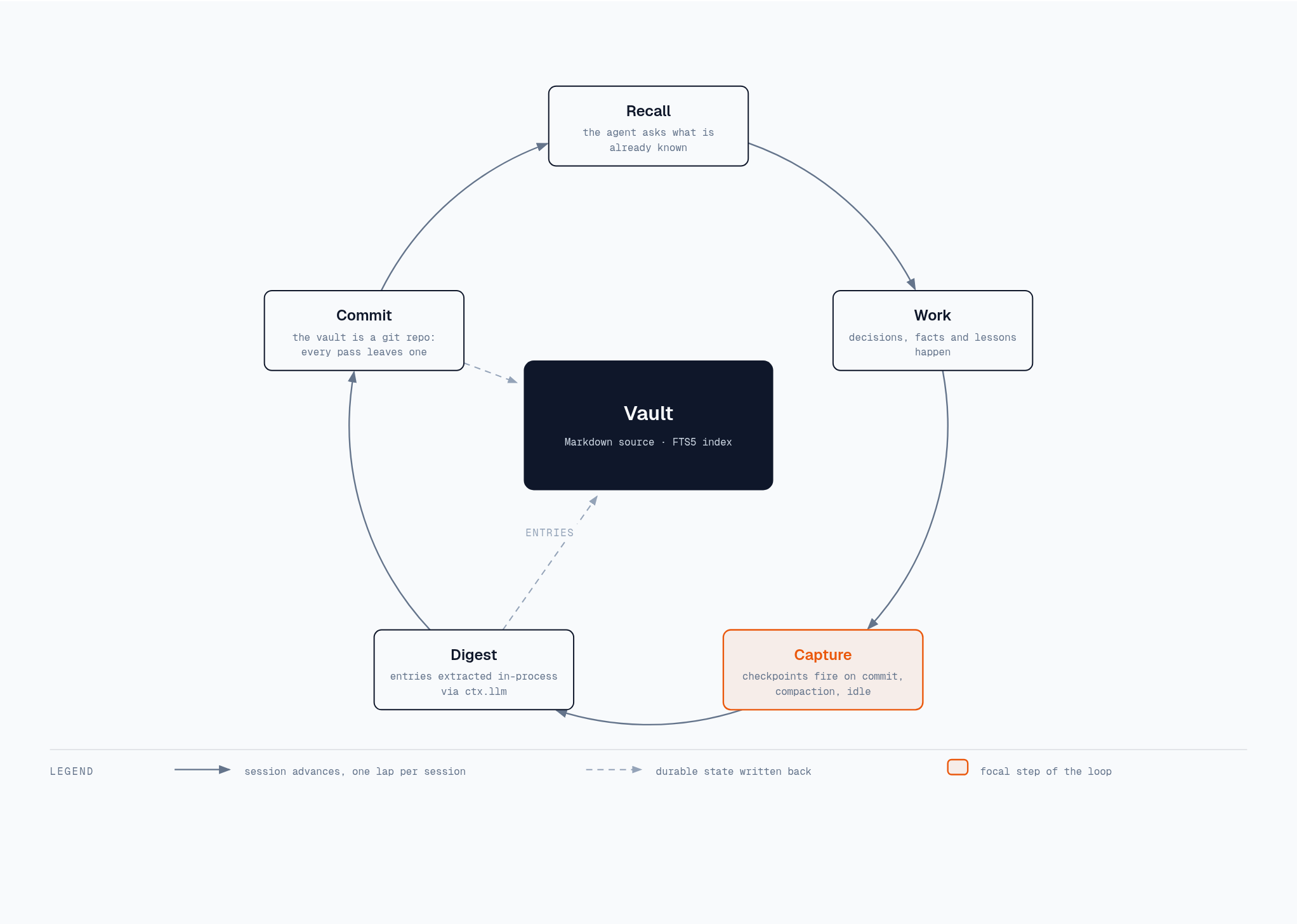
One lap per session: the agent recalls what the vault already knows, works, the checkpoints capture what happened, and the digest commits the durable state back — so the next lap starts from a richer record. Markdown stays the source of truth; SQLite FTS5 is an index derived from it.
What an install gives you
| 10 MCP tools | search_memory · store_decision · store_fact · store_learning · store_convention · store_profile · store_source · export_memories · get_profile · ping |
| 3 commands | /brain and /checkpoint ship with memory-mcp; /checkpoint-auto ships with memory-auto |
| Automatic capture | digests on git commit, compaction, idle and session end — extracted in-process through the harness's own LLM service |
| A vault | OKF bundle with per-type templates, a type registry and a tag vocabulary; runtime data is created on first use |
Install
# 1. install both plugins (npm, prebuilt — no build approvals, no repo clone)
dsh plugin --profile web add @luisarg/memory-mcp@0.1.7 @luisarg/memory-auto@0.1.7

# 2. launch — first boot installs the vault server under $DSH_HOME (~/.dsh by
#    default) and the vault starter at ~/.memories, automatically
dsh web

# verify
dsh --profile web --dump-config | grep -A8 memory
The version is pinned because pnpm's default
minimumReleaseAge(3 days) would otherwise resolve an older release. The bundled Python server is refreshed on every boot; the vault is never overwritten — it copies only what is missing, so your entries survive upgrades.
Upgrading from 0.1.5: the default vault moved from
$DSH_HOME/memory-vaultto~/.memories(the central zone indocs/central-zone.md). Entries written by 0.1.5 therefore stay in the old directory until you move them (rsync -a --ignore-existing ~/.dsh/memory-vault/projects/ ~/.memories/projects/) or pointDSH_MEMORY_PATHback at it.
Developers (local checkout instead of npm):
dsh plugin --profile demo add ./packages/memory-mcp ./packages/memory-auto
Offline: pnpm --filter @luisarg/memory-mcp pack and add the .tgz files. Installing the
repo root from GitHub is not supported (the root has no dsh.bundle; pnpm lacks git
subdirectory specs) — use npm or the tarball.
Releases are published by CI: pushing a v<version> tag builds, tests, validates the tarballs
and publishes both packages to npm with a
provenance attestation, authenticated
by GitHub OIDC — no publish token exists in this repository or on the maintainer's machine. What
runs before an artifact ships is in docs/releasing.md.
Components
| Component | What it does | Bundle |
|---|---|---|
memory-mcp | MCP stdio client: spawns the vault server, exposes its tools and the brain / checkpoint skills | @luisarg/memory-mcp |
memory-auto | Session hooks + in-process digest, and the checkpoint-auto skill | @luisarg/memory-auto |
memory-vault-server/ | Python MCP server: SQLite FTS5 + Markdown OKF | — |
memory-vault/ | Vault starter: templates + type registry + tag vocabulary | — |
scripts/digest_session.py | Optional standalone digest CLI (not used by the plugins) | — |
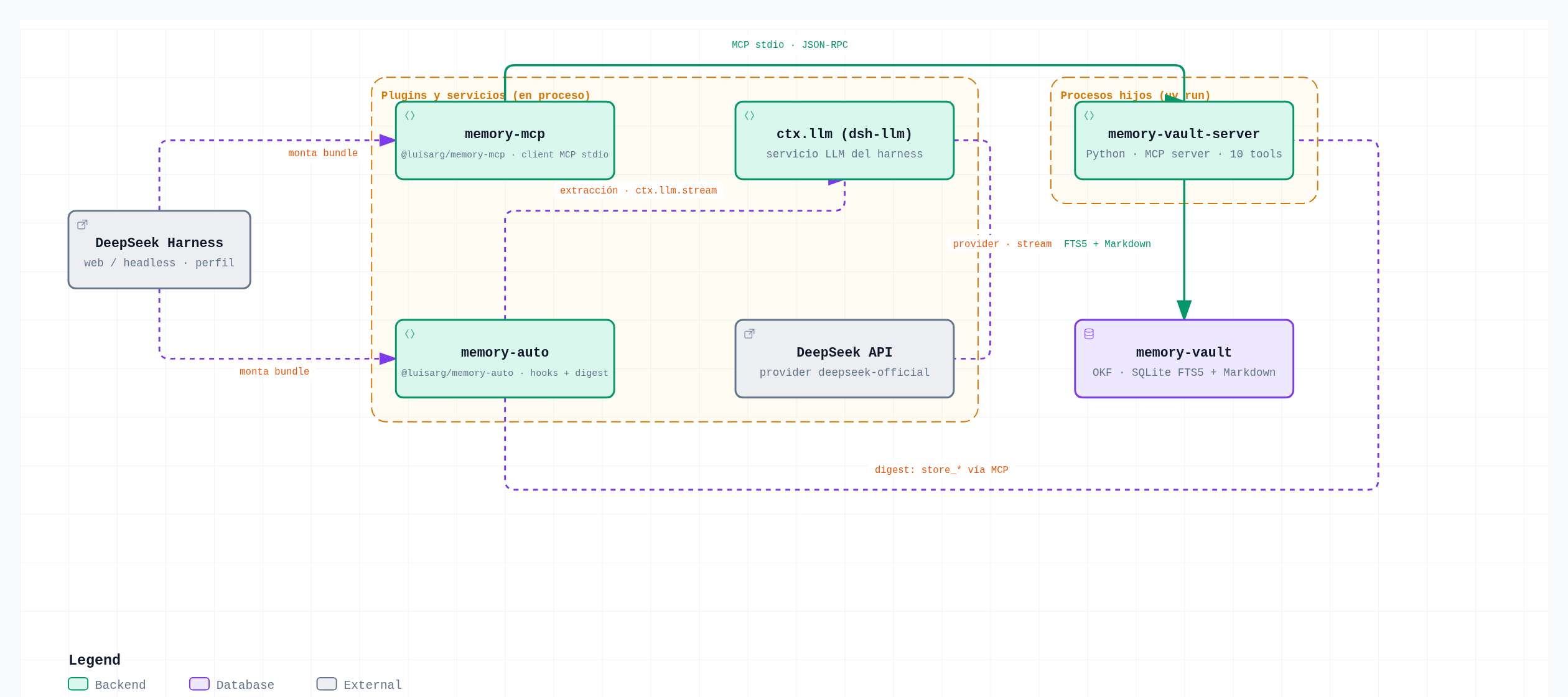
Use it
Ask in the chat
The agent reaches the vault through MCP tools (mcp__memory__* — the server is named memory);
you do not call them yourself:
| You say | Tool the agent uses |
|---|---|
"search your memory for <topic>" | search_memory |
"remember this: <fact/decision>" | store_decision / store_fact / … |
"export everything you know about <project>" | export_memories |
| "summarize my profile" | get_profile |
Bundled skills
Both plugins also ship the commands that drive those tools, so a fresh install gets them without copying anything into a skill directory:
| Command | Ships with | What it does |
|---|---|---|
/brain | memory-mcp | Reads the vault: topic search, recall by project, profile, full export |
/checkpoint | memory-mcp | Captures the session as decision/fact/learning/convention entries, then commits the vault |
/checkpoint-auto | memory-auto | Explains and steers the automatic capture: triggers, the [memory-checkpoint] marker, the knobs |
They register at DSH's bundled rank, the weakest in the local discovery table, so a skill of
the same name in ~/.agents/skills, ~/.dsh/skills or a project's .agents/skills still wins —
these are defaults, not a takeover. To override one, copy its SKILL.md out of
packages/*/skills/ into your skill root and edit it: the file is the single source of its own
name, description and usage guidance, so it works in both places.
Automatic capture
memory-auto triggers digests on git commits, compactions, idle sessions and session end. Digests log as
[memory-auto] … lines in the harness console, and the entries land under
<vault>/projects/<project>/<type>/ (Markdown) plus the SQLite FTS5 index. The extraction runs
in-process through ctx.llm — the credentials DSH is already configured with — so there is no
external CLI and no stored key. Set enabled: false in the plugin config to turn it off.
Configuration
DSH does not chdir: the launch directory is irrelevant and paths are absolute. They resolve in this order:
- Env vars (override everything):
DSH_MEMORY_PATH,DSH_MEMORY_SERVER_DIR. - Defaults: the vault at
~/.memories(the OS home —DSH_HOMEdoes not move it) and the server at$DSH_HOME/memory-vault-server(~/.dshwhen$DSH_HOMEis unset). - Profile patch (
cordis.patch.yml) or--patchoverlay with explicit values.
| Env var | Used for | Default |
|---|---|---|
DSH_MEMORY_PATH | vault directory (the server receives it as MEMORY_PATH) | ~/.memories |
DSH_MEMORY_SERVER_DIR | directory with server.py | $DSH_HOME/memory-vault-server |
Plugin-level config (patch layer): provider (deepseek-official), model
(deepseek-v4-flash), maxTokens, minTranscriptChars, enabled.
The vault starter is an OKF bundle: templates/ (one per entry type), type-registry.yaml
(source of truth for types) and tag-vocabulary.json (tag normalization). Runtime data
(projects/, raw/, logs/, memory.db) is created by the server on first use and excluded
from git.
Runtime for the server: uv on PATH is recommended but not required. The bundled
launcher.mjs runs the server with uv run when uv is present, and otherwise falls back to a
pip-managed venv (python3 -m venv + pip install -r requirements.txt; the first boot needs
network). Both packages are self-contained: they ship the Python server and the vault starter.
Operations
# composed config shows both bundles with the resolved paths
dsh --profile web --dump-config | grep -A8 memory

# what the vault holds (default vault: ~/.memories)
ls ~/.memories/projects/               # per-project OKF entries
grep -i "digest" ~/.memories/log.md    # digest markers

# talk to the vault MCP server directly (standalone smoke test)
printf '%s\n' \
  '{"jsonrpc":"2.0","id":1,"method":"initialize","params":{"protocolVersion":"2025-06-18","capabilities":{},"clientInfo":{"name":"cli","version":"0"}}}' \
  '{"jsonrpc":"2.0","method":"notifications/initialized"}' \
  '{"jsonrpc":"2.0","id":2,"method":"tools/call","params":{"name":"ping","arguments":{}}}' \
  | MEMORY_PATH=$HOME/.memories uv run --directory memory-vault-server python server.py

# a second harness instance on another port (testing without touching your main session)
pnpm dsh web --port 3090
Troubleshooting pnpm
unable to open database file→ the pnpm store is not writable (sandboxed environment). Use--store-dir ./.pnpm-storeon everypnpm installand ondsh plugin --profile X --store-dir ./.pnpm-store add ....dsh: pnpm failedwhen installing from GitHub → only applies to packages with apreparescript; copy the printed key into the profile'spnpm-workspace.yaml(allowBuilds). The subpackages of this monorepo cannot be installed withgithub:...at all — use npm or a tarball.
Second MCP client: opencode
The vault is a plain stdio MCP server, so any MCP client can use the same server and the same
vault (see docs/central-zone.md for the shared-vault layout). For
opencode, ~/.config/opencode/opencode.json:
"mcp": {
  "memory-server": {
    "type": "local",
    "command": ["uv", "run", "--directory", "<repo>/memory-vault-server", "python", "server.py"],
    "enabled": true,
    "environment": { "MEMORY_PATH": "<absolute path to your vault>" }
  }
}
The key must be
environment—envis silently ignored and the server falls back to the default vault. The plugin skills are a DSH feature and do not travel over MCP: an opencode user who wants the same commands copies theSKILL.mdfiles into a directory opencode reads (~/.config/opencode/skills/<name>/SKILL.md), renaming the tool prefix frommcp__memory__*tomemory-server_*.
Development
pnpm install
pnpm -r build

# run the harness against the checkout, with an overlay (paths relative to the repo cwd)
dsh web --patch ./examples/dev-memory.cordis.yml
packages/memory-mcp/          # cordis bundle: MCP stdio client (+ brain, checkpoint skills)
packages/memory-auto/         # cordis bundle: automatic session digest (+ checkpoint-auto skill)
memory-vault-server/          # Python MCP server (SQLite + Markdown OKF)
memory-vault/                 # vault starter (templates + type registry)
scripts/digest_session.py     # optional standalone digest CLI (not used by the plugins)
examples/dev-memory.cordis.yml       # memory-mcp
examples/dev-memory-auto.cordis.yml  # memory-mcp + memory-auto
pnpm -r build runs each package's build; pnpm bundle copies the server and the vault starter
into the packages, so a release tarball is self-contained. CI runs lint, build and the test
suites on every push (pnpm lint && pnpm -r build && pnpm -r test).
Docs
docs/— architecture, diagrams, the central zone, releasing- Releasing & version tags — which commit each
v*tag maps to - Your first plugin
- Build a tool
- Plugin configuration
- Package and install