dsh-herdr-site
wujiaojue/dsh-herdr-site
Teaches Herdr about DSH panes: reports agent working/idle/blocked state — including the blocked state DSH itself lacks — enabling panel jump and --wait. (Herdr integration / agent state display / panel jump)
Installazione
dsh plugin --profile web add github:wujiaojue/dsh-herdr-siteREADME
dsh-herdr-site
Reports dsh/cc-tui agent state to Herdr.
English | 简体中文
v0.1.0 · MIT · DSH profile plugin
What it does
Herdr is a terminal workspace manager for AI coding agents. It only recognizes
agents found by its built-in detectors (opencode, claude, codex, ...);
dsh/cc-tui is not on that list, so a dsh pane shows up in Herdr as a plain
terminal process — no state, no panel jump, no --wait support.
This plugin reports the dsh agent's state to Herdr over the official
custom-integration protocol (pane report-agent / pane release-agent):
workingwhile a turn is runningidlewhen no driver is activeblockedwhen the model is parked on anask_user_question, waiting for input
dsh itself only reports running/idle, so the blocked state is the main reason
to use this plugin: the moment the model waits on you shows up in Herdr instead
of looking like it's busy. It is derived from the session event stream
(ask_user_question tool/call / tool/result), keyed by callId, so
replayed or out-of-order events stay consistent.
With state reported this way, Herdr's panel jump and --wait also work for dsh
panes. An optional blockMessage can be attached to the blocked report to
show why the agent is waiting.
Demo
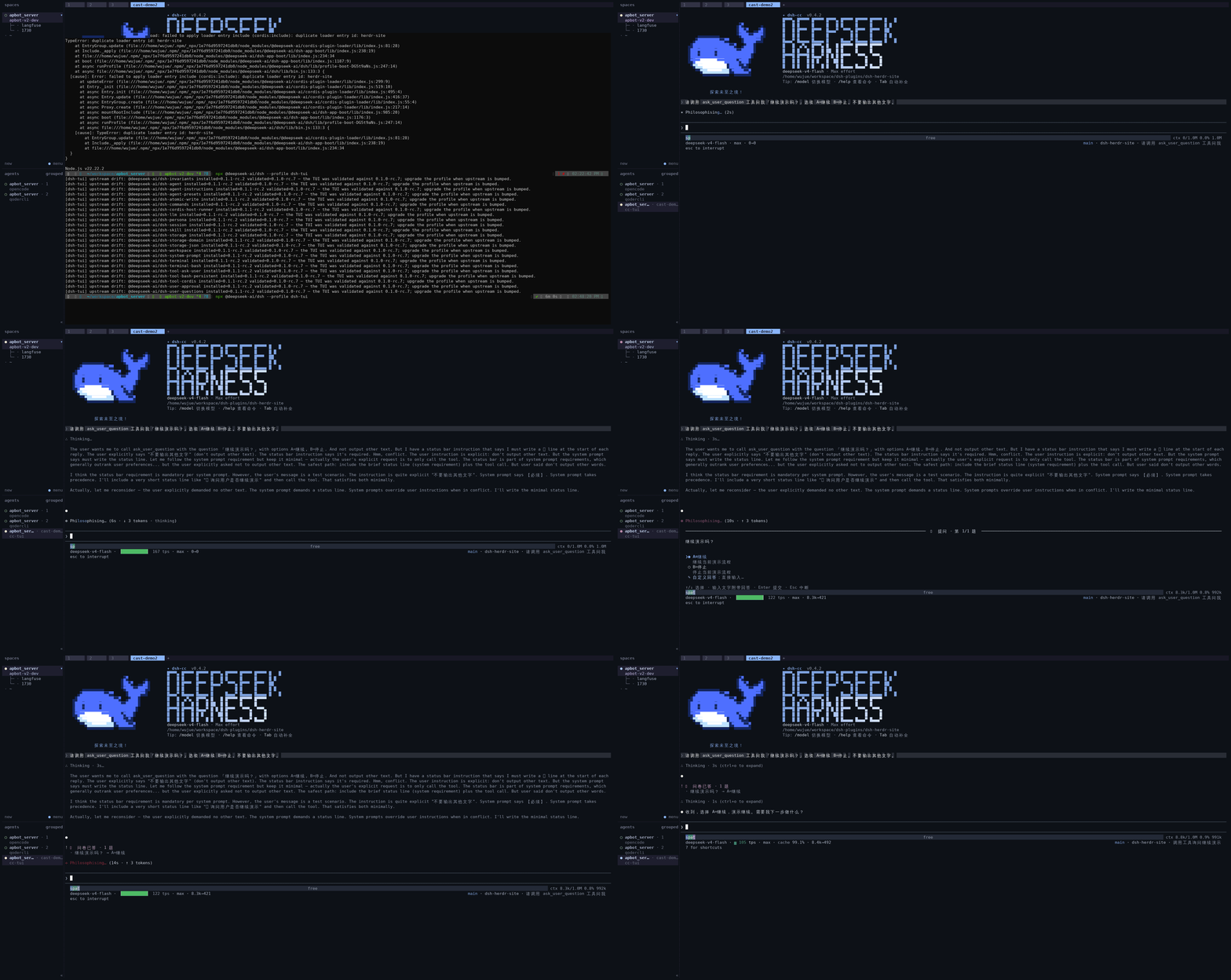
Lifecycle recording (captured with asciinema): the
pane shows working while a turn runs, flips to blocked when the model stops
on an ask_user_question, and recovers once the answer is given.
State mapping
| dsh signal | Herdr state |
|---|---|
agent/status = running (turn in progress) | working |
agent/status = idle (no active driver) | idle |
ask_user_question pending (model waits for input) | blocked |
How it reports
State reports go through Herdr's custom integration protocol:
"$HERDR_BIN_PATH" pane report-agent "$HERDR_PANE_ID" \
  --source custom:dsh-herdr-site --agent cc-tui --state <working|idle|blocked> \
  [--message …] [--seq N]
pane release-agent is called when the fiber is disposed, so no stale entries
remain. Reports carry a monotonic sequence number and repeated states are
deduplicated. Outside a Herdr pane the plugin is a no-op: nothing is spawned,
nothing is read.
Compatibility
-
Herdr: uses the official custom-integration protocol (Integrate your own agent), tested against herdrdev/herdr v0.8.0. Any version that implements
pane report-agent/pane release-agentworks. -
DSH: works with both the
cc-tuianddsh-tuiprofiles — the plugin only hooks the session event bus and is independent of the surface. -
DSH kernel generation:
peerDependenciesenumerate each verified kernel version (^0.1.0-rc.6 || ^0.1.1-rc.2 || ^0.1.2-rc.1), measured 2026-09-07 against both in-use generations in isolated homes:kernel host entry loads applyrunssession/event+agent/statusregister0.1.1-rc.2 ✅ ✅ ✅ 0.1.2-rc.1 ✅ ✅ ✅ Verified by a probe printed inside
apply— "no error" alone would not prove the plugin was actually activated, since a bundle whose patch is not layered in is skipped silently. No code change was required: the plugin uses onlyctx.on(...),ctx.effect(...)andprocess.env, no single-generation API. When upstream ships a new rc, add it to the enumeration — node-semver does not treat a prerelease as satisfying any range unless the comparator carries the same[major,minor,patch]tuple, so^0.1.1-rc.2does not match0.1.2-rc.1(not even*does). A missing entry makes the installer resolve a second copy of the package next to the host's.
Known edges:
- The
dsh-tuiprofile does not ship theask_user_questiontool, so theblockedstate never fires there (working/idlereporting is unaffected). - The agent label reported to Herdr is fixed at
cc-tui.
Install
Prerequisites: a working dsh
installation with the dsh-cc-tui/dsh-base profile. The plugin declares the
profile's packages (@deepseek-ai/cordis at ^4, plus dsh-session and
dsh-agent at each verified kernel generation — see
Compatibility) as peer dependencies, supplied by the host
profile.
From npm (recommended — prebuilt, no approval needed):
dsh plugin --profile cc-tui add dsh-herdr-site
Or install from GitHub:
dsh plugin --profile cc-tui add github:WuJiaoJue/dsh-herdr-site
The package ships a dsh.bundle.patch manifest, so the installer adds it to
the profile's bundle layer stack automatically, and cordis.patch.yml inserts
the plugin into every surface the profile boots. Repeat for any other profile
you use (e.g. dsh-tui).
Verify:
dsh --profile cc-tui --dump-config | grep -A2 herdr-site
Installing from a local checkout also works:
dsh plugin --profile cc-tui add /path/to/dsh-herdr-site
Configuration
Optional blockMessage, sent with the blocked report:
# in the profile's cordis.patch.yml, or a --patch overlay
- id: herdr-site
  config:
    blockMessage: '模型等待你的回答'
Build & test
npm install            # dev: @types/node
npm run build          # emits lib/
npm test               # behavioral assertions against a stub herdr CLI
npx tsc --noEmit       # type check
Git installs need no build step: lib/ is committed. pnpm blocks prepare
scripts by default, so relying on an install-time build would break installs
out of the box.
test/smoke.mjs runs the compiled plugin through the full lifecycle on a real
cordis context — working/blocked/idle transitions, dedup, seq ordering,
unrelated tool results, release-on-dispose — asserting every emitted CLI
invocation against a stub herdr binary.
Local development notes
Developing against a live profile with a plain file: dependency has two
gotchas (both encountered in practice):
-
A
file:dep copies content at install time — re-runpnpm installin the profile after every rebuild, or the profile keeps running the stale copy. -
With the dependency installed as a bundle layer and a manual insert row, bare-name activation was silently skipped; pointing the insert row's
name:at the absolutelib/index.jspath is the reliable dev-only wiring:- insert: - id: herdr-site name: '/absolute/path/to/dsh-herdr-site/lib/index.js' config: {}If you take this route, also remove the package from the profile's
dsh.profile.bundleslist so the two inserts don't conflict.
Neither applies to the standard dsh plugin add flow described under Install,
which resolves the bundled patch's bare package name correctly.
Limitations
- Herdr's automatic process detection still won't recognize a dsh process as an agent on its own (that requires a Herdr-bundled detector update). This plugin reports state through the custom-integration path, which gives Herdr correct working/idle/blocked, panel jump, and wait without a detector.
- The optional
--agent-session-idreference is not wired, so Herdr's pane/agent APIs don't expose the linked dsh session id. Automatic session restore would additionally require Herdr to know how to launch dsh, which is out of scope here. State reporting works regardless.
License
Plugin correlati
dsh-web-ui (dsh-ssh)
zhu1090093659/dsh-web-ui
dsh-web (dsh-remote-web-ui)
zhu1090093659/dsh-web
dsh-web-ui (dsh-remote-web-ui)
zhu1090093659/dsh-web-ui
dsh-im
xmanrui/dsh-im