dsh-plugin-marketplace
w2112515/dsh-plugin-marketplace
DeepSeek Harness 向けの、ツリー外にインストール可能なプラグインマーケットプレイスバンドル
インストール
dsh plugin --profile web add github:w2112515/dsh-plugin-marketplaceREADME
DSH Plugin Marketplace
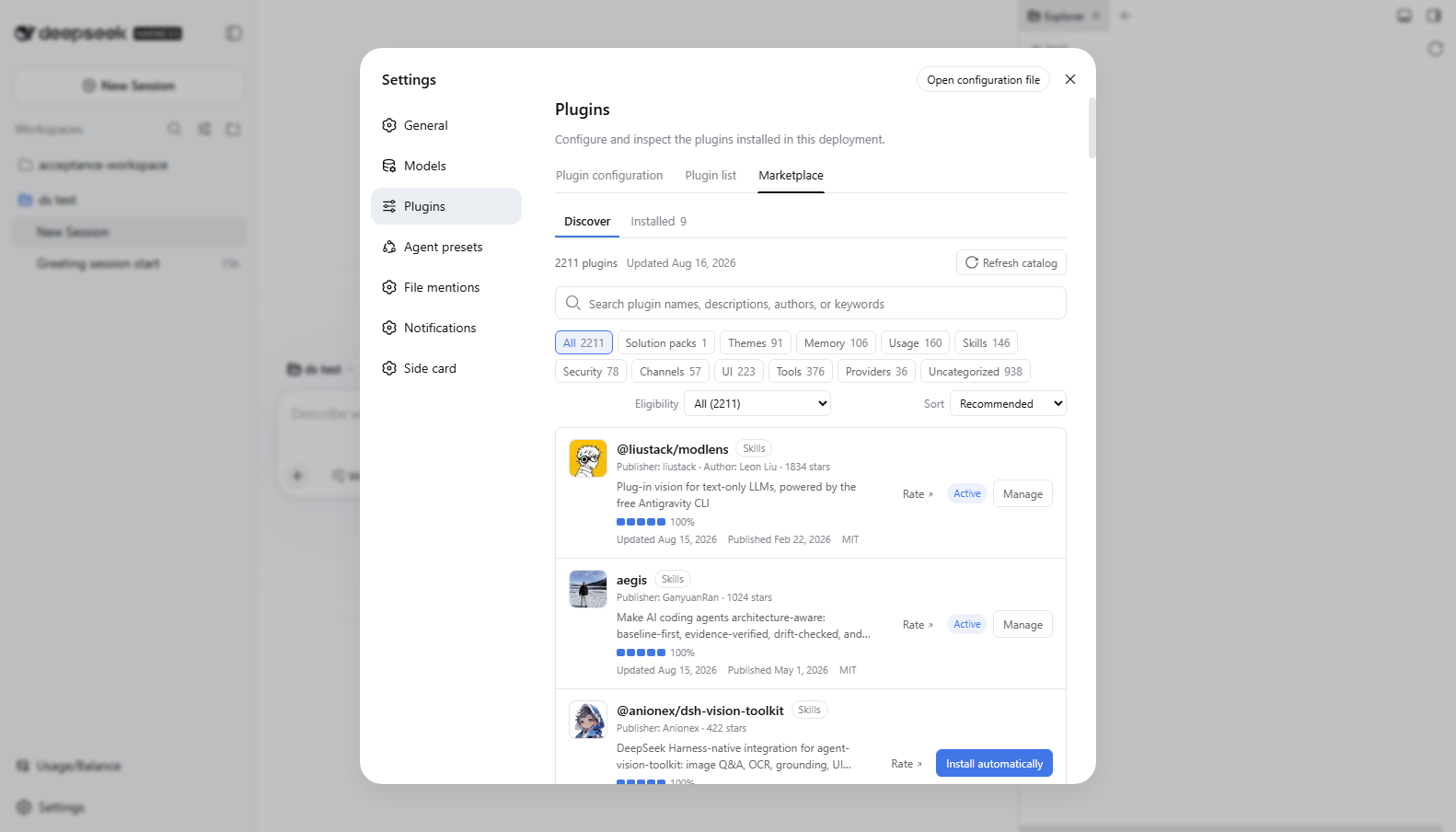
The plugin marketplace for DeepSeek Harness (DSH): browse, review, and install DSH plugins from inside DSH's own Settings UI — with evidence-based install safety, consent-gated install scripts, curated solution packs, and zero telemetry.
中文文档:README.zh-CN.md(界面语言跟随 DSH 自动切换)
What is DSH Plugin Marketplace?
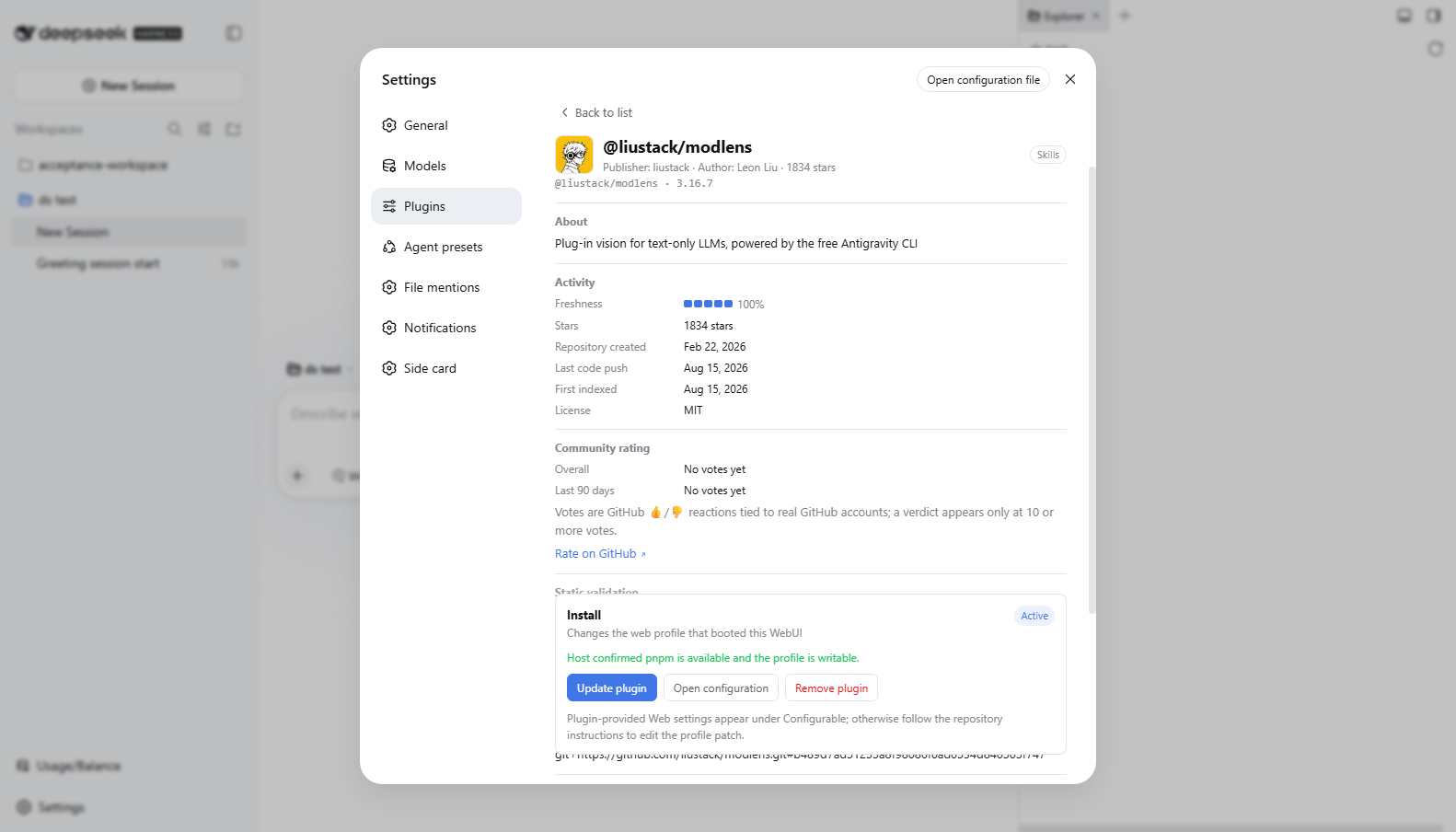
DSH Plugin Marketplace is an out-of-tree, installable DSH bundle that adds a full plugin marketplace to DeepSeek Harness. It is not part of the official DSH repository, requires no changes to DSH source code, and is not a standalone web product. Once installed into the web profile, DSH's Host Loader mounts the marketplace Host plugin, and the package's declared dsh.client browser entry registers itself under Settings → Plugins → Marketplace. The UI is bilingual and follows DSH's display language automatically (中文 / English).
At a glance:
- 2,200+ plugins discovered by a daily scan of every GitHub repository carrying the
dsh-plugintopic — no GitHub account or token needed to browse. - Evidence-based install eligibility: the scanner proves which install targets exist at each plugin's pinned commit, so "one-click" means proven installable, not probably fine.
- Consent-gated scripts: install scripts are shown verbatim and run only after explicit, per-install consent — never persisted, never bulk-approved.
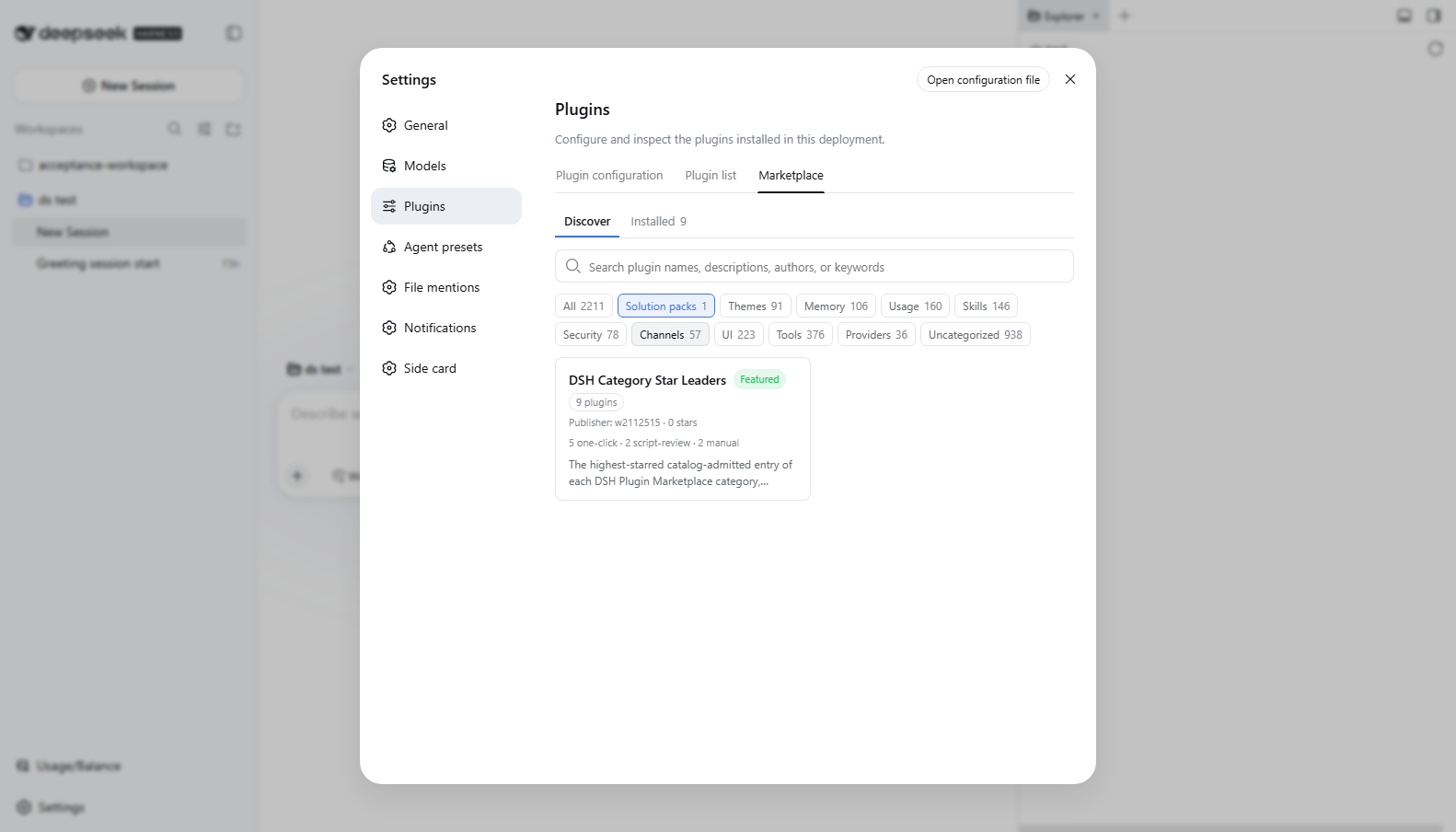
- Curated solution packs that install a coherent capability baseline in one reviewed action.
- No telemetry, no install counts, no server — the catalog is static JSON on GitHub Pages.
Install into your DSH
From npm:
dsh plugin --profile web add @w2112515/dsh-plugin-marketplace
Or pin an immutable commit from GitHub (this repository commits its built lib/, so no prepare runs on your machine):
dsh plugin --profile web add github:w2112515/dsh-plugin-marketplace#<40-char-commit>
Regular users need no GitHub token. Automatic installs require the Host to run pnpm 11 (the plugin also tries corepack pnpm); consent-gated script installs require pnpm ≥ 11.7. When no package manager exists, the WebUI keeps browsing and shows a recovery hint instead of a fake success. Uninstall: dsh plugin --profile web remove @w2112515/dsh-plugin-marketplace.
The default catalog is served from this repository's GitHub Pages. During development you can override it:
$env:DSH_PLUGIN_MARKETPLACE_CATALOG_URL = 'https://w2112515.github.io/dsh-plugin-marketplace/plugin-marketplace/catalog-v1.json'
dsh plugin --profile web add D:\Work\dsh-plugin-marketplace
dsh --profile web --dump-config
dsh web
Install safety
Automatic installs pin an immutable 40-character commit and always go through capability preflight → short-lived review plan → confirmed execution, with rollback of the profile manifest, lockfile, and workspace config on failure. Eligibility is decided by evidence at the pinned commit:
| Catalog entry | What the scanner proved | What happens on install |
|---|---|---|
| Automatic install | Every install target (entry files, patch) exists in the pinned commit's git tree | pnpm add --ignore-scripts — third-party lifecycle scripts never run |
| Needs script review | Targets are absent (build output not shipped), but the package declares lifecycle scripts | Scripts are shown verbatim in the review step; after your explicit consent, the Host installs once with --allow-build=<name> instead of --ignore-scripts, scoping script execution to exactly the reviewed package within that single invocation. Nothing is written to allowBuilds; consent is never persisted |
| Manual install | Neither of the above | Repository link only; the marketplace never runs anything |
Solution packs
A pack is a curated list of plugin repositories — nothing more. A repository becomes a pack by carrying both the dsh-plugin and dsh-plugin-pack topics plus a dsh.pack.json manifest:
{
  "schemaVersion": 1,
  "name": "My Essentials",
  "description": "A curated starter set",
  "items": ["owner/plugin-a", "owner/plugin-b"]
}
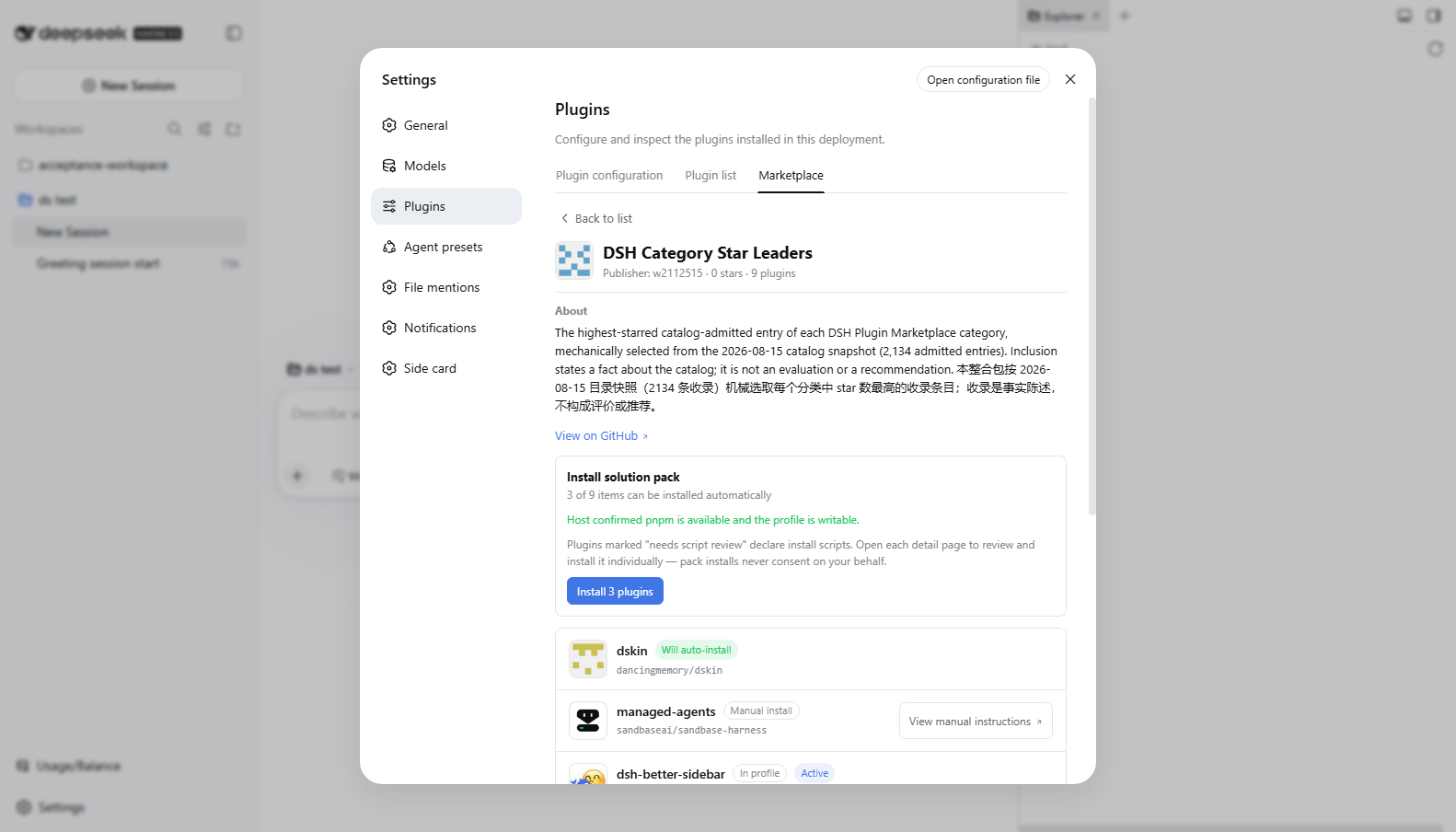
itemsholds 1–50owner/repostrings; resolution to stable repository ids happens at scan time against the catalog itself, so renames never rewrite identity silently.- The marketplace shows every item's explicit status — will auto-install, needs script review, manual install, not in catalog, already installed — and an honest
install N of Mcount. Pack cards also disclose the install composition up front (7 one-click · 1 script-review · 1 manual), computed from catalog truth at scan time. - Installing a pack runs the normal single-plugin plan→execute path serially, stops at the first failure, rolls nothing back, and reports each item's outcome.
- Packs grant no privilege: script-gated items still require their own per-plugin review and consent; manual items stay manual.
- Packs are never ranked by stars. Star ranking would reward stuffing a pack with the most-starred plugins — a star-sorted category view in disguise, not curation. Order is editorial first (packs reviewed by the marketplace maintainers for coherence and honesty, listed in
FEATURED_MARKETPLACE_PACKS), then freshness. Curation follows 宁缺毋滥 (quality over quantity): a missing capability slot stays empty rather than being filled with an unproven plugin.
If you use Codex, Claude Code, or Cursor to author a pack, install the portable dsh-marketplace-publish Skill. This page and the scanner remain the admission rules.
Community ratings
Ratings borrow GitHub's native reactions: every catalog plugin gets a ballot comment under the ratings issue, and a 👍/👎 reaction on it is a vote — one vote per real GitHub account. Detail pages show an overall window plus a trailing 90-day window, and no verdict appears below 10 votes. The client is read-only; voting itself happens entirely on GitHub, so the marketplace never holds your credentials.
For agents
The marketplace is agent-native: the Host plugin registers four tools the DSH agent can call in any session — marketplace_search, marketplace_detail, marketplace_install, and marketplace_manual_guide. Search and detail are read-only. Installs run the same plan→execute pipeline as the WebUI, and every call asks for one-time human approval with the plugin name, pinned commit, and risk signals in the prompt — consent is never persisted and never bulk-granted. Script-gated entries are refused by design (verbatim script review stays in Settings → Plugins → Marketplace); manual entries are never executed by the marketplace — the guide tool fetches the repository's own install instructions for the agent to follow with its ordinary shell tools. Plugins activate after a dsh web restart. Set agentTools: false in the bundle config to disable the agent surface.
An agent can also install the marketplace itself with its ordinary shell tool:
dsh plugin --profile web add github:w2112515/dsh-plugin-marketplace#<40-char-commit>
dsh --profile web --dump-config   # verify the bundle layer
# restart dsh web to activate
Privacy stance
The marketplace is read-only against a static catalog and never phones home: no install counts, no telemetry, no analytics endpoint. There is deliberately no server to collect them — the catalog is plain JSON on GitHub Pages, and every install decision happens on your machine. Popularity signals come from GitHub's own public data (stars), nothing else.
How it works
- Distribution unit: one npm/Git/tarball package declaring
dsh.bundle.patch. - Host: downloads and strictly validates the central static catalog (schema + integrity digest), keeps a last-known-good cache, and owns review and mutation of the current profile.
- Client: a
settings.plugins.tabSlot contribution providing search, category filters, detail pages, risk signals, review confirmation, and solution packs. - Host/Client channel: a package-private, same-origin
/api/plugin-marketplaceJSON API. DSH's static Typert Remote manifest is untouched. - Catalog production: a daily GitHub Actions scan of repositories carrying the
dsh-plugintopic. Only statically validated, non-archived bundles enter the public catalog; rejects are kept in the workflow artifact. Searches that hit GitHub's 1,000-result cap are bisected by creation-date windows. Only the central scanner uses the repository's ownGITHUB_TOKEN. - Categories: plugins are classified into nine categories (theme, memory, usage, skill, security, channel, UI, tool, provider) from an explicit
dsh-category-<slug>topic or conservative whole-word tokens; a plugin with no honest signal stays uncategorized rather than being misfiled.
For plugin authors
To be discoverable, your repository needs the dsh-plugin topic, a package.json declaring dsh.bundle.patch, and a valid cordis.patch.yml. An optional dsh-category-theme|memory|usage|skill|security|channel|ui|tool|provider topic sets your catalog category explicitly.
To qualify for automatic install, the files your bundle loads must exist in the git tree at the pinned commit — commit your built output (e.g. lib/), the way this repository does. If built output is intentionally not committed and your prepare/install scripts produce it, users will see your scripts verbatim and can consent to run them per install; the consent never extends beyond the reviewed commit.
If you use Codex, Claude Code, or Cursor to list a plugin, install the same dsh-marketplace-publish Skill. It does not replace the rules above.
Configuration
The bundle's patch row id is plugin-marketplace. Override the full config in $DSH_HOME/profiles/web/cordis.patch.yml (patch config is replaced wholesale, not deep-merged — write every field):
- id: plugin-marketplace
  config:
    catalogUrl: https://w2112515.github.io/dsh-plugin-marketplace/plugin-marketplace/catalog-v1.json
    maxAgeMs: 172800000
    timeoutMs: 60000
    maxBytes: 15000000
Repository layout
dsh-plugin-marketplace/
├── package.json
├── cordis.patch.yml
├── src/
│   ├── index.ts                 # Host plugin & same-origin API
│   ├── catalog*.ts              # schema, network, LKG cache, queries
│   ├── profile-operations.ts    # plan/confirm/rollback, consent-gated execution
│   └── client/                  # WebUI Slot plugin (zh/en)
├── scripts/                     # GitHub scanner (plugins + packs)
├── website/public/              # workflow-generated static catalog
└── .github/workflows/           # CI and the daily Pages publication
Local development
Requires Node.js ^22.19.0 || >=24 and pnpm 11.
cd D:\Work\dsh-plugin-marketplace
pnpm install --frozen-lockfile
pnpm run build
pnpm run check
pnpm pack --dry-run
Non-goals
- No code submissions to, or release demands on,
deepseek-ai/deepseek-harness. - No modification of DSH's Web bundle, Settings Slot, API Remote, or CLI sources.
- The browser never talks to the GitHub API directly; users never configure tokens.
- Lifecycle scripts never run without the user's explicit, per-install, per-commit consent.
- No telemetry of any kind — including install counts.
Links
- DeepSeek Harness — the host project
- DSH Category Star Leaders — a solution pack listing each category's highest-starred catalog entry (mechanical, snapshot-dated)
- DSH Marketplace Publish — portable Agent Skill for listing plugins and creating packs
- linux.do — 新的理想型社区(友链)