dsh-graft-plugin
adithyanraj03/dsh-graft-plugin
Shows which graft index a dsh session is serving and whether it still matches the code, and gives the model graft_ask, graft_grep, graft_callers, graft_skeleton and graft_map as native tools.
설치
dsh plugin --profile web add github:adithyanraj03/dsh-graft-pluginREADME
dsh-graft-plugin






A DeepSeek Harness plugin that puts graft — a prebuilt graph of every symbol, its file:line span, and who calls what — in front of both you and the model.
It does four things:
- A chip in the composer naming the graft index the current session is actually serving, whether it still matches the code, and how many tokens graft has saved in that repo.
- Five tools for the model —
graft_ask,graft_grep,graft_callers,graft_skeleton,graft_map— resolved per session, so one dsh can serve several workspaces at once. /graftto build or rebuild the index, and auto-rebuild after the model edits files.- A
graft vizbutton that opens the graph in dsh's built-in right sidebar (0.1.5+), in dsh-better-sidebar if you still run it, and in a browser tab as the last resort.
Install
dsh plugin --profile web add dsh-graft-plugin
dsh --profile web
pnpm 10 and later block postinstall scripts from unapproved packages, and dsh skips writing the plugin's bundle row whenever the install exits non-zero — the dependency lands, the plugin stays invisible, and dsh starts up cleanly with no error to search for. If add ends with ERR_PNPM_IGNORED_BUILDS, approve and re-run it:
cd ~/.dsh/profiles/web && pnpm approve-builds      # tick dsh-graft-plugin
dsh plugin --profile web add dsh-graft-plugin      # re-run so the bundle row gets written
Confirm it mounted — the plugin must appear in both dependencies and dsh.profile.bundles in the profile's package.json:
cd ~/.dsh/profiles/web && node -e "const p=require('./package.json');
  console.log(p.dependencies['dsh-graft-plugin'],
              p.dsh.profile.bundles.includes('dsh-graft-plugin'))"
Every tool here shells out to the graft CLI, so it needs @nanonets/graft on PATH:
npm install -g @nanonets/graft
A postinstall does this for you when your package manager runs lifecycle scripts — under pnpm 10+ they are blocked by default, so treat the command above as the required step there, not a fallback. If your global npm prefix needs elevation, the postinstall says so and prints the one command to run by hand.
Then index a repo once:
cd <your repo>
graft build
The sidebar tab
On dsh 0.1.5 and later the button opens the graph in dsh's own right sidebar — a tab titled Graft, also listed on the sidebar's guide page as "The graft graph for this workspace" — and a second click focuses the tab that is already open. No install needed for that path: the registration is soft, so an older dsh without the right sidebar falls through to dsh-better-sidebar when it is mounted, and to a browser tab when neither is there.
If your profile still runs dsh-better-sidebar, that path is tried first and behaves exactly as before. It ships as a dependency of this plugin (0.18.x), so it is already downloaded — but dsh only mounts what the profile lists:
dsh plugin --profile web add dsh-better-sidebar
Compatibility.
dsh-better-sidebar0.18.x requires@deepseek-ai/dsh-client-ui-primitives, which dsh removed in0.1.5-rc.2. On that version or later it will not mount — which is exactly the profiles where the built-in right sidebar takes over instead. Everything else in this plugin — chip, tools,/graft, auto-rebuild — is unaffected.
The chip, the tools, /graft and the auto-rebuild all work without any sidebar; the button simply falls back to a browser tab when neither one is present.
This plugin does not insert a
dsh-better-sidebarrow itself, on purpose. That package's own bundle row carries a guard that disables it when another enabled row already mounts the same package. A second row with a different id makes that guard circular, and the losing outcome is your existing sidebar silently disabling itself. One explicit command is worth more than that risk.
What you get
The chip
Sits in the composer next to the model name:
● graft · my-repo          in sync
◐ graft · my-repo          syncing
▲ graft · my-repo          stale
Hovering (or clicking) opens a card with the resolved root, node and edge counts, freshness, the running saved-token tally, and the graft viz button.
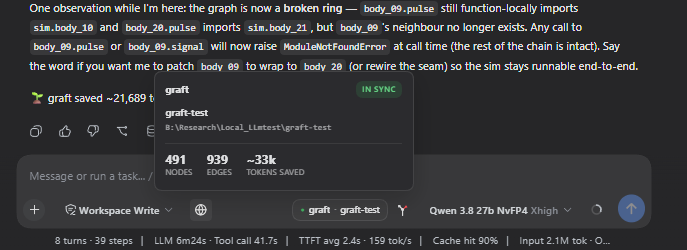
The root is resolved from the session's own workspace, not from wherever dsh was launched. That is the whole reason this exists rather than the graft mcp server: graft mcp resolves its repo once, from its own working directory at startup, and nothing can re-point it afterwards. Launched from a home directory it answers "no graph found" for every workspace you open.
The visualiser
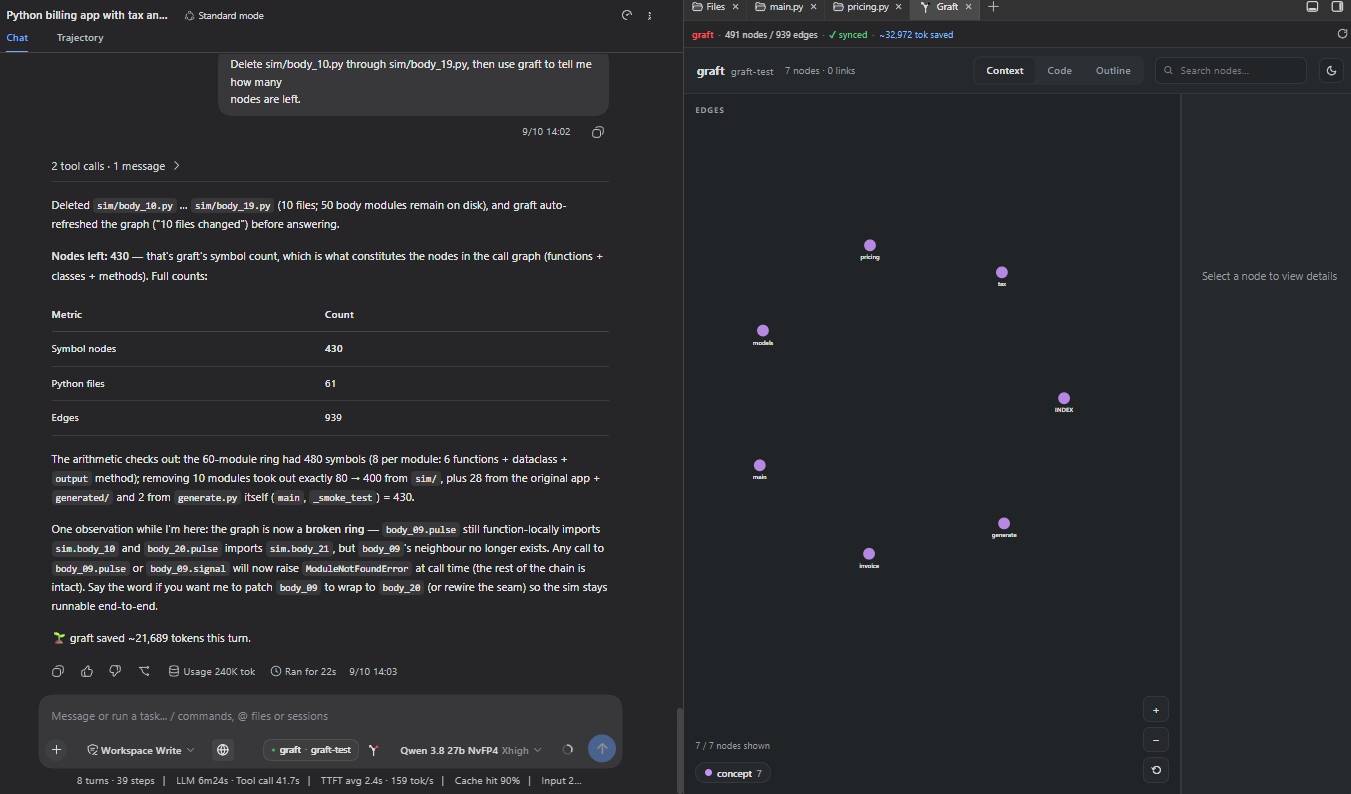
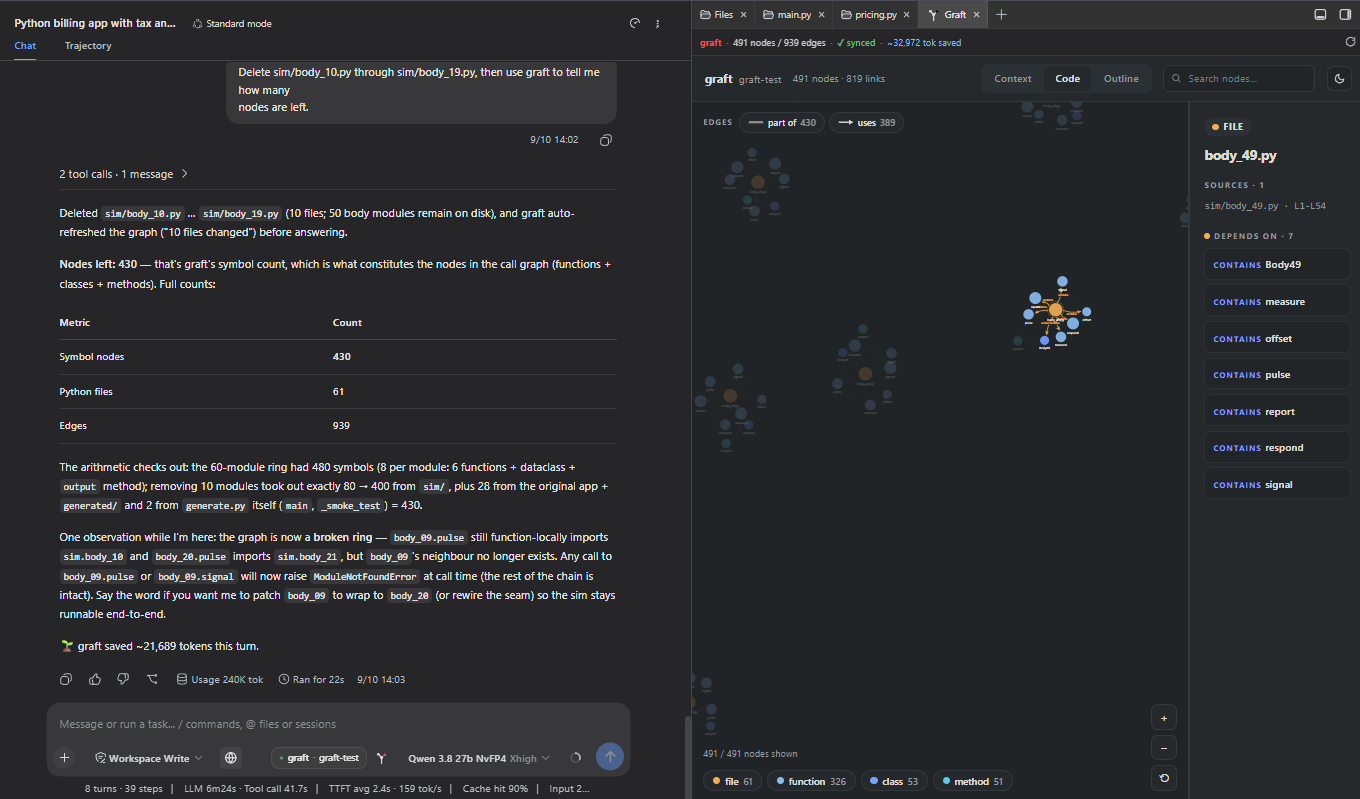
The graft viz button opens the graph as a tab — in dsh's built-in right sidebar on 0.1.5+, in dsh-better-sidebar if that is what you run. The context view lays out the whole graph:
The code view drills into a single file — what it contains, what it depends on, what depends on it:
The tools
| tool | what it answers |
|---|---|
graft_ask | "how does X work" / "where is Y" — ranked hits with code inlined at exact file:line |
graft_grep | every occurrence, grouped by enclosing symbol (graft_ask is top-N and misses some) |
graft_callers | who calls a symbol, what it calls, or the full blast radius before a rename |
graft_skeleton | a file's whole API in ~200 tokens |
graft_map | orientation in an unfamiliar tree |
None of them take a boolean parameter. They take string enums instead — detail: "full" rather than full: true — which reads better to a model and sidesteps a real failure mode on some OpenAI-compatible servers, where a tool call that sets a boolean is emitted as literal <tool_call> text and never runs.
/graft
/graft— build the index, or rebuild it if one exists/graft status— what the chip knows, as text/graft deep— a full rebuild
Auto-rebuild
After the model writes or edits files, the index is rebuilt in the background, debounced so a long turn does not rebuild on every keystroke. This reuses graft's own sync runner rather than reimplementing it, so it cannot drift from what graft build does.
Configuration
All optional, all on the plugin's row in your profile's cordis.patch.yml:
- id: graft-status
  name: 'dsh-graft-plugin'
  config:
    cwd: 'C:/path/to/repo'   # pin to one repo instead of resolving per session
    tools: false             # drop the graft_* tools, keep the chip
    command: false           # drop /graft
    promptSection: false     # stop telling the model to prefer graft
    autoBuild: false         # stop rebuilding after edits
Requirements
| dsh | status |
|---|---|
0.1.2-rc.1 – 0.1.0-rc.7 | tested, full feature set — the graft viz tab via dsh-better-sidebar |
0.1.5-rc.2 / 0.1.5 | tested — chip, tools, /graft and auto-rebuild all work; on 0.1.5 the graft viz button opens the graph in the built-in right sidebar |
- Node 22+
- the
graftCLI on PATH (npm install -g @nanonets/graft)
The client bundle requires only react, which is why it survives the dsh 0.1.5-rc.2 client-package removals that broke several neighbouring plugins.
Development
npm install
npm test           # portable: builds a synthetic graft index in a temp dir
npm run test:live  # drives the real graft CLI against a real repo
npm test needs no graft index and no graft install anywhere on the machine. The one suite that does build a real index skips itself, loudly, when graft is absent — a missing CLI is a setup state, not a defect.
Two identifiers, deliberately different
The cordis row id (graft-status) is this plugin's own handle — it keys the storage file, the prompt section and every effect label, and is stable across renames.
The client bundle's __ModuleLoader__.load({ id }) is not that handle. It must be the published package name: dsh builds each client row from entry.options.name — the name: in cordis.patch.yml — serves the bundle at /plugins/<name>/client.js, then asserts that a factory registered under that same name. Using the row id there fails every boot with:
bundle /plugins/dsh-graft-plugin/client.js loaded without
registering "dsh-graft-plugin" via __ModuleLoader__.load
npm test guards this both ways (the guard was added with the 0.1.1 fix).
Troubleshooting
No chip appears and dsh started without errors. The plugin is in the profile's package.json dependencies but not in dsh.profile.bundles — which happens under pnpm 10+ when the add ends non-zero on ERR_PNPM_IGNORED_BUILDS; dsh skips the bundle row in that case and starts up looking healthy. Fix: pnpm approve-builds in the profile directory (tick dsh-graft-plugin), then re-run dsh plugin --profile web add dsh-graft-plugin. If pnpm approve-builds reports nothing awaiting approval, check pnpm-workspace.yaml for an unanswered dsh-graft-plugin entry (pnpm's approval placeholder) and set its value to true first.
/graft says the graft CLI is not on PATH. The postinstall was blocked or skipped (see Install): npm install -g @nanonets/graft.
Licence
MIT