dsh-progressive-tools
everclear077/dsh-progressive-tools
캐시 안정적 점진적 도구 탐색: 모든 요청에 고정된 tool_search와 tool_dispatch 표면, 인메모리 카탈로그 검색, Harness 파이프라인을 통한 중첩 디스패치, 탐색 전반에 걸쳐 바이트 안정적인 네이티브 도구 목록.
설치
dsh plugin --profile web add github:everclear077/dsh-progressive-toolsREADME
DSH Progressive Tools


Cache-stable progressive tool discovery for DeepSeek Harness. The default mode sends a small, fixed tool surface on the first request, keeps the complete catalog in process memory, and executes discovered tools through the ordinary Harness pipeline.
Documentation map · Getting started · Upgrade guide · Troubleshooting
Why
Every visible tool definition consumes input tokens on every request. Changing that definition list later also changes the request prefix and reduces context cache reuse. Progressive disclosure needs both properties at once:
- a small first request;
- a byte-stable tool and system prefix across later requests.
The default stable-proxy mode provides that contract:
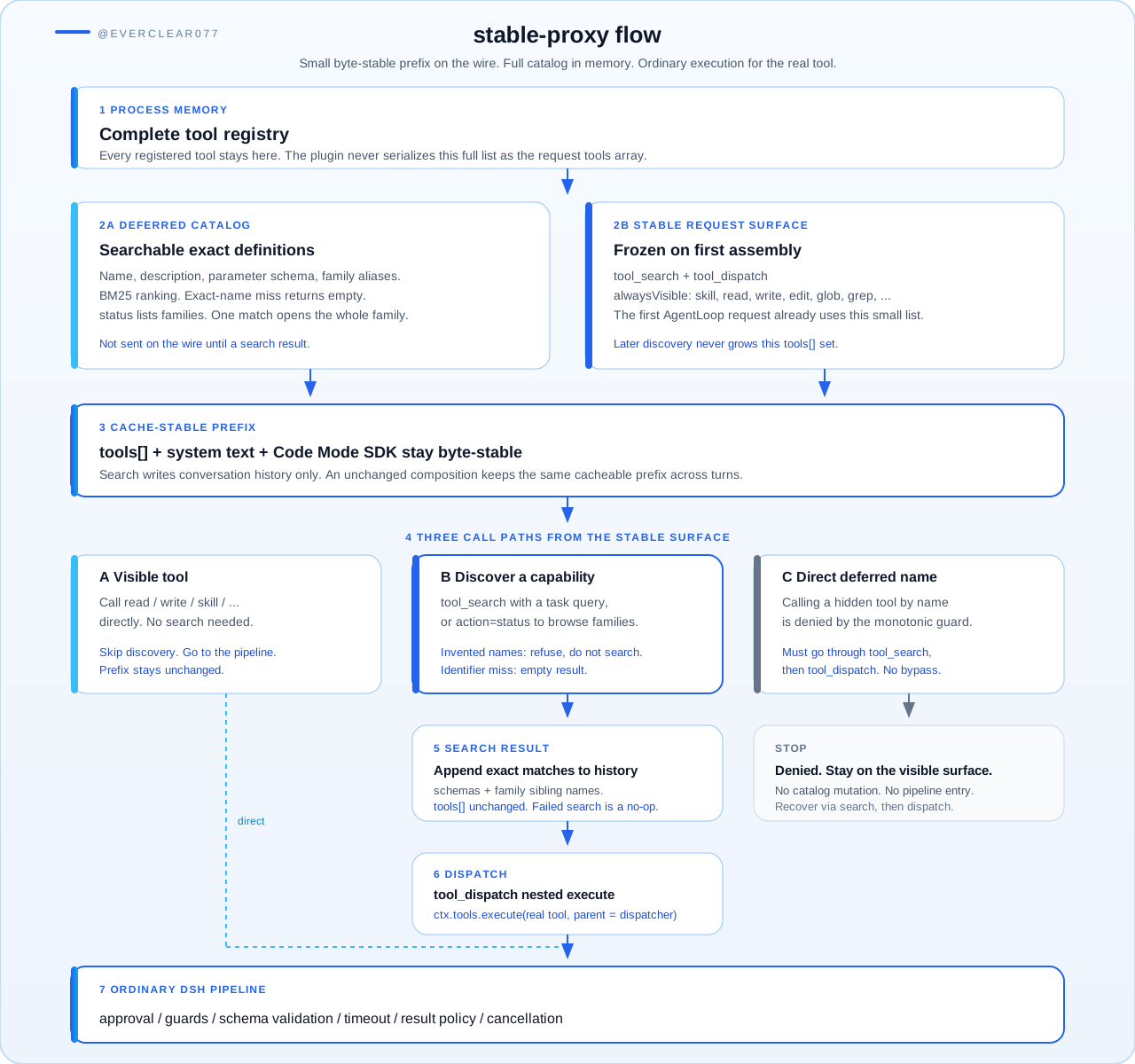
Search changes conversation history, not the top-level tool list. Approval, guards, argument validation, timeout wrappers, result policy, deferred context, and cancellation still run for the selected real tool.
Measured impact
The tables below compare the plugin off (the host sends every registered
tool on every request: 71 definitions in this profile) with the current
defaults on (stable-proxy, filesystem tools always visible, maxResults: 2:
9 definitions on the wire). Both arms used the same eight task families,
100 comparable turns, and the same local web profile. Cache-read tokens are
the cached request prefix the host reports; uncached input is everything else
that still has to be sent.
Headline: ordinary file and coding work keeps uncached input almost unchanged, cuts cache-read volume by about four fifths, lowers output, and finishes sooner. Catalog browsing and invented-name probes are the remaining places where the plugin still writes extra uncached tokens.
Overall tokens, cache, and latency (100 turns)
| Metric | Plugin off | Plugin on | Change |
|---|---|---|---|
| Visible tools per request | 71 | 9 | −87% |
| Uncached input tokens | 130,122 | 155,823 | +20% |
| Output tokens | 28,532 | 24,418 | −14% |
| Cache-read tokens | 3,133,428 | 663,687 | −79% |
| Combined (input + output + cache read) | 3,292,082 | 843,928 | −74% |
Cache share of the prompt (cache / (input + cache)) | 96.0% | 81.0% | −15 pp |
| Mean latency | 45.2 s | 20.9 s | −54% |
| p50 latency | 31.7 s | 18.8 s | −41% |
| p90 latency | 85.4 s | 34.8 s | −59% |
Uncached input rises because discovery results (and, in the first 100-turn run, searches that only proved a name was missing) land in conversation history. Cache-read volume falls because the stable prefix no longer carries dozens of unused schemas. Billing still usually tracks cache reads at a lower rate than fresh input; the combined column is the raw token volume, not a vendor price.
Restricting the same 100 turns to ordinary work (S1–S7, 87 turns, no invented-name probes):
| Metric | Plugin off | Plugin on | Change |
|---|---|---|---|
| Uncached input tokens | 120,753 | 121,105 | +0.3% |
| Output tokens | 26,624 | 20,869 | −22% |
| Cache-read tokens | 2,927,348 | 573,831 | −80% |
Tokens by task family
| Family | Turns | Input off | Input on | Output off | Output on | Cache read off | Cache read on |
|---|---|---|---|---|---|---|---|
| S1 Arithmetic, no tools | 12 | 1,892 | 8,325 | 532 | 364 | 196,852 | 36,231 |
| S2 Inspect workspace | 13 | 15,729 | 17,837 | 2,446 | 2,616 | 418,816 | 94,720 |
| S3 Create and reread a file | 12 | 17,022 | 17,584 | 2,521 | 2,347 | 603,136 | 122,880 |
S4 Read README.md | 13 | 15,841 | 15,594 | 2,600 | 1,567 | 518,912 | 83,200 |
| S5 Browse the hidden catalog | 12 | 38,561 | 27,086 | 12,539 | 8,055 | 367,104 | 76,800 |
| S6 Multi-file inspect | 13 | 19,695 | 21,036 | 4,832 | 4,768 | 435,712 | 83,200 |
| S7 Remember a follow-up | 12 | 12,013 | 13,643 | 1,154 | 1,152 | 386,816 | 76,800 |
| S8 Call a missing name | 13 | 9,369 | 34,718 | 1,908 | 3,549 | 206,080 | 89,856 |
| Total | 100 | 130,122 | 155,823 | 28,532 | 24,418 | 3,133,428 | 663,687 |
S1 pays a larger 9-tool prefix than a 4-tool prefix would, but still far less
cache than 71 native schemas. S2–S4 and S6 no longer search: read / write /
glob / grep are on the stable surface. S5 is cheaper on the plugin because
tool_search with action: "status" replaces long host-side exploration. S8
in this 100-turn table still searched on most plugin rounds; the follow-up
below is the current behavior.
Latency by task family
| Family | Mean off | Mean on | Change | p50 off | p50 on |
|---|---|---|---|---|---|
| S1 Arithmetic, no tools | 11.3 s | 7.5 s | −34% | 9.6 s | 6.8 s |
| S2 Inspect workspace | 69.8 s | 20.3 s | −71% | 63.6 s | 18.8 s |
| S3 Create and reread a file | 79.4 s | 23.7 s | −70% | 67.0 s | 23.0 s |
S4 Read README.md | 67.9 s | 15.6 s | −77% | 67.2 s | 16.6 s |
| S5 Browse the hidden catalog | 47.2 s | 31.8 s | −33% | 38.6 s | 30.6 s |
| S6 Multi-file inspect | 33.1 s | 25.6 s | −23% | 31.4 s | 25.0 s |
| S7 Remember a follow-up | 29.7 s | 21.6 s | −27% | 22.9 s | 17.0 s |
| S8 Call a missing name | 22.1 s | 21.0 s | −5% | 17.8 s | 20.9 s |
| All 100 turns | 45.2 s | 20.9 s | −54% | 31.7 s | 18.8 s |
Task results and prefix stability
| Check | Plugin off | Plugin on |
|---|---|---|
| Completed turns | 100 / 100 | 100 / 100 |
| S1–S7 success | 87 / 87 (100%) | 87 / 87 (100%) |
| S8 refused to invoke the fake tool | 13 / 13 | 13 / 13 |
| S8 grader “success” in the 100-turn run | 12 / 13 (1 partial) | 0 / 13 (grader treated tool_search as failure) |
| Top-level tool list stable across the turn | 100 / 100 | 100 / 100 |
Turns that called tool_search | 0% | 24% (all of S5, 12 / 13 of S8) |
Turns that called tool_dispatch | n/a | 0% |
S1–S7 task quality did not regress. The 100-turn S8 grader was too strict: it flagged a search whose query contained the fake name, even though dispatch never ran. After the current “do not search merely to prove a named tool is missing” guidance (and empty results for unmatched identifier queries), a dedicated 13-turn S8 rerun looked like this:
| S8 (missing name) | 100-turn plugin run | Later 13-turn rerun |
|---|---|---|
| Search rate | 92% | 0% |
| Uncached input | 34,718 | 13,404 (−61%) |
| Output | 3,549 | 2,078 (−41%) |
| Mean latency | 21.0 s | 11.4 s (−45%) |
| Warm-turn uncached input | ~3,500 with search / 819 without | 716 |
| Fake tool invoked | 0 | 0 |
| Grader success / partial / fail | 0 / 1 / 12 | 10 / 3 / 0 |
The three later partials were still correct refusals; the grader missed wording such as “doesn't exist” / “can't”.
Why the defaults moved filesystem tools onto the surface
An earlier 100-turn plugin run used a 4-tool prefix (tool_search,
tool_dispatch, skill, ask_user_question) and maxResults: 5. File work
then paid a search-then-dispatch round, which is where most of the +80%
uncached-input tax came from:
| 100-turn plugin arm | 4-tool prefix | Current 9-tool prefix | Change |
|---|---|---|---|
| Uncached input | 233,716 | 155,823 | −33% |
| Output | 34,933 | 24,418 | −30% |
| Cache-read | 744,898 | 663,687 | −11% |
| Mean latency | 31.9 s | 20.9 s | −35% |
| File-task search / dispatch | 100% / 100% on S2–S4, S6 | 0% / 0% | — |
These numbers are a snapshot of this host's tool composition, not a promise
for every profile. A larger native catalog makes the cache saving larger; a
task mix that always needs deferred tools will still pay discovery into
history. Re-measure after changing alwaysVisible or the installed plugin
set.
Features
- Minimal tool definitions on the actual first AgentLoop request.
- Byte-stable native tool list and Code Mode SDK across discovery calls.
- Exact tool matches with full name, description, and parameter schema.
- Family-wide discovery: each match names every sibling tool of its family, so one search opens a plugin's complete dispatchable surface.
- Browsable
statuscatalog listing, with an optionalstatusGrantsDiscoverygrant for trusted deployments. - Bounded conversation growth: search results record per-call discovery increments while resume state travels in presentation metadata.
- Deterministic BM25-style lexical ranking over names, descriptions, nested parameter descriptions, enums, family metadata, and multilingual aliases.
- Stable
tool_dispatchtransport with runtime schema validation through the original tool definition. - Monotonic guard that rejects direct calls to deferred tools and permits only dispatcher-owned nested execution trees.
- Support for inherited and agent-scoped tools.
- Durable discovery reconstruction for top-level and Code Mode search calls.
- Optional skill-to-family discovery bindings.
dynamiccompatibility mode for deployments that require native definitions after activation.- Reversible Cordis effects for unload and configuration reload.
Requirements
- Node.js
^22.19.0or>=24.0.0 - Host runtime
0.1.5-rc.1(exact tested core peer versions) - pnpm for source installation and development
Runtime compatibility
Version 0.4.0 targets runtime 0.1.5-rc.1. Core peer versions are
pinned to that tested release; older runtimes and later prereleases are not
covered. Earlier plugin versions predate this adaptation. The command below
uses the release tag for reproducible deployments.
Install
dsh plugin --profile web add github:everclear077/dsh-progressive-tools#v0.4.0
Source installs run the package prepare script. If pnpm asks for build
authorization, add the exact package key it reports to the profile's
pnpm-workspace.yaml:
allowBuilds:
  dsh-progressive-tools: true
Verify the composed layer before starting the profile:
dsh --profile web --dump-config
The dump should contain the progressive-tools row contributed by this bundle.
Use
The default direct surface contains:
tool_search;tool_dispatch;skill,ask_user_question,report,submit_*, andstructured_output*when registered;read,write,edit,glob, andgrepwhen registered;- reserved Harness presentation transports when the active tool mode needs them.
No special wording is required in an ordinary conversation. A stable system instruction tells the agent to search before declaring a needed capability class unavailable, and to refuse invented or uncallable names from the visible surface without searching. If an identifier query still runs and matches no catalog name, search returns no definitions instead of unrelated schemas.
Discovery returns exact definitions:
{
  "query": "browser navigation",
  "max_results": 2
}
The next call uses one returned definition:
{
  "name": "browser_open",
  "arguments": {
    "url": "https://example.com"
  }
}
Each match also lists every member tool name of its family, and the whole family becomes dispatchable from that one search — siblings that did not make the top-ranked slice can be dispatched by name or schema-loaded with one exact-name query.
tool_search also accepts {"action":"status"}, which lists every deferred
family with its member tool names alongside catalog and savings estimates. By
default the listing is browse-only: dispatching an unseen name still requires
one exact-name search, and the rejection message says so. Deployments that
prefer immediate access can set statusGrantsDiscovery: true. Search results
are append-only conversation content; they never add native definitions to the
top-level request.
Configure
The default configuration is intentionally small:
- id: progressive-tools
  config:
    mode: stable-proxy
    toolName: tool_search
    dispatchToolName: tool_dispatch
    maxResults: 2
    requireDiscovery: true
    statusGrantsDiscovery: false
    deferToolGuidance: true
    alwaysVisible:
      - skill
      - ask_user_question
      - report
      - submit_*
      - structured_output*
      - read
      - write
      - edit
      - glob
      - grep
Family rules improve search without changing the stable request surface:
- id: progressive-tools
  config:
    groups:
      - id: browser
        description: Browser navigation and page interaction
        aliases: [browser, web page, 浏览器]
        include: [browser_*]
      - id: database
        description: Database inspection and queries
        aliases: [database, sql, 数据库]
        include: [db_*, sql_*]
See configuration for every option, the
plugin-ecosystem onboarding checklist (alwaysVisible for high-frequency
tools, skillBindings for Skill-shipping packages, explicit groups for
unconventional names), and the migration notes for dynamic mode. The
progressive disclosure model maps Skills,
exact tool definitions, execution, and provider capability gaps.
Execution and security semantics
Stable mode filters the authoritative prompt assembly instead of changing the
registry view. A direct call to a deferred name is then denied by a monotonic
tool guard. tool_dispatch creates a nested execution with the original agent,
signal, root call identity, arguments, and real tool name, so normal DSH policy
continues to apply to that real tool.
The guard is a routing invariant, not a replacement for approval or sandbox policy. Security-sensitive deployments should keep their existing controls enabled.
Trade-offs
- Deferred tools lose provider-native argument grammar at the outer request. Their original schema is validated at dispatch time by DSH.
- A task may need one discovery call before execution.
- Family siblings become dispatchable before their schemas were shown; the pipeline still validates every call, but complex or side-effectful siblings are best schema-loaded first with one exact-name search.
- Search is deterministic lexical ranking, not an embedding service.
- Search results add only matched definitions to conversation history, but those definitions remain there until normal compaction.
- A registry or composition change can legitimately alter the next prompt. Discovery alone does not.
Development
pnpm install
pnpm run check
The test suite includes a real AgentLoop request test that captures the first wire-ready tool array and verifies that discovery leaves both tools and system text unchanged.
The implementation follows the public references for architecture, system prompt assembly, tool execution, skills, and plugin packaging.