dsh-novel-mode
github-yousen/dsh-novel-mode
Writes a novel from one idea to a validated manuscript with a code-driven workflow: a JavaScript state machine runs the stages (constitution, outline, design, writing, validation, batch, export) and a 15-step per-chapter loop, PowerShell scripts validate each gate, and versioned checkpoints let a restart resume at the exact chapter. Nine subagent roles do the drafting and review. Needs PowerShell 7 (pwsh) and Python 3.7+; without pwsh the gates record a DEGRADED verdict and the run pauses.
설치
dsh plugin --profile web add github:github-yousen/dsh-novel-modeREADME
小说模式 · Novel Mode
From one idea to a finished, consistency-checked novel — a deterministic writing engine that runs the stages for you, so you never babysit a prompt.
「一个想法到一本校验通过的小说:确定性写作引擎替你跑完全部阶段,你不用再伺候提示词。」
中文 · License: MIT · Market entry
Most "writing assistants" are a prompt pack: you paste instructions, the model might follow them, and you re-check every chapter by hand. 小说模式 is an engine, not a prompt. A real JavaScript state machine owns the stage order, the gates, the retries and the checkpoints. The model is a worker the engine calls at specific stages — it never decides whether a chapter passed.
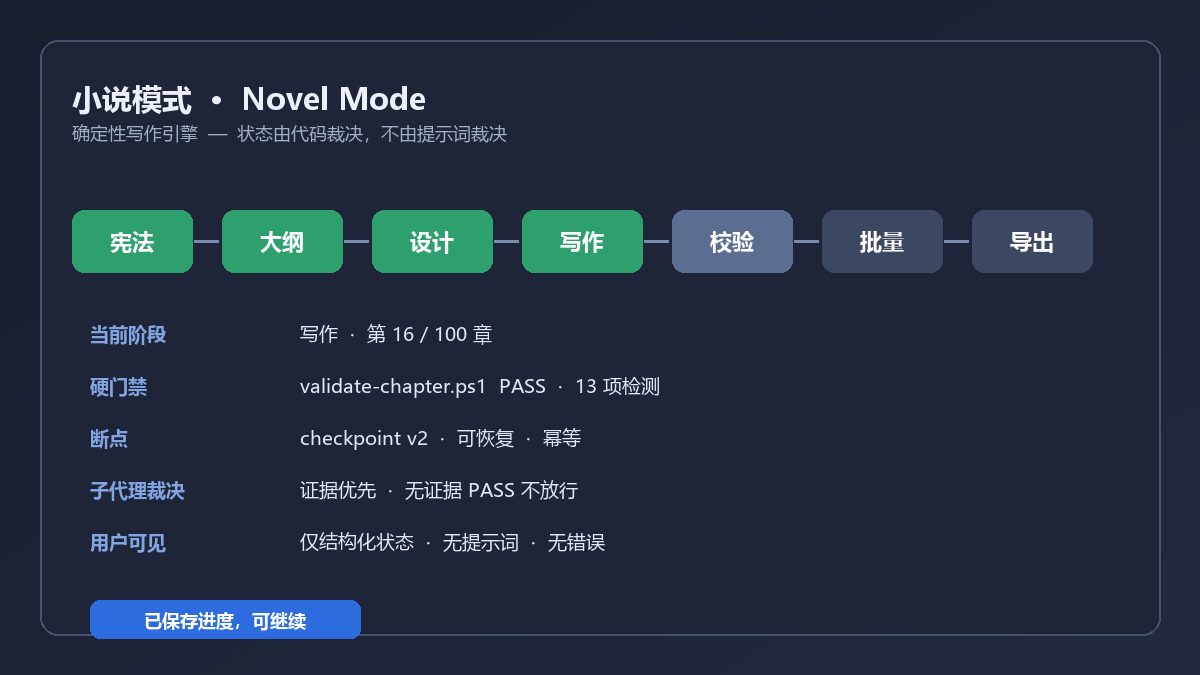
Why it is different
| Prompt pack | 小说模式 engine |
|---|---|
| A paragraph telling the model "act as a finite state machine" | An actual STAGE_GRAPH transition table in lib/orchestrator.js; illegal transitions are rejected |
| Quality decided by the model's opinion | PowerShell validators decide (validate-chapter.ps1: 13 hard checks); a gate cannot be flipped by model text |
| Progress lost when the session ends | Versioned atomic checkpoint under .dsh/state/; resume at the exact stage after a restart |
| "PASS" from a subagent is trusted | Code adjudication: evidence precedence, a PASS with no evidence is NOT_COVERED, a disproved CRITICAL is dismissed |
| Errors, script names, stderr in your chat | Only generic localized status tokens — never internals |
What it does
- Select 小说模式 in the session's mode dropdown. That is the entire UI.
- The engine runs a 7-stage DAG (constitution → outline → design → write →
validate → batch → export) plus three bootstrap branches (guided constitution,
disassemble/reskin, import an existing manuscript).
BATCHis a nested, strictly serial 15-step per-chapter sub-FSM. - Code-enforced gates: entry guards check artifacts; exit gates run the
validation scripts with
pwsh -NoProfile -File … -Chapter <int>; a failed gate pauses the run with a bounded, classified retry policy — the engine never advances on unresolved errors and never "带病放行". - Checkpoint & resume: interrupt at chapter 47 of 100 and continue exactly there; idempotent re-runs; corruption-tolerant (bad checkpoint is backed up, not silently dropped).
- Adjudicated workers: 9 isolated subagent roles with typed, minimal arguments; the dispatcher literally cannot emit a file list or plot hint; the engine resolves their findings against the truth files.
- Silent & safe: no prompt text shown, no errors leaked, zero bundled credentials, no effect on sessions in other projects.
Honest asset line, verified against the shipped tree: 21 skills · 18+ PowerShell/Python validators · 9 subagent roles · 7 Markdown templates + 1 state.yaml skeleton · 2 rule sets · 2 credential-free templates.
Install (≤5 lines)
dsh plugin --profile <profile> add https://github.com/github-yousen/dsh-novel-mode
# or, from a local checkout, via the Harness plugin manager:
# plugin_manager install_bundle with target = absolute path to this directory
Then restart DeepSeek Harness (a mere page refresh does not reload the new cordis.patch.yml preset row), open the mode dropdown, pick 小说模式, and describe
what you want to write. The engine takes it from there.
30-second try it
You: 帮我从零搭一个都市悬疑的世界观,再写第 1 章
Model → novel_orchestrate(start → select-branch constitution → …)
You see: 阶段:准备开始 · 请选择开始方式   →   阶段:撰写正文 · 第 1 章 · 进行中
Behind that one-line status the engine has already picked the branch, checked entry artifacts, run the design/chapter validators, adjudicated the review worker and written a versioned checkpoint. Kill the session at chapter 47 of 100 and it resumes at 47 — no prompt to re-paste, no state to reconstruct by hand.
Requirements: DeepSeek Harness 0.2.x (Web profile), PowerShell 7 (pwsh),
Python 3.7+. If pwsh is absent the gate records a DEGRADED verdict and the
run pauses — it never silently passes and never crashes.
Architecture (short)
user picks mode ──▶ novel_orchestrate tool (Host)
                       │
        lib/orchestrator.js  ← pure, importable, unit-tested
        STAGE_GRAPH / BATCH_SUBSTEPS / advance() / gate() / adjudicate()
        loadState() / saveState()  → .dsh/state/novel-mode.checkpoint.json
                       │
        workers: 21 runtime skills (creative stages only)
        validators: pwsh scripts (authority for quality)
                       │
        structured status only — no prose, no errors, no prompts
Full details: docs/ARCHITECTURE.md · docs/PM-PRD.md (acceptance criteria) · test/ (multi-angle test suite).
Privacy & security
No credentials are bundled. Optional Fanqie integrations ship empty
*.json.template files; copy them to the real filenames and fill in your own
values locally (those names are git-ignored). publish_result.json, lockfiles,
bytecode caches and the large reverse-engineering artifacts are excluded. All
script invocations use explicit, integer-bounded arguments — never -Command,
never string-concatenated user input.
Status
- Open-source repo: https://github.com/github-yousen/dsh-novel-mode (Public,
main, MIT, topicdsh-plugin). - Market submission: awesome-dsh-plugin PR #13689.
MIT. Bundled Humanizer-zh carries its own license.