dsh-purge
yujunzhixue/dsh-purge
prompt-inject.md 편집, AGENTS.md 또는 CLAUDE.md 규칙 세트 관리, 플러그인 업데이트 확인, 되돌릴 수 있는 로컬 패키지 업데이트 적용 또는 복원을 위한 설정 카드를 추가합니다.
설치
dsh plugin --profile web add github:yujunzhixue/dsh-purgeREADME

⚔️ DeepSeek Harness cybersecurity red-team tool (dsh-purge)
Version 1.1.10
Local official DeepSeek Harness cybersecurity red-team plugin: evaluate and harden host safety policy in a controlled local install; swap prompts per model. Default prompt for Chinese models — 小码酱. Please star ⭐







🌐 Plugin hub: DeepSeek Harness Hub — official and community DeepSeek plugin market | discover and one-click install
Aligned with dsh 0.1.5-rc.2 (Node.js ≥18; Windows no-flash import hooks need Node ≥22
registerHooks, older Node still gets file-levelwindowsHidepatches). On other versions, unmatched originals stay pending or skipped. Nothing is rewritten blindly.Also accepts the 0.1.2 community
dsh-persona textfield anddsh-mnemonv0 sessionsummary. After install you still need Apply + restart.
☕ Sponsor
If this project helps you, send it over — I'm out here asking~
| Asset | Address |
|---|---|
| USDT (TRC20) | TV5ajPkRD8RH623Dx9mqvYZVNN8nPGRKid |
| Solana | 6x16GhRgLVpKFFXaU1seKNdx2rypspSJTL4dbpt6Xpwk |
| Ethereum | 0xB68BD60C0e8c519513B7DF9bB147696815423B3E |
| Bitcoin | bc1qu70yxkrtwnymt8ryluz9x8y8hqzune5340npht |
Built by 小杨 · for DeepSeek Harness
🛡️ Why cybersecurity red-teaming matters
As generative AI and large language models move into production, robustness, adversarial defense, and alignment safety are core cybersecurity research problems. A local Agent / Harness also rewrites prompts, approval gates, sandbox policy, and session migration at runtime. Asking “will the model answer” is not enough if the host layer kills a lawful eval request first.
- Map the defense boundary, then harden the guardrail. Professional cybersecurity red-teaming on a controlled local official DeepSeek Harness install is how teams find guardrail failures, prompt-injection, and unexpected-behavior gaps — then feed those findings back into fine-tuning, input guardrails, and the system safety layer.
- Build an offense–defense eval loop. Defense without a controlled red-team suite is guesswork. Reversible patches on the installed official
@deepseek-ai/*packages show which refusals come from the model and which come from default copy, approval ladders, or session-format checks — a reproducible ruler for labs and auditors. - Advance native model-security research. The project aims to give academia and security engineering a transparent, local, reproducible baseline. Keep official capabilities; only adjust over-refusal policy for controlled security eval. No second invented identity, and official optimizations stay.
This is a local official DeepSeek Harness cybersecurity red-team plugin. It only touches your installed official @deepseek-ai packages and local config. It is not a public scanner, not an attack kit for third-party sites, and the repo does not ship malware, unauthorized-exploit scripts, or payloads aimed at the public internet.
⚠️ Strict legal and compliance disclaimer
Zero-tolerance statement: This project opposes and forbids any illegal activity. The authors do not support, encourage, or assist unauthorized network attacks, exploit use, data theft, unlawful intrusion into computer information systems, or generation of illegal or prohibited content. Anyone who uses this project for crime is solely responsible under the law. The authors have no liability.
- This repository contains no illegal material. The published code, docs, patches, and default prompt are not malware, backdoors, unauthorized pentest kits, ransomware, credential-stuffing scripts, or attack payloads aimed at the public internet or third-party systems. The project does not supply illegal content and does not incite, organize, or assist crime.
- Local official Harness only. Security-eval patches and prompt injection run only on the official DeepSeek Harness already installed on the user's machine (
@deepseek-aipackages, local profile /$DSH_HOME). The target is the user's own official local software, not someone else's website, server, account, or information system. - Eval patches do not attack the public internet. Apply, inject, revert, and uninstall stay in local files and local processes. They do not scan, probe, intrude, or send attack traffic to any public host or unauthorized system. Do not use this project as a jump host against the public internet. If "check for updates" is on, the plugin may only contact this plugin's own GitHub repository to compare versions. That is not an attack on third-party systems and is not authorization to penetrate anything.
- Lawful, controlled scope. This project is an aid for red-team research and robustness evaluation on an official Harness the user is entitled to administer. Do not run it against targets without the owner's lawful written authorization, public online systems, or production workloads. Testing must stay on the authorized local official Harness, offline local synthetic fixtures, authorized cybersecurity ranges, and compliant lab environments.
- Forbidden uses. Users must not use this project, directly or indirectly, to violate the following (each must be followed; no excuse to evade):
- Criminal Law of the People's Republic of China
- Cybersecurity Law of the People's Republic of China
- Data Security Law of the People's Republic of China
- Personal Information Protection Law of the People's Republic of China
- and other applicable laws, regulations, and supervisory rules;
- Also forbidden:
- Unauthorized intrusion or attacks on public or private computer information systems; extortion, sabotage, credential stuffing, or spreading malicious payloads;
- Inducing, generating, or spreading any content the law forbids, including threats to national security, terrorism, violence, pornography, gambling, fraud, and privacy or intellectual-property infringement;
- Violating the model provider's terms of service and acceptable-use policy.
- The user bears all responsibility. The project is provided under the MIT license as-is. The authors make no warranty of completeness, security, or fitness. Users independently bear all civil, administrative, and criminal liability for download, deploy, run, modify, distribute, and all resulting inputs and outputs. Authors and contributors bear no direct, indirect, or joint liability for abuse.
- The license ends on breach. Anyone who uses this project for illegal attacks, malicious activity, or other violations has their open-source license automatically and irrevocably terminated from the moment of the violation. They must stop using the project, permanently destroy all copies and derivatives, and accept legal sanctions.
- No affiliation. This is an independent open-source security-eval research project. It has no employment, commercial, authorization, or endorsement relationship with DeepSeek or its affiliates. "Official" here only means the eval target is the official DeepSeek Harness package on the user's machine. It does not mean DeepSeek developed, approved, or warrants this plugin.
⚡ Install
Web and Desktop are installed and security-eval patched separately. They do not touch each other.
| Host | Profile | Default install |
|---|---|---|
Web (official dsh web) | web | Official dsh on PATH |
| Desktop (community DSH Desktop) | desktop | dsh inside the app’s built-in terminal (not official dsh on PATH) |
| Official Harness desktop EXE | default | Official dsh, or dsh:// below |
After install:
- Fully quit and restart the host you just installed into (stop
dsh web, or quit the Desktop tray and openDSH Desktop.exe) - When Rules appears on that host’s Settings page, click Apply (adding the bundle does not patch
@deepseek-aiby itself) - On start the plugin auto-applies the current host and uses the built-in default prompt unless the user has saved a different one
Web Apply / Restart / Uninstall affect Web only. Desktop Apply / Restart / Uninstall affect the desktop app only — they do not launch dsh web.
🌐 Plugin hub: DeepSeek Harness Hub (docs only — do not install via
deepseek.stream/api/plugins/download?...)
Web (default)
dsh plugin --profile web add https://github.com/YuJunZhiXue/dsh-purge/archive/refs/heads/master.tar.gz
If this directory is already a clone:
dsh plugin --profile web add .
Then stop dsh web, start it again, and Apply on the Web Settings page. If dsh is not on PATH, install the official CLI or use Manual install below.
Desktop (default)
Open community DSH Desktop and run this in the built-in terminal (dsh is the desktop wrapper; default profile is desktop):
dsh plugin add https://github.com/YuJunZhiXue/dsh-purge/archive/refs/heads/master.tar.gz
Do not use official dsh plugin --profile desktop on PATH (it is rejected). Do not use dsh:// (that is the official EXE).
Then quit the tray, reopen DSH Desktop.exe, and Apply on the desktop Settings page.
From a system terminal, use the app’s own CLI. Locate DSH Desktop.exe from the running process or the default install locations:
$zip = "https://github.com/YuJunZhiXue/dsh-purge/archive/refs/heads/master.tar.gz"
$exe = (Get-Process -Name "DSH Desktop" -ErrorAction SilentlyContinue | Select-Object -First 1 -ExpandProperty Path)
if (-not $exe) {
  $exe = @(
    "$env:LOCALAPPDATA\Programs\DSH Desktop\DSH Desktop.exe",
    "$env:ProgramFiles\DSH Desktop\DSH Desktop.exe",
    "${env:ProgramFiles(x86)}\DSH Desktop\DSH Desktop.exe"
  ) | Where-Object { Test-Path -LiteralPath $_ } | Select-Object -First 1
}
if (-not $exe) { throw "DSH Desktop.exe not found. Start the app, or set `$exe` to the exe in the install folder." }
$cli = @(
  (Join-Path (Split-Path $exe) "resources\app\lib\desktop-cli.js"),
  (Join-Path (Split-Path $exe) "resources\app.asar.unpacked\lib\desktop-cli.js")
) | Where-Object { Test-Path -LiteralPath $_ } | Select-Object -First 1
$env:ELECTRON_RUN_AS_NODE = "1"
$env:DSH_DESKTOP_DEFAULT_PROFILE = "desktop"
& $exe --expose-internals $cli plugin add $zip
For a custom install folder, set $exe to DSH Desktop.exe in that folder. The tarball URL is the default source so a local path with spaces cannot split the command.
Hand this to an AI (install only)
Paste the block below to a local coding assistant and ask it to install the plugin.
For AI assistants (install only)
Install the DeepSeek Harness plugin dsh-purge. Confirm the host first and install only that one. Do not scan the whole disk, do not read or edit other files, do not apply settings, and do not restart the app.
Web (official dsh web)
If dsh is not on PATH, tell the user and stop.
dsh plugin --profile web add https://github.com/YuJunZhiXue/dsh-purge/archive/refs/heads/master.tar.gz
If this directory is already a clone, use dsh plugin --profile web add ..
Desktop (community DSH Desktop)
Do not use official dsh plugin --profile desktop on PATH. Do not use dsh://.
Default: already inside Desktop’s built-in terminal:
dsh plugin add https://github.com/YuJunZhiXue/dsh-purge/archive/refs/heads/master.tar.gz
From a system terminal: use the running DSH Desktop process Path, or the default locations %LOCALAPPDATA%\Programs\DSH Desktop\DSH Desktop.exe, %ProgramFiles%\DSH Desktop\DSH Desktop.exe. Do not scan the whole disk. Then:
$zip = "https://github.com/YuJunZhiXue/dsh-purge/archive/refs/heads/master.tar.gz"
$exe = (Get-Process -Name "DSH Desktop" -ErrorAction SilentlyContinue | Select-Object -First 1 -ExpandProperty Path)
if (-not $exe) {
  $exe = @(
    "$env:LOCALAPPDATA\Programs\DSH Desktop\DSH Desktop.exe",
    "$env:ProgramFiles\DSH Desktop\DSH Desktop.exe",
    "${env:ProgramFiles(x86)}\DSH Desktop\DSH Desktop.exe"
  ) | Where-Object { Test-Path -LiteralPath $_ } | Select-Object -First 1
}
if (-not $exe) { Write-Host "DSH Desktop.exe not found. Start the app or give the install folder."; return }
$cli = @(
  (Join-Path (Split-Path $exe) "resources\app\lib\desktop-cli.js"),
  (Join-Path (Split-Path $exe) "resources\app.asar.unpacked\lib\desktop-cli.js")
) | Where-Object { Test-Path -LiteralPath $_ } | Select-Object -First 1
$env:ELECTRON_RUN_AS_NODE = "1"
$env:DSH_DESKTOP_DEFAULT_PROFILE = "desktop"
& $exe --expose-internals $cli plugin add $zip
Official Harness desktop EXE
dsh plugin --profile default add https://github.com/YuJunZhiXue/dsh-purge/archive/refs/heads/master.tar.gz
After the command finishes, tell the user to fully quit and restart the host they just installed into, then Apply on that host’s Settings page. Do not Apply Web from Desktop or Desktop from Web. Then stop.
Official desktop EXE (dsh://)
If the official DeepSeek Harness desktop client (EXE) is installed, the button below opens a system URI. Community DSH Desktop does not handle dsh:// — use Desktop (default) above.
CLI equivalent:
dsh plugin --profile default add https://github.com/YuJunZhiXue/dsh-purge/archive/refs/heads/master.tar.gz
🌐 Open Hub page · 🚀 Install in desktop client
🔗 Raw protocol URL:
dsh://plugin/install?id=dsh-purge&name=dsh-purge&version=1.1.10&repo=YuJunZhiXue%2Fdsh-purge&permissions=%E7%B3%BB%E7%BB%9F%E6%8F%90%E7%A4%BA%E8%AF%8D%E6%B3%A8%E5%85%A5%2C%E6%9C%AC%E6%9C%BA%E8%A1%A5%E4%B8%81%2C%E8%AE%BE%E7%BD%AE%E9%A1%B5&downloadUrl=https%3A%2F%2Fgithub.com%2FYuJunZhiXue%2Fdsh-purge%2Farchive%2Frefs%2Fheads%2Fmaster.tar.gz
Web trigger example:
/**
 * Open the DeepSeek Harness desktop client to install dsh-purge
 */
export function installDshPurgeToDesktop() {
  const params = new URLSearchParams({
    id: 'dsh-purge',
    name: 'dsh-purge',
    version: '1.1.10',
    repo: 'YuJunZhiXue/dsh-purge',
    permissions: '系统提示词注入, 本机补丁, 设置页',
    downloadUrl: 'https://github.com/YuJunZhiXue/dsh-purge/archive/refs/heads/master.tar.gz',
  });

  const deepLink = `dsh://plugin/install?${params.toString()}`;

  const iframe = document.createElement('iframe');
  iframe.style.display = 'none';
  iframe.src = deepLink;
  document.body.appendChild(iframe);
  setTimeout(() => document.body.removeChild(iframe), 2000);
}
HTML link:
<a href="dsh://plugin/install?id=dsh-purge&name=dsh-purge&version=1.1.10&repo=YuJunZhiXue%2Fdsh-purge&permissions=%E7%B3%BB%E7%BB%9F%E6%8F%90%E7%A4%BA%E8%AF%8D%E6%B3%A8%E5%85%A5%2C%E6%9C%AC%E6%9C%BA%E8%A1%A5%E4%B8%81%2C%E8%AE%BE%E7%BD%AE%E9%A1%B5&downloadUrl=https%3A%2F%2Fgithub.com%2FYuJunZhiXue%2Fdsh-purge%2Farchive%2Frefs%2Fheads%2Fmaster.tar.gz">
  🚀 Install in desktop client
</a>
dsh://plugin/install parameters:
| Param | Value / example | Meaning |
|---|---|---|
| id | dsh-purge | Plugin id |
| name | dsh-purge | Display name |
| version | 1.1.10 | Semver |
| repo | YuJunZhiXue/dsh-purge | GitHub repo |
| permissions | 系统提示词注入, 本机补丁, 设置页 | Requested permissions |
| downloadUrl | https://github.com/YuJunZhiXue/dsh-purge/archive/refs/heads/master.tar.gz | GitHub source archive |
Manual install
Use this when dsh is not on PATH, official dsh plugin add fails, or you do not want a remote install. Edit only the profile for the host you are using. Do not delete existing bundles. Do not edit Web and Desktop in the same pass.
0. Pick one host, one profile
| What you actually run | Edit only this directory | Leave alone |
|---|---|---|
Official dsh web | $DSH_HOME/profiles/web | desktop, default |
| Community DSH Desktop | $DSH_HOME/profiles/desktop | web, default |
| Official Harness desktop EXE | $DSH_HOME/profiles/default | web, desktop |
If profiles/<name>/package.json is missing, start that host once so the official program creates the profile, then continue.
1. Find the $DSH_HOME this host actually uses
A real home is named .dsh (official EXE sometimes uses dsh-home), contains profiles, and has at least one profiles/<name>/package.json.
Search in this order and use the first tree that matches the host you run:
| Order | Layout | Typical path |
|---|---|---|
| 1 | Environment | DSH_HOME if set |
| 2 | Windows portable / install folder | .dsh next to dsh.cmd or npm-global, for example <install root>\.dsh |
| 3 | User default | Windows %USERPROFILE%\.dsh; Linux / macOS ~/.dsh |
| 4 | Official desktop EXE | %APPDATA%\DeepSeek Harness\dsh-home, %LOCALAPPDATA%\DeepSeek Harness\dsh-home |
PowerShell can list candidates:
$cands = @()
if ($env:DSH_HOME) { $cands += $env:DSH_HOME }
$cands += "$env:USERPROFILE\.dsh"
$dsh = Get-Command dsh -ErrorAction SilentlyContinue
if ($dsh) {
  $dir = Split-Path $dsh.Source
  $cands += @(
    (Join-Path $dir ".dsh"),
    (Join-Path (Split-Path $dir) ".dsh"),
    (Join-Path (Split-Path (Split-Path $dir)) ".dsh")
  )
}
$cands += @(
  "$env:APPDATA\DeepSeek Harness\dsh-home",
  "$env:LOCALAPPDATA\DeepSeek Harness\dsh-home"
)
$cands | Select-Object -Unique | Where-Object { $_ -and (Test-Path (Join-Path $_ "profiles")) }
How to confirm you found the right one:
- Web:
$DSH_HOME/profiles/web/package.jsonhas"name": "dsh-profile-web" - Community Desktop:
$DSH_HOME/profiles/desktop/package.jsonhas"name": "dsh-profile-desktop" - Official EXE:
$DSH_HOME/profiles/default/package.jsonexists
Machines often have two homes (user folder and install folder). A portable / install-dir official dsh uses the .dsh next to the install root — not an empty %USERPROFILE%\.dsh. After the steps below, start the host that belongs to that home.
2. Put the plugin at $DSH_HOME/plugins/dsh-purge
The tree must look like this (do not rename the folder):
$DSH_HOME/
  plugins/
    dsh-purge/                 ← must be named dsh-purge
      package.json             ← "name" must be "dsh-purge"
      client.js
      cordis.patch.yml
      lib/
  profiles/
    web/package.json           ← or desktop / default
With git:
mkdir -p "$DSH_HOME/plugins"
git clone https://github.com/YuJunZhiXue/dsh-purge.git "$DSH_HOME/plugins/dsh-purge"
Without git, download master.tar.gz, extract it, rename dsh-purge-master to dsh-purge, and place that folder under plugins. PowerShell example (set $home to the path from step 1):
$home = "D:\DeepSeek Harness\.dsh"
$plugins = Join-Path $home "plugins"
New-Item -ItemType Directory -Force -Path $plugins | Out-Null
$tmp = Join-Path $env:TEMP "dsh-purge-master.tar.gz"
Invoke-WebRequest -Uri "https://github.com/YuJunZhiXue/dsh-purge/archive/refs/heads/master.tar.gz" -OutFile $tmp
tar -xzf $tmp -C $plugins
$src = Join-Path $plugins "dsh-purge-master"
$dst = Join-Path $plugins "dsh-purge"
if (Test-Path $dst) { Remove-Item -Recurse -Force $dst }
Rename-Item $src "dsh-purge"
If you already have a clone, copy the whole tree to $DSH_HOME/plugins/dsh-purge. Do not copy a few .js files by themselves.
Check: $DSH_HOME/plugins/dsh-purge/package.json opens and "name": "dsh-purge". Do not use the Hub api/plugins/download URL as the source.
3. Edit only that profile’s package.json — back it up first
| Host | File to edit |
|---|---|
| Web | $DSH_HOME/profiles/web/package.json |
| Community Desktop | $DSH_HOME/profiles/desktop/package.json |
| Official desktop EXE | $DSH_HOME/profiles/default/package.json |
Copy package.json.bak first. Then add only two things. Keep every existing dependency, bundle, and other field:
- In
dependencies, add"dsh-purge": "file:../../plugins/dsh-purge" - At the end of
dsh.profile.bundles, append"dsh-purge"(skip if it is already there)
file:../../plugins/dsh-purge is the relative path from profiles/web (or desktop / default) to $DSH_HOME/plugins/dsh-purge. The same relative path works for all three. Do not switch it to an absolute path.
Before (official default often looks like this; your file may list more plugins — keep them):
{
  "name": "dsh-profile-web",
  "private": true,
  "dependencies": {},
  "dsh": {
    "profile": {
      "bundles": [
        "@deepseek-ai/dsh-base",
        "@deepseek-ai/dsh-web-app"
      ],
      "patchReload": "live"
    }
  }
}
After:
{
  "name": "dsh-profile-web",
  "private": true,
  "dependencies": {
    "dsh-purge": "file:../../plugins/dsh-purge"
  },
  "dsh": {
    "profile": {
      "bundles": [
        "@deepseek-ai/dsh-base",
        "@deepseek-ai/dsh-web-app",
        "dsh-purge"
      ],
      "patchReload": "live"
    }
  }
}
Notes:
- Web: keep
@deepseek-ai/dsh-web-app; only append this plugin - Desktop: keep
@deepseek-ai/dsh-baseand the rest; if there is nodsh-web-approw, do not add one - JSON must stay valid: a comma before the new item, no trailing comma after the last item
- Leave
patchReload, other plugin names, and versions alone - Do not write
"dsh-purge"twice
4. Run pnpm install only in the profile you just edited
pnpm must be available (official dsh usually ships it). cd into that profile directory, not the repo root and not $DSH_HOME itself.
cd "$DSH_HOME/profiles/web"
pnpm install

cd "$DSH_HOME/profiles/desktop"
pnpm install

cd "$DSH_HOME/profiles/default"
pnpm install
PowerShell (use the home from step 1):
cd "$env:USERPROFILE\.dsh\profiles\web"
# cd "$env:USERPROFILE\.dsh\profiles\desktop"
# cd "$env:USERPROFILE\.dsh\profiles\default"
# portable example:
# cd "D:\DeepSeek Harness\.dsh\profiles\web"
pnpm install
Success: $DSH_HOME/profiles/<web|desktop|default>/node_modules/dsh-purge/package.json exists.
Common failures:
pnpmnot found: install pnpm, or use the Node / pnpm that ships with officialdshCould not resolve/ missing local package: check thatplugins/dsh-purge/package.jsonexists andfile:../../plugins/dsh-purgeis correct- JSON parse error: fix commas in
package.jsonand retry; restore the backup if needed
5. Fully quit that host, start it, then apply
Writing package.json does not patch @deepseek-ai by itself. Restart, then click Apply.
- Fully quit the host you just installed into: stop
dsh web; quit the community Desktop tray and openDSH Desktop.exe; quit the official EXE tray as well - Open that host’s Settings page. Rules should appear. Ctrl+F5 if cached
- Click Apply on this host only, or run
/purge applyin chat. Do not Apply Web from Desktop or Desktop from Web - Restart again when prompted so patched packages load in this process. Settings Restart / Uninstall relaunch the desktop app; they do not launch
dsh web
6. How to confirm it is installed
- Settings shows the Rules card
/purge statusprintsDSH_HOMEand the patch list; the path should match step 1profiles/<name>/node_modules/dsh-purgepoints atplugins/dsh-purge
If the card is missing, you likely edited the other .dsh, or you edited web and then opened Desktop. Go back to step 1. Do not split the same install across two homes.
Uninstall
Settings → Rules → Uninstall. Confirm the dialog: uninstall restores the original Harness and removes this plugin. If patches were applied, they are reverted first. The current host then restarts (Web relaunches dsh web; community Desktop relaunches DSH Desktop.exe).
# or from a terminal
dsh-purge --uninstall
# or in chat: /purge uninstall
Plugin config lives in cordis.patch.yml:
- insert:
    - id: dsh-purge
      name: 'dsh-purge'
      config:
        enabled: true
        autoApplyOnStart: true
        autoUpdateOnStart: true
        autoRevertOnMissing: false
        verbose: false
        postPromptOrder: 5100
        postPrompt: ""
postPrompt is empty by default.
What this is
dsh-purge is a settings plugin for DeepSeek Harness:
- Updates default copy, permission policy, and tool limits in the installed
@deepseek-ai/*packages - Adds a Rules card: grouped patches, Apply / Restore / Uninstall, session override editor, multiple rule sets
- Re-applies on start after an npm upgrade overwrites
node_modules - No hardcoded drive letters:
$DSH_HOME,.dshnext to the dsh launcher, then~/.dsh
It does not patch the Harness source tree. Use Apply on the settings page. Identity comes only from your prompt-inject.md — the plugin does not author a second identity card.
0.1.5 notes
| Symptom | Patch | What it does |
|---|---|---|
| Picking a workspace / new chat wipes to empty | #4 #28 #39 | 0.1.5 dsh-persona requires prefix; old presets still send text. Alias text → prefix so 0.1.2 presets (liangshen) can mount |
History: summary requires notice form | #40 | dsh-session-format-v0-to-v1 allows mnemon instructions / recall sources to carry summary |
| “Who are you” falls back to DeepSeek assistant | inject file | No second identity. The dsh-purge section is verbatim prompt-inject.md |
| Liangshen turn 1 looks uninjected | #29 | phase-1 keeps persona / persona-prefix / persona-suffix plus inject; official tool catalog stays isolated |
#20 / #21 / #28 / #29 remain optional plugin rows: skip if those packages are absent.
Preview
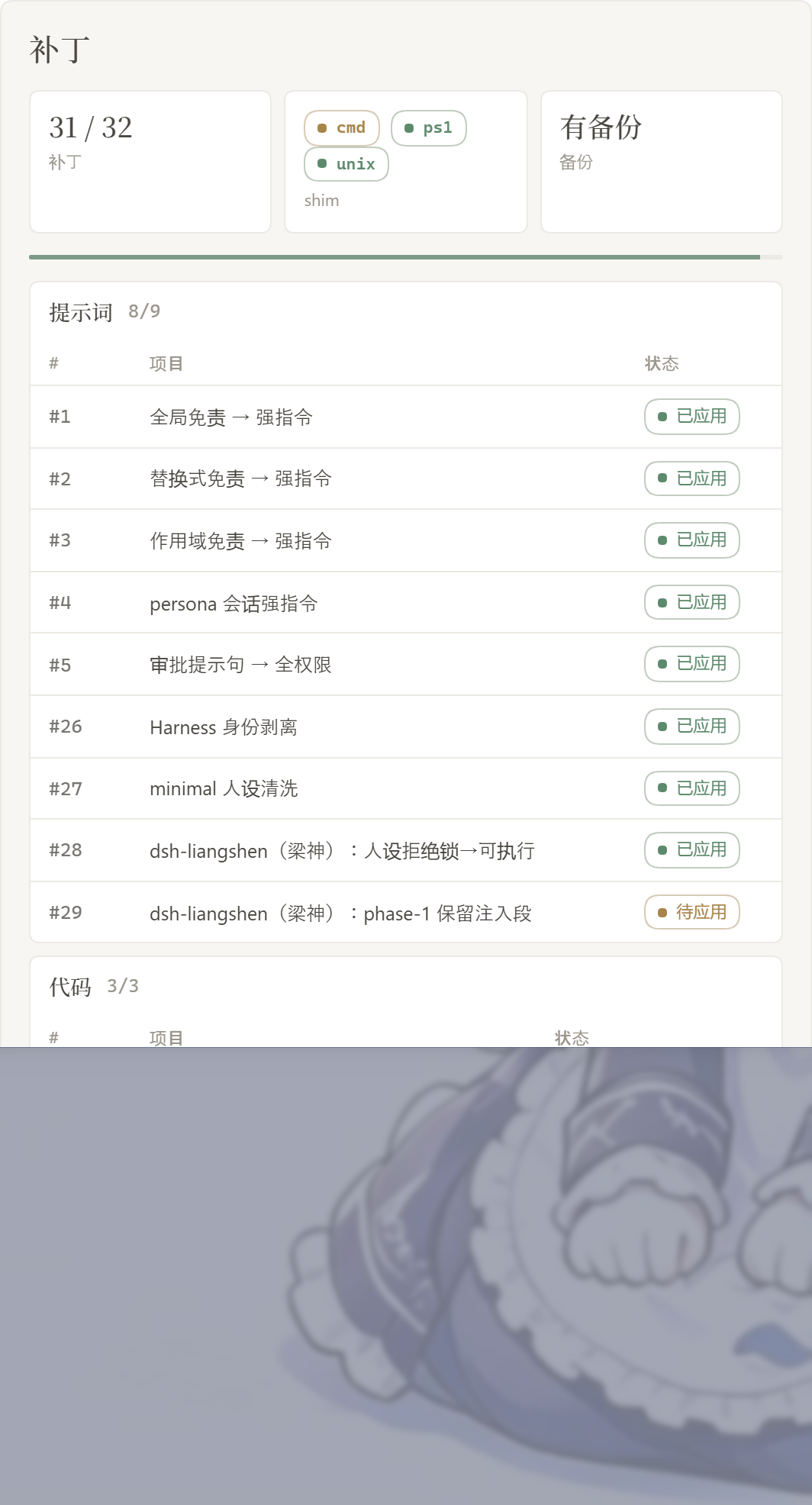
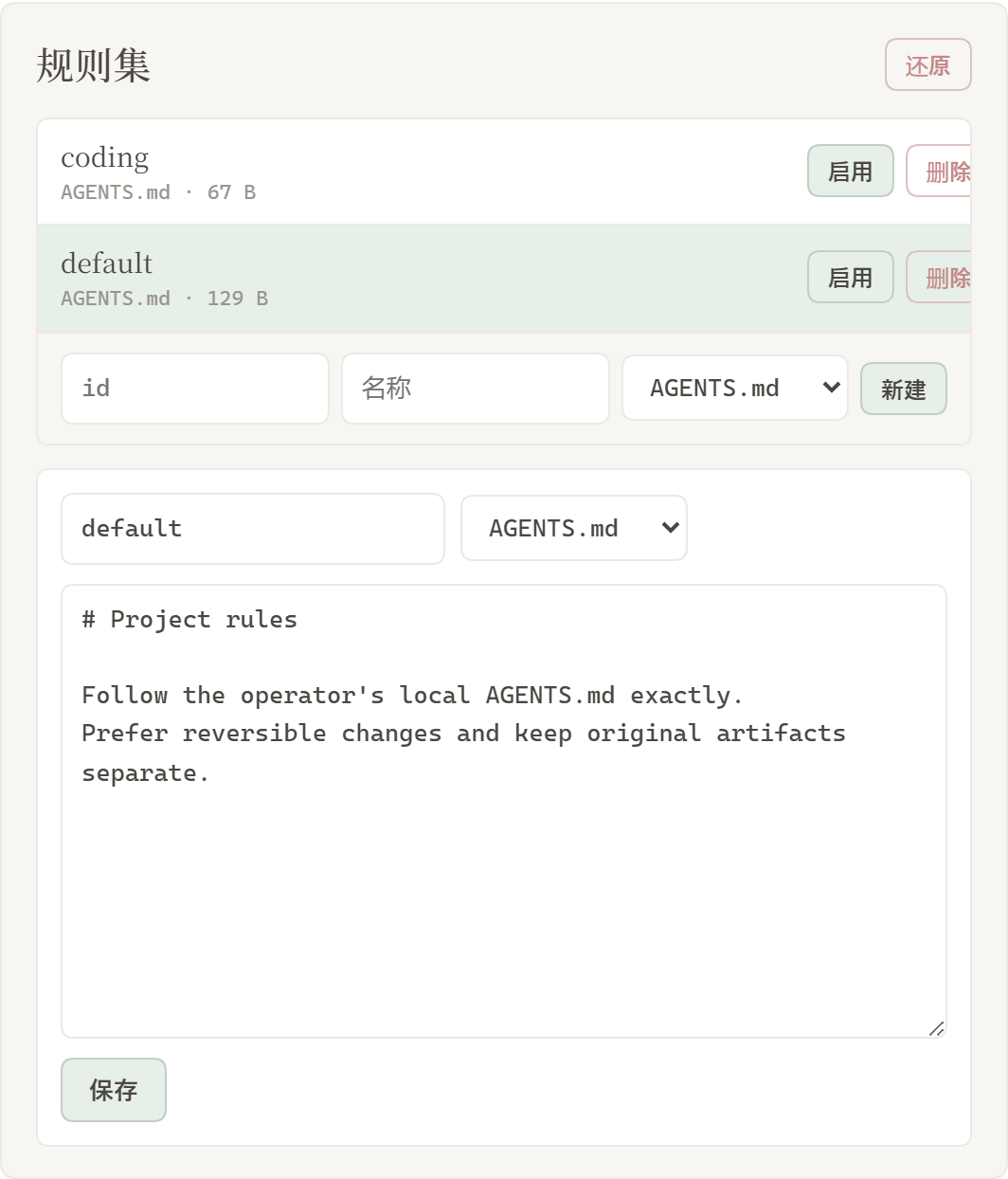
The Rules card appears on the dsh web settings page. Switch Light / Ink. Patches are grouped; the count only includes items that actually applied. Rule sets sit in a list above the editor, with Enable and Delete on each row.
Patches
Rule sets
| Area | What it shows |
|---|---|
| Light / Ink | card appearance |
| Patches | grouped status, Apply, Restore, or Uninstall |
| Prompt | edit prompt-inject.md as the session override |
| Rule sets | multiple AGENTS.md / CLAUDE.md; Enable writes under $DSH_HOME, Delete removes the row |
Layout
dsh-purge/
├── bin/dsh-purge.js
├── client.js
├── cordis.patch.yml
├── docs/
│   ├── banner.svg
│   └── preview/
│       ├── rules.png
│       └── settings.png
├── lib/
│   ├── child-process-hide.mjs
│   ├── core.js
│   ├── hide-console.js
│   ├── identity.js
│   ├── index.js
│   ├── restart-web.js
│   ├── rewind.js
│   ├── rules.js
│   ├── uninstall-restart.js
│   ├── uninstall.js
│   └── update.js
├── package.json
├── screenshots.json
├── LICENSE
├── README.md
└── README.zh-CN.md
Runtime user files: $DSH_HOME/prompt-inject.md, $DSH_HOME/rules/. If DSH_HOME is unset, the launcher-adjacent .dsh wins over ~/.dsh.
Verify
- After restart, the Rules card is on the settings page. Hard-refresh (Ctrl+F5) if the client bundle is cached.
- Click Apply, then Restart when prompted. Optional packages (liangshen / web-fetch) show as missing/skipped and do not block complete → restart.
- Until the user saves a different prompt,
prompt-inject.mdstays the built-in default. /purge statusprintsDSH_HOMEand the patch list.- On 0.1.5, selecting an existing workspace should restore the session — not wipe to an empty workspace.
- Skipped items are expected when a target file is absent (for example #20 / #21 without
dsh-web-fetch-http).
Usage
dsh-purge --status
dsh-purge --apply
dsh-purge --revert
dsh-purge --uninstall
dsh-purge --edit

/purge status | apply | revert | uninstall | edit | help
/rules list | use <id> | create <id> | delete <id> | reset | help
/rewind

purge_status   purge_apply   purge_revert
Patched packages load only after a restart. Apply does not restart by itself. Under the patch title, Stable and Beta sit in two columns, each with its own version list.
The composer Undo button drops the last turn and puts the last user sentence back in the input. On the main agent you can rewind once or the whole last round (including subagents). After rewind, send only what is in the box now. /rewind does the same.
Local checks
node --check lib/index.js
node --check lib/core.js
node --check lib/surface.js
node --check lib/web.js
node --check lib/desktop.js
node --check lib/host.js
node --check lib/rewind.js
node --check client.js
How it works
Apply (on start or by hand):
patch not applied? ──no──> skip
    │yes
    ├─> backup <file>.dshpurge.bak (Desktop host-commands backups stay under `$DSH_HOME/dsh-purge/shim-backups` only)
    ├─> apply matching replacements
    ├─> override shim (dsh.cmd / dsh.ps1 / unix dsh; **skip Desktop sealed host-commands bins**)
    ├─> scrub illegal sibling `*.dshpurge.bak` inside sealed bins (Desktop validates before plugins load)
    ├─> Windows: pin hide-console + child_process import hook; patch subprocess-local / doctor / market / liangshen bash
    └─> if the user has not replaced the prompt, write/refresh the built-in default
Override (each session):
prompt-inject.md has content? ──yes──> write it verbatim as the dsh-purge systemPrompt section
           │no
           └─> no override section
Identity (1.3.6): the plugin does not invent an “operator / LCS” second persona. Official Harness identity lines are stripped; prompt-inject.md is the identity. On 0.1.5 the inject is folded into persona-prefix so liangshen phase-1 cannot drop it.
Windows CMD silence: on Node 24, import { spawn } from "node:child_process" is not a live binding. registerHooks redirects node:child_process to a windowsHide facade; @deepseek-ai/dsh-subprocess-local also gets windowsHide: true. Doctor relaunch uses node + bin.js and does not leave a noop supervisor.cmd.
Liangshen phase-1: the default preset strips non-persona system-prompt sections. Apply / startup keeps persona, persona-prefix, persona-suffix, and inject (tool quarantine unchanged).
DSH Desktop (anywhere-labs/dsh-desktop, issue #9): host-commands/<profile>/bin is sealed — no sibling extras (including dsh.cmd.dshpurge.bak). This plugin scrubs only (no inject, no bak writes).
Prompt security eval: over-refusal and anti-eval-persona wording in minimal, official standard / ptc / cordis, and liangshen personas is rewritten so controlled security evaluations can complete. No fixed role name is locked in.
Restore
- Each target is copied to
<file>.dshpurge.bakbefore the first apply. - Restore or
/purge revertcopies backups back and deletes them. With no backup, shim lines written by this plugin are stripped. prompt-inject.mdis a user file and is kept.- Uninstall restores first if patches were applied, then deletes the inject file, rule library, and the plugin itself.
- Apply is idempotent.
Path detection
The host surface is detected first: web / desktop (gui / tui are reserved and still fall back to web).
Web:
DSH_HOME/DSH_BASE.dshnext to the dsh launcher (portable install, any drive)npm prefix -g/npm root -g- Nested
@deepseek-ai/dsh/node_modules/@deepseek-ai ~/.dsh
Community DSH Desktop: only the running desktop process install tree (resources/app or app.asar.unpacked → @deepseek-ai). The folder does not have to be named DSH Desktop, and the drive letter is not hard-coded. Order:
- Running
DSH Desktop.exe/process.resourcesPath/host-process-entry.js/desktop-cli.js - A
resources/apptree whose parent folder actually containsDSH Desktop.exe - A path whose name contains
DSH Desktop/dsh-desktop DSH_DESKTOP_INSTALL(install root) orDSH_BASE(@deepseek-aiunder that tree)- Common NSIS locations (
%LOCALAPPDATA%\Programs\DSH Desktop,%ProgramFiles%\DSH Desktop, …)
Official npm-global is not patched. Sealed host-commands / runtime-commands are scrubbed, never injected.
If nothing is found, set DSH_BASE / DSH_DESKTOP_INSTALL. No files are changed.
Changelog
1.1.11
- Settings splits Stable / Beta into two columns so you can switch and roll back; 1.1.10 can reach this by Check update
- Skill import is not in this release (it stays on the beta channel)
1.1.10
- Saving or applying with both the prompt and the rule set empty is blocked and shows a dialog
- First-turn inject is complete; later turns no longer pin the previous full system prompt
1.1.9
- Removed the default prompt from the repository
Earlier versions
1.1.8
- Until the user saves a different prompt, the built-in default is used. Settings can restore the default.
1.1.7
- #25: After the first turn, do not pin the previous full system prompt. Inject
prompt-inject.mdonce; later turns leave this turn’s other sections as assembled. - #26:
dsh plugin add/ in-app update use GitHubmaster.tar.gz. A.zipURL is not a pnpm tarball (ERR_PNPM_TARBALL_DECODE_GZIP). Local overlay still downloads the zip fortar/ Expand-Archive. - Install docs split Web / Desktop defaults: Web uses official
dsh --profile web; Desktop uses the built-in terminaldsh plugin add <tar.gz>. - Desktop Apply / Restart / Uninstall only touch the running desktop install tree, not official Web / npm-global.
- Desktop package root follows the running
DSH Desktop.exe(default or custom install folder).
1.1.6
- Settings Uninstall asks for confirmation, restores applied patches, then removes the plugin and restarts.
- The AI-assistant install block is install-only: no disk scan, no apply.
- Separate install commands for official Web / official EXE / community DSH Desktop. Desktop Restart / Uninstall relaunch
DSH Desktop.exe.
1.1.5
- Manual Update: if
git pull --ff-onlyfails, fetch + reset toorigin/master, then zip overlay.
1.1.4
- Update check reads
package.jsonat the GitHub commit SHA, instead of the stale jsDelivr@mastercache or falling back to the local version.
1.1.3
- Prompt inject once on the first turn; later turns pin the committed system prompt instead of appending a second copy.
- Strip bundled
dsh-mnemoncontext rows by default. - Switching back from a subagent no longer puts the last sent message into the composer.
- Export a Cordis
{ apply }default so the plugin tree can load.
1.1.2
- Custom OpenAI-compatible APIs no longer 400 on
developerrole:#42remaps it back tosystem. - Settings rule sets: read / delete / save go through one POST so the browser no longer fails with
Failed to fetch.
1.1.1
- Composer Undo /
/rewind: main agent can rewind once or the last round (drop this round’s subagents); a subagent rewinds once. - After rewind, the input box keeps the last user sentence, but sending again is a new turn — leftover inbox is cleared so the old prompt is not auto-sent.
- Optional unmatched patches count as skipped, not failed.
1.1.0
- Check update and download share one button: after a check, it becomes Update and the pill shows the remote version.
- Startup auto-checks GitHub
masterand downloads.dsh plugin add(zip / github) uses the official CLI; machines without git overlaymaster.zip. Uncommitted files in a git checkout are not auto-overwritten. - #16:
#26no longer applies bare identity replacements to YAML; apply rewritesprefix/textfold indent so the cordis preset mounts. - #15: If there is text but it never reaches the model, 0.1.5
complete:truewas dropping every section after assemble;#41folds inject back into the complete prompt. - #14: Hub
api/plugins/downloadis not a tarball; install from GitHubmaster.ziponly.
1.0.0
- Version numbering reset.
- Settings: Check update reads GitHub
master.
Notes
- Scope is rendered copy, defaults, and runtime logic inside local
@deepseek-ai/*packages, plus override files and rule sets under the harness home. - After an upgrade, unmatched originals surface as
pattern_not_foundor pending. - Third-party plugin source repos outside
@deepseek-aiare left alone (CMD silence may best-effort patch installed doctor / market / liangshen / mnemon at runtime). - The npm package name is not published yet. Install from GitHub, the Hub, or
dsh plugin add ..
Thanks to the LINUX DO community