dsh-skill-7d-code-reviewer
7dgroup-ai/dsh-skill-7d-code-reviewer
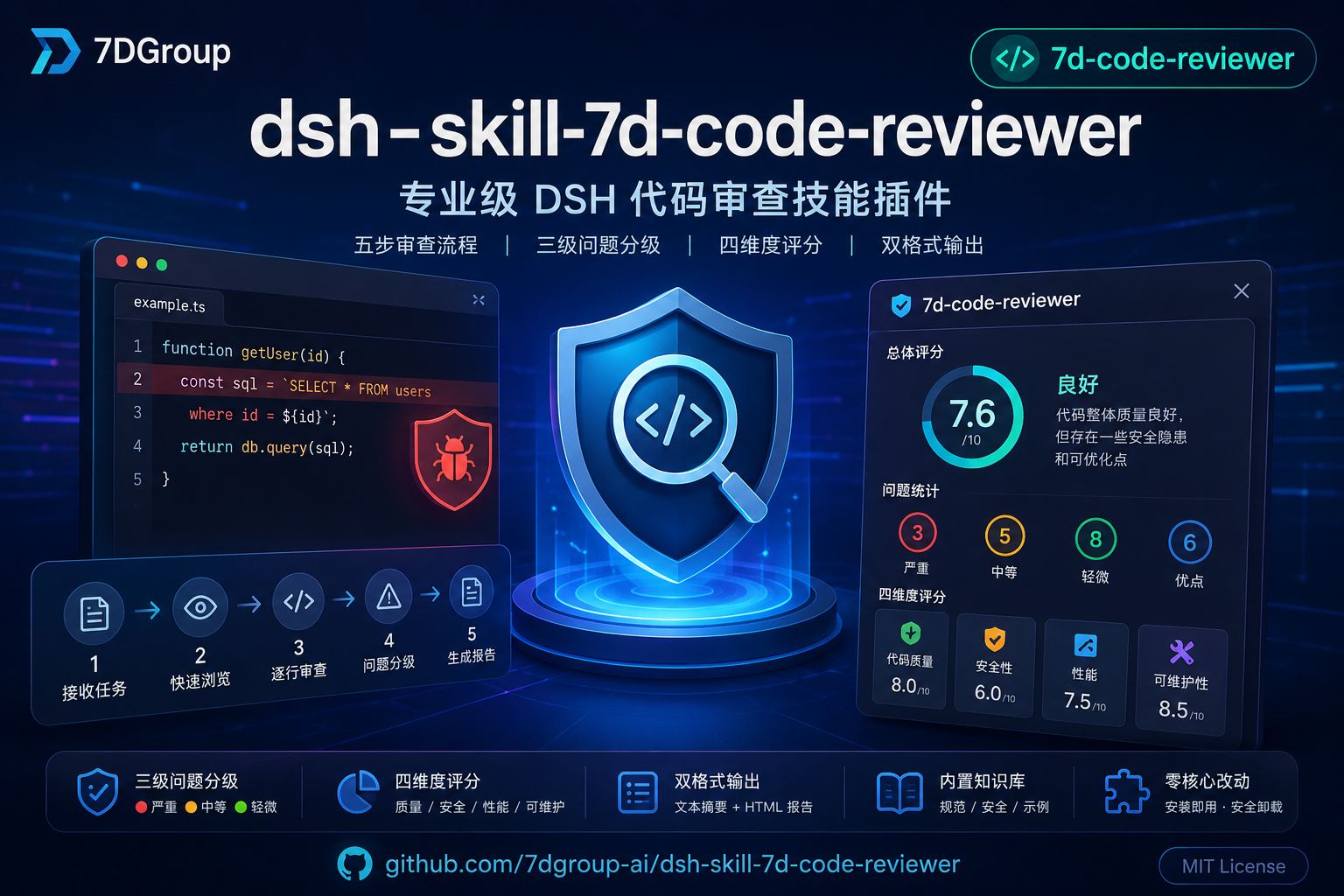
Template-driven code review skill: five-step review flow, critical/medium/minor severity grading, four-dimension scoring (quality, security, performance, maintainability), dual text and HTML report output, and an on-demand reference knowledge base.
Install
dsh plugin --profile web add github:7dgroup-ai/dsh-skill-7d-code-reviewerREADME





English | 中文
@7dgroup/dsh-skill-7d-code-reviewer
Author: 7DGroup
A professional, template-driven code review skill plugin for DeepSeek Harness (DSH), developed by the 7DGroup team for AI-assisted code review in any dsh session. Built on TypeScript + Cordis, it installs as a composable bundle and registers the 7d-code-reviewer skill with ctx.skills: a five-step review flow, critical/medium/minor severity grading, four-dimension scoring, and dual text + HTML report output. Zero core changes — install to enable, remove the bundle row to uninstall.
📌 Project Info
| Field | Value |
|---|---|
| Author | 7DGroup |
| Version | 0.1.0 |
| Runtime | Node `^22.19.0 |
| Supported dsh versions | 0.2.0-rc.2+ (0.2.x) |
| Peer dependencies | @deepseek-ai/cordis · @deepseek-ai/dsh-skill · @deepseek-ai/dsh-invariants |
| Skill name | 7d-code-reviewer |
| Repository | github.com/7dgroup-ai/dsh-skill-7d-code-reviewer |
| License | MIT |
🖼️ Plugin Effect
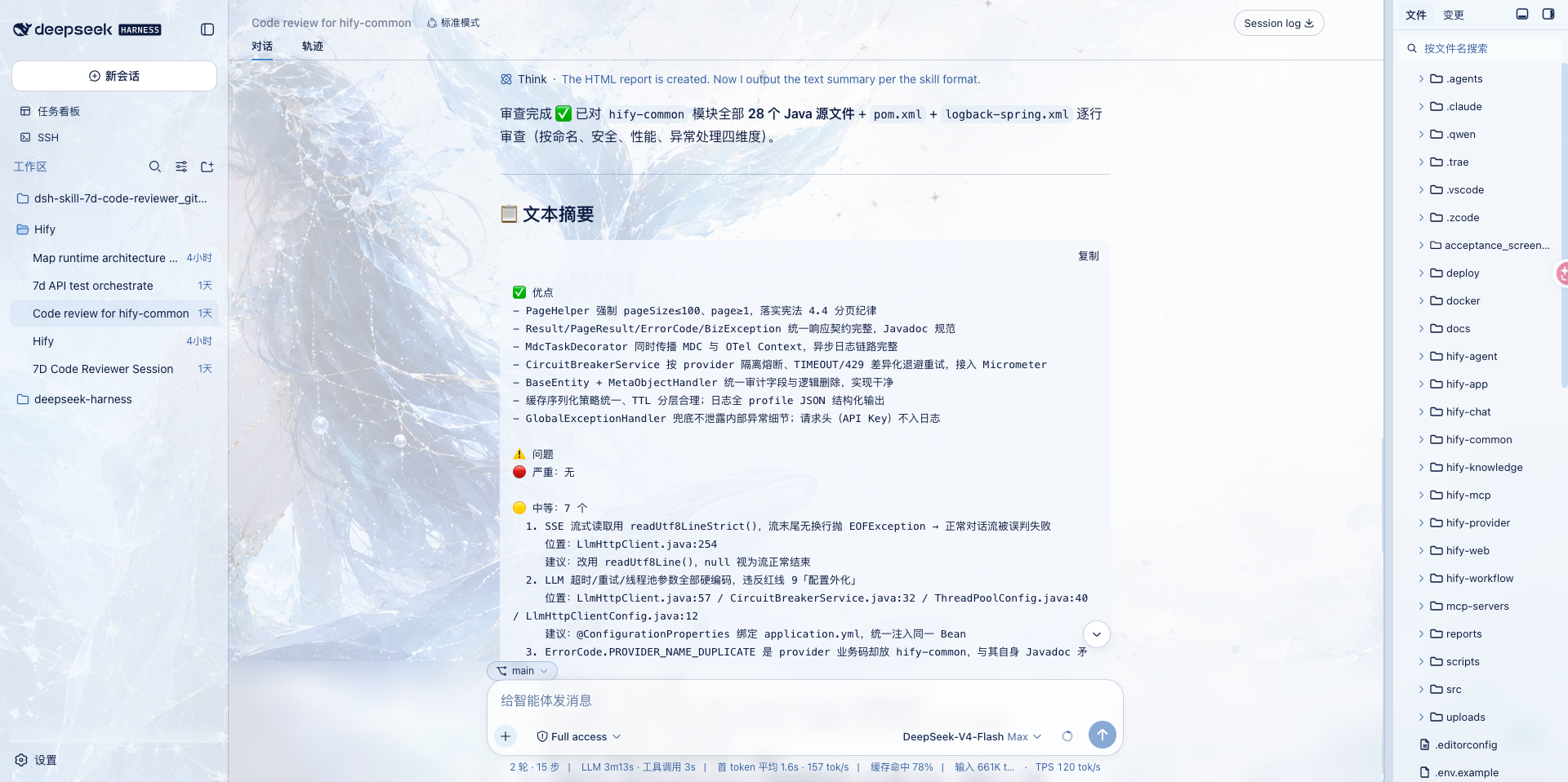
Skill invocation in a dsh session:
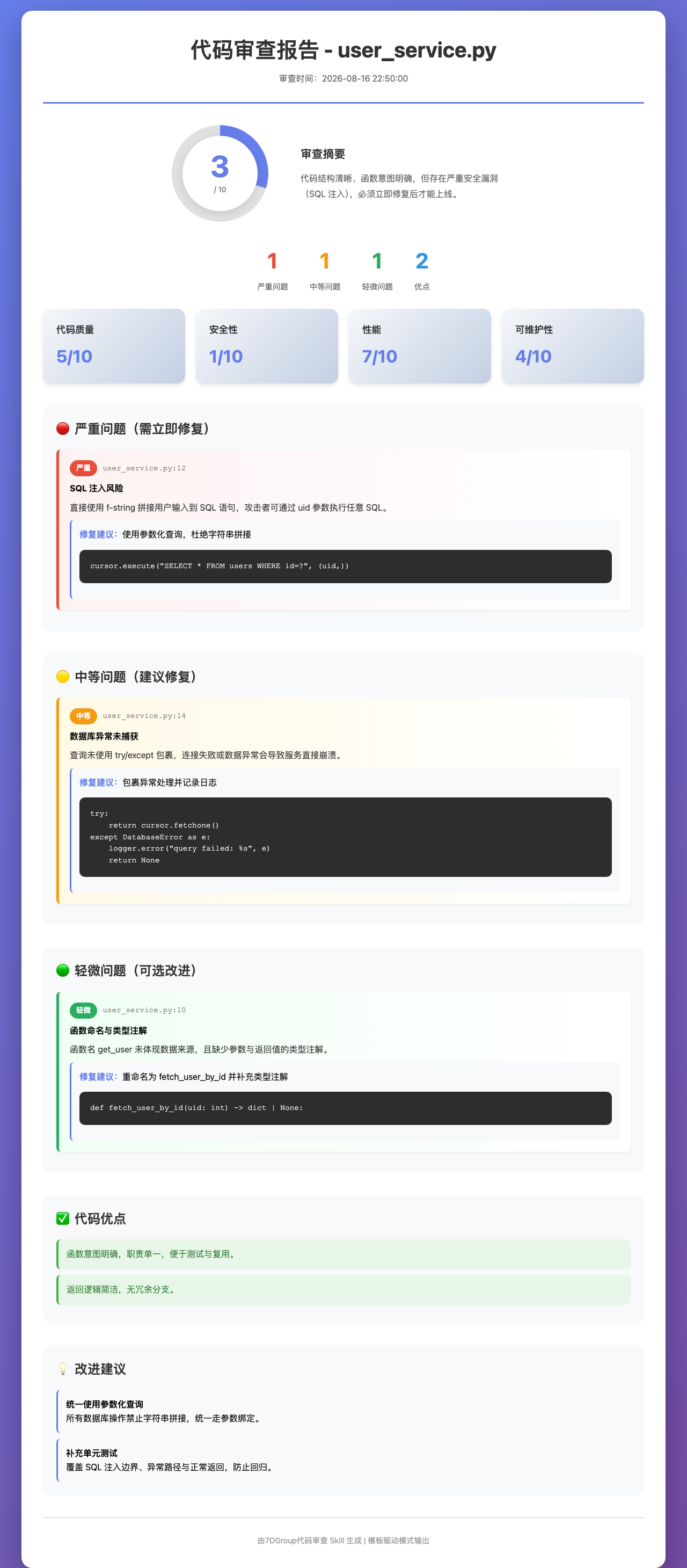
Sample HTML report generated from the pure-placeholder template:
Core Capabilities:
- Template-driven mode — separation of concerns:
SKILL.mddecides what to review and how severe it is,templates/only presents. The HTML report template stays pure placeholders; all placeholders must be filled, and every dynamic value is HTML-escaped. - Five-step review flow — accept the task → quick scan → line-by-line review (loading
references/on demand) → severity grading → report generation. - Three-level severity grading — 🔴 critical (must fix) / 🟡 medium (should fix) / 🟢 minor (optional polish).
- Four-dimension scoring — code quality / security / performance / maintainability, each on a 1–10 scale, plus an overall score and an auto-generated summary.
- Dual output — a text summary for quick reading, plus a full HTML report saved as
code-review-report-{timestamp}.html. - Built-in knowledge base — coding standards, security checklist (SQL injection, XSS, authentication/authorization, sensitive-data leaks) and worked review examples, loaded on demand instead of bloating the prompt.
- Zero core changes — pure composable bundle; no patches to the DSH core, safe to install and remove.
Use Cases:
- Code review before commit / merge request
- Security audit of existing code
- Quality assessment before refactoring
- Enforcing team coding standards
- Any code quality question inside a dsh conversation
✅ Features
- ✅ Five-step template-driven review flow
- ✅ Three-level severity grading with fix suggestions
- ✅ Four-dimension scoring rubric (code quality / security / performance / maintainability)
- ✅ Text summary + HTML report dual output
- ✅ Pure-placeholder HTML report template with mandatory filling rules
- ✅ Documented HTML escaping rules for all filled content
- ✅ On-demand knowledge base (coding standards / security checklist / review examples)
- ✅ No executable scripts ship with the skill
- ✅ Installable from GitHub (
github:shorthand), npm or tarball - ✅ Git-install build is self-contained (
preparehook, transpile-only)
📂 Project Structure
dsh-skill-7d-code-reviewer/
├── src/                                # source code
│   ├── index.ts                        # Cordis plugin: registers the skill provider
│   └── invariant.ts                    # companion plugin: package ownership invariant
├── assets/7d-code-reviewer/            # skill resources shipped with the package
│   ├── SKILL.md                        # review logic + template selection
│   ├── references/                     # knowledge base, loaded on demand
│   │   ├── coding-standards.md         # naming rules, code complexity
│   │   ├── security-checklist.md       # SQL injection, XSS, auth, leaks
│   │   └── review-examples.md          # worked review examples
│   ├── templates/
│   │   └── report-template.html        # pure-placeholder HTML report
│   └── scripts/
│       └── html-report-generation.md   # HTML escaping rules for filled content
├── tests/                              # vitest suite
│   └── skill-7d-code-reviewer.spec.ts
├── screenshots/                        # README screenshots
│   ├── skills.png                      # skill invocation
│   └── report-preview.png              # sample HTML report
├── cordis.patch.yml                    # composition patch layer
├── tsdown.config.ts                    # build config (transpile-only)
├── 7dgroup-dsh-skill-7d-code-reviewer-0.1.0.tgz   # prebuilt tarball
├── package.json
└── README.md
🚀 Quick Start
Prerequisites: dsh CLI, Node ^22.19.0 || >=24.0.0, pnpm 10+.
Install from within a dsh session (recommended)
The most direct way — just ask the agent in any dsh conversation, and it runs the install for you. Use the GitHub spec — the npm name @7dgroup/dsh-skill-7d-code-reviewer only works after the package is published:
安装插件 github:7dgroup-ai/dsh-skill-7d-code-reviewer
(Or in English: "Install the plugin github:7dgroup-ai/dsh-skill-7d-code-reviewer" — the agent executes the equivalent dsh plugin command through its session shell.)
For a git install the agent will hit the same pnpm allowBuilds gate and print the exact key to add to the profile's pnpm settings file (~/.dsh/profiles/<name>/pnpm-workspace.yaml); after you add it, ask the agent to retry and the skill is enabled.
Install directly in dsh (CLI)
Run one command directly in dsh — the github: shorthand is the fastest way:
dsh plugin --profile <name> add github:7dgroup-ai/dsh-skill-7d-code-reviewer
<name> is the profile you boot with dsh --profile <name> — see What is a dsh profile? below for how profiles work, how to pick a name and where the profile files live.
The full URL form is equivalent:
dsh plugin --profile <name> add git+https://github.com/7dgroup-ai/dsh-skill-7d-code-reviewer.git
dsh plugin appends the bundle to the profile's dsh.profile.bundles, and the bundle's own patch layer mounts the skill-7d-code-reviewer row over the base composition.
pnpm blocks a git dependency's build scripts until explicitly allowed, so the first add fails. Copy the exact package key pnpm printed into the profile's pnpm settings file — ~/.dsh/profiles/<name>/pnpm-workspace.yaml — then re-run:
allowBuilds:
  '@7dgroup/dsh-skill-7d-code-reviewer@git+https://github.com/7dgroup-ai/dsh-skill-7d-code-reviewer.git#<sha>': true
(With the github: shorthand the key reads @7dgroup/dsh-skill-7d-code-reviewer@github:7dgroup-ai/dsh-skill-7d-code-reviewer#<sha> — always copy the exact key pnpm prints.)
Allowing a build means letting that package's code run on your machine at install time, outside any agent sandbox. Prefer pinning a commit (...#<sha>) so later pushes cannot silently change what runs.
What is a dsh profile?
Every dsh run boots a profile — a named environment whose configuration lives under the harness home in ~/.dsh/profiles/<name> (or $DSH_HOME/profiles/<name> if the DSH_HOME env var is set). A profile directory holds:
| File | Purpose |
|---|---|
package.json | Profile manifest: dsh.profile.bundles lists the ordered plugin bundles to mount; dependencies holds out-of-tree plugins |
cordis.patch.yml | Your own patch layer, applied after every bundle layer |
pnpm-workspace.yaml | pnpm settings for the profile; the allowBuilds key goes here |
node_modules | pnpm-managed plugin dependencies |
There is no default profile — dsh --profile <name> is required on every run (dsh web is a shorthand for dsh --profile web). The shipped web and headless profiles auto-initialize on first boot; any other name is created automatically the first time you run a dsh plugin --profile <name> ... command, which reports where it was created:
dsh plugin --profile tui add github:7dgroup-ai/dsh-skill-7d-code-reviewer
# dsh: initialized profile tui at ~/.dsh/profiles/tui
To see which profiles already exist, list ~/.dsh/profiles/ — each subdirectory is one profile name. A custom name must be created this way before it can boot: dsh --profile <name> on an unknown custom name fails with the hint create it with 'dsh plugin --profile <name> add <package>'.
Install from tarball (no build approval)
A prebuilt tarball is committed at the repository root — download it and install directly:
dsh plugin --profile <name> add ./7dgroup-dsh-skill-7d-code-reviewer-0.1.0.tgz
Or once published on npm:
dsh plugin --profile <name> add @7dgroup/dsh-skill-7d-code-reviewer
Both forms ship prebuilt code and need no allowBuilds allowance.
Recommended setup — install into the web profile
Most sessions boot the default web profile (dsh web is a shorthand for dsh --profile web), so the recommended path is to install the skill there — no new profile needed:
Step 0 — pnpm on PATH. dsh plugin forwards to pnpm in the profile directory, so pnpm must be installed and on PATH:
corepack prepare pnpm@latest --activate # or: npm install -g pnpm@10
Step 1 — install via the github: shorthand. A git install runs the package's prepare build, which pnpm blocks until explicitly allowed — so the first add fails:
dsh plugin --profile web add github:7dgroup-ai/dsh-skill-7d-code-reviewer
Copy the exact key pnpm prints into ~/.dsh/profiles/web/pnpm-workspace.yaml:
allowBuilds:
  '@7dgroup/dsh-skill-7d-code-reviewer@github:7dgroup-ai/dsh-skill-7d-code-reviewer#<sha>': true
then re-run the same command. Prefer pinning a commit — append #<sha> to the spec (github:7dgroup-ai/dsh-skill-7d-code-reviewer#<sha>) so later pushes cannot silently change what runs.
Prefer no build approval? Install the prebuilt tarball instead — it ships ready-to-run code and never hits the allowBuilds gate:
dsh plugin --profile web add ./7dgroup-dsh-skill-7d-code-reviewer-0.1.0.tgz
After install. The profile manifest ~/.dsh/profiles/web/package.json gains the dependency and the bundle row:
{
  "name": "dsh-profile-web",
  "private": true,
  "dependencies": {
    "@7dgroup/dsh-skill-7d-code-reviewer": "<version>"
  },
  "dsh": {
    "profile": {
      "bundles": [
        "@deepseek-ai/dsh-base",
        "@deepseek-ai/dsh-web-app",
        "@7dgroup/dsh-skill-7d-code-reviewer"
      ]
    }
  }
}
Nothing else needs editing — cordis.patch.yml stays [], because the bundle's own patch layer mounts the skill-7d-code-reviewer row automatically. Verify the mount with dsh --profile web --dump-config, restart the session (bundle changes apply on the next boot), then run /7d-code-reviewer.
Using a different profile? Replace web with the name you boot (dsh --profile <name>); the skill only activates in the profile it is installed into.
Build and test
pnpm install
pnpm build   # tsdown; also runs as the `prepare` hook on git installs
pnpm test    # vitest
💡 Usage
The skill activates whenever you ask for a code review — either with the slash command or in natural language:
/7d-code-reviewer Review this module: ...
The five-step review flow:
| Step | What happens |
|---|---|
| 1. Accept the task | Take the submitted code or file paths; determine the language and business context |
| 2. Quick scan | Classify the change (new feature / bugfix / refactor); locate the core files and key logic |
| 3. Line-by-line review | Load the matching references on demand; check naming, security, performance and error handling |
| 4. Severity grading | 🔴 critical — must fix · 🟡 medium — should fix · 🟢 minor — optional improvement |
| 5. Report generation | Fill the placeholder HTML template; output the text summary plus code-review-report-{timestamp}.html |
Output example (text summary)
✅ 优点
- 函数意图明确,返回用户数据

⚠️ 问题
🔴 严重:SQL 注入风险
  位置:get_user() 第 2 行
  描述:直接使用 f-string 拼接用户输入到 SQL 语句
  建议修复:使用参数化查询,如 cursor.execute("SELECT * FROM users WHERE id=?", [uid])

📊 总体评分:3/10
   代码质量: 5/10 | 安全性: 1/10 | 性能: 7/10 | 可维护性: 4/10
The full HTML report is saved to code-review-report-{timestamp}.html and the file path is reported back to you.
📊 Grading & Scoring Standards
Severity levels:
| Level | Marker | Definition | Handling |
|---|---|---|---|
| Critical | 🔴 | security vulnerability, crash risk | must fix |
| Medium | 🟡 | performance hazard, logic flaw | should fix |
| Minor | 🟢 | naming, comments | optional improvement |
Dimension scoring (each on a 1–10 scale):
| Dimension | Excellent (8–10) | Good (6–7) | Needs work (4–5) | Poor (1–3) |
|---|---|---|---|---|
| Code quality | clear naming, clean structure, no duplication | mostly compliant, minor issues | confusing naming or high complexity | violates coding standards |
| Security | no risk, parameterized queries, full validation | basically safe, small flaws | security hazards | severe vulnerabilities |
| Performance | efficient algorithms, caching, no N+1 | acceptable | obvious problems | severe defects |
| Maintainability | documented, modular, high test coverage | maintainable | missing comments/tests | hard to maintain |
Overall score bands: 9–10 excellent · 7–8 good · 5–6 fair · 3–4 poor · 1–2 very poor (fix immediately).
📈 HTML Report
- Score circle — overall score (1–10) with an auto-generated summary
- Issue statistics bar — critical / medium / minor counts and good points
- Dimension score cards — code quality / security / performance / maintainability
- Issues grouped by severity — location, description and fix suggestion (with code sample)
- Good points & improvement suggestions sections
- Pure-placeholder template — all placeholders must be filled; every dynamic value is HTML-escaped per
scripts/html-report-generation.md - Empty sections follow the no-content rule (e.g. "🎉 未发现严重问题!")
⚠️ Notes
- The provider contributes one fixed skill; no runtime customization.
- Report quality depends on the model following the placeholder-filling and HTML-escaping rules; nothing validates the generated report.
- The prepared build ships no type declarations; the dsh Loader loads the runtime entry only.
- The build is transpile-only (
dts: false) with no lint or typecheck scripts — type errors surface in the editor/IDE. - Commit messages in this repository follow the Simplified Chinese convention:
【类型】简短描述(nine fixed type tags).
❓ FAQ
Q: Why does the first dsh plugin add fail?
A: pnpm refuses to run build scripts of git dependencies until explicitly allowed. Copy the exact package key pnpm printed into the profile's pnpm-workspace.yaml → allowBuilds, then re-run.
Q: How do I pin a specific commit?
A: Append #<sha> to the spec, e.g. git+https://github.com/7dgroup-ai/dsh-skill-7d-code-reviewer.git#<sha> — later pushes cannot silently change what runs.
Q: How do I uninstall?
A: Run dsh plugin --profile <name> remove @7dgroup/dsh-skill-7d-code-reviewer (pnpm removes the dependency and the bundle row is reconciled away), or edit the profile's package.json and remove the row from dsh.profile.bundles. No core patches are left behind.
Q: Can I install without approving builds?
A: Yes — use the prebuilt tarball (committed at the repository root) or the npm package (once published); neither needs allowBuilds.
Q: Which profile should I install into?
A: The one you boot — dsh --profile <name> is required on every run, and the skill only activates in the profile it is installed into. Most sessions boot web (dsh web), so dsh plugin --profile web add ... is the typical command.
Q: dsh plugin fails with "pnpm not found"?
A: dsh plugin forwards to pnpm in the profile directory — install pnpm and put it on PATH (corepack prepare pnpm@latest --activate or npm install -g pnpm@10), then re-run.
📄 License
MIT · Copyright (c) 2026 7DGroup
Related plugins
auto-claude-code-research-in-sleep
wanshuiyin/auto-claude-code-research-in-sleep
archify
tt-a1i/archify
dsh-web (dsh-skill-explorer)
zhu1090093659/dsh-web
dsh-web-ui (dsh-skill-explorer)
zhu1090093659/dsh-web-ui