dsh-plugin-chatgpt
ckanner/dsh-plugin-chatgpt
Sign in with ChatGPT inside DeepSeek Harness, and use your ChatGPT subscription to serve models.
Install
dsh plugin --profile web add github:ckanner/dsh-plugin-chatgptREADME
dsh-plugin-chatgpt
English | 中文
Adds one DeepSeek Harness provider route, chatgpt, that answers model calls from a signed-in ChatGPT subscription rather than an API key. Signing in uses OpenAI's published Sign in with ChatGPT flow, so the account's own plan pays for inference. The route is named chatgpt and not openai because the built-in pi-ai plugin already owns that name. Models, their context windows, and their reasoning levels come from your account's own listing, so the roster follows your plan rather than a hard-coded list.

Table of Contents
- Use this package
- What you get
- Understand the implementation
- Further Exploration
- Model Experience
- Known Limitations and Deferred Work
- Dev Note
Use this package
Install into a profile
The whole install is one line:
dsh plugin --profile <name> add dsh-plugin-chatgpt
Restart the harness afterwards: a profile is composed at startup. Removing it:
dsh plugin --profile <name> remove dsh-plugin-chatgpt
The package is on npm, so the registry is the whole install and no build step is involved:
dsh plugin --profile <name> add dsh-plugin-chatgpt@0.1.9 # pin a version, or omit it for the latest
Installing from a repository URL instead builds from source, and pnpm refuses a git dependency's build scripts until they are allowlisted: add https://github.com/ckanner/dsh-plugin-chatgpt fails with ERR_PNPM_GIT_DEP_PREPARE_NOT_ALLOWED until dsh-plugin-chatgpt is approved under onlyBuiltDependencies in the profile's pnpm-workspace.yaml.
The package declares dsh.bundle, so adding it appends the bundle to the profile's dsh.profile.bundles and inserts its row into the composition. Verify the layer without booting:
dsh --profile <name> --dump-config # shows a "# == dsh-plugin-chatgpt" layer
A package installing without a dsh.bundle declaration activates no layer; dsh plugin warns instead.
Sign in
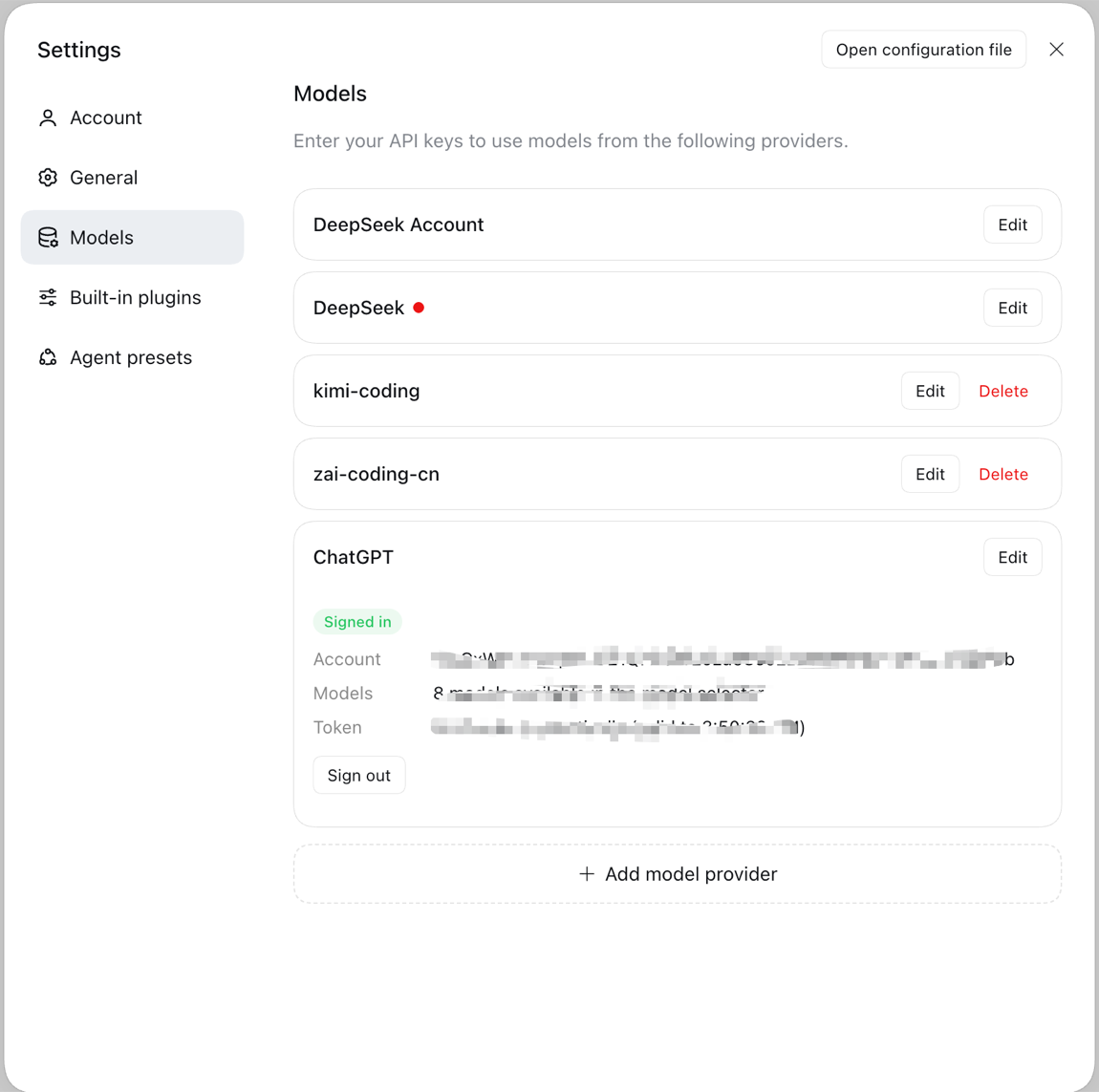
Open Settings → Models. The plugin owns a ChatGPT row, and the card on that row offers Sign in with ChatGPT. The card shows the authorization URL and selects it for copying, accepts the final redirect URL pasted back when the browser cannot reach the loopback address, and afterwards reports the account — its plan, the token's next refresh, and how many models it offers — with a Sign out button. No token reaches the page.
Signing out revokes the renewable session at the authorization server before clearing it locally, and says so when the server did not confirm.
A headless harness drives the same session object with no browser at all:
import { ChatGptAuth } from 'dsh-plugin-chatgpt/src/auth/manager.ts'

const auth = new ChatGptAuth({
  stateDir: `${process.env.DSH_HOME ?? `${process.env.HOME}/.dsh`}/chatgpt-subscription`,
  agentNameHint: 'DeepSeek Harness',
})

const attempt = await auth.begin()
console.log('Open this URL in your browser:\n' + attempt.authorizationUrl)

// The browser redirects to the loopback listener this attempt bound. If the
// redirect cannot reach it — a headless host, or a blocked popup — paste the
// final URL back instead.
// await attempt.submit('<the full redirect URL from your browser>')

const credential = await attempt.result
auth.adopt(credential)
The grant is stored owner-only under stateDir. attempt.submit() rejects a malformed or mismatched value and leaves the attempt open, so a mistyped paste can be corrected.
What you get
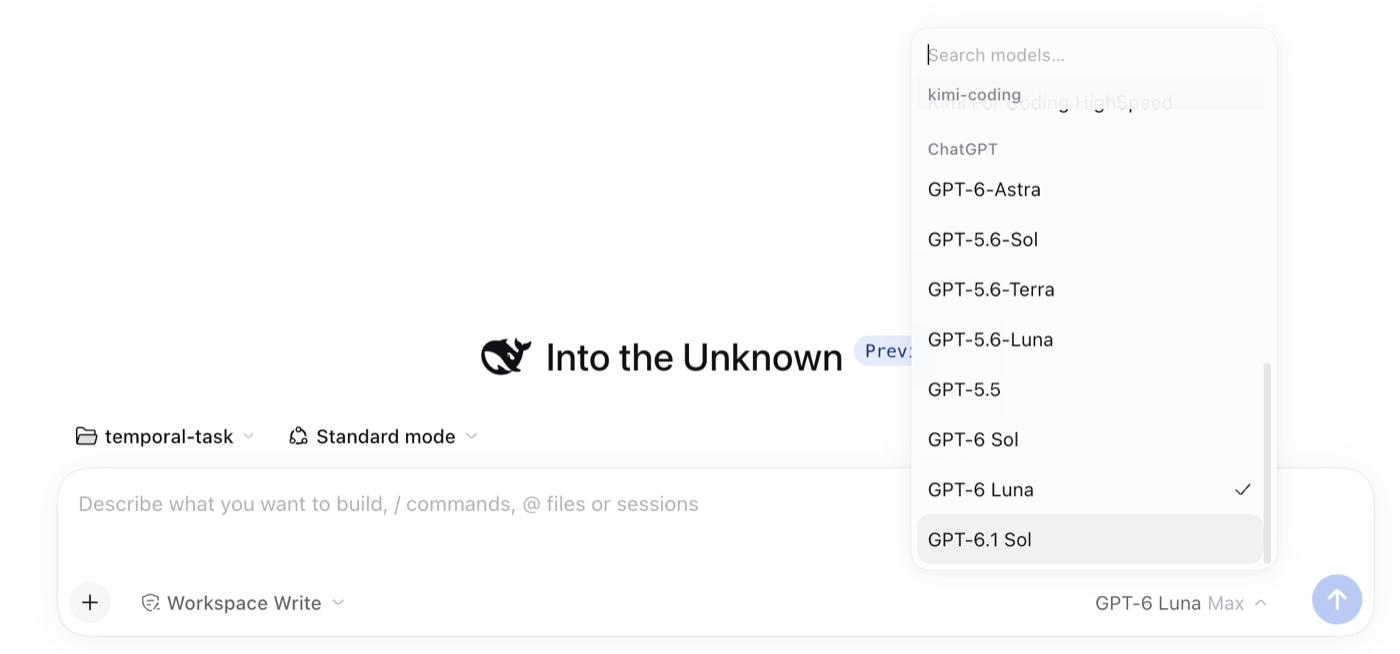
One provider route, listed in Settings → Models like any built-in provider, with the model roster, context windows, and reasoning levels the account is entitled to. Selecting a model there is what puts it in the model selector; no separate picker is involved.
Model metadata comes from the account listing. By default the adapter follows each model's advertised context window, including updates when the catalog refreshes. Set contextWindowLimit for a global budget or modelContextWindowLimits for individual models; explicit values are used as-is. Sign-in lives on that row's card.
For example, add this field to the plugin's configuration to set DSH's context budget to 1,000,000 tokens for models without an individual override, even if the catalog reports a maximum of 872,000. Remove it to restore account defaults for those models. These settings are independent of Codex settings. DSH still reserves headroom for compaction; they do not change service-side request limits.
contextWindowLimit: 1000000
For separate model budgets, use exact model IDs as dictionary keys. The priority is individual model, then global budget, then account default. In this example Astra uses 1,000,000, Sol uses 800,000, and other models use 500,000. The global field is optional; omit it to let other models follow their account defaults.
contextWindowLimit: 500000
modelContextWindowLimits:
  gpt-6-astra: 1000000
  gpt-6.1-sol: 800000
Changes take effect the next time DSH resolves a model. Removing a model entry restores the current global budget, or its account default when no global budget is set. Keys are case-sensitive exact IDs, not display names or wildcard patterns.
The share of the plan this installation may spend is set per app, in ChatGPT settings:

Understand the implementation
Implementation internals — click to expand
| Source | Responsibility |
|---|---|
cordis.patch.yml | The layer: one inserted row naming the route and the state directory. |
src/index.ts | The plugin entry: owns the adapter instance and registers the route. |
src/auth/protocol.ts | The exact endpoints, scopes, and loopback rules of the published flow. |
src/auth/sign-in.ts | Authorization: loopback listener and pasted redirect URL, raced. |
src/auth/manager.ts | Stored grants, the active account, and single-flight refresh. |
src/auth/store.ts | Atomic, owner-only credential storage. |
src/api/events.ts | Decoding the Responses event stream and its failure modes. |
src/convert/request.ts | Harness request to Responses body, including the fields the route refuses. |
src/convert/harness.ts | DSH request boundary, including session identity and replay metadata. |
src/convert/replay.ts | Validated native output and DSH replay envelopes, scoped to an account and model. |
src/convert/blocks.ts | Wire events to the harness's numbered content blocks. |
src/api/client.ts | The two HTTP calls: list models, run one turn. |
src/models/describe.ts | Availability and capacities, preferring what the account reports over the bundled catalog. |
src/adapter.ts | The harness-facing half of the provider contract. |
Three rules the code enforces rather than documents:
- A request never carries
temperature,max_output_tokens,top_p,truncation, or the other fields the plan-usage route refuses. They are named inREFUSED_FIELDSso they cannot be reintroduced by accident. response.completedis the only successful terminal. A stream that ends without one is an error, because a truncated answer that reads as finished is worse than a visible failure.- Account metadata is read at run time. The plugin requests
GET /v1/modelswith the selected account's grant. The bundled catalog fills missing metadata, and the dated measured list can add unlisted models. Model availability and context capacity are separate from the context budget reported to DSH.
Further Exploration
- Sign in with ChatGPT: OSS token sharing — the published flow this implements.
- Models and inference — the listing and request constraints.
- Preview limitations — the capabilities this route does not have yet.
Model Experience
This bundle inserts one provider row, and that row's plugin owns all of its model-facing behaviour; the layer itself contributes no prompt, tool, or context of its own.
Request context and condition
What the model sees
For every turn routed to chatgpt, the adapter preserves the order of messages, assistant blocks, tool calls, and results. System and developer instructions become developer messages at their original positions. DSH is told to append system-prompt updates in history. Native assistant output, including encrypted reasoning, is retained in DSH's replayState and replayed for the same authorization, route, and model when the saved content is unchanged.
Token effect
Variable. Visible context comes from DSH. Replaying encrypted reasoning can also contribute input tokens; a readable reasoning summary is not a substitute. The adapter does not truncate history: DSH owns compaction using the reported context budget. Output reservations are kept below that budget, but this route does not accept an output-token cap.
KV Cache effect
The adapter preserves reusable prefixes and opaque reasoning across tool turns and session restore. A bounded hash of the local authorization namespace, client registration, endpoint, provider, session ID, and call purpose supplies both prompt_cache_key and the session_id header; token refresh does not change it. Reauthorization gets a fresh namespace; legacy grants acquire one on first load. Sessionless calls omit these identifiers. OpenAI handles cache routing automatically on GPT-5.6 and later; a key is not a cache-hit guarantee. The SIWC route requires store: false and full HTTP history; response storage and prompt caching are separate. Cache retention/options remain omitted, as in Pi's public SIWC path, pending model-and-route-specific validation. See the official caching guide and reasoning replay guidance.
Known Limitations and Deferred Work
-
Existing histories remain usable — older sessions have no encrypted replay state to recover. Their visible messages and tools are replayed in order. Edited, pruned, foreign, malformed, or incompatible replay metadata falls back to visible history without reintroducing discarded content. This integration requires a DSH host supporting
finish.replayStateandsystemPromptUpdate: "in-history"; see the replay design and validation plan. -
One account at a time in the UI — the host keeps every authorized account separate and can sign one out by subject, but the card shows and switches only the active account, so adding a second one means signing out first.
-
Images and files are not sent — an image or file block carries a durable attachment reference that this adapter does not resolve, so it reaches the model as the placeholder text
[image omitted: not yet supported]. The omission is visible rather than silent, but the content is genuinely lost. -
The plan-usage route is in preview — computer use, Code Interpreter, file search, hosted MCP, image generation, and
tool_searchare refused upstream regardless of what this plugin sends, andmulti_agent,temperature, andmax_output_tokensare among fifteen fields that must be omitted. -
The roster mixes two sources with different authority — the account's listing supplies advertised models with the endpoint's own metadata; the models this route measurably serves but the listing omits are added from
src/models/served.ts, dated by when they were measured. A listing that changes under a stale measurement will show extras that no longer answer, andincludeUnlisted: falsenarrows the roster to the account's own answer. -
One installation, one host id — the host id is scoped to the state directory. Two profiles sharing one directory are one installation to OpenAI; two directories are two, and each is consented separately.
-
agent_name_hintis a constant — it defaults toDeepSeek Harnessand can be overridden per profile, but it is what a human reads on the consent screen and what OpenAI records as this app's identity, so changing it changes how existing grants are attributed. -
Context growth has a configurable budget — the default follows each model's account-catalog window, without a shared fixed cap.
contextWindowLimitand everymodelContextWindowLimitsvalue must be safe integers of at least 1,024 tokens. Individual model values override the global value; both take precedence over catalog metadata without clamping, following Pi's override behavior. Without an override, missing account metadata uses the bundled fallback. DSH's own compaction policy controls the actual trigger and headroom. This is a context budget, not a hard spending limit or a cache-hit target. -
Signing out is two things, and the card says which happened — the renewable session is revoked at the authorization server before the credential is cleared here, because a grant deleted locally may still be live elsewhere. When the server cannot be reached the sign-out still completes locally, and the outcome says the remote revocation was not confirmed. An exhausted allowance names ChatGPT's own usage page and says that the code identifies neither the cause nor a reset time: the plan's shared usage and an app-specific limit are both possible, which is why a plan that looks well within its limits on the site and a refusal can both be true.
-
Every Config field is
volatile(), and that is load-bearing — the harness builds a plugin's settings form from its volatile fields alone, and a plugin with none gets no settings namespace. The Models page renders a provider row only for a row whose namespace exists, so a schema without a volatile field leaves the route, and the card that rides it, impossible to display. Volatile fields are read through.get()at the point of use rather than captured as values. -
The Client half mounts its own Remote namespace — a bundled third-party plugin cannot reach
ctx.remote.<namespace>on its own: the Gateway installs a namespace only from a contribution of generated descriptors, and the package carrying those for the shipped API packages is generated at build time from a fixed list of workspace packages. Nothing generates one for an out-of-tree package, and the generator is not published, so this plugin mounts the contribution itself fromsrc/remote-methods.ts. A test reads the controller's source and fails when the two lists drift, because a method added on one side only would fail at the moment a user clicks. -
Signing in announces the new roster to the browser — a model selector caches the Host catalog and reloads it only when the Host says something changed, so a plugin that fills an empty roster at sign-in time has to publish
llm/adapters-updated. Without it the models are served and never appear in the selector, which looks exactly like a broken provider. The account card reports how many models the account offers, or why the listing could not be read. -
Cache statistics are measured, not predicted — the percentage is
cacheReadTokens / (inputTokens + cacheReadTokens + cacheWriteTokens)using provider-reported counters. Earlier versions reordered tool history and dropped native reasoning; their low hit rates do not establish an inherent SIWC limit. Prefix-preservation tests do not measure live cache hits. Compare fixed-model, fixed-effort runs after warm-up, recording cache reads/writes, total input, latency, and quota impact. -
Each installation registers its own client — ChatGPT settings lists one app row per registration, named by
agent_name_hint, and this plugin keeps the account/client mapping after signing out so the next sign-in on the same installation reuses its row instead of adding another. A second state directory is a second installation to OpenAI, and registers separately; deleting a state directory is what forgets one.
Dev Note
npm test          # node --test, no build step
npm run typecheck # entry point checked against dev-types/ shims
npm run build     # tsc emits the host half and the declarations, esbuild the browser bundle
npm run verify:harness -- /path/to/deepseek-harness # actual DSH assembler, offline
dev-types/ holds development-only declarations for the harness's LLM and Cordis seams, transcribed from the harness sources. They are not published and never shipped; the host supplies the real packages as peer dependencies. An end-to-end mount in a real harness remains the authoritative check.
Regenerate the model catalog when the upstream catalog moves:
node scripts/generate-model-catalog.mjs /path/to/@earendil-works/pi-ai
Related plugins
dsh-routing-suite
yjh051108/dsh-routing-suite
dsh-our-free-model
ebony-vinyl/dsh-our-free-model
dsh-workbuddy-connect
corrinehu/dsh-workbuddy-connect
dsh-plugin-subscriptions
v1ki/dsh-plugin-subscriptions