touchstone-dsh
gavinc-cn/touchstone-dsh
AI-agent-driven automated testing platform for DeepSeek Harness (dsh): Markdown case library, bug reports, per-project serial queue, development board and built-in load testing.
Install
dsh plugin --profile web add github:gavinc-cn/touchstone-dshREADME
Touchstone
An AI-agent-driven automated testing platform. Point it at a repository; it explores the code, writes and runs test cases, files what breaks, fixes it, and re-verifies the fix.




English | 中文
What is Touchstone?
Touchstone turns "we really should test more" into a running loop. You register a project — its source
directory, a working directory, an environment label, and the house rules the agent must follow — and
Touchstone drives an AI agent through DeepSeek Harness
(dsh) to generate test cases, execute them, report failures as bug reports, fix the code, and
re-verify the fix. Every artifact lands on disk in a reviewable form: a case library of Markdown case
files, a bug_report/ directory, and per-round logs.
It is not a one-shot "run my test suite" CLI. Touchstone is built around long-lived, multi-round agent sessions: a task runs round after round in the same session with its context intact, so the agent remembers what it already tried. A unified queue keeps exactly one writer per project (no two agents editing the same checkout at once), and the whole thing is observable — live round logs, a rendered session window, and an SSE-backed board.
Touchstone runs locally. It is a Python web site with a SQLite database and a file-system workspace;
no data leaves your machine except for the model calls your dsh host makes.
Highlights
- Six task types covering the whole QA loop — exploration, regression, stress, fix, retest, and case revision — each following a seven-stage lifecycle (generate cases → execute → report → analyze → fix → deploy → retest).
- A case library, not a test log. Cases are human-readable Markdown (
case.md+status.mdper case, plus anINDEX.mdper directory). Agents read and extend them across tasks; you can fix a bad case by editing a file. - Bug reports as first-class artifacts. Failures are written up as structured reports (severity, reproduction steps, log evidence, related cases) and can be routed back into fix / retest / case-revision tasks from the UI.
- Unified per-project queue. Tasks, board cards, and chat messages all take the same serial slot per project; queue position, the current holder, and evidence are queryable rather than guessed.
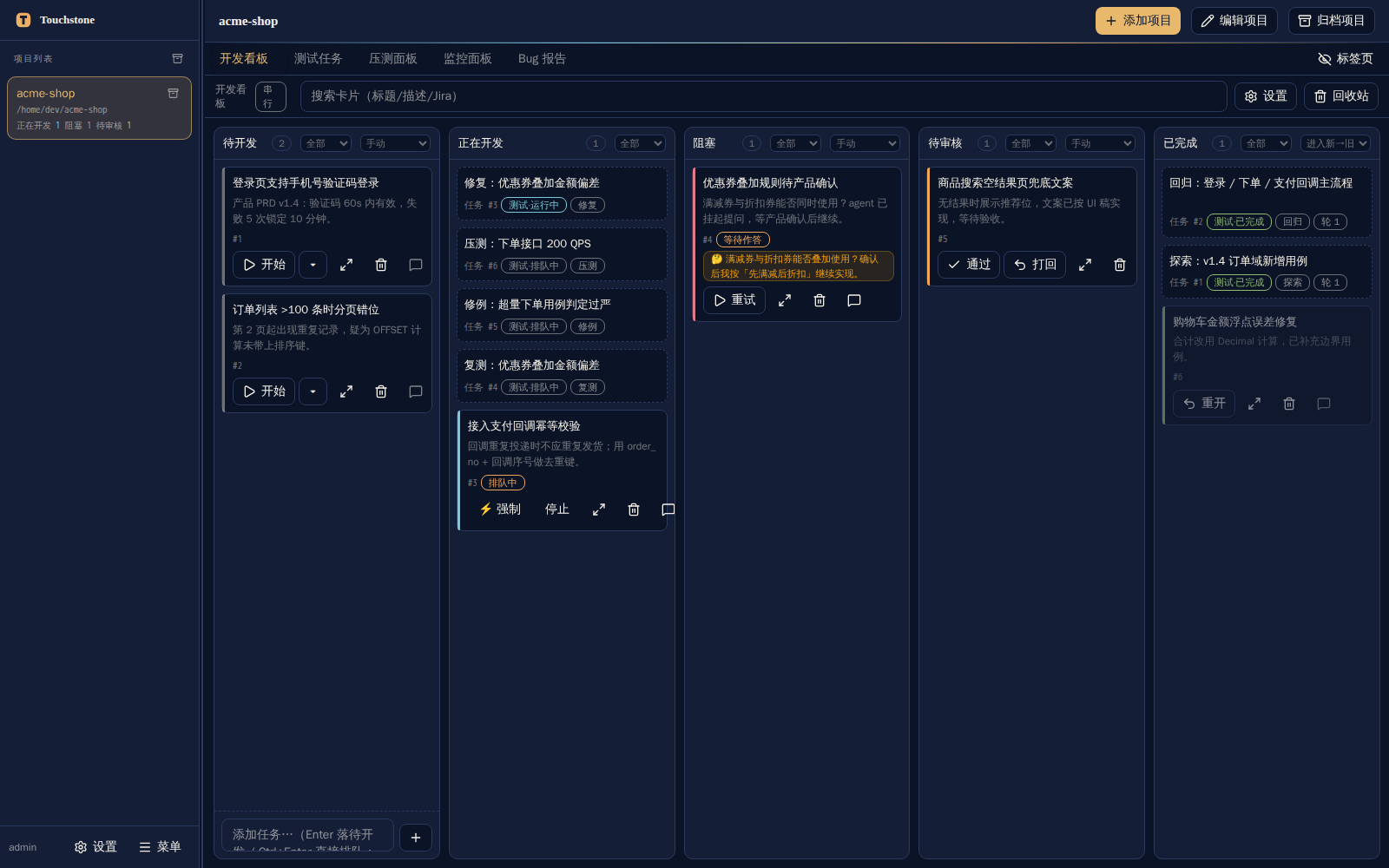
- A board for agent-driven development. Kanban cards start, queue, block, and complete agent sessions;
cards can run in an isolated
git worktreeso exploratory work never touches your main checkout. - Observable sessions. Render the full transcript of any agent session (messages, reasoning, tool calls, results), reply to it, inject into the running turn, compact it, fork it, or rewind to an earlier point through a fork.
- Stress testing built in. A stress task asks the agent for a scenario + script; the platform then drives the load itself, N runs per task, with per-run metrics, charts, and Markdown/JSON reports.
- Optional integrations. Feishu (Lark) push notifications with two-way answering from chat cards, and RAG-based semantic search over the case library.
- Self-contained stack. Backend: Python standard library plus four small dependencies. Frontend: React
- Vite. Storage: SQLite + plain files. Runs on Linux and Windows.
Screenshots
The development board — cards per column, task entries inline, per-project queue badges:
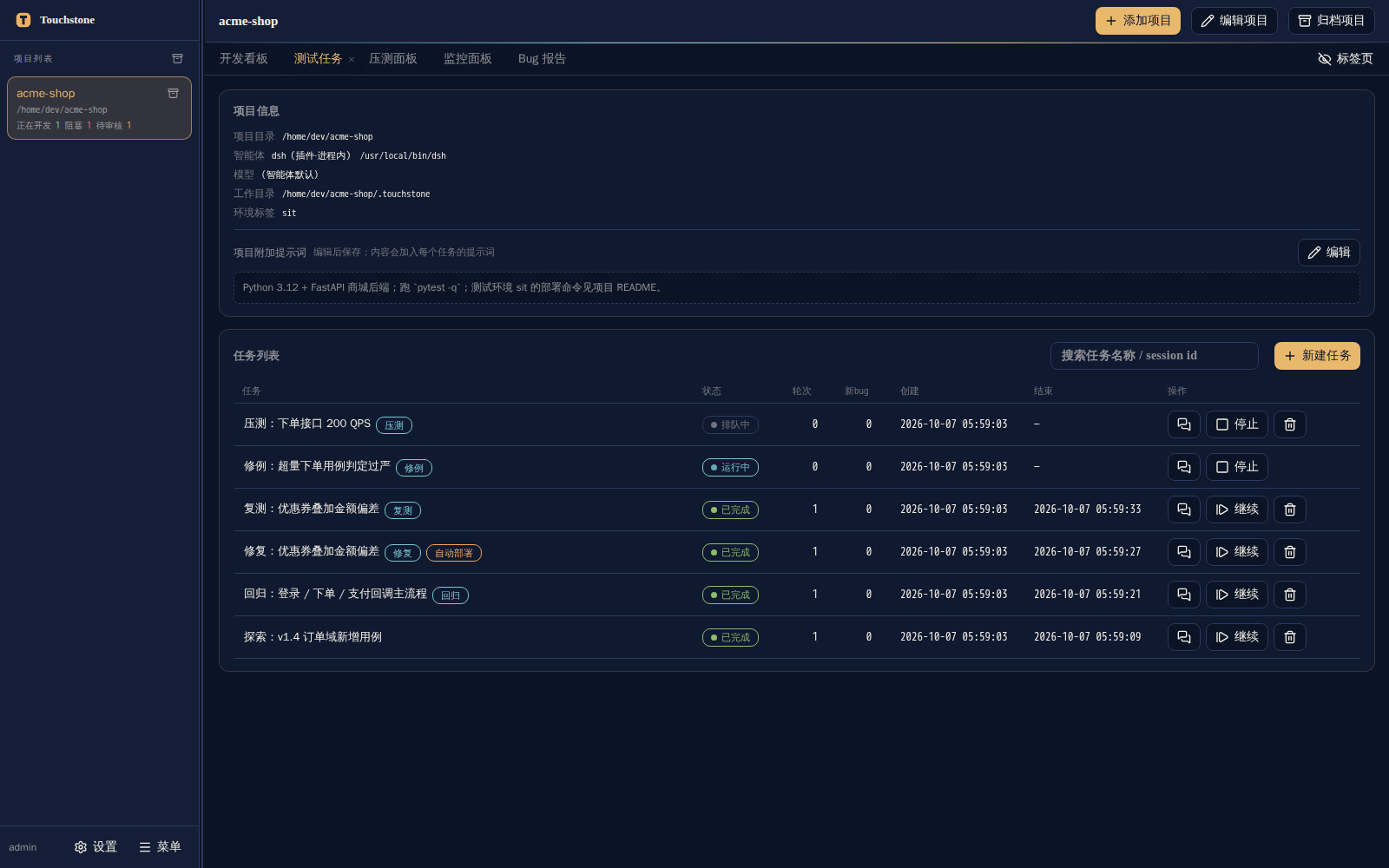
Test tasks — six task types, round counts, statuses, and per-task actions:
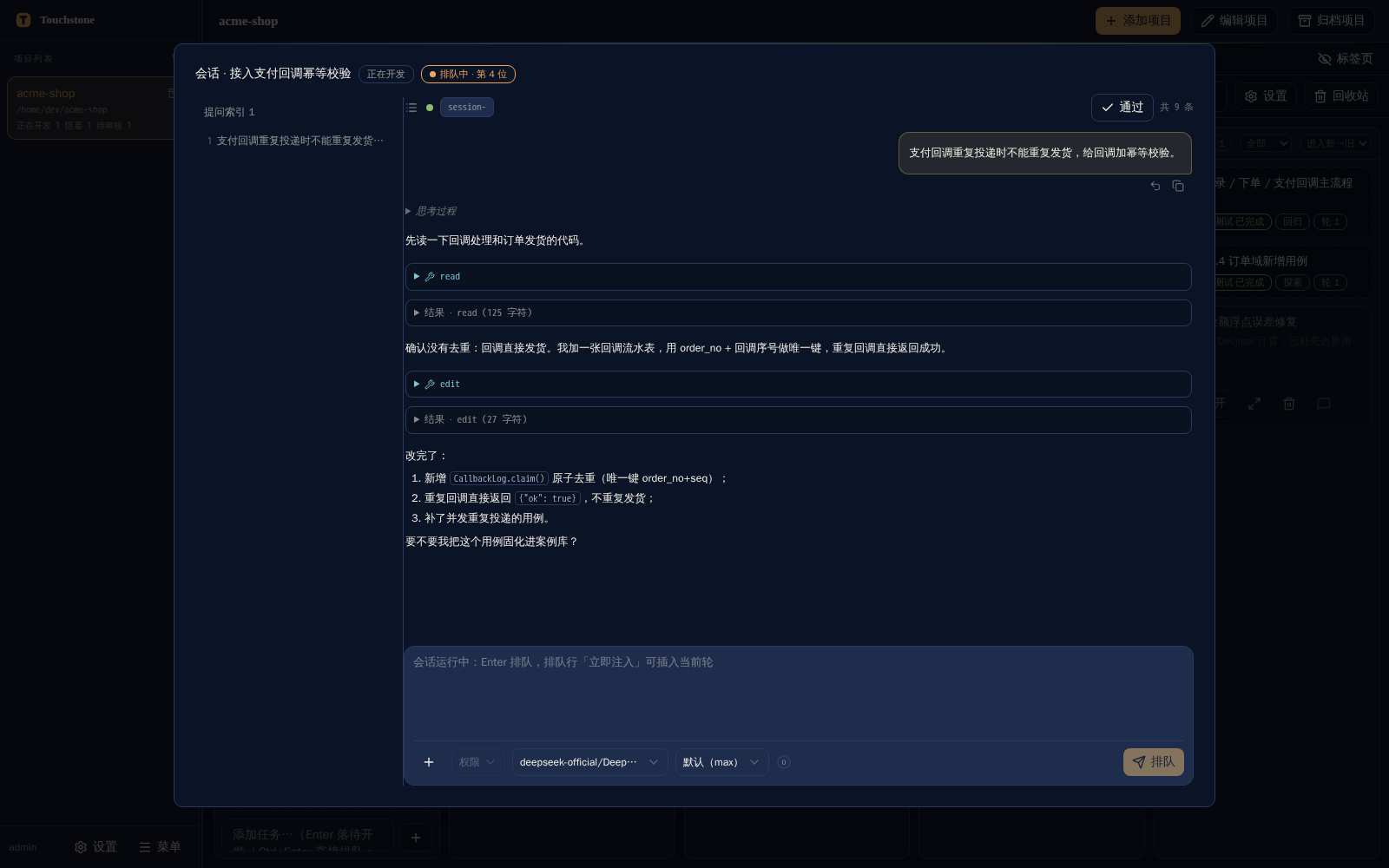
The session window — the full agent transcript rendered from the dsh session store, with reply,
approval, and model controls:
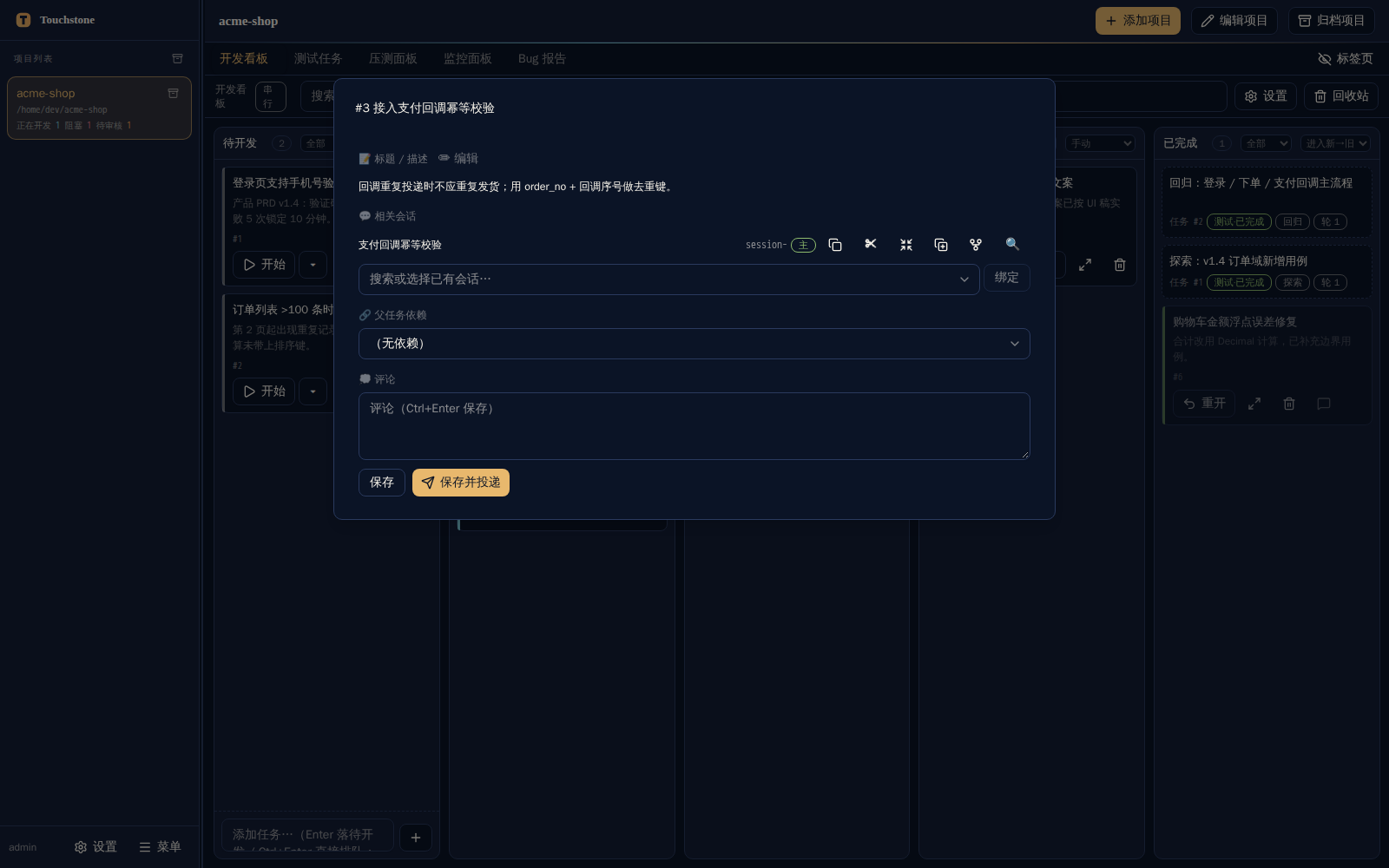
Card detail — description, scheduling, dependent cards, bound sessions, and comments:
How it works
flowchart LR
  U[Browser] -->|REST + SSE| S["Touchstone server<br/>Python stdlib · SQLite · files"]
  S -->|"/touchstone-agent<br/>resident sessions"| D["dsh host<br/>DeepSeek Harness"]
  D -->|"read / edit / bash"| R["Your repository"]
  D --> C[("Case library<br/>free_style/")]
  D --> B[("Bug reports<br/>bug_report/")]
  S --- C
  S --- B
- You create a project. Touchstone stores the repository path, a work directory, the environment label, optional project skills, and free-form guidance that is injected into every first-round prompt.
- You create a task. Pick a type (say, Exploration) and an end stage (say, report), and Touchstone queues it for that project.
- Rounds run in a resident agent session. Touchstone asks the
dshplugin to create or resume a session and sends the round prompt. Rounds stream back to the UI and to<work_dir>/.web/task_<id>_round_<n>.logas they happen. - Artifacts land in your work directory. New cases under
free_style/, bug reports underbug_report/, monitoring state under.live/. You review them like code. - Follow-up tasks close the loop. A report can spawn a fix task, a fix can spawn a retest, and a rejected report can spawn a case-revision task. When a task's end stage goes past "report", the platform appends the downstream stages as a follow-up task automatically.
Task types
| Type | What the agent does | Typical end stage |
|---|---|---|
| Exploration | Reads the code and writes new test cases into the case library | Report |
| Regression | Re-runs existing cases (optionally limited to a commit date range) | Report |
| Stress | Produces a load scenario + driver script, then the platform runs the load | Report |
| Fix | Analyzes a bug report, patches the code, deploys, and re-tests | Fix / Deploy / Retest |
| Retest | Re-verifies one bug report (retest only, deploy + retest, or deploy only) | Retest |
| Case revision | Rejects a bug report as a bad case and rewrites the case instead | Revision |
Core concepts
| Concept | Meaning |
|---|---|
| Project | A repository plus its work directory, agent binding, environment label, and guidance |
| Task | One queued unit of work: a task type, a stage range, a stop condition, and a round history |
| Round | One prompt/response cycle in the task's agent session |
| Case library | <work_dir>/free_style/ — Markdown cases, status files, and per-directory indexes |
| Bug report | <work_dir>/bug_report/<timestamp>_FS_<title>/ — the failure dossier for a case |
| Card | A board item that can start, queue, and drive its own agent session |
| Queue | The per-project serial slot shared by tasks, cards, and chat messages |
Quick start
Prerequisites
| Requirement | Version | Needed for |
|---|---|---|
| Python | 3.12+ | The server (verified on 3.12) |
| Node.js | 22.19+ or 24+ | Running the dsh host (the front-end build alone needs Node 18+) |
DeepSeek Harness (dsh) | current release | Agent execution — required for plugin mode |
1. Clone and install
git clone https://github.com/gavinc-cn/touchstone-dsh.git
cd touchstone-dsh
python3 -m pip install -r requirements.txt
2. Start the site (standalone mode)
./touchstone.sh start          # builds the front end on first run, then serves 127.0.0.1:4601
./touchstone.sh status         # PID and the actual port
./touchstone.sh stop
Then open http://127.0.0.1:4601.
The first start seeds an admin account. If TS_ADMIN_PASSWORD is not set, a random one-time password
is generated and printed once in the startup banner:
grep '一次性初始口令' .run/server.log # or: ./touchstone.sh status
You will be asked to change it on first login. Set TS_ADMIN_PASSWORD=<your-password> before the first
start to skip the one-time password (and the forced change).
Plugin mode (
dsh) is password-free by default (2026-10-08): the shell passesTS_ADMIN_PASSWORDLESS=1, so the seededadminhas an empty password and no forced change — the panel is auto-logged-in asadminanyway. Set a password in Settings → Change password whenever you want one (it then becomes the password used for direct/standalone logins). The plugin also writes the backend's stdout/stderr line by line to<db dir>/plugin-backend.log(next to~/.touchstone/touchstone.db) — that is where the plugin-mode startup banner and the[board]/[waitq]/[runner]diagnostics can be read.
Standalone mode gives you the full site — projects, case library, bug reports, board, queue, monitoring — but agent execution needs plugin mode (below), because the agent runs inside the
dshhost process.
3. Run as a dsh plugin (recommended: enables agent execution)
The plugin embeds Touchstone in the dsh Web UI as a sidebar entry and panel, and lets Touchstone drive
resident agent sessions in the host process.
Option A — from npm (self-contained package: whole platform + prebuilt front end):
npx @deepseek-ai/dsh web          # 1) start the dsh host once (creates ~/.dsh/profiles/web)
dsh plugin --profile web add @gavinc-cn/touchstone-dsh   # 2) install the plugin package
# 3) select the bundle in the profile manifest (the Plugins panel toggle does the same thing):
node ~/.dsh/profiles/web/node_modules/@gavinc-cn/touchstone-dsh/dsh-plugin/scripts/select-bundle.mjs \
  ~/.dsh/profiles/web/package.json
# 4) restart the dsh web UI, open http://127.0.0.1:3080, use the Touchstone entry (Alt+T toggles the panel)
The platform's own Python dependencies are installed with pip, not npm:
pip install -r ~/.dsh/profiles/web/node_modules/@gavinc-cn/touchstone-dsh/requirements.txt
# Windows: python -m pip install ...   (the official installer ships python.exe, not python3)
The plugin resolves the interpreter itself when you do not configure one: it probes python first, then
python3 (the same order as touchstone.cmd), and uses the first one that actually runs. If that is not the
interpreter where you installed the dependencies, the missing-dependency page prints the exact command for the
interpreter it picked; to pin another one, set pythonPath in the profile patch:
- id: touchstone-dsh
  config: { pythonPath: /path/to/python }
No repoDir is needed: the package carries server.py and webui/dist-plugin, so the plugin falls back to
its own directory.
Option B — from a checkout (development):
cd touchstone-dsh
./dsh-plugin/install.sh           # idempotent install of this checkout into the profile
The installer prints the optional profile patch for pointing the plugin at your working copy (or picking a specific interpreter); skip it to use the package's own directory:
- id: touchstone-dsh
  config: { repoDir: /path/to/touchstone-dsh, pythonPath: /path/to/python3 }
Both run modes share one database (~/.touchstone/touchstone.db by default) and are mutually exclusive
while running; the second instance refuses to start and tells you who holds the lock.
Windows
A cross-platform launcher offers the same commands:
python touchstone.py start | stop | restart | status | build | test
First steps in the UI
- Sign in and open Settings → Change password if you used the one-time password.
- Add project — source directory, work directory (defaults to
<project>/.touchstone), environment label, and the guidance the agent should follow. The case library and bug report directories are derived and created for you. - Create a task (or a board card) and let the queue pick it up. Round logs stream live; the session window shows the transcript as it grows.
Configuration
| Variable | Default | Purpose |
|---|---|---|
TS_PORT / TS_HOST | 4601 / 127.0.0.1 | Listen address. Use TS_HOST=0.0.0.0 to expose the site on your LAN |
TS_PYTHON | python3 | Interpreter used by the launcher (must have the runtime dependencies) |
TOUCHSTONE_DB | ~/.touchstone/touchstone.db | SQLite database. Must live on a local disk — file locking does not work on CIFS/network shares |
TS_ADMIN_PASSWORD | (random, printed once) | Initial admin password; setting it skips the forced change |
TS_ADMIN_PASSWORDLESS | 1 in plugin mode | Seed admin with an empty password and no forced change (the plugin shell sets this); ignored when TS_ADMIN_PASSWORD is set |
TS_WEB_DIR | webui/dist | Static front-end directory the server serves |
TOUCHSTONE_RUN_DIR | .run/ in the repository | PID / log / port files |
TS_EXT_DIR | extensions | Root of the built-in asset manifests |
TS_ARCHIVE_SYNC | 1 | Keep board "Done" and dsh session archive in sync (set 0 to disable) |
TS_DSH_PROFILE / TS_DSH_PYTHON | web / auto-detected | dsh profile and interpreter used by the plugin installer |
Runtime paths inside a project's work directory:
| Path | Contents |
|---|---|
free_style/ | Case library (cases, status files, indexes) |
bug_report/ | Bug reports, one directory per report |
.web/ | Round logs, chat logs, stress metrics and reports |
.live/live.json | Agent live state used by the monitoring page |
board_media/ | Attachments pasted onto board cards |
Capabilities and limits
| Area | Supported |
|---|---|
| Agent sessions | Create, resume, reply, inject into the running turn, cancel, compact, fork, rewind-by-fork, model and permission-preset switching |
| Session observability | Full transcript rendering, archive state, attachment preview, live status stream (no polling) |
| Tasks | Six types, seven stages, stop conditions, date-range scoping, per-round logs, restart, continue |
| Board | Cards across five columns, drag & drop, queue position, parent dependencies, scheduled start, trash, isolated worktrees |
| Case library | Derived indexes, change-based retest triage, optional semantic (RAG) search |
| Stress testing | Scenario validation, concurrent load, second-by-second metrics, charts, Markdown/JSON reports per run |
| Notifications | Feishu (Lark) outbound push, inbound commands, and answering questions from chat cards |
| Multi-user | Login, admin/user roles, per-project ownership checks on every project-scoped endpoint |
Known limitations, stated plainly:
- The UI is currently Chinese-only.
- Agent execution requires plugin mode; standalone mode is the site without the agent.
- Rewind and "compact into a new session" are approximations — rewind starts a new branch at an earlier point (the original session is kept), rather than truncating in place.
- No error banner for failed model requests —
dshhas no event for it, so the session window shows what the host reported and nothing more. - The Windows launcher is implemented but
dshitself has not been verified on Windows yet. - End-to-end test scripts are not distributed in this repository (see below), so
test-fullandtest-uireport a skip rather than running.
Repository layout
touchstone-dsh/
├── server.py            HTTP site: routing, auth, REST, SSE, static front end
├── runner.py            Task execution engine and per-project scheduling
├── waitq.py             Unified queue model (the single source of truth for "who runs next")
├── board.py             Development board: cards, gates, agent sessions, archive sync
├── chat.py              Session chat: queued messages and injection
├── prompts.py           Per-round prompt templates (per task type, per stage)
├── sessparse.py         Reads the dsh session store into a renderable transcript
├── dshdriver.py         Client for the in-process dsh agent driver
├── dshevents.py         Folds the dsh state stream into an in-process registry
├── rag.py               Optional semantic search over the case library
├── loadgen.py           Built-in stress engine (scenarios, metrics, reports)
├── feishu.py            Feishu (Lark) integration
├── db.py                SQLite data layer
├── builtin_prompts/     Prompt assets injected into first-round prompts
├── dsh-plugin/          The dsh plugin package (thin Node shell + driver + client bundle)
├── extensions/          Built-in assets installable from the settings page
├── webui/               React + Vite front end
├── tests/               pytest / vitest suites and the isolated-instance harness
└── touchstone.sh|py|cmd Launchers (Linux / cross-platform / Windows)
Development
./touchstone.sh build        # install front-end deps and build webui/dist
./touchstone.sh test         # backend pytest + front-end vitest
./touchstone.sh test-full    # + isolated end-to-end scripts (scripts are not distributed here)
./touchstone.sh test-ui      # Playwright end-to-end (needs a running site; scripts not distributed)
cd webui && npm run dev      # front-end dev server on :5173, /api proxied to :4601
Optional commit gate:
git config core.hooksPath githooks # pre-commit runs the fast test layer (SKIP_TS_TESTS=1 to skip once)
See tests/README.md for the test matrix and prerequisites.
Security notes
- The site listens on
127.0.0.1by default and requires a login. Exposing it (TS_HOST=0.0.0.0) puts it on your network — do that deliberately. - Every project-scoped endpoint checks ownership before returning data; the
adminaccount is the only administrator and cannot be renamed or deleted. - The agent runs with the permission preset you configure. The default is the most permissive one (no approval prompts), which is convenient and sharp-edged: review the project guidance and the preset before pointing it at a repository you care about.
- Passwords are stored with the hashing scheme the project was specified against (unsalted MD5 for new passwords, PBKDF2-SHA256 for legacy seed accounts). Treat this as a local-development-grade store.
License
MIT © Touchstone contributors
Related plugins
webnovel-writer
lingfengqaq/webnovel-writer
loopx (dsh-loopx-plugin)
loopx-project/loopx
ouroboros (dsh-plugin)
q00/ouroboros
loopx (dsh-loopx-plugin)
huangruiteng/loopx