dsh-openrouter-plus
gnaneshkunal/dsh-openrouter-plus
Per-Session OpenRouter routing: a loopback relay writes `service_tier`, `provider.sort` and the `:floor` variant into each request from one of nine presets picked on the composer chip, with a pinned base URL per preset for route-level defaults.
Install
dsh plugin --profile web add github:gnaneshkunal/dsh-openrouter-plusREADME
dsh-openrouter-plus


Service-tier routing and a live model list for OpenRouter — as a DeepSeek Harness plugin, with no patched packages.
DSH's OpenRouter support has two gaps, and neither one is reachable from a provider profile.
Routing. OpenRouter lets you steer where a request is served from: flex endpoints bill half
price on a slower pool, priority endpoints bill a multiplier for lower latency, and the throughput
or price comparators reorder the pool in between. @deepseek-ai/dsh-llm-pi-ai exposes baseURL and
headers on a provider profile, but no request-body fields
(discussion #9787).
Model discovery. Fetch available models is answered from the catalog baked into
@earendil-works/pi-ai, and for a catalog-backed route (openrouter) it answers before it reads
that route's baseURL. The snapshot only refreshes when pi-ai is published again, so every model
OpenRouter has added since then is invisible — on the build this plugin was written against, that was
65 of OpenRouter's 463 live models, including openai/gpt-6.1-terra,
moonshotai/kimi-k3.1-pro and x-ai/grok-4.20-multi-agent. Pointing the row at another endpoint
does not help: the provider name is what short-circuits, not the URL.
This plugin closes both gaps from the outside, and it never patches a shipped package. A loopback
relay applies the routing preset to each request. Sync live models reads the endpoint a route
points at and lists it, so you can tick the models you want and add just those. Both ride on schema
fields the profile already has, so both survive bun install -g upgrades and never touch
~/.bun/install/global.
The preset is chosen per session, at request time. One provider row keeps serving every preset, so switching never mints a provider, a route or a model list.
  composer chip: this session runs on «priority»
      │
      ▼
  dsh-llm-pi-ai ──►  dsh-openrouter-plus relay  ──►  https://openrouter.ai/api/v1
      baseURL =           │ reads the session from x-session-id / prompt_cache_key,
  127.0.0.1:8791/t/<id>/v1  │ applies that session's preset to the body
                            └── /__openrouter-plus/* ──► OpenRouter Plus settings page
                                  ├ /models      reads the live listing
                                  └ /models/add  adds only the ticked models
What you get
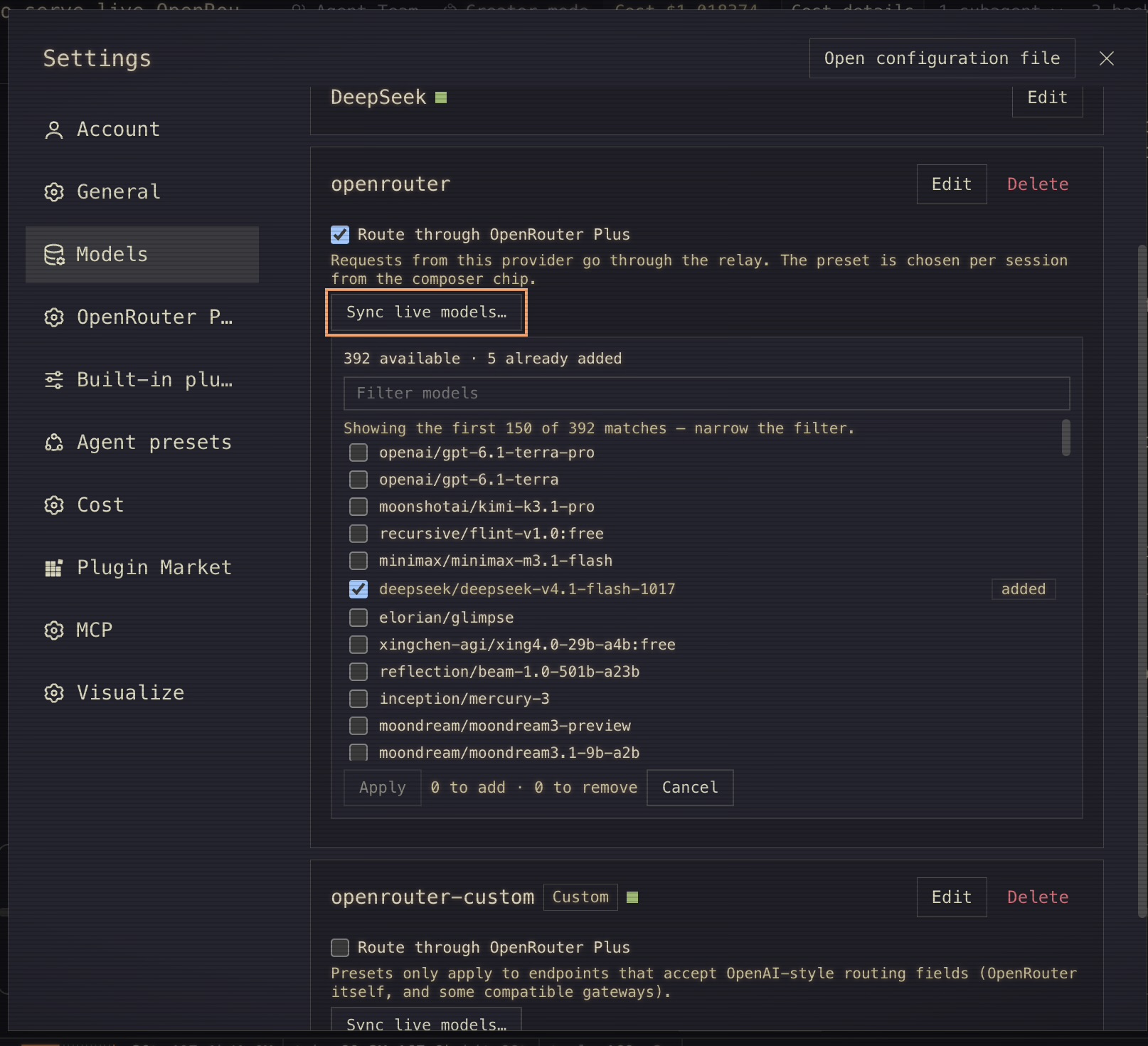
- Sync live models. Every
llm-pi-aiprovider row gets a Sync live models… button. It reads the endpoint that row points at and shows what it publishes right now — including models added after the pi-ai catalog in your install was generated — with a filter box and a checkbox per model. Tick what you want and only those are added; models the route already declares are markedaddedand cannot be added twice. Nothing is rewritten: hand-written names, context windows and effort maps are left exactly as they are. - One provider row, any preset. A routed provider keeps its key, protocol and models and gains one thing: a composable preset that the relay applies to each request. No per-preset provider copies, no sibling route per preset, no model list duplicated nine times.
- Pinned base URLs for what a chip cannot cover —
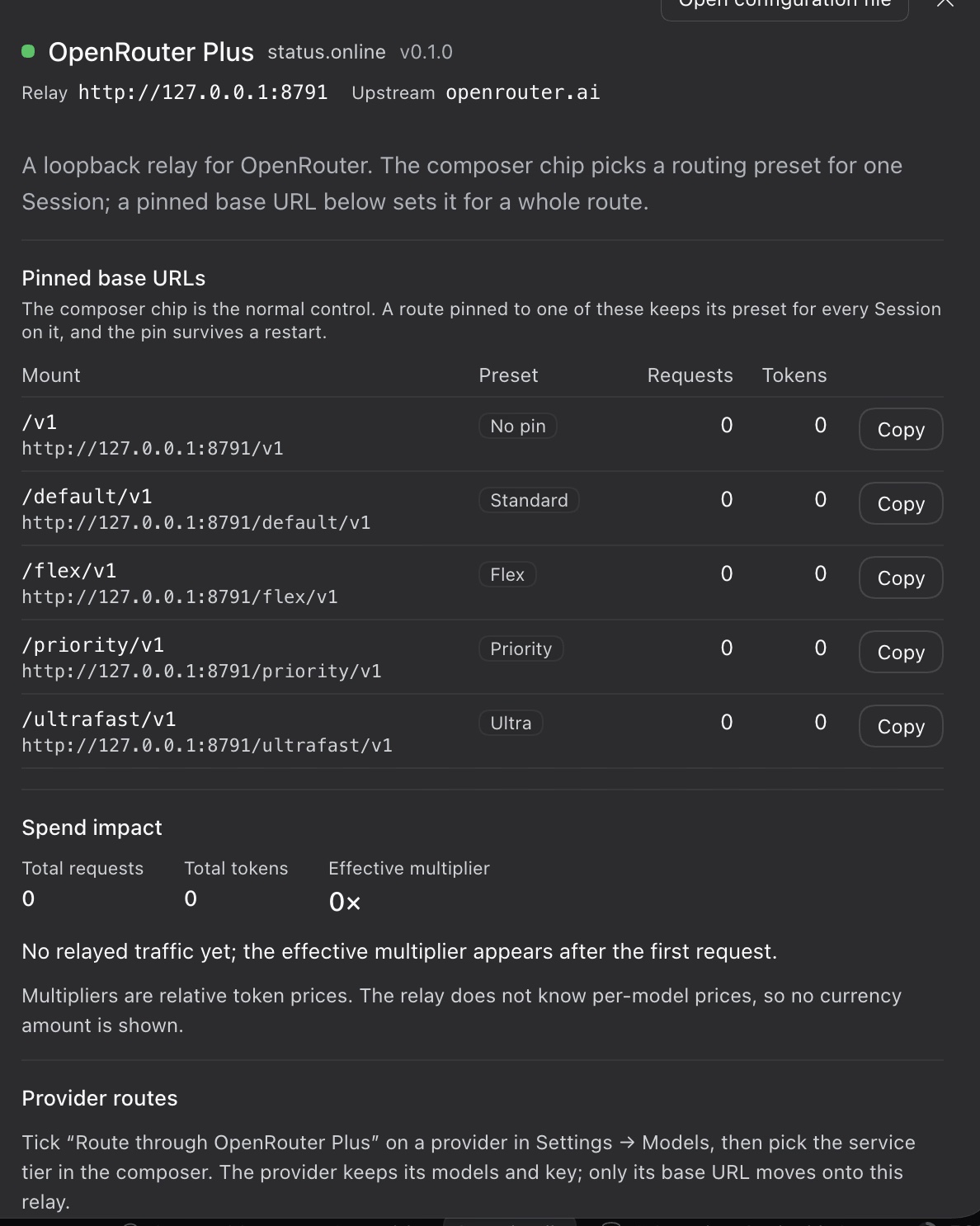
/v1(no pin),/default/v1(Standard),/flex/v1(Flex),/priority/v1(Priority),/ultrafast/v1(Ultra). Paste one into an OpenAI-compatible provider route and that preset applies to every Session on the route, subagents included, and survives a restart. The relay still serves the older names (/auto/v1,/fast/v1,/scale/v1); the settings page lists one mount per preset so it never offers the same choice twice. - Its own settings page (Settings → OpenRouter Plus) showing relay state, one pinned base URL per preset with a copy button, live request/token counters per preset, the measured effective multiplier, and recent requests.
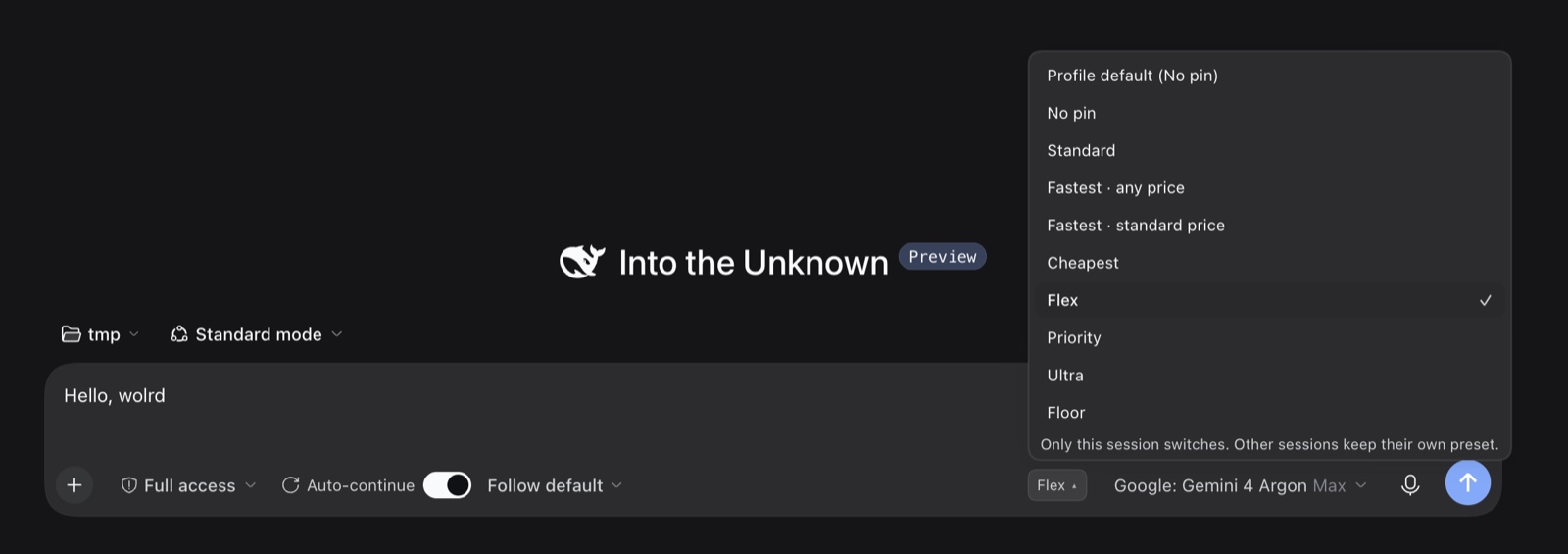
- A preset chip in the composer — next to the model selector, a compact chip shows the preset
this Session will actually apply and switches it in one click. The switch is per session: it
changes what the next request from this conversation carries, so two conversations can sit on
FlexandPriorityat the same time. It shows up on a brand-new Session too — before the first message the chip reads the profile default, so a preset can be picked before you start typing. The reasoning effort you chose stays put: switching a preset touches no provider row and no model list. - A switch on every provider row — in Settings → Models, each
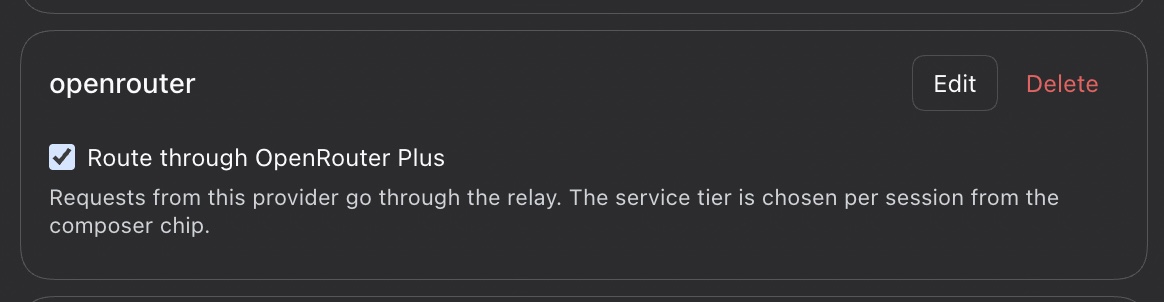
llm-pi-aiprovider gets a Route through OpenRouter Plus checkbox. Tick it and that provider's traffic flows through the relay to the endpoint you already gave it; untick it and the endpoint comes back. Your provider entry, protocol, key and models are left exactly as they were. - A default preset for the profile — the settings page sets what an unchosen Session inherits
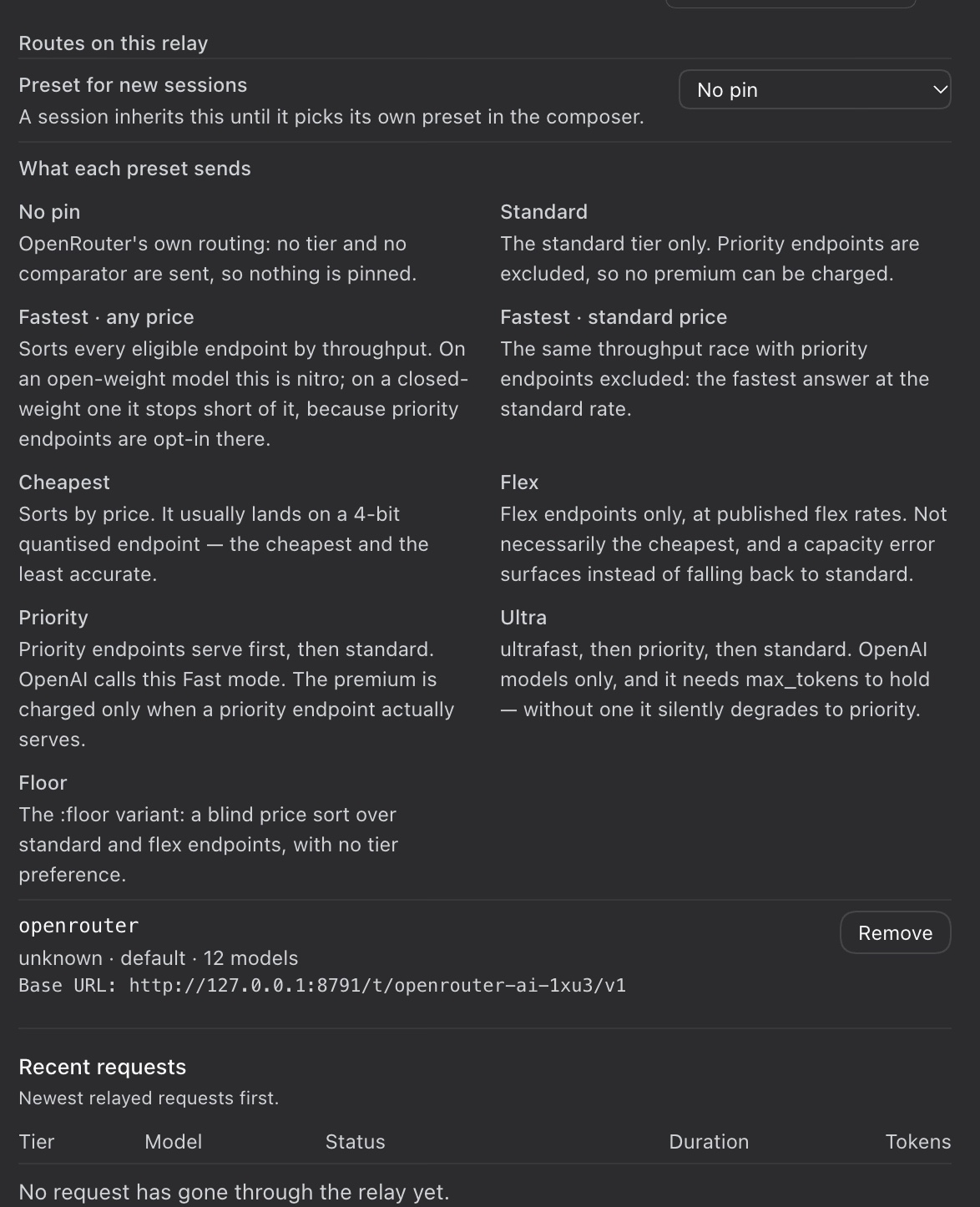
(and explains what every preset sends), and the composer chip's
Profile default (…)entry hands a Session back to it. - Zero risk to your existing setup — the relay holds no API key, forwards your
Authorizationheader verbatim, binds only to loopback, and the only profile changes it makes are reversible by construction.
Screenshots
The switch lives on the provider you already use, in Settings → Models. Ticking it moves that row's traffic onto the relay and changes nothing else:
The settings page — relay state, one pinned base URL per preset, the counters, and what each preset actually sends:
The composer chip, which switches the preset for one Session without touching any provider row:
The provider row also carries Sync live models…: it lists what that row's endpoint publishes right now, ticked where the route already has the model, so you can add a model or untick one without touching anything else. Hand-written entries are never rewritten.
Install
--profile is not optional — dsh plugin manages the plugins of one named profile, so pass the
one you actually boot (web for dsh web, default for a bare dsh). Without it the CLI stops
with required option '--profile <name>' not specified.
dsh plugin --profile web add dsh-openrouter-plus                              # from npm
dsh plugin --profile web add github:GnaneshKunal/dsh-openrouter-plus#v0.1.0   # or a pinned tag
From a clone, which is what development uses:
git clone https://github.com/GnaneshKunal/dsh-openrouter-plus
dsh plugin --profile web add ./dsh-openrouter-plus     # or, from a session:
#   plugin_manager { action: install_bundle, target: "./dsh-openrouter-plus" }
The manifest declares engines.dsh, so the plugin manager refuses a harness older than the build
it was tested against instead of mounting something that cannot work.
The plugin adds one entry to Settings navigation: OpenRouter Plus, directly after Models. If
the relay is up, the page shows the origin (http://127.0.0.1:8791) and its mounts.
Releasing
.github/workflows/ci.yml runs npm run check, npm test and npm pack --dry-run on every push
and pull request. .github/workflows/release.yml turns a tag into a release:
$EDITOR package.json CHANGELOG.md      # version 0.2.0, and a "## [0.2.0] — 2026-11-02" section
git commit -am "chore: 0.2.0" && git push
git tag v0.2.0 && git push origin v0.2.0
The job refuses a tag that disagrees with package.json, runs the suite, publishes to npm, and
opens the GitHub Release with the matching CHANGELOG.md section as its notes. It fails rather
than skipping when npm already has that version: a release is a new version, never a re-upload.
npm needs the package to exist before it can trust a publisher, so 0.1.0 went up by hand, once,
from a logged-in machine:
npm login
npm publish --access public
npm trust github dsh-openrouter-plus --file release.yml \
  --repo GnaneshKunal/dsh-openrouter-plus --env release --allow-publish
Every version after it is a tag, and nothing else. The tag does everything: the workflow run's OIDC identity is accepted, npm attaches a
provenance attestation linking the tarball to the commit and run that built it, and no
NPM_TOKEN exists in the repository. npm trust list dsh-openrouter-plus shows the grant.
Publishing to npm is optional for users: dsh plugin --profile web add github:… installs the same code from a
tag, which is how most of the community ships.
Use it
Two clicks: tick the provider, pick the preset
- Settings → Models → tick Route through OpenRouter Plus on the provider you already use
(for example
openrouter-custom). That provider's traffic now flows through the relay; itsapi,apiKeyEnv, headers and models are untouched. - Open the composer of any Session and pick a preset in the chip next to the model selector. Every request that Session sends now applies that preset.
Nothing else to create, and nothing to clean up: the provider row is the only row that ever existed, and the preset is a per-Session choice rather than a provider.
The settings page manages the profile-level Service tier for new sessions — with a short table of what each preset sends — and lists the routes that currently point at this relay (with Remove for the ones you no longer want).
From a provider row (the switch)
In Settings → Models, every llm-pi-ai provider row carries a compact strip added by this
plugin: a Route through OpenRouter Plus checkbox.
Ticking it does three things, all through the control API:
- records the endpoint that row currently points at (that is your real base URL) as a target in this plugin's own config;
- gives that target a mount —
http://127.0.0.1:8791/t/<targetId>/v1— which mounts the endpoint without pinning a service tier: the presets come from the Sessions that call it; - repoints only that provider row's
baseURLat the mount.api,apiKeyEnv, headers and models are not touched, and no plugin bookkeeping is written into the provider entry (it is schema-validated, so it stays clean).
The first attach reloads the plugin. Recording a new target is a write to this plugin's own
config, so the Loader re-applies the Host row and the listener rebinds — which can cut the HTTP
response to that very request. It is not a failure: the strip re-probes /health, re-reads
/targets and shows the truth, and every write here is idempotent, so a retry lands cleanly. Later
attaches (a detach, a re-attach of a known endpoint) reuse the target row and do not reload anything.
A preset switch never writes anything, so it never reloads anything either.
What happens to a request: the relay strips the mount prefix, appends the rest of the path to your
recorded endpoint, resolves the preset the Session carrying that request chose, and applies it to the
JSON body. No pin sends neither a tier nor a comparator — and a service_tier the client put there
itself is removed, so a Session that pinned nothing stays unpinned rather than inheriting whatever a
UI happened to send.
Untick it (Detach) and the row's baseURL goes back to the endpoint recorded for that target;
the mount stays until you remove the target. Everything is idempotent: the same endpoint always maps
to the same target id, so ticking the box twice cannot fork the table or repoint anything twice.
Why the switch is on the row and not inside the add-provider form. The obvious place for this checkbox is the "Custom model API" form itself. A plugin cannot put it there: the
settings.models.provider-cardextension slot hands an extension{provider, configured, keyConfigured}and no setter, the draft Base URL lives in a privateuseStateinside the editor, and that card dispatches no extension at all before the provider is saved. The saved row is the earliest surface a plugin can reach — same page, one save later. The same class of limitation is why a re-picked model loses hand-declared fields (tracked upstream as discussion #11097).
By hand
Point any OpenAI-compatible provider route's baseURL at a mount:
- id: llm-pi-ai
  config:
    providers:
      my-flex-route:
        api: openai-responses
        apiKeyEnv: OPENROUTER_API_KEY
        baseURL: http://127.0.0.1:8791/flex/v1
        models:
          - id: deepseek/deepseek-v4.1-flash
            # Optional but recommended — see "Reasoning effort" below.
            reasoningEfforts:
              off: null
              low: low
              medium: medium
              high: high
              max: max
Or route a provider to its own endpoint through a target mount — no provider config needed beyond the base URL:
- id: llm-pi-ai
  config:
    providers:
      acme-gateway:
        api: openai-completions
        apiKeyEnv: ACME_API_KEY
        baseURL: http://127.0.0.1:8791/t/acme-gw-9f3a/flex/v1
        models:
          - id: acme-large
/t/<targetId>/v1 is the shape the switch writes: it mounts the endpoint and pins nothing, so each
Session's chip decides. /t/<targetId>/<tier>/v1 is the older pinned shape and still works — useful
when a row must sit on one tier regardless of who calls it. The target's endpoint is declared once,
in the plugin's config (see targets below), so one listener can front any number of OpenAI- or
Anthropic-style endpoints.
Reasoning effort on a relay route
A relay route is a provider key the installed catalog has never seen, so
@deepseek-ai/dsh-llm-pi-ai cannot inherit a model's reasoning capability for it. Without an
explicit reasoningEfforts the model materializes as reasoning: false and the composer shows
"This model provides no reasoning effort levels." — no effort selector, no error, nothing in the
log. The relay itself is not involved; it never touches reasoning fields.
The plugin fills that gap when it creates a route, from the best evidence available:
- a capability the model already declares (in the source route), kept byte-identical;
- a declaration for another variant of the same id —
google/gemini-4-argon:flexteaches the plugin aboutgoogle/gemini-4-argon; - the configured
reasoningEffortsmap, as a fallback for everything else.
Set reasoningEfforts: false to switch filling off, or omit it to fill only from evidence 1–2.
A model that declares reasoningEfforts: false is itself opted out: the fill leaves it alone.
The fill also re-applies itself. Re-picking a model in Settings → Models rebuilds that row from
the catalog — id, name, context window, max tokens — and drops reasoningEfforts along with
every other hand-declared field. That is the shape of this bug: the effort selector works, you touch
the model list afterwards, and it is gone. The cause is upstream rather than here (adopt() in
@deepseek-ai/dsh-client-ui-settings-models copies a fixed field list), so the plugin watches the
profile instead: a debounced pass runs on every config settle and restores the capability a moment
after the edit lands. Set autoRepairReasoning: false to keep the plugin out of your config
entirely, and use Add reasoning to N models in the settings page (or
POST /__openrouter-plus/routes/repair) when you want the fill on demand.
Either way it only ever touches routes whose baseURL points at the relay, never overwrites a
declared map, never resurrects an explicit false, and writes nothing when there is nothing to do.
Presets
A service tier is not one field. OpenRouter exposes three levers — service_tier (which pools may
serve, and in what order), provider.sort (the comparator over that pool) and two slug suffixes
(:nitro, :floor) that mix the two — and each preset is a combination the API actually defines:
| Preset | Sends | What it does |
|---|---|---|
| No pin | nothing | OpenRouter's own routing. |
| Standard | service_tier: "default" | The standard tier only; priority endpoints are excluded. |
| Fastest · any price | provider.sort: "throughput" | The whole eligible pool sorted by throughput. On an open-weight model this is nitro — its priority endpoints already compete in default routing. On a closed-weight one it stops short, because those endpoints are opt-in. |
| Fastest · standard price | sort: "throughput" + service_tier: "default" | The same race over the standard pool only, so the priority premium is unreachable. |
| Cheapest | provider.sort: "price" | Lowest price over the standard pool — usually a quantized version of the model. It never admits a flex endpoint, so it cannot reach a flex rate. |
| Flex | service_tier: "flex" | Flex endpoints only, at flex rates. Not necessarily the cheapest, and a flex capacity error surfaces instead of falling back to standard. |
| Priority | service_tier: "priority" | Priority endpoints serve first, then standard. OpenAI calls this Fast mode. The premium is charged only when a priority endpoint actually serves, and within each group endpoints sort by throughput unless you set a comparator. |
| Ultra | service_tier: "ultrafast" | ultrafast, then priority, then standard. OpenAI models only, and it needs max_tokens to hold — without one it silently degrades to priority. |
| Floor | model: "…:floor" | A blind price sort across the standard and flex pools. No parameter form exists for this, which is why it is a slug. :nitro is deliberately not offered separately: for the models where it changes the outcome, Fastest · any price is the same race. |
Two rows sit between "no tier" and "priority" for a reason: provider.sort and service_tier
decide different things. Sorting by throughput reorders whatever pool the tier admitted; pinning
service_tier: "default" is what keeps the premium out of it. Neither one alone can say
"fastest, and never at a premium".
From the composer (the preset chip)
Once a provider row is routed, a compact chip appears in the composer next to the model selector, showing the preset the next request will apply. Picking another one there does not rewrite any config and does not mint a provider: the Host records the choice for this Session in memory, and the relay applies it to the request body on the way out.
The menu carries labels only — Fastest · any price, Cheapest, Flex, Priority, … — and the
long explanation of what each one sends lives on the settings page, where it is read once. The first
entry, Profile default (…), stops choosing for this Session and shows which preset it will
inherit.
That is why it is per session: two conversations can be on Flex and Priority at the same time,
neither of them rewrites the other's provider row, and the reasoning effort you selected survives
the switch because the selection itself never changes.
The choice lives in the Host's memory — it is runtime state, like the effort level — so it survives
the whole Session but not a Host restart (a default-preset write reloads the plugin, which drops
those choices too). Want a preset that outlives every restart? Either set the profile Service tier
for new sessions or point a provider at a pinned mount by hand (/flex/v1).
The chip only appears when the Session's current provider is routed through a mount
(/t/<targetId>/…). Elsewhere the Models-page switch is the control: it is the one that moves the
provider itself.
Control API
Served on the DSH web server's own origin, under /__openrouter-plus, outside the relay's
proxy path space. That is deliberate: the settings page, the Models-row switch and the composer chip
all talk to it, and a page must be able to reach the API it was served from. Mounting it next to the
GUI means no second port, no CORS, and no difference between a desktop tab and a phone on the
tailnet — anywhere the GUI loads, the control API answers.
The relay listener keeps the same endpoints on loopback. It is the curl/script path and the
fallback for a composition with no web GUI; the browser half never uses it.
| Endpoint | Purpose |
|---|---|
GET /__openrouter-plus/health | liveness |
GET /__openrouter-plus/status | address, bound/port, upstream, mounts, metrics |
GET /__openrouter-plus/targets | source routes, routes on this relay, the targets table, and the preset table ({ default, presets }) |
GET /__openrouter-plus/tier?session=<id> | what that Session would apply now: preset, wire, chosen, default, presets |
POST /__openrouter-plus/tier | { session, preset } — choose this Session's preset; preset: null hands it back to the profile default. Memory only, never a config write |
POST /__openrouter-plus/tier/default | { preset } — the preset an unchosen Session inherits; omit it (or send none) to pin nothing |
GET /__openrouter-plus/models?route=<id>&upstream=<url> | the live catalogue for one route, each model marked inRoute |
POST /__openrouter-plus/models/add | { route, upstream?, models: [], remove: [], confirmRemove? } — add/remove an explicit selection; a removal requires confirmRemove: true |
POST /__openrouter-plus/routes/remove | { name } |
POST /__openrouter-plus/routes/repair | adds missing reasoningEfforts to the routes this plugin owns |
POST /__openrouter-plus/routes/attach | { route, upstream } — record the endpoint and point that provider at the relay |
POST /__openrouter-plus/routes/detach | { route, id } — put that provider back on its own endpoint |
POST /__openrouter-plus/targets/register | { upstream, tier?, id? } — record an endpoint without touching a provider |
POST /__openrouter-plus/targets/remove | { id } — refuse while a provider still routes through it |
attach/detach are what the Models-page switch calls; both are idempotent and report
changed: false when the row is already in the requested state. A rejected request answers 400
with { error: { message } } — for example a body that is not an http(s) URL, or one that points
back at the relay. POST /tier answers 400 for an unknown preset (turbo) or a missing
session, and accepts preset: null (or no preset at all) to clear. The tier-era body shape is still
read: tier: "fast" maps onto the priority preset, and any other legacy name maps onto the preset
that sends the same field.
Everything in /tier is deliberately write-free: a config write would re-apply this plugin row and
restart the listener, which is not something a mid-conversation click should risk. Only
/tier/default writes, because it is a preference rather than one Session's state.
On the web origin the API is behind the GUI's own fence (ctx.connection.requestRejection): the
Host/Origin trust check plus the dsh-auth-* session cookie, so a page served from another origin
cannot read the telemetry or drive a write. A request with a loopback Host and no Origin is a
local process — curl, a script — and is allowed through as before, which is also why the command
below works without a cookie. POST additionally requires x-oorp-client: web, and the loopback
copy of the API reflects CORS only for loopback GUI origins.
# Control API on the GUI origin (same answer, no extra port):
curl -s http://127.0.0.1:3080/__openrouter-plus/status | jq .metrics.byTier
# The relay's loopback copy still answers too:
curl -s http://127.0.0.1:8791/__openrouter-plus/status | jq .metrics.byTier
Configuration
cordis.patch.yml ships the defaults; override them in your profile's patch layer:
| Key | Default | Meaning |
|---|---|---|
enabled | true | false keeps the plugin installed but binds nothing |
host | 127.0.0.1 | bind address — loopback only, deliberately |
port | 8791 | preferred port |
portFallback | true | fall forward to the next free port (the page probes 8791–8794) |
upstream | https://openrouter.ai/api/v1 | where requests are forwarded, no trailing slash |
routes | tier mounts | mount path → tier, for pinned URLs (/flex/v1); null tier is a pure passthrough. Accepted names are default, flex, priority, ultrafast, and the aliases auto/scale (both mean no pin) and fast (= priority). The per-session design needs only /v1 |
upstreamTimeoutMs | 0 | 0 disables the upstream timeout (long SSE completions) |
reasoningEfforts | false-able map | levels written onto relay routes' models; false disables, omit for evidence-only |
autoRepairReasoning | boolean, default true | re-apply that fill whenever the profile changes, so editing a route's models cannot silently strip the effort selector |
defaultPreset | none | the preset an unchosen Session inherits; none pins nothing. A tier-era defaultTier is read forward onto the equivalent preset. Written by Service tier for new sessions on the settings page |
targets | {} | extra endpoints served from /t/<id>/… mounts: { "<id>": { upstream } }. Written by the switch; edit by hand only if you want one without a provider row |
Security model
- Loopback only. The relay forwards the caller's
Authorizationverbatim and stores no key. Do not bind a routable interface. - The control API rides the GUI's origin and fence. It is mounted on the DSH web server, so it
is reachable exactly where the GUI is and nowhere else, and every browser request passes the same
Host/Origin check and session cookie the GUI's own API uses. Only a loopback request with no
Origin— a local process — is exempt, and that is the privilege it already had on the relay listener. - Read-only telemetry. The status API exposes counts and token sums, never prompts or keys.
- Reversible by construction. The plugin only ever adds a provider route whose
baseURLpoints at its own origin, and only removes routes that pass that same test. The switch is the same idea one level down: the endpoint it took over is recorded in the plugin's config, and Detach — or deleting the target — puts it back, so a provider is never left pointing at a dead mount.
Troubleshooting
| Symptom | Cause and fix |
|---|---|
| Card says OpenRouter Plus is not answering | The Host row is not loaded, or the request was refused by the GUI's fence. Check the Host log for [openrouter-plus]; reload the page after a Host update. |
| The relay is down but the page still answers | That is the split working: the control API reports bound: false plus the bind error from /status, instead of looking like a dead plugin. Check the port range or enabled: false; set a fixed port. |
| Settings → OpenRouter Plus works on the desktop but not on another machine or a phone | Should not happen any more: the page calls its own origin. If it does, the Host is too old to mount the API on the web server — update it, or reach the loopback copy on the relay port. |
| A model errors after disabling the plugin | That model belongs to a route pointing at the relay. Re-enable the plugin or remove the route on the OpenRouter Plus page. |
| Requests work but nothing is steered | The Session is on No pin (or the profile default is), the mount is a bare /v1 passthrough, or the request is not POST with a JSON body. |
| The chip shows a preset, but another Session still bills full price | Every preset is per Session by design. Set it in that Session's composer, or set a profile Service tier for new sessions. |
| The chip disappeared after a Host restart | Choices are runtime state and the memory table is dropped on restart (and on a default-preset write, which reloads the plugin). Re-pick it, or set the profile default. |
Flex still bills full price | The provider decides which endpoint served; a preset only decides which ones may be asked. Confirm the served endpoint with usage or the OpenRouter dashboard. |
Fastest · any price did not get faster | The comparator only reorders the pool the tier admitted. On a closed-weight model the fastest endpoints are priority-only, so use Priority — or compare against the :nitro slug in the OpenRouter dashboard. |
Ultra behaves like Priority | ultrafast only holds on OpenAI models that receive a max_tokens limit; without one the API degrades to priority. The relay never invents a limit, so set one on the model row. |
| The page says failed to render, and switching the chip says the relay did not confirm the change | The tab is running the browser half from before the update against the restarted Host. Reload the page (or reopen the app window); only a document reload re-fetches the client bundle, and a Host restart alone keeps the old module in memory. |
| No effort selector for a relay route's model | The model has no reasoningEfforts — usually because the model list was edited in Settings → Models afterwards. It is restored automatically; if autoRepairReasoning is off, press Add reasoning to N models on the OpenRouter Plus page. See "Reasoning effort on a relay route". |
Uninstall
Remove the route(s) in Settings → Models, then:
dsh plugin --profile web remove dsh-openrouter-plus
Development
node --check index.js && node --check client.js
node --test            # 99 tests, no network, no profile writes
See docs/ARCHITECTURE.md for the module contract, and
docs/DESIGN.md for the design rationale against the upstream discussion.
MIT.

Related plugins
dsh-our-free-model
ebony-vinyl/dsh-our-free-model
dsh-routing-suite
yjh051108/dsh-routing-suite
dsh-workbuddy-connect
corrinehu/dsh-workbuddy-connect
dsh-connect-workbuddy
dingminhua/dsh-connect-workbuddy