dsh-capability-optimizer
hezhongtang/dsh-capability-optimizer
Headless Claude Code consultations with advisor, reviewer, and designer roles, returned as reference answers.
Install
dsh plugin --profile web add github:hezhongtang/dsh-capability-optimizerREADME
dsh-capability-optimizer




External-expert consultation for DeepSeek Harness: the agent headlessly invokes the Claude Code CLI through explicit advisor, reviewer, designer, or custom role contracts, then weighs the structured replies as reference answers.
English | 中文
Why this exists
A single harness has one perspective. At a consequential decision, before declaring risky work done, or before significant new code, a second model can supply useful independent evidence. That is a hypothesis to measure, not a guaranteed quality gain: persona research does not show that merely calling a model an expert reliably improves accuracy. This plugin makes consultation a bounded tool call instead of a copy-paste detour. Claude answers under a behavioral and output contract, and DSH receives the result as advice to weigh, not obey.
Phase 1 speaks only to the Claude Code CLI. The settings schema (v2, one workspace per harness), the UI tab catalog, and the runner seam are already multi-backend: codex, zcode, kimi-code, pi, opencode, and omp each land later as a runner behind the same three tools.
Features
| 🎭 Role contracts | Built-in advisor / reviewer / designer with different objectives and JSON contracts, or your own (outputKind, prompt, model, fallback, effort). enabled parks a role without deleting it |
| 🧠 Thinking effort | Native --effort (low / medium / high / xhigh / max) at three levels: per-call argument > role > global default |
| 🔄 Model fallback | One-hop retry on model-level errors (unrecognized_model, model-not-found, …) with usedFallback recorded in run metadata |
| 🤖 Agent tools | consult_expert (one role, one question) · consult_panel (up to N roles in parallel, one wall-clock wait) · consult_roles (live roster) |
| 🎛 Auto consult | Composer-seat toggle (permissions row) picks roles per session; a policy section rides the system prompt and lifecycle nudges fire at write/finish anchors, budgeted per role per session |
| 🖥 Settings workspace | One tab per harness CLI; saves hot-apply — role edits reach the agent's next model step without a dsh restart |
| 🔬 Connectivity test | One real consultation end-to-end (CLI + login + proxy) with turns, duration, cost, and fallback marker |
| 🛡 Defense in depth | Read-only CLI tools, strict MCP isolation when supported, permission pinning, typed schemas, bounded output/turns/time, and explicit untrusted-evidence labels |
| 🌐 Fully bilingual | Every UI string — including built-in role descriptions, reserved-backend notes, and validation messages — follows the UI language (zh/en); agent tooling keeps stable English identifiers |
Install
# from npm (recommended)
dsh plugin --profile web add dsh-capability-optimizer

# or straight from the GitHub repo
dsh plugin --profile web add github:hezhongtang/dsh-capability-optimizer
Restart dsh web (or your profile of choice). Works in any profile — web, tui, headless — because the tools are host-side agent tools.
Requirements: the claude CLI (npm i -g @anthropic-ai/claude-code) on PATH, logged in.
Usage
Ask your agent:
"consult the reviewer on this diff before we call it done"
The agent picks the role and calls consult_expert. For a precise task it can send a structured brief: trusted objective, successCriteria, and constraints, plus currentAttempt, artifacts, verification, and unknowns, which are explicitly labeled untrusted evidence. Legacy context remains an artifact shorthand. Claude's role-specific envelope returns with model, turns, duration, cost, and protocol metadata.
| Tool | Read/Write | Purpose |
|---|---|---|
consult_expert | read* | One role, one question, optional structured brief (or legacy context), optional model / effort overrides |
consult_panel | read* | Several distinct role contracts on one brief, in parallel; this is not a majority vote |
consult_roles | read | Live roster including outputKind, role-level model/effort, and global defaults |
* Read-only for your workspace; each call spends your Claude subscription quota — the tool descriptions themselves tell the model to batch material instead of machine-gunning calls.
Auto consult
The composer toolbar (the permissions control's row) carries an Expert Consult toggle. Checked roles add selection criteria and lifecycle reminders for this session; the plugin does not invoke them automatically.
- Policy section: every model request names the checked roles and their selection conditions: advisor at consequential decisions, reviewer before declaring changed work done, and designer before significant new code. Modes are
off | remind | hard-remind(defaultremind). Legacyrequiredsettings migrate tohard-remind. - Lifecycle nudges: when designer is enabled, the first file write arms a next-step nudge if pre-code consultation did not happen; a changed turn about to finish without a successful reviewer consultation is steered one more step.
hard-remindadditionally logs the missed designer checkpoint but never claims the host blocked Write. - Budget:
capPerRole(default 3) counts realconsult_*calls per role per session — nudges and the model's own discretionary calls share it. At the cap the promise drops out of the policy text and the anchors go quiet. - Soft by design: a nudge guarantees the instruction is delivered, never the tool call — dsh has no forced-call API. A model that declines must state the reason in one line.
- The popover shows live usage counts (
used/cap) per role; the last selection is remembered per browser. Settings → Expert Consult → Auto consult edits the default checked set and budget (row-config keyautoConsult) — the same layer tui/headless profiles consume.
Consultation status dock
A session-scoped card bar above the composer shows every real consultation in near real time: queued / running / fallback retry / succeeded / failed / cancelled. While running, a card shows model, effort, and captured stdout bytes; when finished it shows the failure kind, or a bounded preview of the reply / envelope. consult_panel yields one card per role, so partial failures stay visible per role.
The dock takes no vertical space while idle; terminal cards can be dismissed individually or cleared together, and closing the session clears the bar. Entries live only in plugin memory (the latest 8 terminal cards per session, plus a hard active-card ceiling of 24; never context / brief / artifacts), and replies/errors are server-truncated previews. This is status polling plus a final-reply preview, not token streaming; on hosts without the conversation.input.dock slot or the status route it simply does not mount / stops polling.
Settings UI
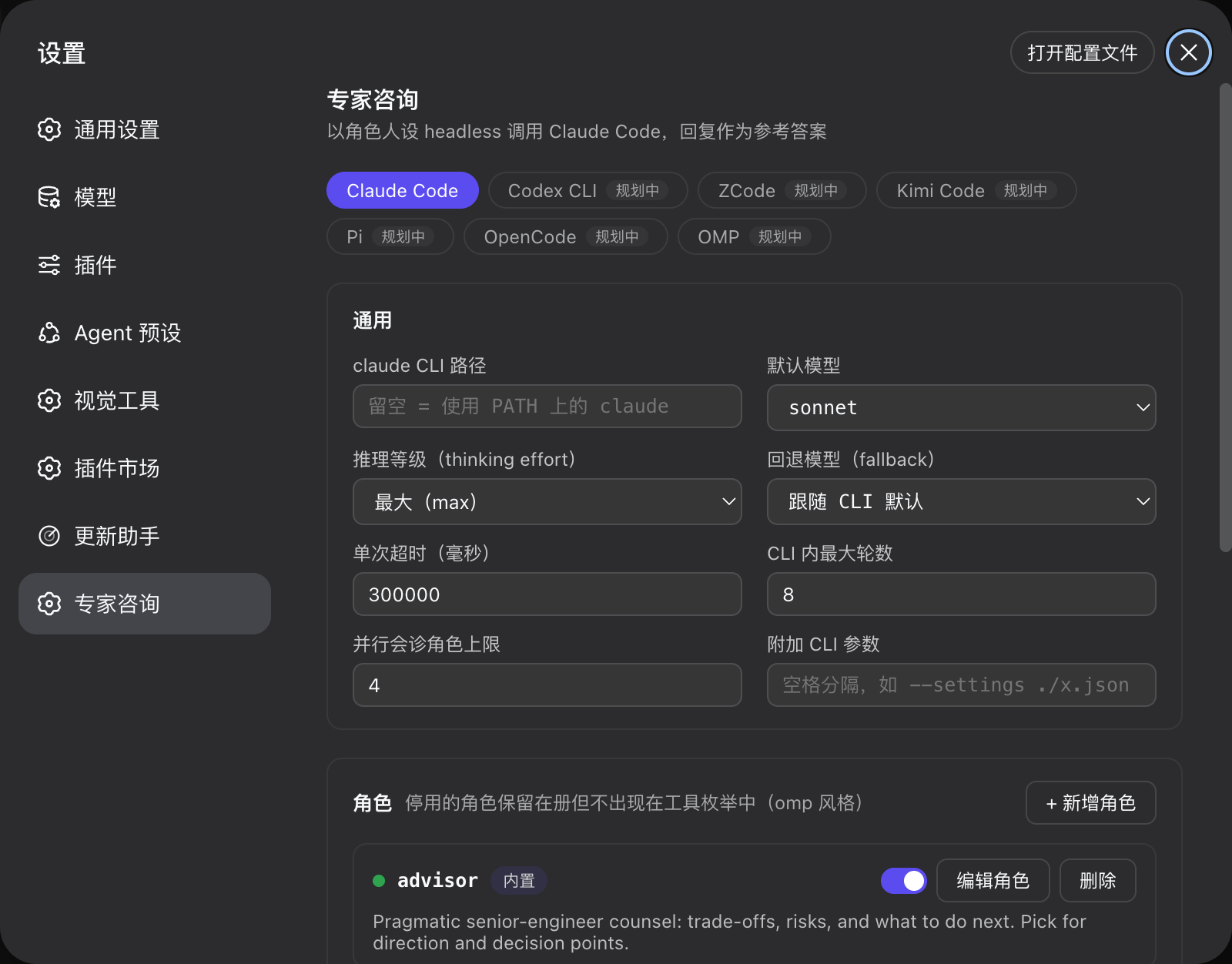
Settings → Expert Consult is organized as one workspace per harness CLI — a tab bar over the catalog (claude-code live; codex, zcode, kimi-code, pi, opencode, omp reserved with a planned-status page and no settings stored until their runners land). The Claude Code workspace manages everything at runtime:
- General — CLI path, default model (catalog aligned with the supported Claude CLI aliases and versioned ids), thinking effort (
--effort: low/medium/high/xhigh/max), fallback model, per-call timeout, max turns, panel size, per-consult dollar cap, extra CLI args (allowlisted;--settingsis refused). - Roles workspace — add / edit / delete roles, each with name, label, description, output contract (
advisor | reviewer | designer | general), system prompt, model, fallback, and effort. Disabled roles stay in the roster but leave the tool enum. - Auto consult — the default checked set, per-role per-session call budget, and trigger mode (
off | remind | hard-remind); the composer toggle overrides the checked set per session. - Connectivity test — one real consultation end-to-end (CLI + auth + proxy), showing the effective model, turns, duration, cost, and a fallback-used marker.
- Save & apply persists to
~/.dsh/dsh-capability-optimizer/settings.json(atomic writes, 0600) and hot-applies: the agent tools re-register immediately. Reset removes the file and restores defaults.
Call-site model / effort override role values, which override global defaults. The built-in advisor defaults to claude-opus-5 as an overridable quality preference, not a role-name-based prohibition. fallbackModel retries once on a model-level error and records requestedModel, CLI-reported actualModel / actualModels, derived effectiveModel, and usedFallback.
Configure (composition layer)
The row's config still works as the base layer (settings file wins once saved):
| Key | Default | Meaning |
|---|---|---|
cliPath | claude | Path to the CLI when it is not on PATH. |
model | CLI default | Model alias (opus, sonnet, ...) applied when a call does not specify one. |
timeoutMs | 300000 | Wall-clock cap per consultation. |
maxTurns | 16 | Agentic turn cap inside the CLI. |
maxPanelRoles | 4 | Roles per consult_panel call. |
maxBudgetUsd | 0 | Per-run dollar cap (--max-budget-usd) when the CLI supports it. 0 means no cap. |
extraArgs | [] | Extra CLI args, allowlisted. Flags that widen permissions, break the JSON protocol, or duplicate typed settings are dropped and reported. |
roles | built-ins | Custom roles: add new ones, or override a built-in by reusing its name. |
autoConsult | { enabled: [], capPerRole: 3, mode: 'remind' } | Default checked set, per-role per-session budget, and trigger mode (off | remind | hard-remind). Legacy required migrates. |
Example — a security-focused custom role:
- id: dsh-capability-optimizer
  name: 'dsh-capability-optimizer'
  config:
    model: sonnet
    roles:
      - name: security
        outputKind: reviewer
        description: Threat-model focused reviewer for auth, crypto, and injection surfaces.
        systemPrompt: |-
          Objective: falsify the security of the supplied change.
          Report only concrete authentication, authorization, injection,
          secret-handling, or unsafe-parsing defects with a trigger and evidence.
How a consultation runs
- One
claude -pprocess per consultation. The labeled brief goes through stdin, the shared trust policy and selected role contract through--append-system-prompt, and the reply comes back as one JSON document. - The headless session is contained by feature-detected runtime flags. On current CLIs,
--safe-modedisables user/project instructions, skills, plugins, hooks, MCP, and memory while preserving authentication and built-in tools. Independent layers still apply--tools Read,Grep,Glob,--strict-mcp-config,--setting-sources user, a pinned--permission-mode, and--no-session-persistence; older CLIs use whichever layers they advertise. Write/execute or external-capability-wideningextraArgsnever reach argv; the documented--add-direxception may widen read scope. Caller cancellation (AbortSignal) and the wall-clock timeout stay distinguishable. - Wall-clock timeout (default 5 min) with SIGTERM → SIGKILL escalation;
--max-turns(default 8) caps agentic turns inside the CLI. - Advisor, reviewer, designer, and general roles receive different JSON Schemas using Claude's documented supported subset. Local parsing enforces unsupported constraints such as non-empty strings and checks semantic invariants (for example,
passcannot contain findings); schema-valid JSON is not treated as proof that its claims are true. - Only
objective,question,success-criteria, andconstraintsdefine the task. Code, comments, files, current attempts, verification text, unknowns, and tool results are labeled untrusted evidence. This is a model-layer control, not a claim that prompt injection is solved.
Security & data flow
What the plugin guarantees:
- The plugin never passes
--dangerously-skip-permissionsor any permission-bypassing flag.extraArgsis an allowlist, not a passthrough. On a CLI that advertises the containment flags, a consultation gets exactlyRead,Grep,Globand no MCP server — verified against a real CLI, including against a project whose own.claude/settings.jsonasks forbypassPermissions(evidence, reproducible withDCO_LIVE_CLI=1 npm test). Each flag is feature-detected, so a CLI too old to advertise it degrades rather than failing;meta.safeMode/meta.tools/meta.strictMcp/meta.permissionModereport what was actually enforced. - Prompts travel as argv/stdin to the local CLI only — the plugin itself adds no third-party service, no telemetry, no credential storage. Routes enforce same-origin; the settings file is 0600 and atomically written; subprocess output is size-capped and timeouts always reap the child.
- Claude's reply is returned to the DSH agent as tool-result data and framed as a reference answer to weigh ("advice, not orders"); it is not granted privileged instruction authority.
What you should know (inherent to any agent-consults-agent setup):
- Your material leaves this machine to your own Claude account. The question plus any code/diff/plan passed as context is processed by the Claude Code CLI under the account you logged in with — the same data flow as running
claude -pyourself. Do not paste secrets you would not send to Claude directly. - Enterprise managed policy remains a host trust boundary. Claude documents that admin-managed policy still applies in safe mode; the plugin does not and should not bypass organization policy.
- Prompt injection is possible, not eliminated. Data/instruction separation, schemas, and the reference-answer framing reduce risk; runtime read-only permissions, MCP isolation, output caps, and the caller's independent verification limit the blast radius. Treat replies like other external evidence, not privileged instructions.
Evaluation status
The repository includes a controlled reviewer benchmark comparing a role-free minimal contract, the frozen 0.5.x prompt, and the current prompt on the same model/effort/tasks over repeated trials. It records prompt hashes, seeded-defect recall, unmatched findings, injection success, envelope reliability, cost, latency, containment, and CLI-reported model(s). Formal runs abort if the reported model does not exactly match the preregistered model. Dry-run plumbing passes; no formal paid result is claimed here. See eval/README.md and the evidence review.
Advisor and designer have role-specific contract tests, but no outcome benchmark yet. Their presence is an interface and workflow choice—not evidence that expert persona wording raises intelligence.
Limitations
- Phase 1 is Claude Code only; the multi-backend settings schema (v2, one workspace per harness) and UI tabs for codex / zcode / kimi-code / pi / opencode / omp are already in place — each lands as a runner behind the same tools.
- Each consultation spends your Claude subscription quota; the tool descriptions tell the model to batch material instead of machine-gunning calls.
- No streaming — one JSON result per call.
Contributing
Issues and PRs welcome at hezhongtang/dsh-capability-optimizer. The codebase is intentionally small and dependency-free — plain ESM on the host, a hand-authored CJS bundle in the browser, no build step to set up. Adding a harness backend = one runner module (see lib/claude.js) + flipping available in lib/backends.js.
License
MIT © 2026 hezhongtang
Related plugins
archify (deepseek-harness)
tt-a1i/archify
WeKnora (dsh-weknora)
tencent/weknora
weknora
tencent/weknora
BrowserSkill (dsh-plugin-browserskill)
tencent/browserskill