dsh-quant
pengpengyi92/dsh-quant
Quantitative R&D toolkit for DeepSeek Harness — 59 tools across six domains covering market data, indicators, factor evaluation, walk-forward ML validation, risk (VaR/CVaR/drawdown/Beta with Kupiec POF), options, bonds, FICC and fund simulation, with an end-to-end PDAT→PET research pipeline.
Install
dsh plugin --profile web add github:pengpengyi92/dsh-quantREADME
🐳 dsh-quant — The Everything-Plugin Quant OS
📣 Announcement archive: 2026-09-01 X open-source launch copy
🌐 Site: https://dsh-quant-site.pages.dev · ✅ Listed in awesome-dsh-plugin (one-click install via dsh-market)






AI-native & DSH-native quant toolkit for every quant aspect — 59 tools · 6 domains (data / alpha / ML / risk / execution / ecosystem) · one end-to-end PDAT→PET research pipeline. Methods open, secrets internal.
🧩 Core Philosophy: Everything is a Plugin (quant edition)
dsh's philosophy is everything is a plugin; dsh-quant brings it to quant — open-sourcing the internal five-team paradigm (PDAT → PAAT → PCPT → PRT → PET) as five pluggable modules:
data plugin   dsh-data      market data / sources / quality  ← plug in Binance or your own data
alpha plugin  dsh-alpha     indicators / factors / eval      ← write your own alpha (internal alpha stays private)
model plugin  dsh-ml        backtests / ML/DL/RL framework   ← train your own models (internal research stays private)
risk plugin   dsh-risk      VaR / drawdown / options / bonds ← set your own risk limits
exec plugin   dsh-execution sim execution / fund / report    ← build your own trading system (paper or live)
- What's open is the paradigm: how modules compose, how contracts are defined (null alignment / no look-ahead / hand-computed tests), how results are validated — not the internal secrets
- You fill it in: product power = UI + strategies + data interfaces + DL/RL models + trading-system building, all self-assembled, all pluginized
- Infinite self-evolution: fill the framework with your modules → run paper/live → feed the ecosystem back — that's dsh-quant
Plugin call for proposals: Issue #27 (five modules × many plugins) — PDAT plugins, PET plugins, anything you can imagine 🐋
🤖 AI-Native Is Deliberate (design statement)
dsh-quant's primary consumer is the agent (the model), not the human — a deliberate choice from day one:
- Tool schemas are injected into the system prompt — every contract (args / outputs / alignment rules) is written from the model's perspective
- Equal-length null alignment — outputs match input length; leading window
positions are
null, so the model aligns by index and never pads - Canonical JSON + render separation — machines read structure, humans read prose
- All isConcurrencySafe — pure functions, no shared state; agents can call all 59 tools in parallel without interference
- Skill layer —
skill/quant-researchlets the model load the workflow itself
Full statement: Issue #14 "AI-native is deliberate".
🐍 Why Almost No Python?
A common question: a quant project without .py files? Answer: 0 Python files,
21 TypeScript source files, zero runtime dependencies — deliberate:
- dsh-quant is a dsh plugin running inside the harness's Node runtime: same process as the agent, composable by the Loader, reversible registration (HMR-safe) — TypeScript is the only natural choice
- Where Python is needed (akshare / tushare / baostock), use the channel knowledge
base (
quant_data_guide, 15 channels): dsh ships shell / subprocess capabilities, so the agent decides whether to spawn Python — dsh-quant carries no runtime - All numerical methods (indicators / backtests / options / bonds) are pure
functions with hand-computed baselines: zero deps, offline-verifiable,
npm testgreen anywhere
One goal: build the most usable AI-native quant repo 🐋
59 quant_* tools · 6 domains · 215 unit tests · zero runtime deps. Full positioning: pinned Issue #9.
🤖 For visiting agents
Agents landing on this repo: start at AGENTS.md (root-level, auto-read by Copilot / Claude Code / dsh), then the closed-loop example plugin/CASE_STUDY.md or Discussion #38, and the one-glance contract mcp/AGENT_GUIDE.md.
Quick Install (dsh users)
npm i dsh-quant
Add one line to your cordis.yml:
- name: 'dsh-quant'
59 tools auto-register — indicators / backtests / factors / risk / fund simulation /
ecosystem metrics out of the box. One quant_research_pipeline runs the whole
PDAT→PET chain. ML/DL knowledge: docs/ML_GUIDE.md;
executable demo: npx tsx demos/ml-workflow.ts.
🚀 Product Experience: Three Minutes to a Full Quant Pipeline
Right after install, experience the complete PDAT→PET flow (BTC public data + simple strategy + backtest + paper trading):
data(quant_market_fetch) → quality(quant_data_quality) → factors(quant_factor_evaluate)
→ backtest(quant_backtest) → metrics(quant_metrics) → risk(quant_risk)
→ drawdown(quant_drawdown) → paper sim(quant_execute_sim) → fund sim(quant_fund)
→ report(quant_report)
One-liner: quant_research_pipeline(symbol=BTCUSDT, limit=120) returns everything
in one call.
Then plug your own plugins into each module (data sources / alpha / models / risk / execution — everything is a plugin, proposals at Issue #27).
Five-step walkthrough with commentary: docs/ONBOARDING.md · Agent one-glance guide: mcp/AGENT_GUIDE.md
🖥️ UI Workbench (dsh-quant-ui)
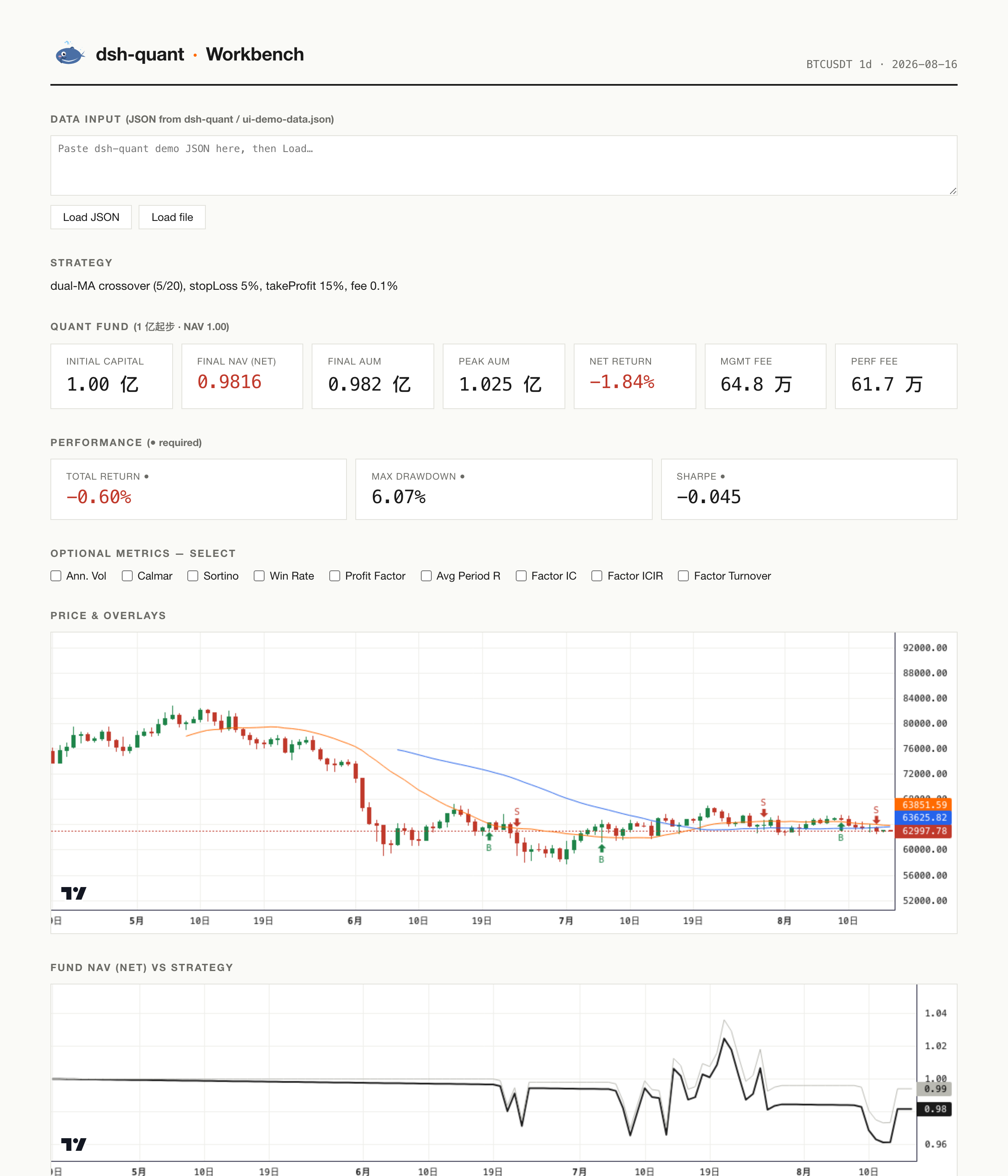
dsh-quant-ui: candlesticks + MA overlays + trade markers, equity curves, fund NAV / management-fee / performance-fee cards, metric selector — plus a swimming chibi whale 🐋 (click the title 3 times).
Live demo: https://dsh-quant-ui.pages.dev
⌨️ CLI (dsh-quant terminal)
Zero-dependency readable terminal (pure Node + ANSI, same philosophy as the P-Research CLI). Browse the research columns and live market data without a browser:
node cli/main.mjs repo                      # 59 tools · 6 domains
node cli/main.mjs history                   # 53 firm archives index
node cli/main.mjs history citadel           # one firm's archive (rendered)
node cli/main.mjs history --reports         # ANALYSIS / TIMELINE / LINEAGE / BANK_LINEAGE
node cli/main.mjs history --search 高频      # cross-archive search
node cli/main.mjs kline BTCUSDT --limit 20  # colored OHLC table + stats
node cli/main.mjs browse                   # interactive TUI: arrow-key firm browser
After npm install -g ., the commands shorten to dsh-quant repo,
dsh-quant history citadel, etc.
Tools
| Tool | Parameters | Canonical output | First valid index |
|---|---|---|---|
quant_data_compare | dataType (e.g. "financials"/"daily bars") | { dataType, channels: [{ name, cost, covers, bestFor }] } (covering first) | — |
quant_data_advice | dataType + budget (free/low/institutional) + purpose (research/backtest/official) | { recommendations: [{ rank, name, reason }] } (decision-tree ranked) | — |
quant_series_stats | values: number[] | { count, mean, std, min, max, median, skew, kurtosis, autocorr1, annualizedVol, totalReturnPct } | — (first step after fetching) |
quant_var_backtest | returns + varSeries + confidence=0.95 | { failures, expected, lrStat, pValue, passed, periods } (Kupiec POF test) | — (the ground truth for VaR models) |
quant_option | spot + strike + timeToMaturity + riskFreeRate + type + exactly one of volatility/price | { price, impliedVolatility, delta, gamma, vega, theta, rho, … } | — (Optiver-inspired: BS pricing + five greeks + IV solve) |
quant_volatility | close: number[] + annualization=252 | { annualized, perPeriod, n, logReturns(aligned) } | — (realized vol; the RV-vs-IV research entry) |
quant_bond | couponRate + periodsToMaturity + paymentsPerYear? + exactly one of ytm/price | { price, yieldToMaturity, macaulayDuration, modifiedDuration, convexity, dv01, … } | — (FICC link: pricing/duration/convexity/DV01, textbook discounting) |
quant_drawdown | equity: number[] | { underwater(aligned), maxDrawdownPct, currentDrawdownPct, periods(peak/trough/recovery/depth/duration), ongoing } | — (drawdown episode analysis) |
quant_resample | candles + period (week=7 bars/month=30 bars) | { candles } (OHLCV aggregation, 24/7 markets) | — |
quant_report | strategy/metrics/risk/factor/fund (module outputs) | { report } (Markdown research report) | — (R&D conclusion assembly) |
quant_repo_stats | owner + repo | { stars, forks, watchers, openIssues, openPullRequests, topics, latestRelease, … } (public GitHub API, no credentials) | — (ecosystem data) |
quant_npm_stats | pkg | { latest, weeklyDownloads, monthlyDownloads, description, … } (npm registry + downloads API) | — (ecosystem data) |
quant_oss_pulse | stars + downloadsWeekly? + starsPrevious? + openIssues? + openPullRequests? + daysSinceRelease? | { score(0-100), grade(A-D), components, suggestions, summary } | — (open-source influence score; missing inputs score neutral 50) |
quant_stress_test | weights + betas + assetVolsPct + correlation=0.6 | { weights, scenarioLossesPct, worstScenario, maxLossPct, portfolioVolPct, notes } | — (portfolio loss under crash/liquidity/vol scenarios) |
quant_risk | returns (decimal series) + benchmarkReturns? + confidence=0.95 | { var95, cvar95, downsideDeviation, maxDrawdownPct, beta, alpha, informationRatio, trackingError, periods } | — (core risk module) |
quant_fund | equityCurve + initialCapital=1e8 + managementFeeRate=0.02 + performanceFeeRate=0.2 | { initialCapital, finalNavNet, finalAum, peakNav, peakAum, gross/netReturnPct, fees, navNet } | — (quant hedge-fund sim: NAV 1.00 start, daily mgmt fee, 20% high-water-mark performance fee) |
quant_metrics | equityCurve + trades? | { totalReturnPct, maxDrawdownPct, sharpe, annualizedVol, calmar, sortino, winRate, profitFactor, avgPeriodReturnPct, tradeMetrics } (required trio: return/drawdown/sharpe) | — (METRIC_CATALOG for UI pickers) |
quant_chart | kind (candles/series/annotations) + matching data | structured chart data (dsh-chart protocol: candles+overlays+markers / multi-series / annotation views) | — (UI-route data plane) |
quant_execute_sim | close + orders[{index, side, quantity?/valueFraction?}] + initialCash? + feeRate? + slippageBps? + latencyBars? | { fills, equityCurve, finalEquity, totalReturnPct, totalFee, totalSlippageCost, tradeCount, unfilledCount, cash, position } | — (execution framework, no live trading) |
quant_trading_cost | quantity + price + commissionRate=0.001 + spreadBps=5 + annualVolPct=30 + dailyAdv? + participationRate=0.01 | { totalCostBps, commissionBps, slippageBps, impactBps, notional, notes } | — (commission + slippage + market impact) |
quant_trade_quality | fills (from quant_execute_sim) + unfilledOrders? + holdingPeriodBars? | { orders, fills, fillRate, totalSlippageCost, avgSlippageBps, avgHoldingBars, buys, sells, avgFillValue, notes } | — (execution quality: sim → live expectations) |
quant_research_pipeline | symbol? + interval? + limit? + provider? + candles? + strategy/fund params | { candles, quality, stats, metrics, risk, drawdown, fund, factor, report, charts } | — (one-call PDAT→PET research) |
quant_factor_evaluate | factorValues + forwardReturns (factor[i] predicts ret[i+1]) + quantiles=5 + window=20 + decayHorizons=5 | { ic, rankIc, icDecay, icir, icSeries, quantileReturns, longShort, turnover, autocorr1, n } (alphalens set + RankIC/IC decay) | — |
quant_factor_neutralize | factorValues + groups? + styleFactors? + method? | { values(standardized), method, groupCount, styleCount, rSquared } | — (group z-score / OLS residual neutralization) |
quant_walk_forward | returns + features[][] + trainWindow + testWindow + step? | { predictions(null-aligned), oosIc, oosRankIc, oosCount, windows, trainR2Mean } | — (rolling train / out-of-sample, no look-ahead) |
quant_rebalance_schedule | driftPerPeriod + costPerRebalance + maxFrequency=60 | { frequencies, totalCosts, bestFrequency, bestCost, costBreakdown, notes } | — (drift vs cost: optimal rebalance frequency) |
quant_parameter_sensitivity | baseValue + range=0.2 + steps=9 + metricValues? | { paramName, values, metricValues, baseValue, robustness, bestValue, bestMetric, worstMetric, notes } | — (grid robustness: plateau vs needle-sharp) |
quant_linear_model | X(samples×features) + y + lambda? + predictX? + yTest? | { intercept, weights, lambda, trainR2, n, predictions?, testR2?, testIc? } | — (standalone OLS/Ridge fit & predict) |
quant_factor_correlation | factors (equal length) + factorNames? + threshold=0.7 | { factorNames, correlationMatrix, highCorrelationPairs, meanAbsCorrelation, effectiveFactorCount, notes } | — (factor redundancy: dedupe before combine) |
quant_factor_combine | factors: number[][] (equal length) + weights? | { signal(rank 0..1), effectiveWeights, factorCount } | — (z-score weighting + cross-sectional ranking) |
quant_ic_decay | factor + returns (same length) + maxHorizon=10 | { horizons, icByHorizon, halfLife, bestHorizon, peakIc, peakHorizon, signalType, notes } | — (IC decay: signal shelf-life → rebalance frequency) |
quant_layered_backtest | factor + returns (time×asset matrices) + layers=5 + horizon=5 + feeRate=0.001 | { layers, topEquity, bottomEquity, longShortEquity, topReturnPct, bottomReturnPct, longShortReturnPct, rebalances, layerMeanReturnPct, notes } | — (quantile-layer backtest: factor → strategy sketch) |
quant_series_quality | values: number[], jumpThreshold=0.2 | { count, missingCount, zOutliers, jumps, longestConstantRun, healthy } | — (series-level quality) |
quant_data_annotate | values: number[], jumpThreshold=0.2 | { count, annotations: [{index, label, severity, detail}], summary } | — (point-level labeling, a tribute to Scale AI) |
quant_data_quality | candles (quant_market_fetch output) | { count, highBelowLow, nonPositive, timeNotIncreasing, timeGaps, extremeMoves, healthy } | — (pre-analysis health check) |
quant_deflated_sharpe | observedSharpe + numPeriods + numTrials=1 + skewness? + kurtosis? | { observedSharpe, minSignificantSharpe, deflatedSharpe, significant, pValue, notes } | — (Bailey & López de Prado overfitting-adjusted Sharpe) |
quant_data_pit | values: (number|null)[] + channels? | { healthScore, pit{pass, lookAheadIndices, notes}, survivorship{continuous, gaps, tailTruncated}, channels[] } | — (AI-infra quality: point-in-time / survivorship / channel reliability) |
quant_channel_guide | channel (e.g. "akshare") + check? + hasCredentials? | { channel, displayName, steps[], prerequisites[], example, fallback, readiness? } | — (agent-ready channel access guide + readiness check) |
quant_data_guide | query (channel name/data type, e.g. "tushare"/"financials") or channel (exact name) | { query, results: [{ name, url, cost, dataTypes, setup, tutorialUrls, bestFor, … }] } | — (built-in 15-channel data knowledge base: A-shares/US/bonds + dsh ecosystem data plugins) |
quant_market_fetch | symbol: string (e.g. BTCUSDT / sh600000 / AAPL), interval: 1m…1M, limit: 1-1000, provider: binance/okx/bybit/sina/tencent/yahoo | { symbol, interval, provider, candles: [{openTime, open, high, low, close, volume}] } | — |
quant_sma | values: number[], window: integer | { values: (number|null)[], window } | index window-1 |
quant_ema | values: number[], window: integer | { values: (number|null)[], window } | index window-1 (seed = first-window mean, alpha = 2/(w+1)) |
quant_rsi | values: number[], window: integer = 14 | { values: (number|null)[], window } | index window (Wilder smoothing) |
quant_macd | values: number[], fast=12, slow=26, signal=9 | { macd, signal, histogram } (equal length) | macd: slow-1; signal/histogram: slow+signal-2 |
quant_bollinger | values: number[], window=20, multiplier=2 | { upper, middle, lower, window, multiplier } | index window-1 (population std) |
quant_atr | high/low/close: number[], window=14 | { values: (number|null)[], window } | index window (Wilder smoothing) |
quant_kdj | high/low/close: number[], window=9 | { k, d, j } (equal length) | index window-1 (RSV method, K/D seeded at 50) |
quant_williams_r | high/low/close: number[], window=14 | { values: (number|null)[], window } | index window-1 (range -100..0) |
quant_cci | high/low/close: number[], window=20 | { values: (number|null)[], window } | index window-1 (±100 overbought/oversold) |
quant_obv | close/volume: number[] | { values: number[] } | everywhere (first value 0, no nulls) |
quant_adx | high/low/close: number[], window=14 | { adx, plusDi, minusDi, window } | ±DI: index window; ADX: index 2*window-1 |
quant_roc | values: number[], window=12 | { values: (number|null)[], window } | index window |
quant_backtest | close: number[], fast=10, slow=30, feeRate=0.001, stopLoss?, takeProfit? | { totalReturnPct, maxDrawdownPct, sharpe, position, equityCurve, trades(with exitReason) } | first trade one bar after first confirmed cross |
quant_backtest_bollinger | close: number[], window=20, multiplier=2, feeRate=0.001, stopLoss?, takeProfit? | same (buy on upper-band breakout, sell on mid-band cross-down) | one bar after first confirmed breakout |
quant_backtest_rsi | close: number[], rsiWindow=14, buyBelow=30, sellAbove=70, feeRate=0.001, stopLoss?, takeProfit? | same (buy on RSI cross-up through buyBelow, sell on cross-down through sellAbove) | one bar after first confirmed signal |
quant_backtest_portfolio | assets: [{name, close}], weights?, rebalanceEvery?, feeRate=0.001 | { totalReturnPct, maxDrawdownPct, sharpe, equityCurve, assetNames, finalWeights, rebalances } | — (multi-asset portfolio) |
quant_portfolio_optimize | returns (time×asset matrix) + method=maxSharpe|minVar|riskParity + iterations? | { method, weights, annualReturnPct, annualVolPct, sharpe, assetSharpe, concentration } | — (weight optimizer; feed result to quant_backtest_portfolio) |
quant_attribution | returns (time×asset) + weights (sum 1) + factorExposures? [time][asset][factor] | { totalReturnPct, assetContributionsPct, assetContribShares, factorContributionsPct, residualPct, factorR2, notes } | — (portfolio attribution: where did the return come from) |
quant_backtest_grid | close: number[], fastMin=3, fastMax=10, slowMin=10, slowMax=30, feeRate=0.001 | { results(sorted by return desc), best, fastRange, slowRange, feeRate } | — (grid search; skips fast >= slow) |
Typical chain (model's view)
quant_market_fetch(symbol: BTCUSDT, interval: 1d, limit: 100)
  → take close → quant_sma / quant_ema / quant_rsi / quant_macd / … → quant_backtest
Verified live: real Binance daily bars → indicators → backtest (fast 5 / slow 20) end to end.
Backtest contract
- Dual-MA crossover: buy all-in when fast SMA crosses above slow SMA, liquidate when
it crosses below; signals confirm on bar
iand fill at bari+1close (no look-ahead). - Fees are charged on both sides of notional (
feeRateper side). - Open tail position: the last trade's
exitIndex/exitPrice/returnPctarenull. positionandequityCurvematch input length; equity is normalized (starts at 1); Sharpe is annualized assuming daily frequency (√365).
Alignment conventions
- All outputs are equal-length with inputs; leading unwindowed positions are
null— the model aligns by index, no padding needed. - Empty series or
window > series lengthis a legal result (allnull), not an error. - Non-finite numbers (NaN/Infinity) are rejected at the registry's lossless-JSON
argument snapshot layer (the model's JSON boundary) and never reach
execute. - Constraints (window ≥ 1 integer, macd fast < slow, atr arrays equal length,
multiplier > 0) are hand-checked in
execute; thrown errors becomeisErrorresults via the registry.
Contract (defineTool)
- Arguments use the unified schema DSL, validated by
defineToolbeforeexecute(types / required / integers). executereturns only the canonical JSON value;output.renderproduces the model-facing prose.- Every tool is
isConcurrencySafe: true— pure functions, no shared state, no side effects, parallel-schedulable. - Registration is a reversible effect:
ctx.tools.registerreturns a disposer; fiber disposal unregisters.
Model Experience
What the model sees
Each tool's name/description/JSON schema is injected into the system-prompt assembly
(ctx.systemPrompt.tools()). Descriptions state the alignment rules (which head
positions are null), so the model never guesses.
Token impact
Each tool costs one fixed schema block; call results are charged by rendered content.
The null-alignment design avoids repeated padding requests from the model.
KV cache impact
The schema prefix is stable (reused as long as the tool set and order are unchanged); results append after the reusable prefix.
Release history (NEWS)
| Version | Date | Notes |
|---|---|---|
| 0.91.0 | 2026-09-11 | QRT Deep-mode full due diligence — nine-section rewrite (AUM chain to $50bn, 2025 flagship +30%, QFII+WFOE not QDLP, Dao 98% cumulative since 2022-11, Jaillon premise removed), 5 research dossiers |
| 0.90.0 | 2026-08-23 | HIGHFLYER_SPECIAL — dual-engine king (quant funds AGI, DeepSeek $45B, Wenfeng world AI-richest), 50 reports total |
| 0.89.0 | 2026-08-23 | UBIQUANT_SPECIAL — China AI-transform deep-dive (WorldQuant lineage, IQuest-Coder 40B open source, capsizing paradigm), 49 reports total |
| 0.88.0 | 2026-08-22 | quant_trading_cost + quant_rebalance_schedule — cost gate + drift/cost optimizer (59 tools, 215 unit) |
| 0.87.0 | 2026-08-22 | Validation tools ×4 — factor_correlation / deflated_sharpe / stress_test / parameter_sensitivity (57 tools, 210 unit) |
| 0.86.0 | 2026-08-22 | Bridges ×3 — quant_layered_backtest / quant_trade_quality / quant_attribution (53 tools, 200 unit) |
| 0.85.0 | 2026-08-22 | quant_ic_decay + quant_portfolio_optimize (50 tools, 193 unit) |
| 0.84.0 | 2026-08-22 | AI-infra data modules ×4 — quant_data_pit / quant_channel_guide / CLI quality / chain-loop (48 tools, 186 unit) |
| 0.83.0 | 2026-08-22 | quant_factor_neutralize repaired + 5 baselines (46 tools, 179 unit) |
| 0.82.0 | 2026-08-22 | TYO_QUANT — Tokyo yen-rates-center census (~9 firms, $30M talent war, Capula stronghold), 48 reports total |
| 0.81.0 | 2026-08-20 | CHI_QUANT — Chicago market-making city census (~14 firms, exchange-gene, UChicago pipeline, Citadel exit), 47 reports total |
| 0.80.0 | 2026-08-20 | QUANT_PEOPLE_CN + QUANT_PEOPLE_GLOBAL — 101st-release quant headcount estimates (CN ~30-50k, 4-city ~25-38k, global ~80-120k), 46 reports total |
| 0.79.0 | 2026-08-20 | QUANT_WORLD_MAP — 100th-release special: global quant world map (5-city axis, 9 paths, talent trees, 4-city census synthesis), 44 reports total |
| 0.78.0 | 2026-08-20 | NYC_FOREIGN_QUANT — New York hedge-fund-universe census (~28 firms, 12 HQs, CT suburb dark core, NY-LDN twin), 43 reports total |
| 0.77.0 | 2026-08-20 | LDN_FOREIGN_QUANT — London global-quant-hub census (~30 firms, 12 HQs, four-city comparison), 42 reports total |
| 0.76.0 | 2026-08-20 | SG_FOREIGN_QUANT — Singapore foreign-quant census (~20 firms, crypto/MM/family-office edge, HK twin comparison), 41 reports total |
| 0.75.0 | 2026-08-20 | HK_FOREIGN_QUANT — Hong Kong foreign-quant census (~26 firms, 5 categories, hub-vs-branch, 2025-26 expansion wave), 40 reports total |
| 0.74.0 | 2026-08-20 | QRT_SPECIAL — data-king deep-dive (Credit Suisse MBO, $42B in 10y, Dao China 10×/98%), 39 reports total |
| 0.73.0 | 2026-08-20 | TWOSIGMA_SPECIAL — ML-pioneer deep-dive (DE Shaw spawn flagship, data-first, dual-founder governance crisis), 38 reports total |
| 0.72.0 | 2026-08-20 | DESHAW_SPECIAL — cradle-king deep-dive (computational finance origin, DE Shaw Mafia, Anton supercomputer), 37 reports total |
| 0.71.0 | 2026-08-20 | RENAISSANCE_SPECIAL — black-box-king deep-dive (Simons' three turns, Medallion 66%/30y, $100B+ profits), 36 reports total |
| 0.70.0 | 2026-08-20 | WORLDQUANT_SPECIAL — alpha-factory deep-dive (BRAIN crowdsourcing, 100M alphas, IQC, 101 Alphas), 35 reports total |
| 0.69.0 | 2026-08-20 | SIG_SPECIAL — poker-mother deep-dive (probability OS, ByteDance 15,000×, talent tree root), 34 reports total |
| 0.68.0 | 2026-08-20 | CITADEL_SPECIAL — scale-king deep-dive (dual-engine fund+market-making, $16B peak year, Miami HQ), 33 reports total |
| 0.67.0 | 2026-08-19 | XTX_SPECIAL — per-capita-productivity king deep-dive (£14M/head, six secrets), 32 reports total |
| 0.66.0 | 2026-08-19 | SHOWDOWN_CN_GLOBAL — six-dimension CN-vs-global showdown (+ transparency inversion), 31 reports total |
| 0.65.0 | 2026-08-19 | LISTED_QUANT — listed-quant census (Virtu/Flow/Man + Knight death chain), 30 reports total |
| 0.64.0 | 2026-08-19 | CAPITAL_MODEL — foreign capital-structure census (prop/fundraise/hybrid), 29 reports total |
| 0.63.0 | 2026-08-19 | POD_PLATFORM — pod-shop capstone (5 angles + dsh isomorphism), 28 reports total |
| 0.62.0 | 2026-08-19 | BALYASNY_SPECIAL — sixth firm deep-dive (Schonfeld lineage + 2018 halving + rebuild), 27 reports total |
| 0.61.0 | 2026-08-19 | MILLENNIUM_SPECIAL — fifth firm deep-dive (pod federation + China talent root), 26 reports total |
| 0.60.0 | 2026-08-19 | POINT72_SPECIAL — fourth firm deep-dive (SAC rebirth + Cubist + 14 offices), 25 reports total |
| 0.59.0 | 2026-08-19 | OPTIVER_SPECIAL — third firm deep-dive (Dutch name + Ready Trader Go + tool lineage), 24 reports total |
| 0.58.0 | 2026-08-19 | JANE_STREET_SPECIAL — second firm deep-dive (SIG trio + OCaml culture), 23 reports total |
| 0.57.0 | 2026-08-19 | IMC_SPECIAL — first firm deep-dive special (office chronicle + Prosperity), 22 reports total |
| 0.56.0 | 2026-08-19 | QUANT_VENDORS_CN — China's picks-and-shovels layer (Kafang/RQAlpha/jqdatasdk), 21 reports total |
| 0.55.0 | 2026-08-19 | FOREIGN_CN_MAP_V2 — fully verified foreign-in-China map (7 PFM, second wave 2024-2026), 20 reports total |
| 0.54.0 | 2026-08-19 | Shanghai gravity + foreign-in-China map — SHANGHAI_GRAVITY + FOREIGN_CN_MAP, 19 reports total |
| 0.53.0 | 2026-08-19 | Quant maps ×2 — QUANT_MAP_CN + QUANT_MAP_GLOBAL (city-centric), 17 reports total |
| 0.52.0 | 2026-08-19 | Office maps ×2 — OFFICE_CN + OFFICE_GLOBAL, 15 reports total |
| 0.51.0 | 2026-08-19 | Signature encyclopedias ×2 — SIGNATURES_CN + SIGNATURES_GLOBAL, 13 reports total |
| 0.50.0 | 2026-08-19 | Age chronicles ×2 — AGE_CN (2004-2022) + AGE_GLOBAL (1783-2018), 11 reports total |
| 0.49.0 | 2026-08-19 | D-tier research reports ×4 — REGULATION / TALENT_MAP / STAR_PRODUCTS / QUANT_AI (9 reports total) |
| 0.48.0 | 2026-08-19 | 5 cross-border archives — Tengsheng/Inshiman/Yuansheng/GSR/Eisler (94 firms) |
| 0.47.0 | 2026-08-19 | 8 CN Lite archives — Kaifeng/Honghu/Egret/Zhuoshi/Hande/Niankong/Mengxi/Xinhong (89 firms) |
| 0.46.0 | 2026-08-19 | 7 CN Lite archives — Shenyi/Jasper/Liyi/Bodao/Zunjia/Qianyi/Pingfanghe (81 firms) |
| 0.45.0 | 2026-08-19 | 3 CN Lite archives — Tianyan/Aifang/Maoyuan (74 firms) |
| 0.44.0 | 2026-08-19 | 10 CN Lite archives — Zhicheng/Qianxiang/Blackwing/Inno/LongQi/JoinQuant/Evolution/Sixie/Bridgewater-CN/Beyang (71 firms) |
| 0.43.0 | 2026-08-19 | Golden Bull special — 12 years of quant winners (2014-2025) + archive cross-analysis |
| 0.42.0 | 2026-08-19 | 5 Lite archives — Hongxi/Mingshi/Wenbo/Luoshu/Pansong (61 firms) + founding-date backfill |
| 0.41.0 | 2026-08-19 | Two-mode DD (Deep/Lite) + 3 Lite archives — ChaoQuanZi/YanSheng/Banyang (56 firms) |
| 0.40.0 | 2026-08-19 | DD standard v1 + China batch 1 re-due-diligenced (nine-section format, to-verify lists) |
| 0.39.0 | 2026-08-19 | China batch 2 — Zhixing Tongda/Chengqi/Ruitian/KuanDe/Lingjun/Xiaoyong (53 firms, WorldQuant lineage) |
| 0.38.0 | 2026-08-17 | Bank/brokerage lineage report — 13 firms, two waves, three generations |
| 0.37.0 | 2026-08-17 | China batch 1 — High-Flyer/Ubiquant/Minghong/Yanfu/Century Frontier (47 firms) |
| 0.36.3 | 2026-08-17 | AGENTS.md engagement loop — full vision + ask-your-human CTA |
| 0.36.2 | 2026-08-17 | AGENTS.md + CLAUDE.md agent onboarding |
| 0.36.1 | 2026-08-17 | Five-slot closed-loop case study + 10 supplyable candidates |
| 0.36.0 | 2026-08-17 | plugin/ five-slot external plugin library (22 repos & MCPs) |
| 0.35.2 | 2026-08-17 | Brand line 🐳 Dsh-Quant — The Everything-Plugin Quant OS |
| 0.35.1 | 2026-08-17 | Full English README |
| 0.35.0 | 2026-08-17 | Core UX: PDAT→PET onboarding (BTC example) + mcp/AGENT_GUIDE |
| 0.34.0 | 2026-08-17 | Quant lineage report (five motherships) |
| 0.33.0 | 2026-08-17 | Macro legends batch (42 firms) + first data analysis report |
| 0.32.0 | 2026-08-17 | Systematic Europe batch (37 firms) |
| 0.31.0 | 2026-08-17 | Market-making & crypto batch incl. Alameda failure case (32 firms) |
| 0.30.0 | 2026-08-17 | QRT/Capula/Winton/DRW/Tower batch (27 firms) |
| 0.29.0 | 2026-08-17 | SIG + quant chronicle timeline (22 firms) |
| 0.28.0 | 2026-08-17 | Balyasny/IMC/XTX/Five Rings + DE Shaw boost (21 firms) |
| 0.27.0 | 2026-08-17 | Man Group/AQR/GSA/Bridgewater batch (17 firms) |
| 0.26.0 | 2026-08-17 | Two Sigma/Virtu/DE Shaw/Renaissance batch (13 firms) |
| 0.25.0 | 2026-08-17 | HRT/Point72/Squarepoint batch (9 firms) |
| 0.24.0 | 2026-08-17 | Millennium/WorldQuant/Jump batch (6 firms) |
| 0.23.0 | 2026-08-17 | quant-history + quant-repo columns (Citadel/Optiver/Jane Street) |
| 0.22.0 | 2026-08-17 | Options & volatility board (Optiver-inspired) |
| 0.21.0 | 2026-08-17 | FICC link: quant_bond + bond data channels |
| 0.20.0 | 2026-08-16 | yahoo US/global klines + 13-channel guide + researchMultiAsset |
| 0.19.0 | 2026-08-16 | quant_linear_model + docs/ML_GUIDE + ml-workflow demo |
| 0.18.0 | 2026-08-16 | Chain completion: A-share klines, RankIC/IC decay, neutralization, walk-forward, drawdown, execution sim, pipeline |
| 0.17.0 | 2026-08-16 | dsh-community domain: quant_repo_stats / quant_npm_stats / quant_oss_pulse |
| 0.16.0 | 2026-08-16 | Domain-driven layout ↔ PDAT/PAAT/PCPT/PRT/PET + exchange fallback chain |
| 0.15.0 | 2026-08-16 | Kupiec VaR backtest + resample + report; 100 unit tests milestone |
| 0.14.0 | 2026-08-16 | quant_risk (VaR/CVaR/Beta/Alpha/IR/TE) |
| 0.13.0 | 2026-08-16 | quant_fund (1e8 capital, NAV 1.00, HWM 20% fee) + UI fund cards |
| 0.12.0 | 2026-08-16 | quant_metrics (9+ metrics) + Jane Street-style UI demo |
| 0.11.0 | 2026-08-16 | quant_chart (dsh-chart protocol) |
| 0.10.0 | 2026-08-16 | quant_factor_evaluate / combine (alphalens methodology) |
| 0.9.0 | 2026-08-16 | series stats + data quality + annotation (tribute to Scale AI) |
| 0.8.0 | 2026-08-16 | channel compare + decision-tree advice |
| 0.7.0 | 2026-08-16 | mcp/tools.json + pure-function re-exports + docs |
| 0.6.0 | 2026-08-16 | data channel guide (8 A-share channels) + rename to dsh-quant |
| 0.5.0 | 2026-08-16 | multi-exchange sources (OKX / Bybit) |
| 0.4.0 | 2026-08-16 | multi-asset portfolio backtest (periodic rebalancing) |
| 0.3.0 | 2026-08-16 | strategy family (Bollinger breakout / RSI reversion) + stop-loss/take-profit |
| 0.2.0 | 2026-08-16 | +6 indicators (KDJ / W%R / CCI / OBV / ADX / ROC) |
| 0.1.0 | 2026-08-16 | Launch: market data + 6 indicators + MA backtest/grid + CI/auto-release |
Full records: NEWS.md and CHANGELOG.md.
Known limitations & roadmap
- Market coverage is crypto-first: Binance / OKX / Bybit public APIs (automatic fallback), no credentials; A-shares go through the channel knowledge base (akshare et al. as future providers).
- Backtests are a built-in strategy family: dual-MA / Bollinger breakout / RSI reversion / portfolio rebalancing / grid search; custom strategy callbacks are the future route.
- presentCall/presentResult not customized: indicator results have no file / terminal / diff semantics; UI falls back to generic cards.
- Market tools need network: live cases live in verify.ts; offline indicator / backtest cases are unaffected.
Domain layout (PDAT→PET pipeline mapping)
src/dsh-data/       data (PDAT): 3 exchanges, 15 channels, quality/annotation, resample
src/dsh-alpha/      alpha (PAAT): 12 indicators + factor eval/combine (alphalens methodology)
src/dsh-ml/         portfolio (PCPT): strategy backtests + portfolio + metric catalog
src/dsh-risk/       risk (PRT): VaR/CVaR/Beta/Alpha/IR + Kupiec test + options + bonds
src/dsh-execution/  delivery (PET): chart data plane, fund sim, research report (no live trading)
src/dsh-community/  ecosystem (unique to the open side): GitHub/npm data + influence pulse
The boundary: data and conclusions stay internal; tools and methods ship to dsh-quant — no alpha, no production strategies, no live-trading engineering, but frameworks, indicators, factor evaluation, UI and demos. See pinned Issue #9.
Quick start (after fork/pull)
npm ci && npm run build && npm test    # offline full tests (215 unit + 4 Loader)
npm run test:verify                    # live market integration (needs network)
npm run gen:tools                      # regenerate mcp/tools.json
Build & use
# build lib/ (tsc, NodeNext ESM; ships .js + .d.ts)
cd quant-indicators && tsc -p tsconfig.json

# use in dsh: add one line to cordis.yml
# - name: 'dsh-quant'
# (the Loader resolves the package exports → lib/index.js from node_modules)
Verification
# pure-function numeric correctness + market parsing + backtests (215 cases, node:test, zero deps)
cd deepseek-harness && pnpm exec tsx --test ../quant-indicators/tests/*.spec.ts

# REAL-composition: cordis.yml booted through the real Loader (registration visible / pipeline / isError / HMR-safety)
cd deepseek-harness && pnpm exec tsx --test ../quant-indicators/tests/loader-composition.spec.ts

# harness integration (schemas → execution pipeline → isError → live fetch→indicators→backtest end-to-end)
cd deepseek-harness && pnpm exec tsx ../quant-indicators/verify.ts

# consumer simulation: built lib loaded through real node_modules resolution (simulates post-install)
cd deepseek-harness && pnpm exec tsx ../quant-indicators/consumer-test/boot.ts
⭐ Support
If dsh-quant helps your research, a ⭐ makes the project visible to more dsh users.
This whale stands for DeepSeek Harness (dsh) — trading on its holographic screen 🐋
Issues / PRs / discussions welcome; share your domain perspective in Discussion #10. 🐋
Ecosystem infrastructure: quant ecosystem directory · ecosystem playbook · ecosystem map Discussion #11
Research columns: quant-history (firm archives) · quant-repo (open-source special)
Plugin library (five slots × external repos & MCPs): plugin/
🤝 Contribute & maintain
- Want to add a plugin / data source / learning material? → Issue #109(插件征集) — data / risk / execution plugins, ML-DL & alpha learning resources all welcome
- Filing a bug / feature / help-wanted issue? → ISSUE_GUIDE.md (agent-friendly rules)
- Sending a PR? → CONTRIBUTING.md (dev loop + design contract)
- Maintainer view (how we review & merge): MAINTAINING.md
Every issue is a future PR; every contributor is a future maintainer. We review fast and merge small PRs quickly — credit goes into release notes + the author section. 🐳
👤 About the author
Pengyi Peng — AI-native builder with a mathematics & quant-research background, building this project as an open research sandbox.
- WorldQuant MAPC 2024 · Global 11 / 850 · UK 1 — official Credly badge
- WorldQuant IQC 2024 · Global 232 / 34,142 · UK 5 (finalist)
- dsh-quant: 59 tools · 6 domains · 215 unit tests · 110+ automated releases
- Quant-industry research: 95 firm archives + 53 research reports (in
quant-history/) - GitHub · LinkedIn
Methods open, secrets internal — the author's research is public, the strategies are not. 🐳
Related plugins
archify (deepseek-harness)
tt-a1i/archify
WeKnora (dsh-weknora)
tencent/weknora
weknora
tencent/weknora
BrowserSkill (dsh-plugin-browserskill)
tencent/browserskill