dsh-irb
perrylink/dsh-irb
Ethics-application checklist for DeepSeek Harness: 18-item keyword checklist (title, PI, purpose, design, participants, recruitment, consent, assent, risks, benefits, confidentiality, vulnerable groups, compensation, conflicts, retention, dissemination, animal ethics, biosafety), an advisory risk level with required safeguards from structured flags, Markdown/SARIF export and REP evidence. Not an IRB decision and not legal advice.
Install
dsh plugin --profile web add github:perrylink/dsh-irbREADME

dsh-irb
当前版本 0.1.4。
Assemble the ethics application before the committee does — and know which core statements are still missing.
An 18-item keyword checklist for ethics applications, an advisory risk level with the safeguards it implies, and a Markdown + SARIF export you can attach to the submission.
简体中文 · Español · Português · हिन्दी


What it does
irb_check— 18 items: title, PI/contact, purpose, design, participants/eligibility, recruitment, informed consent, assent for minors, risks, benefits, confidentiality/data protection, vulnerable groups, compensation, conflicts, retention, dissemination, animal ethics (3Rs), biosafety/human samples. Present items get character locators; missing core items get advice.irb_risk— structured flags (vulnerable groups, minors, prisoners, pregnancy, cognitive impairment, deception, sensitive topics, invasive procedures, biological samples, genetic data, human challenge, gene therapy, automated decisions) → advisory level plus the safeguards each factor requires.irb_export— Markdown (item table, risk table, safeguards) + SARIF 2.1.0, plus REP evidence when the application is checked.

Structure: read → check → export; checks[] and the advisory risk are the two outputs, and a missing optional item is skipped with code: not_applicable, never a pass. The token labels inside the diagram are the real tool, item and field names, so the same picture serves all five languages.
What it does not do
- No approval, no legal advice. A checklist cannot substitute for the IRB/IACUC decision; the export says so.
- No adequacy judgement. It detects whether a statement exists, not whether it is sufficient.
- No risk classification standard. The level is advisory and must be confirmed by the committee.
- No DOCX/PDF. Convert to
.md/.txt(PDF text:dsh-doc-anchor). - No submission portal integration.
Risk factors and safeguards
| Flag | Safeguard advised |
|---|---|
| vulnerable groups | extra consent/assent procedures and independent oversight |
| minors | age-appropriate assent plus parental consent |
| prisoners | independent advocate and protections against coercion |
| pregnant women/fetuses | specific fetal and maternal risk assessment |
| cognitive impairment | capacity assessment and authorised-representative consent |
| deception | debriefing and a justified waiver of full disclosure |
| sensitive topics | referral pathways and interviewer training |
| invasive procedure | clinical oversight, adverse-event reporting, stopping rules |
| biological samples | sample handling, biosafety, secondary-use consent |
| genetic data | specific consent and incidental-finding policy |
| human challenge | safety monitoring board and dose-escalation rules |
| gene therapy | long-term follow-up and regulatory approval |
| automated decisions | human review and an appeal route |
Tools
irb_check
{ text? | path?, persist? } → { ok, analysis, evidenceId?, recordPath? }.
irb_risk
{ vulnerableGroups?, minors?, prisoners?, pregnantWomen?, cognitiveImpairment?, deception?, sensitiveTopics?, invasiveProcedure?, biologicalSamples?, geneticData?, humanChallenge?, geneTherapy?, aiDecisionMaking? } → { ok, risk }.
irb_export
{ analysis, risk?, title? } → { ok, markdown, sarif }.
Error codes
INVALID_INPUT · NOT_FOUND · PATH_ESCAPE · NOT_A_FILE · TOO_LARGE · UNSUPPORTED_FILE · STORE_ERROR
Compatibility & install
| DeepSeek Harness | dsh-v0.2.3-alpha.1 (verified 2026-11-22); peer >=0.2.1-0 <0.3.0 || >=0.2.2-0 <0.3.0 |
| Node | ^22.19.0 || >=24.9.0 (tested 24.22.1), ESM only |
| Peers | @perrylink/dsh-research-core ^0.1.0, @deepseek-ai/cordis ^4.0.5-alpha.1, @deepseek-ai/dsh-tools, @deepseek-ai/schemastery ^3.18.5-alpha.1 |
| Runtime dependencies | zero |
dsh plugin --profile <name> add @perrylink/dsh-research-core dsh-irb
dsh --profile <name> --dump-config | grep dsh-irb
Configuration
| Key | Default | Meaning |
|---|---|---|
enabled | true | false mounts nothing |
root | .irb | store/record root |
workspaceRoot | process.cwd() | application paths must resolve inside it |
maxChars | 1000000 | character cap (fails, never truncates) |
persist | true | store the checked application as REP evidence + record |
Security boundaries
- Read-only on the application; writes only under
root. realpathcontainment; DOCX/PDF rejected with a conversion hint.- With
persist: true(the default) the checked application text is stored as REP evidence underroot; it can contain personal data, so setpersist: falseor protect the store accordingly. - The application text is data; instruction-like content is never executed.
Evaluation
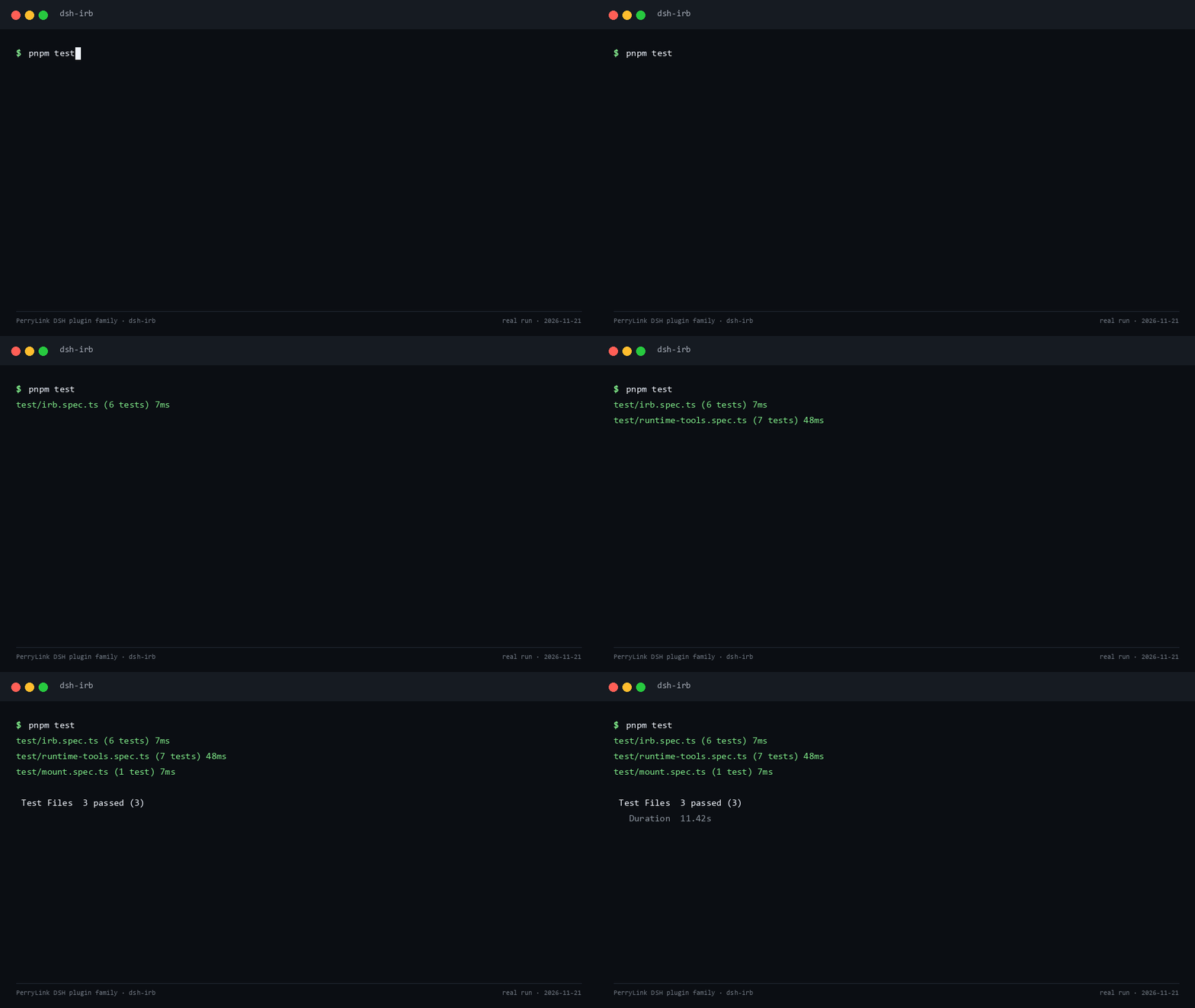
Animated: the real pnpm test output on 2026-11-21 (3 test files). The plugin has no CLI, so its own suite is the run — checklist, advisory risk, REP record and export.
14 tests: checklist present/missing items and core-missing list, generic consent/ethics-committee mentions not mistaken for assent/animal content, empty-text rejection, minimal risk, minors+deception safeguards, all thirteen risk flags, runtime (REP record validity, optional-missing checks recorded as skipped, traversal/binary/oversize/empty rejection), malformed analysis/risk tool guards, tool schemas, check→risk→export end to end, failure branches, package contract.
No benchmark is claimed: keyword presence is pinned by fixtures; there is no labelled corpus of ethics applications.
Known limitations (v0.1)
- English/Chinese keyword cues only; a differently worded statement can be missed.
- Risk flags come from the caller, not from the application text.
- No jurisdiction-specific rules (HIPAA, GDPR, 涉及人的生命科学和医学研究伦理审查办法 details).
- No animal-protocol section structure beyond the 3Rs keyword check.
License
Apache-2.0. No third-party runtime code.
Related plugins
archify (deepseek-harness)
tt-a1i/archify
WeKnora (dsh-weknora)
tencent/weknora
next-ai-draw-io (dsh-plugin)
dayuanjiang/next-ai-draw-io
weknora
tencent/weknora