dsh-nsfc-form-check
perrylink/dsh-nsfc-form-check
国家自然科学基金申请书形式审查与匿名化提示(依据《国家自然科学基金条例》与申请人导入的当年指南,仅提示差异,不作出定性结论)
Install
dsh plugin --profile web add github:perrylink/dsh-nsfc-form-checkREADME
dsh-nsfc-form-check — NSFC proposal form review and identity-clue prompting against the institution's own roster

dsh-nsfc-form-check reads one NSFC proposal — its body lines, its electronic document properties, and the institution's own roster of identity terms — and checks that material against a versioned rule pack: whether a roster is configured at all, where the configured applicant, institution and advisor terms occur in the body and inside a configured line range, what the title, author, company and last-modified-by properties carry, whether the material fits the length limit the deployment set, whether the configured form-review items and duplicate-application disclosure are present, whether the advisor's name has been filled in as the yearly guidelines require, and whether any configured classified or sensitive term appears. Every finding names the clause it came from, states whether that clause is a direct requirement, a principle or a local configuration, and every check that could not run is listed in skipped with its reason.
What it looks like
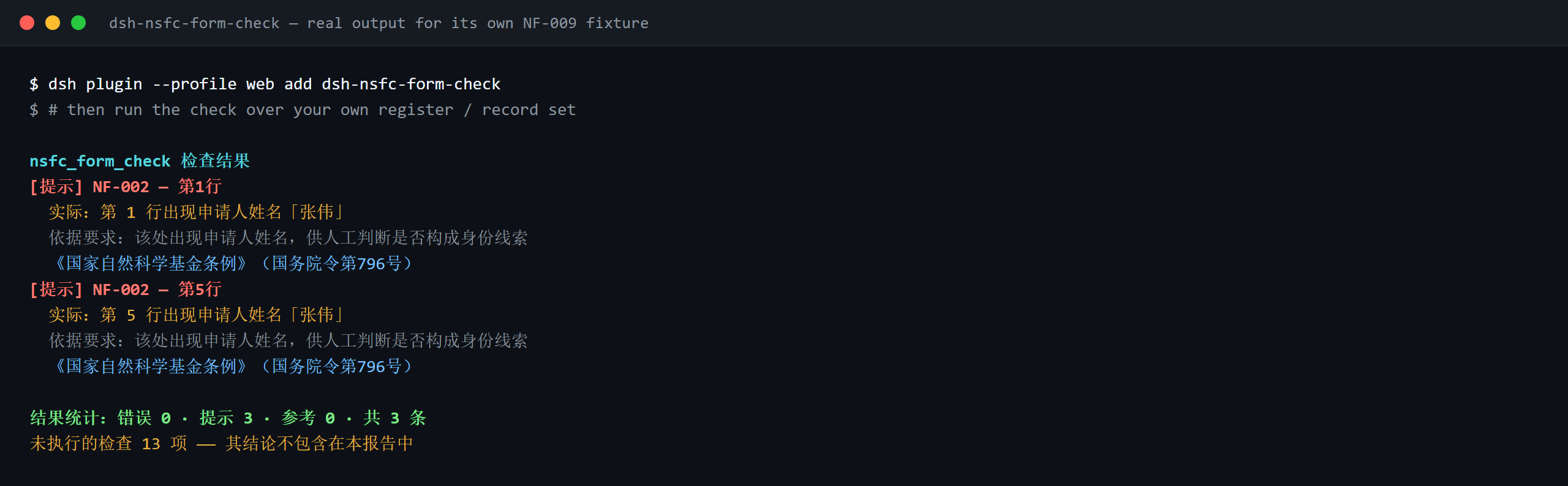
Real output from this plugin over its own NF-009 test fixture — not a mock-up. The rule pack ships no invented quotations, so a finding names both the clause it applied and the fact that the clause text was not obtained.
What it answers
| You ask | What it answers |
|---|---|
| Nobody filled in the applicant name list. Does the identity checking just pass? | No. NF-001 is the first thing reported when authorNames, institutionNames and advisorNames are all empty, and every identity check that needs those terms reports itself in skipped with its reason. An empty finding list therefore never means nothing was wrong — read NF-001 and the skipped entries before drawing any conclusion. |
| A co-author with the same surname as the applicant appears in the body text. | NF-002 matches the configured authorNames literally, line by line, so a namesake, a common surname or a citation of another researcher's work can all be reported. The finding is a technical prompt only — 《国家自然科学基金条例》(国务院令第796号) 第二十一条 requires confidentiality from reviewers and says nothing that forbids a name in the body — so a term you have already cleared can be added to allowList. |
| The author property holds a name. Is that reported, and does it need a configured list? | Yes, and no. NF-006 does not need a roster: with authorNames empty it still reports any non-empty author property, and with a roster configured it says whether the value matches an applicant name. NF-005, NF-007 and NF-008 do need an identity-term list and enter skipped without one. All four only read the properties, so they say nothing about the body text. |
| I filled in the page and word limits myself. Will it tell me the proposal is too long? | Only within the limit you set. NF-010 ships maxLines and maxChars unset and enters skipped, because those limits change every year and by project type; once you fill them in it reports the extracted paragraph count or the character total that exceeds them. maxLines counts extracted paragraphs, not typeset pages, so it is not the same as a page count. |
| Did the material include every form-review item our research office asks for? | NF-011 reports itself in skipped until require is configured, and with no checklist the plugin does not pretend to know one. Once configured it matches your match phrases literally and reports the ones it cannot find. It checks that the phrase is present, not that the column was filled in correctly or that the signature is genuine. |
| We are re-submitting last year's proposal. Must the disclosure note be there? | NF-012 needs both markerPatterns, which recognise your template's wording for a repeat or follow-on application, and requiredDisclosure, which lists what must be disclosed. With either unset it enters skipped; when the markers are configured but no declaration is found it reports that this rule does not apply. It never assumes a disclosure wording, and never decides that a proposal really is a repeat. |
Standards it follows
| Document | Number | Cited by rules |
|---|---|---|
| 《国家自然科学基金条例》 | 国务院令第796号 | NF-001, NF-002, NF-003, NF-004, NF-005, NF-006, NF-007, NF-008, NF-009, NF-010, NF-011, NF-012, NF-013, NF-014, NF-015 |
| 《2026 年度国家自然科学基金项目指南·申请规定》 | 2026 年度(逐年更新) | NF-014, NF-015 |
Boundary: this plugin checks an NSFC proposal's text and electronic document properties and
reports the identity clues it finds, alongside the length and form-review items a deployment
configures. It is not dsh-rulefile-check (which audits the legality of a regulatory document), not
dsh-policy-brief-draft (which drafts a policy explainer), and not dsh-review-reply-check (which
tracks reviewer comments). It reads one proposal and reports literal matches against cited clauses.
⚠️ Read this before using the anonymity checks
There is no current national provision that forbids an applicant's name, institution or advisor from appearing in an NSFC proposal. Three independent texts were read in full for this plugin — 《国家自然科学基金条例》(国务院令第796号), the 2026 年度《项目指南·申请规定》, and the 2019 年度 guidelines — and none contains 匿名, 盲审, 活页, or any "must not appear" wording about identity. The regulation does not contain the word 匿名 at all. Its avoidance clause (第二十条) requires a reviewer from the applicant's own legal entity to recuse, which presupposes that the system knows the applicant's institution — the opposite of an anonymous process.
So every finding this plugin makes about a name or an institution is a technical observation for a human to weigh, labelled 身份线索词 and never phrased as a violation. The plugin is useful for a research-office self-check, and it is wrong to use it as a compliance gate. Two rules go further and cite the guidance verbatim:
NF-014checks that the advisor's name is filled in, because the yearly guidelines require it, andNF-015checks 涉密与敏感信息, which is the one "must not appear" requirement that really exists — and its object is classified information, not identity.
Compatibility
| Surface | Status |
|---|---|
| Harness | Peer range >=0.1.2-rc.1 <0.2.0 || >=0.2.0-0 <0.3.0 — verified to accept both 0.2.0-rc.2 and 0.2.1-alpha.1. engines.dsh is deliberately not declared: it has no reader and cannot reject a host |
| Node | `^22.19.0 |
| Platforms | All (plain ESM; no native code, no network, no model call) |
| Tool mode | Works in native, ptc and both; for a batch of proposals use ptc |
What it does
Registers the nsfc_form_check tool. It reads one proposal — body text, document properties, and the
institution's own roster of identity terms — applies a versioned rule pack, and returns a report in
which every finding names the clause it came from and states whether that clause is a direct
requirement, a principle, or a local configuration.
| Rule | Check | Severity | Basis kind |
|---|---|---|---|
NF-001 | a roster is configured, otherwise the identity checks cannot run | warn | principle |
NF-002 | the body mentions an applicant name | warn | principle |
NF-003 | the body mentions an institution name | warn | principle |
NF-004 | the body mentions an advisor name | warn | principle |
NF-005 | the document title property contains an identity clue | info | principle |
NF-006 | the author property is non-empty or names the applicant | info | principle |
NF-007 | the company property names the institution | info | principle |
NF-008 | the last-modified-by property names the applicant | info | principle |
NF-009 | identity clues inside a configured line range | info | principle |
NF-010 | the material fits the configured length limit | info | local |
NF-011 | the material contains the configured form-review items | info | local |
NF-012 | a repeat or follow-on proposal carries the configured disclosure | info | local |
NF-013 | identity clues inside a configured scope | info | principle |
NF-014 | the advisor's name is present, as the yearly guidelines require | info | local |
NF-015 | the material contains no configured classified term | info | local |
Rules whose thresholds are yearly or per-project-type ship empty on purpose. They report
themselves in skipped until configured, so an unfilled threshold can never read as "nothing wrong".
Install
dsh plugin --profile <name> add dsh-nsfc-form-check
dsh --profile <name> --dump-config | grep 'dsh-nsfc-form-check'
Configuration
Every tunable lives in the Schemastery schema in src/config.ts. The roster is the one thing this
plugin cannot work without: an identity check needs a list of the terms to look for, and that list is
institution-specific, so it stays in the deployment's own configuration rather than travelling with
the package.
| Key | Type | Default | Description |
|---|---|---|---|
rulesFile | string | rules/nsfc-form-check.yaml | Rule-pack path, relative to the package root |
disabledRules | string[] | [] | Rule ids to stop running; each appears in skipped |
onlyRules | string[] | [] | Run only these rule ids; empty runs every rule |
skipNotes | string | "" | Note appended to every skipped reason |
authorNames | string[] | [] | Applicant names to look for |
institutionNames | string[] | [] | Institution and unit names to look for |
advisorNames | string[] | [] | Advisor names to look for |
allowList | string[] | [] | Terms to ignore even when they match |
timeoutMs | number | 120000 | Cooperative tool timeout budget |
Rule-level parameters worth knowing:
NF-009coverLines— how many leading lines count as the cover page. Empty means the plugin does not assume any institution's template.NF-010maxLines/maxChars— the length limit for the year and project type you are filing under.maxLinescounts extracted paragraphs, which is not the same as typeset pages.NF-011require— your form-review item list, as[{ label, match }]pairs.NF-012markerPatterns/requiredDisclosure— how a repeat proposal is recognised in your template, and what it must disclose.NF-014requireMention+advisorNames— the inverse check, off until you enable it for the year.NF-015secretTerms— your confidentiality office's term list. The plugin ships none, because what counts as classified is defined by state secrecy rules, not by this plugin.
Material format
Point the tool at a .docx and it reads the body text and the document properties itself. A .pdf is
not parsed: page-accurate extraction is a different problem with a different failure mode, and a
wrong page number is worse than none, so pass the text you extracted with your own tool. .txt, .md
and .json are accepted too; the JSON form carries both parts explicitly.
{
  "lines": ["申请代码:H0301", "一、立项依据与研究内容", "……"],
  "metadata": { "title": "某信号通路机制研究", "author": "", "company": "", "lastModifiedBy": "" }
}
Matching is literal and line-oriented, so every finding carries a line number you can jump to. A term
shorter than two characters is ignored, and anything in allowList is ignored, because a common
surname would otherwise flood the report.
Rule sources
Rule data lives in rules/nsfc-form-check.yaml. Every rule carries a document, a document number, a
clause in the source's own numbering, a verbatim excerpt and the URL the excerpt was read from. The
loader enforces that an excerpt is a real quotation of at least eight characters, and that a check
resting only on a general principle or a local policy can never be declared error.
Four findings shaped this pack:
- The regulation was revised. 《国家自然科学基金条例》 is now 国务院令第796号 (revised 2024-11-08, in force 2025-01-01), superseding 国务院令第487号 (2007). Clause numbers moved: the review-confidentiality duty is now 第二十一条, not the old 第二十四条. This pack cites only the current revision, and a test asserts that the superseded order number never appears.
- Anonymity has no legal basis, as set out at the top of this file. The rules state this in their own notes so a reader of the report sees it without consulting the README.
- The advisor's name is required, not forbidden. The yearly guidelines instruct applicants to
fill in their graduate and postdoctoral advisor names truthfully.
NF-014therefore checks the opposite ofNF-004, and the pack explains why the two coexist. - Yearly policy is configuration, not code. Page and word limits, the itemised limits on how many proposals may be filed, which project types use a lump-sum budget, and the yearly list of non-acceptance situations all change between years; every one of them ships empty.
The full clause-verification report, including the sources that were checked and rejected, is in
rules/evidence/clause-verification.md.
Troubleshooting
- The plugin installs but the tool never appears. Check that
mainresolves tolib/index.mjsand thatpnpm run buildproduced it; a wrongmainmakes the loader skip the entry silently. - Every identity check is skipped. No roster is configured. Fill in
authorNames,institutionNamesandadvisorNames, andNF-001will stop reporting. - The report is noisy with a common surname. Add the term to
allowList; the plugin refuses to guess which matches are meaningful. - A
.pdfis refused. By design. Extract the text with a tool you trust and pass it throughtext, or convert the proposal to.docx. dsh plugin addrefuses the package as incompatible. The peer range covers0.1.xand0.2.x; if your runtime sits outside it, grant an explicit exemption:dsh plugin --profile <name> allow-version dsh-nsfc-form-check@0.1.0 --dsh-version <runtime> --accept-riskcheckreportsmanifest-peersas failed. The static checker compares against a hard-coded peer range that predates the 0.2 line. The runtime enforces peer compatibility at install time, so the declared range is the correct one; this is a known upstream issue indsh-plugin-dev.
Development
pnpm install
pnpm run typecheck   # tsc --noEmit
pnpm test            # vitest, paired fixtures per rule, plus a real .docx round trip
pnpm run build       # tsdown -> lib/index.mjs + lib/index.d.mts
node ../scripts/sync-shared.mjs dsh-nsfc-form-check   # refresh src/shared from ../_shared
tests/docx-fixture.ts builds real .docx packages in memory (a genuine ZIP with deflated entries),
so the docx path is exercised end to end while the fixtures stay reviewable JSON.
License
Apache License 2.0 © 2026 dsh-nsfc-form-check contributors.
Related plugins
archify (deepseek-harness)
tt-a1i/archify
WeKnora (dsh-weknora)
tencent/weknora
weknora
tencent/weknora
BrowserSkill (dsh-plugin-browserskill)
tencent/browserskill