better-model-provider
sanshanya/better-model-provider
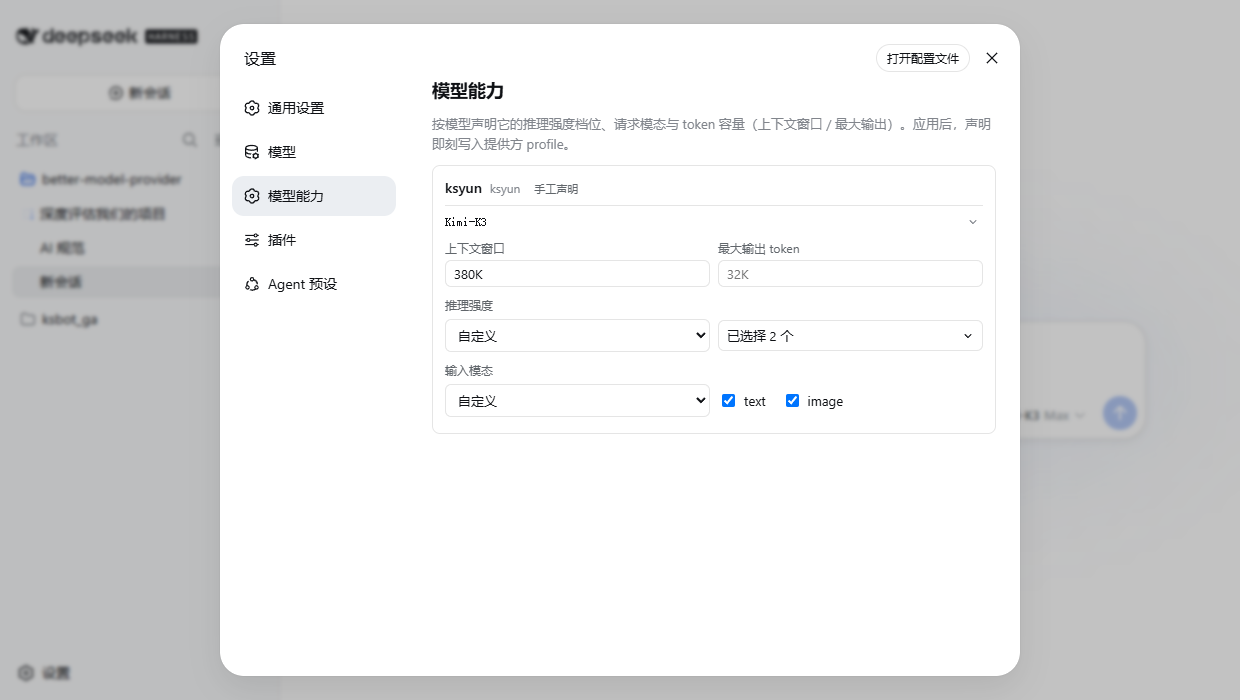
Settings page for per-model capabilities: reasoning-effort levels with their wire spellings, input modalities, and token capacities, written as declarations or sparse catalog overrides.
Install
dsh plugin --profile web add github:sanshanya/better-model-providerREADME
better-model-provider
Sparse, non-destructive per-model overrides on official-catalog routes — including reasoning-effort levels and their wire spellings — without replacing the catalog.
Custom models: edit declarations. Official models: edit overrides. Provider configuration remains official.
Why
The official Models page edits a model's input types and token capacities, but it does so by rewriting that route's whole models array: one field touched, and every other model on the route stops following the catalog — and sparse modelOverrides becomes illegal there. It also has no control for per-model reasoning effort.
This page is the other seam. On an official-catalog route it writes only the difference for the model you touched — including reasoningEfforts levels and their wire spellings — and leaves the rest of the catalog following upstream. On your own declared routes it edits the declarations directly.
Install
dsh plugin --profile web add github:sanshanya/better-model-provider#master
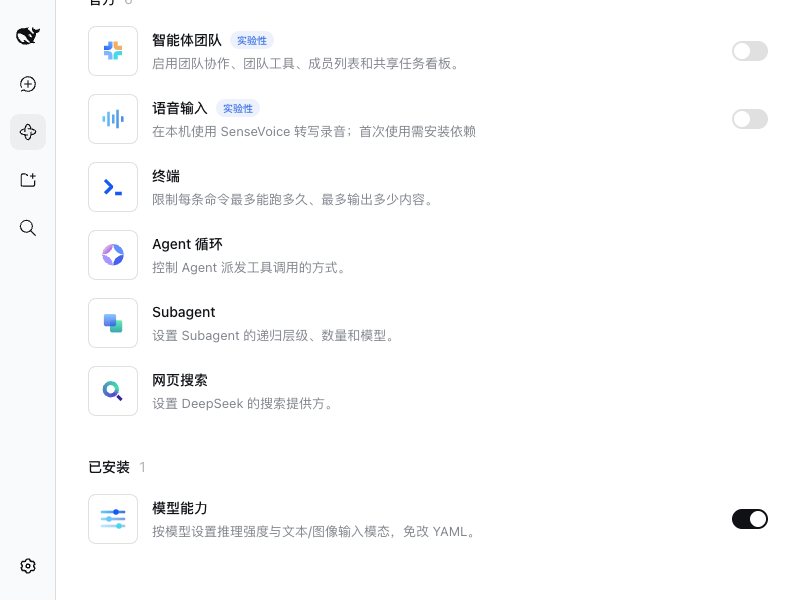
CI rebuilds and republishes ready-built artifacts to the master branch on every green main push, so this path never builds locally. Installing the default branch (github:sanshanya/better-model-provider) builds from source and prints one pnpm allowBuilds key to add, then rerun add; a local link: install must npm install && npm run build first. Restart dsh web, and the Settings sidebar gains Model capabilities.
dsh plugin --profile web rm better-model-provider
Use
- Configure the provider and API key on the official Models page first — keys and route lifecycle are always managed there; this page does not repeat them.
- Expand a model row and edit its capabilities:
- Reasoning effort: pick Custom, check the levels you need; to offer "off" too, check
off(its wire value may stay blank). - Vision models: check
imageunder input modalities — otherwise sending an image to this model gets refused. - Capacities: K/M spelling reads best (
380K,1M). Tap Apply and the change takes effect at once.
- Reasoning effort: pick Custom, check the levels you need; to offer "off" too, check
- Official-catalog routes: tap Manage official models and edit. Every change here stores only the difference from the official default — everything else keeps following catalog updates; Reset to official defaults undoes all of one model's edits at once.
- Manage official providers (N) unfolds installed-but-unconfigured routes: pick one, apply the first change, and the route comes into being (its API key still goes on the official page).
The official Models page can also edit input types and capacities — but only by replacing a route's whole model list, which stops that route following the catalog and rules out overrides. Use this page when you want one model changed and the other thirty-seven still following it. Once a route's list has been replaced on the official page, this page edits that list like any declared route.
Dedicated-adapter apps (built-in DeepSeek / OpenAI Codex) declare their capabilities on their own settings pages and never appear here.
Compatibility
| Harness line | Status |
|---|---|
dsh 0.2.0-rc.1 (npm next) | verified end-to-end |
dsh 0.1.7-alpha.2 (npm alpha) | verified end-to-end |
dsh 0.1.7-rc.2 (npm latest) | verified end-to-end |
dsh 0.1.5-rc.3 | verified end-to-end |
0.1.2-alpha.1 … 0.1.6-alpha.2 | not verified — admitted by the peer ranges, no lane has run on them |
0.1.0-rc.7 … 0.1.1-rc.2 | refused: no connection.api generation here any more |
Verified means both lanes on a real harness: integration boots a checkout and serves the plugin's client module, functional drives a real browser through a capability write and its revert. They are opt-in — BMP_DSH_DIR=/path/to/deepseek-harness npm run test:live (see CONTRIBUTING.md for the functional lane) — and skip without it.
The peers are a single interval, >=0.1.2-alpha.1 <0.3.0: the floor keeps the retired connection.api generation out (the 0.1.0-rc.7 line stays refused), the ceiling admits the dsh 0.2 line. What actually rules on them at install time is dsh's admission gate — it reads prereleases with includePrerelease: true, and that is the path every install of this plugin takes; npm's own peer rule reads the tuple more strictly and disagrees on some versions, but it never governs that path. (Through 0.0.6 the range was enumerated per published line — a residue of npm's stricter reading; 0.0.7 converged it on dsh's semantics.) The nightly canary re-proves the latest, next and alpha channels, and a leg whose channel resolved but whose lane skipped fails the run instead of passing quietly; when a leg turns green again it closes that channel's accumulated red-tracking issues itself.
Field overlap: this page edits per-model reasoningEfforts (levels and their wire spellings) and sparse modelOverrides — the official Models page has no control for either. It also edits input, contextWindow and maxTokens, which the official page edits natively, so those are a convenience here rather than a unique capability. Recovery: if the official page rewrote a route's whole model list while overrides saved here linger beside it, write validation rejects the route — the card offers Remove leftover overrides, one explicit click, never automatic.
License
MIT
Related plugins
dsh-routing-suite
yjh051108/dsh-routing-suite
dsh-commandcode-provider
mars-sea/dsh-commandcode-provider
dsh-workbuddy-connect
corrinehu/dsh-workbuddy-connect
dsh-our-free-model
zouyuxuan122/dsh-our-free-model