dsh-openfoam-workbench
yakovlev-i-a/dsh-openfoam-workbench
OpenFOAM CFD workbench for DeepSeek Harness with 65 tools and 11 skills to inspect a case, plan and check a mesh, scaffold incompressible, compressible and conjugate-heat-transfer cases, run solvers, verify runs and render fields, plus golden cases on OpenFOAM.org 14 and OpenFOAM.com v2606.
Install
dsh plugin --profile web add github:yakovlev-i-a/dsh-openfoam-workbenchREADME
OpenFOAM Workbench (dsh-openfoam-workbench)
Native DeepSeek Harness plugin for OpenFOAM: 65 tools and 11 on-demand skills
covering case scaffolding, inspection, solver development, meshing, multi-region CHT runs,
durable background jobs, off-screen renders, paper reproduction and an
experience library. The agent gets one coherent surface — a thin always-on core
prompt (CORE.md), procedural skills, and tools that enforce the conventions
instead of asking the model to remember them.
Status
Implemented and validated on OpenFOAM 14 (org, modular solvers), OpenFOAM v2606 (com, multi-region tutorials) and ParaView 6.2.0:
v0.9.30 · 65 tools · 11 skills · 187 tests
Pre-1.0: the tool set and the on-disk conventions may still change between minor versions.
Requirements
- DeepSeek Harness
>=0.2.2-rc.1— declared asengines.dsh, so the installer refuses an older host instead of mounting a plugin it cannot support. - OpenFOAM installed locally (org, e.g.
openfoam14, and/or com,vYYMM); the plugin drives it in subprocesses and never vendors it. - ParaView 6.x with
pvpythonfor renders and-helpchecks — optional: everything else works without it. - A POSIX shell (
bash -lc) on Linux or macOS. Windows/WSL is not tested.
Golden cases
Three small cases with stored reference quantities live in test/golden/:
cavity (incompressible, both families), sphereBox (compressible, both
families, stored snappy mesh), sphereCht (CHT, both families, per-family stored
mesh) and pitzDaily (tutorial smoke test). Both branches run the same cases:
the compressible results agree within ~0.1 % and the CHT solid heats to the same
range, which is what makes support: full measurable. sphereCht starts
from a stored mesh fixture (test/golden/meshes/sphereCht, gzipped polyMesh
that both families read), so both branches solve exactly the same mesh and only
the dictionaries are generated per run. Run them against an installation with:
node scripts/run-golden.mjs --distribution org     # verify
node scripts/run-golden.mjs --update               # re-bless after a reviewed change
--update must be a deliberate, reviewed commit: the values are the regression
contract. .github/workflows/golden.yml runs the same script inside OpenFOAM containers
(dicehub/openfoam:14, dicehub/openfoam:opencfd-2606) for the org and com
matrix entries — proven on both: org runs all three cases, com runs cavity
with identical numbers and records the two skips with reasons. A case whose
tutorial is not usable on a distribution is recorded with a reason in
test/golden/cases.mjs.
Supported versions
The tool targets org 14 and com v2606: those are the installations it is
tested end to end on. Every other release is described through a capability
object (probed from the installation) and lands in partial/unknown until it
is added to the test matrix:
| family | tested | support | notes |
|---|---|---|---|
| org (OpenFOAM Foundation) | 14 | full | modular foamRun + solver module, physicalProperties/momentumTransport, surfaceFeatures |
| com (ESI/OpenCFD) | v2606 | full | legacy applications (simpleFoam, rhoPimpleFoam), transportProperties/turbulenceProperties, surfaceFeatureExtract |
| org 10-13 | – | partial | modular conventions assumed; templates and rules use the same layout |
| com 2312-2512 | – | partial | legacy conventions assumed |
| anything older or unknown | – | unknown | best effort; openfoam_check adds an untested-version warning |
Capabilities are detected from the installation itself (openfoam_version_info
and openfoam_env_check return a caps object: modular form, post-processing
and feature utilities, transport/turbulence file names, 0/ vs 0.orig, support
level). openfoam_mesh_plan, openfoam_case_scaffold and openfoam_check
report the same capabilities, so a generated case always says which conventions
it followed.
Install
DSH imports plugin bundles at boot, so every install below ends with a restart of
the host that boots the profile (dsh web for the Web UI, dsh for the terminal
one). --profile web is the profile that serves the Web UI; drop it to use the
default profile.
1. From a release tag — recommended: readable, reproducible, no registry.
dsh plugin --profile web add git+https://github.com/yakovlev-i-a/dsh-openfoam-workbench.git#v0.9.30
# takes anything git can check out: a tag, a branch, or a 40-hex commit. The
tag is the useful middle ground — the version is in the command, the code is
frozen at what was tested and released, and the update is a new tag in the same
place. Use a 40-hex commit instead of the tag when you want to pin exactly, byte
for byte, what a bug report was filed against:
dsh plugin --profile web add git+https://github.com/yakovlev-i-a/dsh-openfoam-workbench.git#c5dac8e
A branch such as #main also installs, but it takes whatever main is at that
moment — including a commit that was never released — and every build from it
reports the same plugin.version, so "which code is running" stops being
answerable.
2. From the release tarball — a versioned artefact, no git clone.
dsh plugin --profile web add https://github.com/yakovlev-i-a/dsh-openfoam-workbench/releases/download/v0.9.30/yakovlev-i-a-dsh-openfoam-workbench-0.9.30.tgz
3. From a local checkout — development.
dsh plugin --profile web add /path/to/dsh-openfoam-workbench
# or link it, so edits are picked up after a restart:
dsh plugin --profile web add link:/path/to/dsh-openfoam-workbench
4. From the marketplace, once the catalog entry is merged:
Discover → search "OpenFOAM" → Install.
After the restart, verify the plugin is live:
openfoam_env_check # plugin.version and the OpenFOAM installations it found
npm distribution was withdrawn: the package is gone from the registry and
package.json keeps private: true, so the git spec and the release tarball are
the supported install paths until that changes.
Zero configuration. The bundle ships no paths: at startup the plugin scans
/opt, /usr/lib/openfoam, /usr/local and ~/OpenFOAM for directories that
contain etc/bashrc (org openfoam14 and com vYYMM are told apart by name),
and looks for ParaView in /opt and on PATH. openfoam_env_check shows what
was found; defaultDistribution picks the install used when a tool is called
without distribution=.
Everything is also editable from Settings → Plugins → OpenFOAM Workbench once
DSH has mounted the plugin (lib/settings-schema.js exports a native schemastery
Config: foamRoots, caseRoots, paraviewPython, language, scaleAskAbove,
logTailBytes, extraCommands, …). The schema borrows the schemastery copy that
ships with DSH, so the bundle keeps zero npm dependencies.
Override in your profile patch (not in this repository) when you prefer YAML or when discovery gets a path wrong:
- id: openfoam-workbench
  name: '@yakovlev-i-a/dsh-openfoam-workbench'
  config:
    foamRoots: { org: /opt/openfoam14, com: /usr/lib/openfoam/openfoam2606 }
    paraviewPython: /opt/paraview/bin/pvpython
    caseRoots: [/path/to/cases]   # relative case paths resolve from cwd otherwise
    language: ru                  # '' = OS locale, 'ru'/'en'/... or a name forces one
Restart DSH after install or after changing the patch.
Update
There is no automatic update, deliberately: a git or tarball install carries no registry metadata, so nothing polls for new versions, and the plugin itself never phones home. A running DSH instance also keeps the code it booted with, so installing new files without a restart changes nothing in memory.
Pick the line that matches how the plugin was installed, then restart the host:
| installed as | update |
|---|---|
git+https://…#<tag or sha> | dsh plugin --profile web add git+https://github.com/yakovlev-i-a/dsh-openfoam-workbench.git#v<new-version> |
| release tarball | dsh plugin --profile web add <new tarball URL> |
local checkout or link: | git -C /path/to/dsh-openfoam-workbench pull --ff-only |
| marketplace | Update on the plugin card, once the plugin is listed |
Then restart the host that boots the profile — that is the step that loads the new code:
dsh web
dsh plugin update only tracks registry packages; with npm withdrawn there are
none, so re-adding the tag (or the tarball) is the update.
If dshmarket is installed it can
signal updates by itself: it compares an npm version, or a pinned commit
against the repository HEAD, and offers a one-click update with a "What
changed" link (its background checks are off by default — enable them under
Plugins → Update checks). A git+…#<sha> install therefore gets a signal; a
tarball install does not (the market updates an archive only through its own
source), and a link: install — a local checkout — is not tracked at all, which
is why that one is git pull plus a restart.
Where the new version comes from:
- the releases page — https://github.com/yakovlev-i-a/dsh-openfoam-workbench/releases (each release carries the tarball and the commit its tag points at);
- the market index —
market/index.jsonin this repository hasversionandsource.commitfor the latest release; - in a session —
openfoam_env_checkprintsplugin.version, so a stale in-memory copy is visible without guessing: if it still shows the old number, the restart has not happened or the install did not replace the package.
Multiple distributions
Several OpenFOAM installations can coexist:
foamRoots:
  org: /opt/openfoam14
  com: /usr/lib/openfoam/openfoam2606
defaultDistribution: org
openfoam_env_check reports every configured distribution. openfoam_run,
openfoam_run_solver_async, openfoam_solver_build, openfoam_dry_compile,
openfoam_solver_smoke and openfoam_version_info take a distribution argument
(org / com) and otherwise use defaultDistribution.
Case libraries (custom .so)
A case can ship its own compiled libraries — a custom fvMeshTopoChanger, an
fvOption, a boundary condition — and list them in system/controlDict:
libs ("libamrTopoChanger.so");
OpenFOAM loads those with dlopen(), so the file has to be on the loader path of
the process that creates the mesh. That path is derived from FOAM_USER_LIBBIN,
which depends on $USER: a case built with a stripped environment (env -i …)
installs into ~/OpenFOAM/-<version>/platforms/..., while the same command run
from a normal shell looks in ~/OpenFOAM/<user>-<version>/platforms/.... The
solver then stops with dlopen error or Unknown fvMeshTopoChanger type, which
names neither the library nor the directory.
Three tools close that gap:
libPaths(run,run_solver_async,field_stats,solver_build) — directories prepended toLD_LIBRARY_PATH, e.g.libPaths: ["/home/me/OpenFOAM/-14/platforms/linux64GccDPInt32Opt/lib"].env— the same thing explicitly:{LD_LIBRARY_PATH: "…:…"}. Only library locations are accepted;LD_PRELOAD,LD_AUDITandPATHare refused, because they would let a call choose the code that runs.solver_build(libbin=…)— install a library into a directory the run can reach (overridesFOAM_USER_LIBBINforwmake). Without it the build reports the resolved target and refuses up front when that directory is not writable — a lib dir outside the workspace is read-only under the file sandbox.
openfoam_check resolves every libs (...) entry against FOAM_LIBBIN,
FOAM_USER_LIBBIN and the ~/OpenFOAM/*/platforms/*/lib trees, and its
case-library-missing finding names the directory that does hold the library
plus the exact libPaths call to fix it. diagnose_error recognises the
dlopen / Unknown fvMeshTopoChanger type messages and points at the same fix.
Background runs keep their registry entry with the extra environment
(openfoam_run_solver_async(logName=…) only renames the log), so
openfoam_run_list / openfoam_solver_status / openfoam_run_progress still
track a run that needed a library path.
Case conventions
Two conventions are enforced by these tools (for any work that goes through them), not by the prompt:
<case-dir-name>.foam—clone_tutorial,mesh_plan,run,run_solver_asyncandrendercreate the ParaView entry file named after the case directory (case.foamis not accepted as a substitute).inspect_casereportsfoamFile,list_casesreports whether it exists.- Relative paths — a relative
casePathresolves against the firstcaseRootsentry (the session working directory is only the fallback whencaseRootsis empty); absolute paths always work. Run records and logs live next to their case in<case>/.openfoam-runs, unlessrunsDirpins a directory. - Geometry-scale gate —
mesh_planandcheckcompare the bounding box withscaleAskAbove(default0.1m). Above it the result carries a language-neutralneeds_inputpayload —{kind, ask, data, options: [{id, label}]}— rendered as a QUESTION block; the agent asks withask_user_questionin the user's language (CORE.md{{language}}), translating the option labels, and continues only after the answer. SetscaleAskAbove: 0to disable.
Multi-region (CHT) cases
A multi-region case (foamMultiRun, chtMultiRegionFoam, system/<region>/...)
is understood end to end, not treated as a broken single-region case:
inspect_case        -> regions, regionSolvers, per-region fields/patches
read_dict           -> file="fluid/fvSchemes", "system/fluid/...", "0/fluid/T", or region="fluid"
mesh_verify         -> checkMesh -region <r> for every region, verdict from checkMesh itself
run / run_async     -> mpirun -np N foamMultiRun (whitelisted launcher)
run_progress        -> t, steps, s/step, ETA from a multi-region/parallel log
solve_verify        -> RUNNING | STALLED | finished, no false divergence from the sigFpe banner
render              -> every mesh region (or region="fluid"), errors on an empty scene
mesh_verify takes its verdict from what checkMesh prints (Mesh OK. /
Failed N mesh checks.) and reports the stricter workbench thresholds
(aspect ratio, non-orthogonality, skewness) as warnings. check (the doctor)
is region-aware too: it reads system/<r>/fvSchemes|fvSolution, 0/<r>/* and
constant/<r>/*, tags every finding with its region, and accepts
region="<name>" to narrow the report. checkMesh -allRegions
does not exist in OpenFOAM.org — the per-region call is the only honest one.
What you get
- Tools (
openfoam_*, 61): env/version, tutorials, solver clone/build/smoke, durable async runs (run_solver_async→run_list/solver_status), run progress/ETA (run_progress), meshing (STL → blockMesh/snappy → checkMesh), render (inline PNG, multi-region), verification (solve_verify,mesh_verify), case editing (dict_set,clean), doctor checks, diagnostics, papers, experience, and a usage self-audit (usage_report). Verdicts on huge logs read only the tail (logTailBytes, 4 MB by default) instead of the whole file. - Skills (
SKILL.md, load on demand, 11): case-builder, cht (multi-region conjugate heat transfer), solver-development, code-modify, meshing, mesh-independence, stats, viz, analyze, paper-reproduction, self-evolution. A test keeps every referenced tool registered and the always-on catalog under 4 KB. - Presentation: inline render images (
imageblocks), table renders forcheck/run_list/mesh_verify/env_check/list_cases/run_progress/solve_verify/usage_report, compact JSON for large payloads, and aQUESTIONblock whenever a tool needs a human decision (needs_input). In the Web UI the call summary of everyopenfoam_*row (openfoam_x · …) is blue,#3b518con light and#9db4e0on dark (client.js, the browser half of this bundle; no per-tool registration).
Screenshots
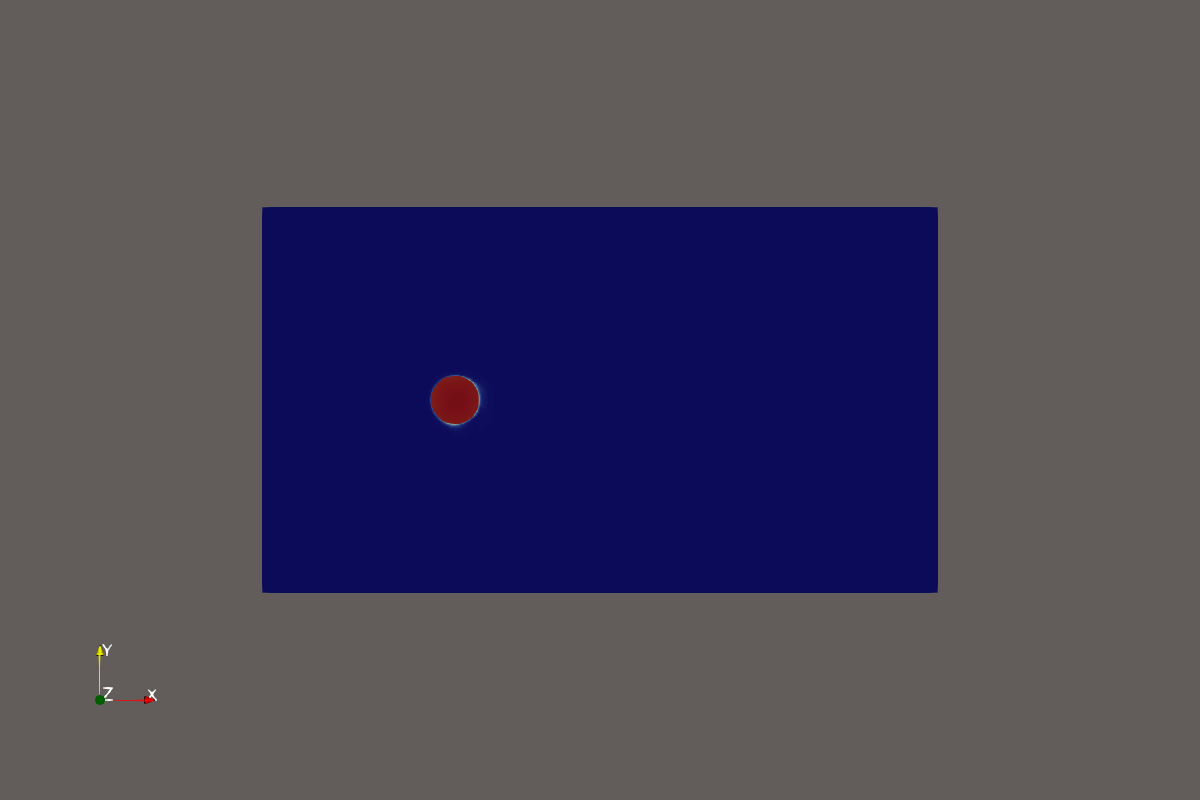
openfoam_render on multiRegion/CHT/coolingCylinder2D — 3045 cells, both
regions, temperature. The render reads only the case directory (no GUI).
Write policy
Every mutating tool decides by impact, and the impact is judged by the entry,
not by the file (a wrong 0/U inlet or fvSchemes term converges to a
plausible but wrong answer, so neither is "safe"):
| Tool / change | Default | Why |
|---|---|---|
clean | dry run | deletion cannot be undone |
case_scaffold | writes only missing files (force: true to overwrite) | an existing setup is the user's |
dict_set on controlDict output keys (writeInterval, writeFormat, …) | applies | organisational, visible in the log |
dict_set on purgeWrite | low for 0, preview for any value > 0 | it deletes older time directories |
dict_set on 0/*, fvSchemes, fvSolution, constant/*, deltaT, application, anything unknown | preview (applied: false, NOT APPLIED) until apply: true | can change physics or numerics |
dict_set on controlDict libs/functions | approval via the DSH user-approval seam, always required (no config switch), fail-closed without an agent identity or an answerer | can execute code |
writeMode: impact | apply | preview (Settings) overrides the default globally.
dict_set edits single-line top-level entries; a sub-dictionary (functions, boundaryField) is refused with an explicit error rather than half-edited.
expect: "<current value>" refuses a write on top of a value you did not see, and
every applied change returns a changeId plus an afterHash; openfoam_dict_undo
reverts it and refuses when the file changed after that edit.
Security
The plugin runs local OpenFOAM programs with the privileges of your OS user
and is not a sandbox: a solver or wmake call has the same access as a shell
started by you.
What it does to make that safe:
- only whitelisted applications run (
BASE_APPSplus theextraCommandsconfig), and a command containing shell metacharacters (;,|,$(), backticks, newlines) is refused before anything is spawned; - the shell is always a static script: the bashrc, the working directory, the
log path and the command arrive as argv / positional parameters, never as text
spliced into the script, so a path containing quotes,
$(), backticks or spaces cannot become shell code (lib/runtime.js,FOAM_RUN_SCRIPT); - child processes get
stdin: ignoreand never inherit a terminal; cleanis a dry run by default,dict_setreplaces one entry atomically and keeps a.bak, and the source tools only read the OpenFOAM installation.
What these gates do and do not cover
The write policy above applies to this plugin's tools. An agent that also has
generic shell/file tools can change a case without them — bash -c 'echo ... >> system/controlDict' never reaches dict_set, its impact classification or its
approval request. So treat them as defense in depth, not as the barrier:
- the effective boundary is the DSH sandbox and permission mode (for example
workspace-write, which refuses writes outside the workspace) plus the approval answerer for what you choose to review; enforceToolRouting(Settings:off/warn/deny/strict, defaultwarn) makes the plugin watch DSH'stools/pre-executeseam: abash/write/editcall that writes a case dictionary is recorded, refused (deny) or refused-unless-escalated (strict);stricthas an audited way out:openfoam_escalate({target, toolsTried, why})grants one single-use, 10-minute token for that target, but only when the named plugin tools were really called and failed in the last 15 minutes (the call history is the evidence).escalationAuthoritydecides who issues it:auto(the plugin, recorded inopenfoam_usage_report) orask(the DSH approval answerer, fail-closed without it). Text matching on shell commands is evadable, so the guard is a strong deterrent plus a signal, not a proof;- within a case, the plugin's gates make the normal path safe (one-entry
atomic edits, previews for physics changes, approval for code execution,
containment checks) and leave an audit trail (
changeId,afterHash,.openfoam-changes/); - when a case matters, review what the agent actually ran:
openfoam_run_list, the change journal andgit diffin the workspace.
No credentials ship with this repo. Put any API keys in DSH's credentials
service, never in settings.json or in the bundle.
Docs
- CORE.md — the always-on core prompt. It is read at runtime (the
section text is a function, re-evaluated on every model step), so editing this
file changes the agent on the next message, without restarting DSH. Keep it
under 3 KB: a test fails if it grows past the budget or loses a routing marker.
The
{{language}}placeholder is filled from thelanguageconfig or the OS locale, so one file serves every language. The iron rules separate verifiable facts (the case, the installed OpenFOAM, a run result — check with a tool) from conceptual answers (why does the pressure equation carry this correction?— answer directly and cite the source when the version matters), so the agent does not call a tool just to satisfy a rule. - NOTICE / LICENSE — attribution (Apache-2.0 + MIT).
- market/index.json — the format-1 marketplace index
pinned to a release commit (
node scripts/make-market-index.mjs --commit <sha> --out market/index.json); host it over https and add that URL in Discover.
Layout
lib/index.js       # entry: apply() mounts core + skills + tool groups (~50 lines)
lib/core.js        # always-on prompt section, read from CORE.md on every assembly
lib/skills.js      # reads skills/*/SKILL.md and registers the catalog
lib/runtime.js     # process/paths/runs helpers + config defaults (deps for tools)
lib/knowledge.js   # solver classification + error patterns + diagnosis
lib/presentation.js# pvpython renders, inline images, tool-call cards, tables
lib/registry.js    # registration choke point: render, strict schema, telemetry, safety
lib/of-engine.js   # OpenFOAM dict parser + 31 silent-failure rules (MIT)
lib/of-case.js     # multi-region model: regions, dict paths, command whitelist, progress
lib/meshlib.js     # STL/geometry helpers + blockMesh/snappy plan writer
lib/caselib.js     # four-step contract extraction, case facts, contract audit
lib/buildlib.js    # Make/files parsing + first compiler error
lib/paperlib.js    # PDF/paper extraction helpers
lib/explib.js      # experience cards + learned error patterns
lib/tools/*.js     # one factory per group: ({cfg, attachImage}) => tools (61 total)
skills/            # 11 × SKILL.md (progressive disclosure)
test/              # 60 tests: engine, tools, registry, skills, case model, inventory, log tail
locale/            # en/ru plugin-card strings
icon.png           # plugin icon (512×512 PNG, < 256 KiB)
Prior art & acknowledgements
The plugin is its own implementation: a Cordis bundle with its own tool layer, runtime, multi-region case model, presentation, tests and prompt design. Two parts nevertheless carry lineage, stated here precisely:
- Dictionary parser and doctor checks —
lib/of-engine.jsis a port of dsh-openfoam-doctor (MIT): the OpenFOAM dictionary parser, the silent-failure rules and the checkMesh / run-log parsers. This plugin extends it (region-aware checks, 31 rules, fixes) and ships its license inlicenses/. - Experience format and operation coverage — the experience-card schema
(
title / domain / triggers / solver / physics / recipe / key_params / verify_seq / pitfalls) and the overall "inspect → plan → run → verify" tool coverage were inspired by NullFlux / CFDriver (Apache-2.0). No source files were copied; the code, architecture and descriptions are original. - Skill protocols — the mesh-independence procedure (STEPS A–E), the
numerical-stats patterns and the PROCEED / REVISE / RERUN decision taxonomy
were adapted from
AI-CFD-Scientist
cfd-skills. The wording lives inskills/and was rewritten for this plugin.
OpenFOAM itself is not redistributed: the plugin drives the user's installed OpenFOAM (GPL-3.0) in subprocesses.
Related plugins
archify (deepseek-harness)
tt-a1i/archify
WeKnora (dsh-weknora)
tencent/weknora
next-ai-draw-io (dsh-plugin)
dayuanjiang/next-ai-draw-io
AiToEarn (dsh-plugin-aitoearn)
yikart/aitoearn