dsh-opencode-client
yhuan416/dsh-opencode-client
Cross-server board, 7/30-day insights and a native dsh subagent backend for OpenCode 2 fleets.
Install
dsh plugin --profile web add github:yhuan416/dsh-opencode-clientREADME
dsh-opencode-client





English | 中文
An observation console for a fleet of OpenCode servers, plus a native dsh subagent backend.
The plugin connects to one or more remote opencode serve instances and answers three questions
OpenCode's own clients cannot: which sessions are running across all servers, which are waiting
for you, and what failed — then delegates work into them and registers each server as a native
dsh subagent provider (opencode-<serverId>).
Positioning (0.6.0): session access is a means, not the goal. Chatting inside a session belongs to OpenCode's TUI/Web (we deep-link into it); this plugin owns the cross-server board, the attention feed, and the agent-facing backend.
Two tracks, one core (2026-11-27):
[observe]— the human-facing console (board, attention, cost governance) — is the current priority and is being finished first;[delegate]— the agent-facing tools and native subagent provider — follows in later releases. Both share one transport and version-probing core. SeeTODO.md§10 for the per-track roadmap.
Compatibility: OpenCode 2.x only (/api/* + HTTP Basic auth). The v1 API (OpenCode
1.18.x) was frozen in 0.7.2 and removed in 1.0.0 — a v1 server now fails with a clear
"requires OpenCode 2.x" error. apiVersion: auto|2 is accepted;
auto probes GET /api/info and records why a probe failed.
See Compatibility & versioning.
Primary role: register OpenCode as a native dsh subagent backend (
opencode_subagent_<server>) and expose remote sessions/workspaces as tools (opencode_subagent,opencode_prompt, shell/git/read/find, catalogs). The embedded OpenCode Web UI is an optional convenience for full-fidelity work, not a replacement for the OpenCode client.
Screenshots
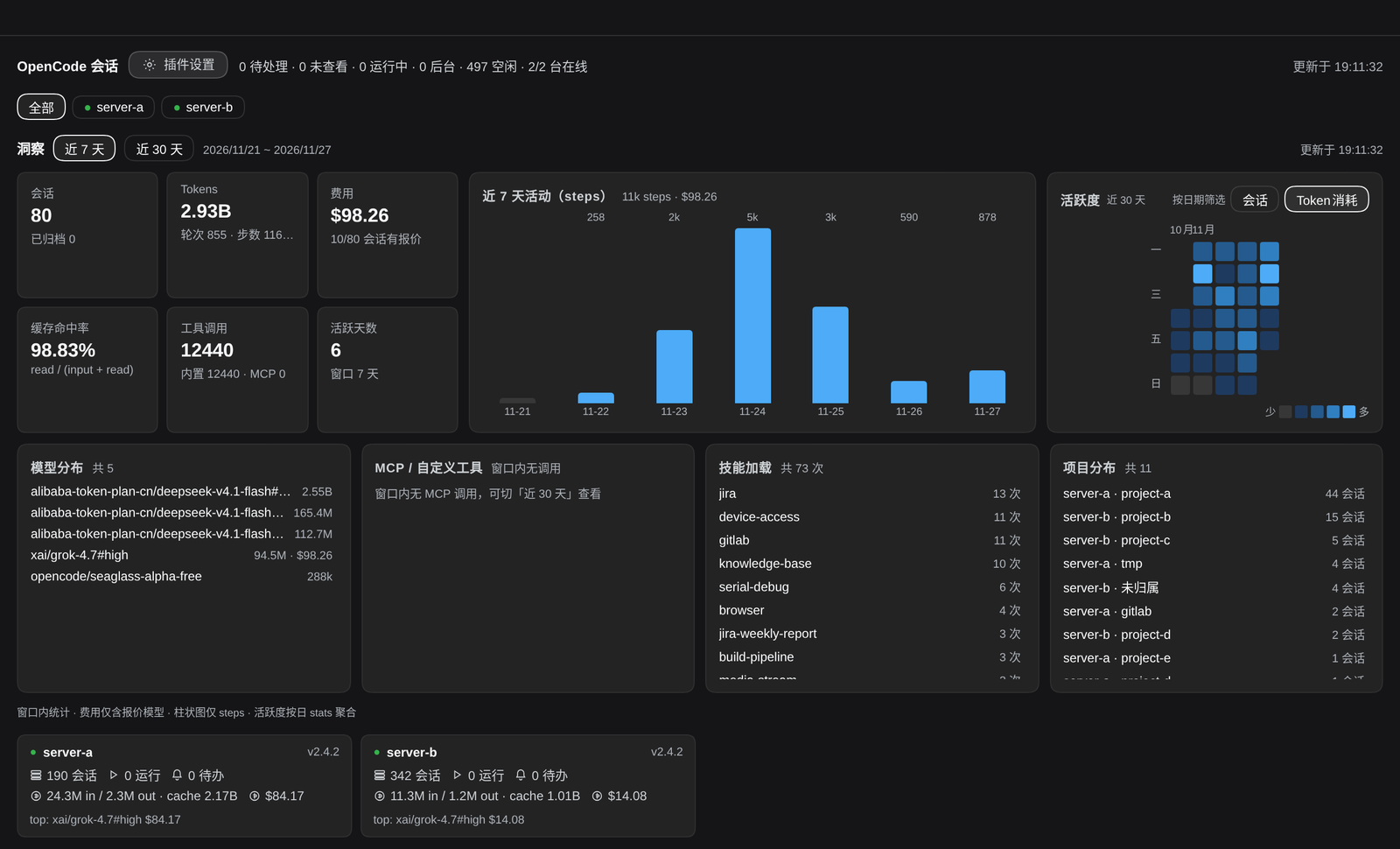
Board — one page across every server: attention, 7/30-day insights, a 30-day activity calendar, and the idle fleet below.
Insights — cards, daily steps and the activity heatmap share one top row.
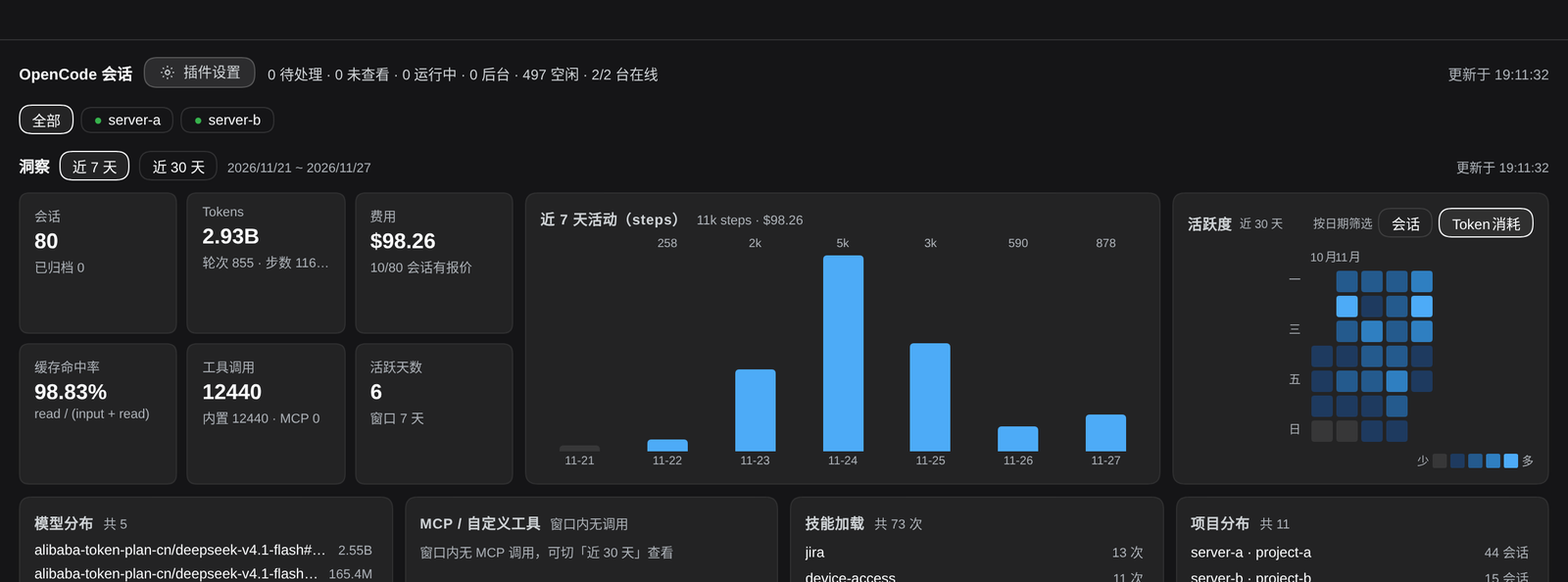
Table of contents
- Screenshots · Quick start · Architecture · Features
- Install (profile) · Configuration · Subagent seam
- Documentation · Ecosystem · Compatibility & versioning · Notes
Quick start
# 1. install the plugin into the web profile (bundle selection is composed at restart)
dsh plugin --profile web add /path/to/dsh-opencode-client

# 2. configure at least one server (full schema in Configuration)
#    OpenCode 2.x also needs the server password:
#    config.servers: [{ id: n100, url: "http://192.168.4.50:4096", password: "<OPENCODE_SERVER_PASSWORD>" }]

# 3. restart dsh web
dsh web
Verify:
- Settings → Plugins → OpenCode Client shows the server / workspace / session section
(
GET /api/opencode-client/listanswers with the configured servers). - Ask the agent to call
opencode_sessions— it lists remote sessions, so the HTTP path toopencode serveworks end to end. - Optional: expose the server as a native subagent (
opencode_subagent_<server>) — see Subagent seam.
Full live acceptance run (needs a real OpenCode 2 opencode serve):
OPC_LIVE_URL=http://192.168.4.50:4096 \
OPC_LIVE_PASSWORD='<OPENCODE_SERVER_PASSWORD>' \
OPC_LIVE_DIR=/home/yhuan/workspace \
node scripts/e2e-live.mjs        # or: npm run e2e; OPC_LIVE_INTERACTIONS=1 also exercises approval/question bridging
OPC_LIVE_PASSWORD is required (OpenCode 2 always uses HTTP Basic auth). Offline checks:
npm test (unit + transport tests) or npm run check (smoke checks + tests).
Prerequisite: opencode serve must be reachable from the dsh host. It binds 127.0.0.1 by
default — bind 0.0.0.0 or put it behind an SSH tunnel. OpenCode 2 always requires
OPENCODE_SERVER_PASSWORD on the serve process plus the same value in the plugin's server
password.
Architecture
OpenCode's own architecture: opencode serve exposes an OpenAPI HTTP server "that an opencode
client can use"; the TUI / Web / SDK are clients of it. This plugin is another client, hosted in
dsh.
flowchart LR
BROWSER["browser<br/>dsh Web UI"] -->|"same-origin HTTP"| DSH["dsh web<br/>host process"]
subgraph PLUGIN["dsh-opencode-client plugin"]
direction TB
CLIENT["client bundle<br/>board page · settings section"]
ROUTES["routes<br/>/api/opencode-client/*"]
TOOLS["tools<br/>28 × opencode_*"]
PROVIDER["provider<br/>opencode-<serverId>"]
SSE["sse<br/>v2 /api/event"]
end
DSH --> CLIENT
DSH --> ROUTES
DSH --> TOOLS
DSH --> PROVIDER
ROUTES -->|"v2 HTTP API"| N100["opencode serve · n100"]
TOOLS -->|"v2 HTTP API"| N100
PROVIDER -->|"v2 HTTP API"| N100
ROUTES -->|"v2 HTTP API"| M65["opencode serve · m65"]
TOOLS -->|"v2 HTTP API"| M65
PROVIDER -->|"v2 HTTP API"| M65
N100 -.->|"SSE"| SSE
M65 -.->|"SSE"| SSE
CLIENT -.->|"iframe: native OpenCode UI"| N100
The browser only talks to the dsh origin — lib/client.js renders the board/plugin page and
embeds the native OpenCode UI in an iframe when a session is opened. lib/routes.js
(/api/opencode-client/*) and the model-facing opencode_* tools (lib/tools.js) make
deterministic calls through @opencode/client (pinned 2.4.2, one client per server);
lib/provider.js (opencode-<serverId>) and lib/session-run.js drive delegated runs;
lib/sse.js subscribes to each server's /api/event stream with Basic auth and reconnect for
live progress, completion and permission/question bridging. lib/http.js probes
GET /api/info once per server, adds HTTP Basic auth and rejects v1 with an actionable error;
lib/oc-client.js owns the client instance and error mapping.
More: ARCHITECTURE.md · docs/ARCHITECTURE.zh.md.
Features
28 model-facing opencode_* tools, host routes, one native subagent provider per server — the
same tool names. OpenCode 2 is the only supported generation: v1 was frozen in 0.7.2 and
removed in 1.0.0; a v1 server is rejected at the transport with an actionable error (policy).
OpenCode 2 API notes
OpenCode 2 removed a few v1 endpoints. Two capabilities now return an explicit "not available on OpenCode 2" message instead of empty data, two are restored with v2-native calls, and two are v2-only:
| Capability | OpenCode 2 behaviour |
|---|---|
opencode_share | not available (no share endpoint) |
opencode_tools | not available (no tool-ids endpoint) |
opencode_find with kind=text | restored via fallback: no content-search endpoint, so the plugin runs a workspace grep through the async shell (literal substring, first 100 matches) |
todo list in opencode_session_info | restored via fallback: /session/{id}/todo was removed, so todos are derived from the last todowrite tool call |
opencode_usage | OpenCode 2 only: GET /experimental/session/stats aggregates sessions/steps/tokens/cost/tool success rate, plus per-model attribution and (host route ?group=directory) per-directory cost |
| background jobs (board/progress) | OpenCode 2 only, experimental: GET /experimental/job lists work that outlives the turn (e.g. a shell script still running after the session went idle); shown as the background status |
On OpenCode 2 the plugin also normalizes these API differences for you:
- Sessions carry
location.directory; session/message/diff results are normalized to one shape. - Prompts are
{text, files};agentandmodelare session state (POST /api/session/{id}/agent|model). - Completion is detected from
session.execution.succeeded|failed|interruptedevents. - Permission approvals use
once|always|reject; questions arrive as forms with typed fields (string / number / integer / boolean / multiselect). opencode_shellruns asynchronously in the session workspace (submit, poll, read output); output pages are followed via cursor (up to 1 MiB) and truncation is reported explicitly with exit/signal.opencode_summarizemaps tocompact(the session's own model is used, somodelis optional);opencode_initruns the built-ininitcommand;opencode_git_diffmapsgit→working;opencode_findretries a glob query as a plain substring (the endpoint does not understand*/?).
Subagent delegation
- Native subagent — provider
opencode-<serverId>; pair with@deepseek-ai/dsh-tool-subagentto expose one-shotopencode_subagent_<server>tools. - Delegation — tool
opencode_subagent(new session, or continue withsession=; optionalagent,modeland prompt-enforcedschema); usessession.prompt+ message polling with a blocking wait, and returns the final answer plus the session id. The prompt is{text, files}andagent/modelare applied as session state. - Turn-by-turn continuation —
opencode_promptsends one message to an existing remote session (fire-and-forget by default,wait=trueto block); read the reply withopencode_messages/opencode_progressand send the next message. This keeps a remote worker session alive across dsh turns. - Completion wait —
prompt_async+ SSE event-driven (returns immediately when the remote finishes), 5 s polling fallback, then a blocking wait. Completion is detected fromsession.execution.succeeded|failed|interrupted. - Live progress —
opencode_progress(current tool/step, elapsed, output tail) fed by SSE tool events; delegation completes on the SSE completion event. - Abort —
opencode_abortstops a running remote session (session.interrupt); a waiting delegation returns an abort error instead of hanging. Call it from another dsh session/agent: tool calls inside one turn are serialized, so it cannot preempt a blockingopencode_subagentin the same turn. - Attachments —
opencode_subagentaccepts afilesJSON array (text/base64 → data URL); attachments are sent as{uri, name}.
Sessions & messages
- Server configuration —
servers: [{ id, label?, url, password?, directory? }], with optional per-server defaultagentandmodel. - Discovery —
GET /api/opencode-client/list(server health, projects, sessions grouped by directory; the directory comes fromlocation.directory). - Session listing — tool
opencode_sessions+GET /api/opencode-client/sessions; rows include the model (with#variant), agent, outcome and cost when the server reports them.archived=truelists archived sessions, andcursor/nextCursorpage past the first 500-row snapshot. - Session messages — tool
opencode_messages+GET /api/opencode-client/messages(text, tool and file parts;content[]text/reasoning/tool parts are normalized). Tool lines include the call input summary and the first output line;type=filters one message kind (server-side). Useful to decide whether a session is the right one to continue. - Session info — tool
opencode_session_info(title/summary/todos/diff; the todo list is derived from the lasttodowritecall, and outcome/cost/tokens plus the changed-file diff are reported) andopencode_share(share/unshare link; not available on OpenCode 2 and the tool says so). - Session management —
opencode_fork,opencode_children,opencode_summarize(mutating; v2 maps it tocompact, where the session's own model is used andmodelis optional),opencode_init(writes AGENTS.md, requiresconfirm=true; runs the built-ininitcommand). - Session search & diagnostics —
opencode_search(session search through the list endpoint'ssearchfilter),opencode_mcp(MCP server status). - Multiple servers — configured as an array and aggregated by the client (opencode itself has no server-side federation).
Catalogs & tool discovery
- Agent catalog — tool
opencode_agents+GET /api/opencode-client/agents(primary/subagent, native/custom); call it beforeopencode_subagentto pick an agent name. - Catalogs —
opencode_models(providers/models, credentials stripped),opencode_commands,opencode_skills,opencode_tools(not available on OpenCode 2; no tool-ids endpoint),opencode_references. - Command execution —
opencode_commandruns a remote command (e.g.init) inside a session and returns its final text.
Workspace & git
- Workspace ops —
opencode_shell,opencode_git_status,opencode_git_diff,opencode_read_file,opencode_find(kind=filesearches paths,kind=dirdirectories;kind=textruns a workspace grep fallback). - These are deterministic direct calls (no remote model involved): verify what a remote agent changed, read a file, run a command, or search the workspace.
opencode_shellis asynchronous (submit, poll, read output) in the session workspace;opencode_git_diffacceptscommitted/branch/working(withgitmapped toworking), plusuntracked=files|foldersandbase=<ref>.
Permissions & events
- Permission approval —
permission: ask(default) turns remote permission requests into dsh approval cards (once/always/rejectare your call);allowis the explicit auto-approve bypass andrejectrefuses everything (unattended deployments). Withaskthe outcome depends on the caller: a delegated run (agent in scope) shows the host approval card; a session dsh did not start keeps the request pending in the board's "needs you" row until you answer in the session; when no approval service is available the request is auto-answeredalwayswith a warn in the plugin log. Every request is counted as a permission diagnostic — the/boardserver object carriespermissions(asked / user-approved / auto-approved / rejected / pending plus the last 20 action+resources) and the board card shows "权限 N · 自动 M" (warning tone when anything was auto-approved), so "the remote never asked" and "it asked and was answered silently" are no longer indistinguishable. - Question bridging — remote questions are forwarded to dsh's user-question UI for
tool-initiated runs (an agent is in scope). A session dsh did not start (for example one you
opened in the OpenCode TUI/Web) keeps its question pending by default: it shows up in the
board's "needs you" row, triggers the attention notification, and waits for you to answer in the
session;
question: rejectopts an unattended deployment into dismissing it. Questions are forms with typed fields (string / number / integer / boolean / multiselect). When several clients share the same OpenCode server, the first client that sees a form answers it: keepquestionidentical everywhere — a client still onquestion: reject(or an older build) dismisses the form before the "needs you" card can appear. - Live events — per-server SSE subscription (
/api/event) with reconnect; fast permission/question handling, live state,GET /api/opencode-client/eventsand/status. - Polling fallback — permission/question requests are answered while a delegated run is active: SSE events are handled immediately, with a 15 s polling fallback when the stream is unavailable.
UI
- Observation console (main panel, 0.6.0) — the left-rail
OpenCodeentry opens a card board, not an embedded page: "needs you / running / error" sit on top across every remote, idle sessions are grouped per remote and directory, a remote filter chip keeps its selection, and a card opens that session in an overlay (Esc or the top bar closes; the overlay keeps a "new tab" escape). Backed byGET /api/opencode-client/board, polled every 5 s and paused while the page is hidden. - Plugin page — "OpenCode Client" section: servers/workspaces/sessions, session ids, active tool, messages, create session.
- Embedded OpenCode UI — a server row's "打开" button opens the real OpenCode Web UI in a fullscreen overlay; a board card opens that session in an in-panel iframe, with "全屏" and "新标签" as escapes. No reimplementation — the embedded page keeps streaming, tool cards, diffs and permissions.
- Usage & attribution (0.7.1 / 0.8.0) — per-server cards show today's tokens/cost, the board has a
"finished, not looked at" zone, and the settings page shows a 7-day per-model / per-directory split
(
reconciledmarks a mismatch with the stats total). - Background work (0.8.0) — a session whose turn ended but whose shell job is still running shows
as "background" with the command and elapsed time, instead of looking idle. When the SSE stream
connects mid-run, the current tool is read once from
session/active+ the latest message so a running card is not blank until the next event. - Insights (0.9.0) — the top of the board page shows a 7/30-day window: session counts, tokens,
cost, cache hit rate, a daily steps chart, plus a separate 30-day activity heatmap
(GitHub-style week columns with month labels; switch between sessions / tokens).
It sits in the top row next to the six cards and the steps chart, like the context-insight
plugin. The heatmap uses one bounded per-day stats call per server, cached for 10 minutes. Top
models/projects, MCP/custom tool usage grouped by server (builtin shell/read/write are not
shown) and per-skill load counts stay on the 7/30-day window. The heatmap itself is fixed at
30 days; the footnote states what OpenCode cannot provide (daily cost, token composition,
duration breakdown). Skill names come from a lazy message scan (
/insights/skills); the activity heatmap is served by/insights/activity(30 days, sessions/tokens). - Upgrade hint — each server card shows
→ vX.Y.Zwhen a newer OpenCode is out (checked once at startup and then daily against the official update service; no badge when offline). - Plugin's own version / repository / update check (1.1.0) — the board header carries a
vX.Y.Zchip (opens the GitHub repository) that turns into "可更新 vY" when a newer release exists; the settings section ends with an About block: version, repository link, latest / update-available / unavailable check, last-checked time and 重新检查. Version and repository come from this package'spackage.json; the newest release comes from GitHub Releases (cached 24 h in the Host, retried after 1 h on failure; the board chip, settings block and detail badge share one load, so a cold start spends one GitHub request). Offline / rate-limited checks degrade only the check area and keep the last known version. 更新 hands registry installations to DSH's own update flow; a path-linked checkout opens the release page and shows a copyablegit -C <dir> pull --ff-only; git installs (plugin market) update through the release page / market. - Fleet health (0.8.0) — the board and settings page show API-version drift, probe failure reasons and SSE reconnect counts.
- Entry points — the left sidebar
OpenCodeentry opens the board; server rows and board cards open the embedded UI. There is no session-header button or right-sidebar tab anymore.
Install (profile)
Installing on another machine (Windows / DSH Desktop, multiple servers, troubleshooting): see docs/INSTALL.zh.md (Chinese).
# A. dsh plugin manager
dsh plugin --profile web add /path/to/dsh-opencode-client

# B. helper script: symlink + dependency + bundle selection + a starter server row
bash scripts/install-into-profile.sh http://192.168.4.50:4096 n100
or add it manually to the profile and select it as a bundle:
{
  "dependencies": { "dsh-opencode-client": "file:/path/to/dsh-opencode-client" },
  "dsh": { "profile": { "bundles": ["@deepseek-ai/dsh-base", "@deepseek-ai/dsh-web-app", "dsh-opencode-client"] } }
}
Restart dsh web afterwards: the bundle selection is composed at startup.
Configuration
- id: opencode-client
  name: dsh-opencode-client
  config:
    servers:
      # OpenCode 2.x: start the server with OPENCODE_SERVER_PASSWORD=<secret> and repeat
      # the same value in `password` (HTTP Basic auth, user "opencode").
      - id: n100
        label: n100 opencode 2.x
        url: http://192.168.4.50:4096
        apiVersion: auto            # auto (probe GET /api/info) | 2 (v1 is rejected)
        password: "<OPENCODE_SERVER_PASSWORD>"
        # directory: /home/yhuan/workspace   # default remote dir when the caller does not give one
        # agent: plan            # default OpenCode agent for delegation
        # model: deepseek/deepseek-chat      # default model "provider/model"; v2 also "provider/model#variant"
    permission: ask              # ask (default, dsh approval card) | allow | reject
    question: ignore             # ignore (default: keep pending on the board + notify) | reject (dismiss, unattended)
    pathMap:                     # only when local and remote path layouts differ
      - { from: /home/yhuan, to: /home/yhuan }
    routing:                     # multi-server subagent dispatch (default: on when servers > 1)
      providerName: opencode-auto
      policy: [directory, sticky, least-busy, round-robin]
      sticky: true               # keep one parent agent on the server that accepted its first child
      failover: true             # try the next candidate when a start fails before publication
apiVersion: auto (the default) asks GET /api/info once per server. A 401 means the password is
missing or wrong; any other probe failure is recorded on server.versionProbe (logged once) and
surfaces as a clear error. A server that answers as v1 is rejected with
opencode.v1_unsupported. Force apiVersion: 2 to skip probing. Sanity-check with
curl -u opencode:$OPENCODE_SERVER_PASSWORD http://host:4096/api/info.
Register as a native subagent
To expose an OpenCode server as a native dsh subagent, add a tool row:
- insert:
    - id: tool-opencode-n100
      name: "@deepseek-ai/dsh-tool-subagent"
      config:
        provider: opencode-n100   # "opencode-" + server id
        maxDepth: provider-managed
        toolName: opencode_subagent_n100
Multiple servers: opencode-auto
opencode-<server> providers are pinned to one server, so a tool row always dispatches to the
same machine. When more than one server is configured the plugin also registers a routed provider
opencode-auto (configurable through routing), which chooses per start:
directory— a server whosedirectorycovers the child cwd (only meaningful when servers declaredirectory);sticky— the server that accepted this parent agent's first child (one parent → one machine);least-busy— fewest running sessions (/session/active), ties rotate;round-robin— rotate through the remaining candidates.
A start that fails before the run is published (unreachable, 5xx, timeout) falls through to the
next candidate when failover: true; the chosen server is appended to the session title
(dsh subagent: <label> @n100) and logged. Expose it as a tool row:
- insert:
    - id: tool-opencode-auto
      name: "@deepseek-ai/dsh-tool-subagent"
      config:
        provider: opencode-auto
        maxDepth: provider-managed
        toolName: opencode_subagent_auto
Set directory per server to enable directory routing (e.g. machines with different mount roots);
without it, routing falls back to sticky / least-busy / round-robin. Continuation is not routed —
a remote session id belongs to one server — so keep using the pinned tools or pass server to
opencode_subagent when resuming.
Subagent seam
The native opencode_subagent_<server> tools plug into dsh's ctx.subagents provider seam.
See docs/subagent-seam.md for the contract, our capability
mapping, and the applied optimizations (parent-agent attribution, event-driven wait,
idempotent dispose). Both opencode_subagent and the native provider share one
session-run lifecycle (lib/session-run.js): same session creation, interaction
tracking, async prompt + SSE completion wait and abort handling. Native subagent sessions are
titled dsh subagent: <label> so they are identifiable in the plugin page (which now
also shows session ids and the active tool of running servers). The provider reports
stopReason faithfully — finish=length becomes max-tokens and content-filter becomes
refusal, so dsh's settlement notice says "ran out of room" / "declined the task" instead of a
generic completion. With multiple servers, opencode-auto routes each child (see above).
Documentation
- ARCHITECTURE.md — module map, data flows, design decisions
- docs/ARCHITECTURE.zh.md — 中文架构(与 ARCHITECTURE.md 对应)
- docs/TOOLS.zh.md — 中文工具总览:28 个
opencode_*工具、参数、只读/可变 - COMPATIBILITY.md — dsh / OpenCode compatibility matrix and versioning policy
- CONTRIBUTING.md — dev setup, tests, commit/PR and release policy
- SECURITY.md — supported versions and private vulnerability reporting
- docs/opencode-v2-migration.zh.md — measured OpenCode 2.3.0 gaps and the phased migration plan, implemented across 0.2.0–0.7.1
- docs/opencode-v2-deeper-integration.zh.md — measured survey of the 100 unused OpenCode 2.3.0 endpoints and the candidate deeper-integration roadmap (inbox/steer, revert checkpoints, worktrees, stats, PTY, reverse MCP)
- docs/subagent-seam.md — dsh subagent provider contract
- docs/chat-ui-proposal.md — in-page remote-session chat proposal
- scripts/e2e-live.mjs — live acceptance run against real OpenCode 2 servers (offline checks stay
npm test/npm run check) - README.zh.md · TODO.md · CHANGELOG.md
Ecosystem
| Project | Role |
|---|---|
| dsh-remote-hub | Hub side: one dsh Web UI for every backend — reverse proxy, managed SSH tunnels, top-bar switcher, remote subagent providers. |
| dsh-remote-agent | Remote side: runs in each backend dsh web and publishes its launch token + identity so the hub needs no manual token copy. |
| dsh-opencode-client (this repo) | Sidecar: treats remote opencode serve instances as a dsh subagent backend and client (sessions, delegation, catalogs) — independent of dsh remotes. |
Compatibility & versioning
See COMPATIBILITY.md for the test matrix and versioning policy.
| Component | Version | Status |
|---|---|---|
| dsh | >=0.2.1-rc.2 (verified against 0.2.2-rc.5) | supported |
| OpenCode 2.x (v2 API) | /api/* + HTTP Basic auth (verified against 2.4.2; 2.3.0+ expected) | supported end to end |
| OpenCode 1.x (v1 API) | any | rejected with opencode.v1_unsupported |
The plugin follows independent semantic versioning and is not published to npm (install from
git or a local path). Current release: 1.1.2 (annotated tag v1.1.2): the observe page and settings share one card
system, remotes are editable in the UI (label / url / password, never echoing the password), and
permission requests are observable (counts, answer source, recent actions, "权限 N · 自动 M" chip);
it also fixes the settings section going blank and the promptFailureMessage ReferenceError.
Previous line, 1.1.1: the observe page fills
in progressively instead of mounting after /insights, every poll runs on one client scheduler
(board, insights, activity, skills, usage), async blocks reserve their final height on the first
frame, and the host serves those reads through SWR + a startup warm-up (cold /insights ~9s → warm
~0.6s). It also ships the 1.1.0 version/update chip plus the question/board fixes. The 1.0.0 line removed the v1 API and moved the transport to
@opencode/client pinned to 2.4.2 (one client per
server; upgrades are deliberate, independent releases); it also included the untagged 0.8.0
(observation trust) and 0.9.0 (insights/activity) changes. The pin policy, SemVer scope and
version matrix live in COMPATIBILITY.md; historical v1→v2 migration notes
are kept in docs/opencode-v2-migration.zh.md.
Notes
- The remote OpenCode server must be reachable from the dsh host;
opencode servebinds127.0.0.1by default — bind0.0.0.0or put it behind an SSH tunnel. OpenCode 2 requiresOPENCODE_SERVER_PASSWORDon the serve process and the same value in the pluginpassword; a mismatch fails the probe with a 401 hint. - Session continuation is done through the OpenCode HTTP API; native external subagents still execute once (matching Codex/Claude Code backends).
- Interactive questions asked by the remote agent are forwarded to dsh's user-question UI when the
run was started by
opencode_subagent(an agent is in scope); without a dsh run they stay pending on the board's "needs you" row until you answer in the session (question: rejectdismisses them instead, for unattended deployments). The same bridge answers typed forms. - Permission cards need a tool-initiated run: approval bridging uses the calling agent; a
delegation started over the HTTP endpoint (no agent in scope) falls back to
allow/reject(once/always/reject). - Multiple servers are configured as an array and aggregated by the client (opencode itself has no server-side federation); each server must expose the OpenCode 2 API.
- A shared OpenCode server is shared state: every dsh/OpenCode client connected to it can claim
and answer a pending form or permission. If a question card flashes and disappears, another
client on that server is dismissing it (typically a
question: rejectdeployment or an older plugin/web build) — not the local plugin. - Permission/question requests are answered while a delegated run is active: SSE events are handled immediately, with a 15s polling fallback when the stream is unavailable.
- The plugin page shows
live(SSE connected) and the number of currently running sessions. - OpenCode 2 transport: requests go through
@opencode/client(2.4.2), which owns paths, Basic auth and response envelopes;lib/oc-client.jscaches one client per server. The remaining v2 gaps (opencode_share,opencode_tools) fail with an explicit "not available on OpenCode 2" message rather than empty data; content search and session todos are restored with v2-native fallbacks (see Features and COMPATIBILITY.md).
Related plugins
archify (deepseek-harness)
tt-a1i/archify
WeKnora (dsh-weknora)
tencent/weknora
next-ai-draw-io (dsh-plugin)
dayuanjiang/next-ai-draw-io
AiToEarn (dsh-plugin-aitoearn)
yikart/aitoearn