dsh-provider-rate-limit
jyao-suse-power-group/dsh-provider-rate-limit
Limita a taxa de solicitações LLM por provedor e por modelo usando um balde de tokens baseado em reserva, com modos de fila ou rejeição, além de regras de identidade de gateway que reescrevem o user-agent e injetam cabeçalhos personalizados.
Instalar
dsh plugin --profile web add github:jyao-suse-power-group/dsh-provider-rate-limitREADME
dsh-provider-rate-limit
English | 简体中文
Per-provider & per-model rate limiting for DeepSeek Harness LLM traffic, plus gateway identity rules (client spoofing) for restricted free-tier gateways.
适用于 DeepSeek Harness 的按供应商/模型粒度 LLM 限速插件,附带网关身份规则(客户端伪装)能力。
Features
- Token-bucket rate limiting per
(provider, model)route — smooth refill with burst support, idle-time recovery - Two modes when the bucket is empty:
wait— hold the request up tomaxWaitMs, then let it through (transparent queueing)reject— short-circuit immediately with a syntheticRATE_LIMITresponse carryingproviderRetryAfterMs
- Strict FIFO — reservation-based design guarantees same-order admission without polling
- Gateway identity rules — rewrite
User-Agent/ inject static headers for URLs matching a pattern (e.g. gateways that validate client identity), with a one-click OpenCode Zen preset - Master switch — flip
enabledoff to pass all traffic instantly, no listener re-registration - Settings UI card — full configuration from the Harness settings page, zh/en localized
- Live stats line — compact readout in the composer dock (under the chat input), SSE-pushed in real time (no polling); hover to see per-route provider·model breakdown
- SSE push endpoint —
GET /api/provider-rate-limit.eventsstreams a fresh stats snapshot every time counters change, with a 15 s heartbeat and automatic reconnection - Stats HTTP API —
GET /api/provider-rate-limit.statsreturns aggregate and per-route counters as JSON (used by the dock line; also available for external tooling) - Cross-plugin stats service —
provider-rate-limit/statsservice for in-process consumers (getStats, getAllStats, getAggregateStats, resetStats) - O(1) route lookup — pre-built Map for rule matching instead of linear scan
- Standard ULID — 26-char Crockford base-32 IDs (48-bit big-endian time + 80-bit random)
Install
DSH plugin manager (recommended)
dsh plugin --profile web add github:jyao-SUSE-power-group/dsh-provider-rate-limit
Then restart DeepSeek Harness. The plugin registers itself into the llm service via its cordis patch.
Manual
git clone https://github.com/jyao-SUSE-power-group/dsh-provider-rate-limit.git ~/.dsh/plugins/dsh-provider-rate-limit
cd ~/.dsh/plugins/dsh-provider-rate-limit && pnpm install --prod
Configuration
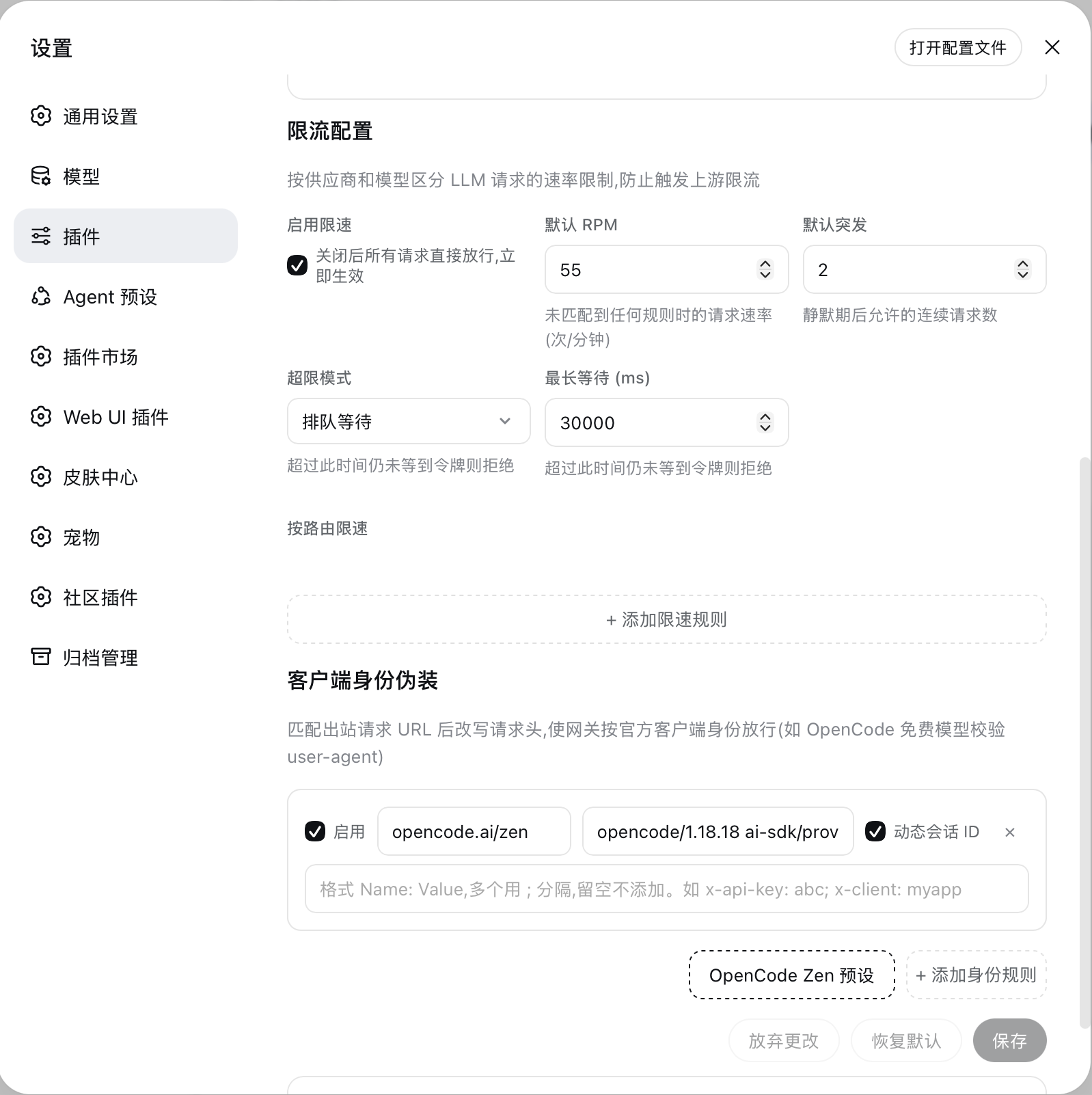
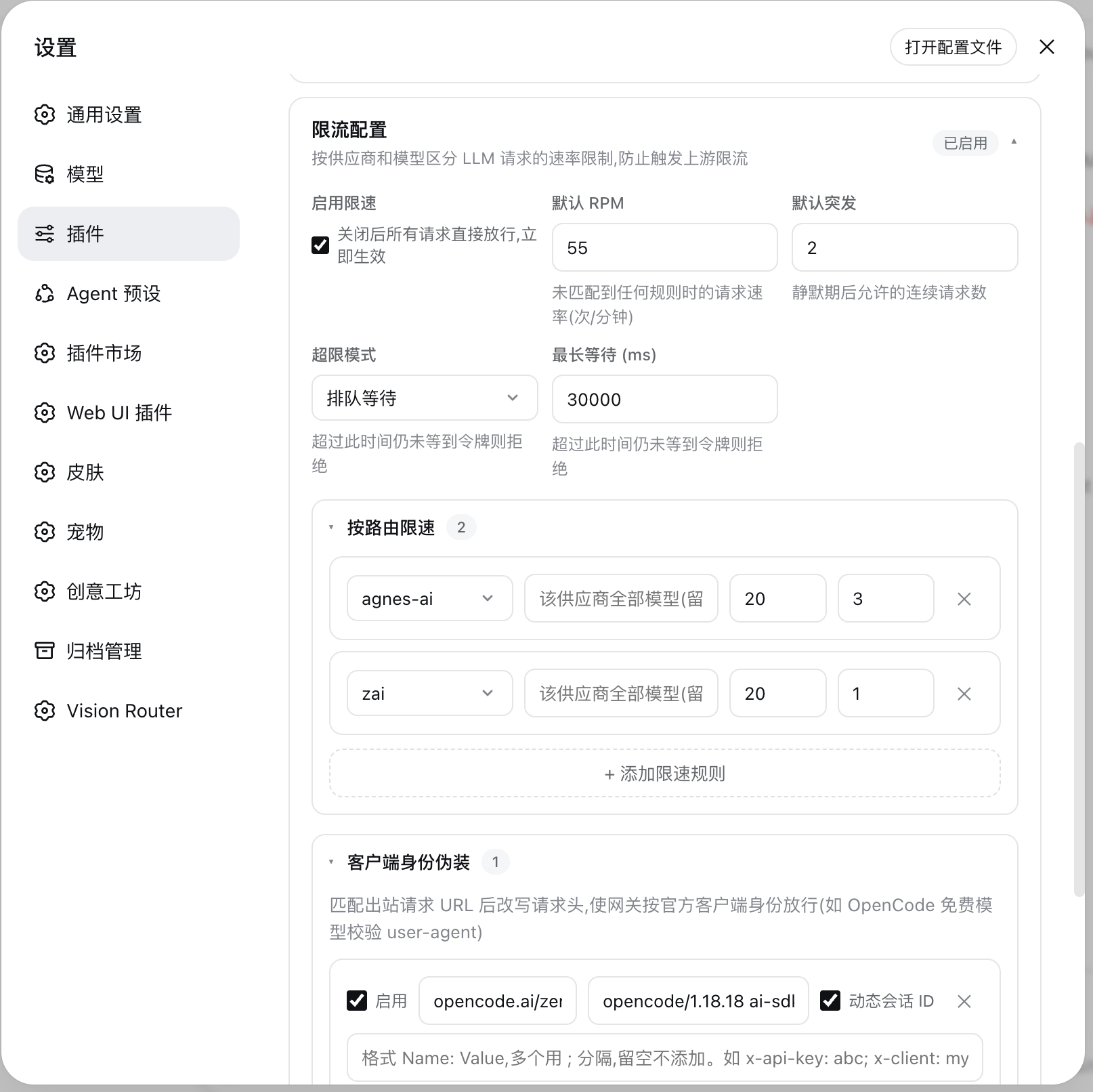
Open Settings → 插件 → Provider Rate Limit. All options hot-reload — no restart needed.
| Option | Default | Description |
|---|---|---|
enabled | true | Master switch; false passes everything untouched |
requestsPerMinute | 20 | Global steady-state rate (applies when no route rule matches); 0 = unlimited |
burst | 4 | Bucket capacity — how many requests may fire back-to-back |
mode | wait | wait = queue up to maxWaitMs; reject = fail fast |
maxWaitMs | 30000 | Longest queue time in wait mode before falling back to reject behavior |
upstream429Backoff | true | On an upstream HTTP 429 (e.g. quota exhausted), pause the route until the window passes |
backoffMs | 30000 | Initial cooldown (ms) when the upstream 429 carries no Retry-After; doubles on consecutive 429s up to maxBackoffMs |
maxBackoffMs | 60000 | Maximum cooldown ceiling (ms) for exponential backoff; 0 = fixed cooldown (same as backoffMs) |
backoffJitter | 0 | Symmetric jitter ratio (0–1) applied to the cooldown to prevent thundering herd; 0 = deterministic |
maxConcurrentRequests | 0 | Maximum in-flight requests per route; 0 = unlimited concurrency |
models | [] | Per-route overrides: match by provider/model substring, each with its own RPM/burst |
Route rules
Route rules match on substrings of the resolved provider id and model name, e.g. provider opencode + model claude-*. The most specific matching rule wins; unmatched traffic uses the global limits.
Identity rules
Some free-tier gateways (e.g. OpenCode Zen) reject clients whose requests don't look like their official tooling. Identity rules let selected outbound URLs carry a different identity:
urlPattern— substring match against the request URLuserAgent— replacementUser-AgentdynamicIds— adds the per-requestx-opencode-client/project/session/requestheader setheaders— arbitrary static headers (Name: Valuepairs), applied last so they can override everything above
The fetch patch is ref-counted and unwinds cleanly: when the plugin deactivates, native fetch is restored exactly once, and a patch layered above ours in the meantime is never clobbered.
⚠️ Only spoof identities for services you are legitimately entitled to use, and in accordance with their terms.
How it works
Every outbound LLM stream passes through one llm/stream hook (a waterfall choke point covering agent loops, title generation, and compaction). Each call synchronously reserves a slot in the route's token bucket:
waitMs = bucket.reserve()        // exact wait, computed from a monotonic floor
if waitMs === 0                  → pass through immediately
else if mode=wait && ≤ maxWaitMs → sleep(waitMs), then pass
else                             → yield RATE_LIMIT finish (+ Retry-After hint)
The bucket floor is now − (capacity − 1) × interval, which gives classic burst-and-recover semantics: after idle time the bucket is implicitly full again, and resizing capacity/rate at runtime never mints a free burst.
Upstream 429 backoff
When the upstream provider answers with an HTTP 429 (e.g. workspace quota exhausted), the plugin watches the finish event and, if upstream429Backoff is on, puts that route into a cooldown window. New requests to that route queue (in wait mode, up to maxWaitMs) or reject (in reject mode) until the window passes, so the provider isn't hammered while it's already rejecting us. The window is providerRetryAfterMs (from the upstream Retry-After header) when present; otherwise backoffMs is used as the initial delay. On consecutive 429s without an intervening success, the delay doubles each time (exponential backoff), capped at maxBackoffMs. A symmetric backoffJitter ratio randomises the final value to prevent thundering herd. A successful (non-429) finish resets the backoff counter back to the base delay. The 429 finish itself is still forwarded, so dsh-llm-retry can also act on it.
Concurrency limiting
When maxConcurrentRequests > 0, the plugin additionally gates how many requests to a route may be in flight simultaneously. Requests that pass the RPM check but find all concurrency slots occupied join a FIFO slot queue and are granted the instant a predecessor releases — no polling, strict arrival order. This prevents a burst of parallel agents or subagents from overwhelming a provider even when individual RPM limits haven't been reached. 0 means unlimited concurrency (only RPM throttles).
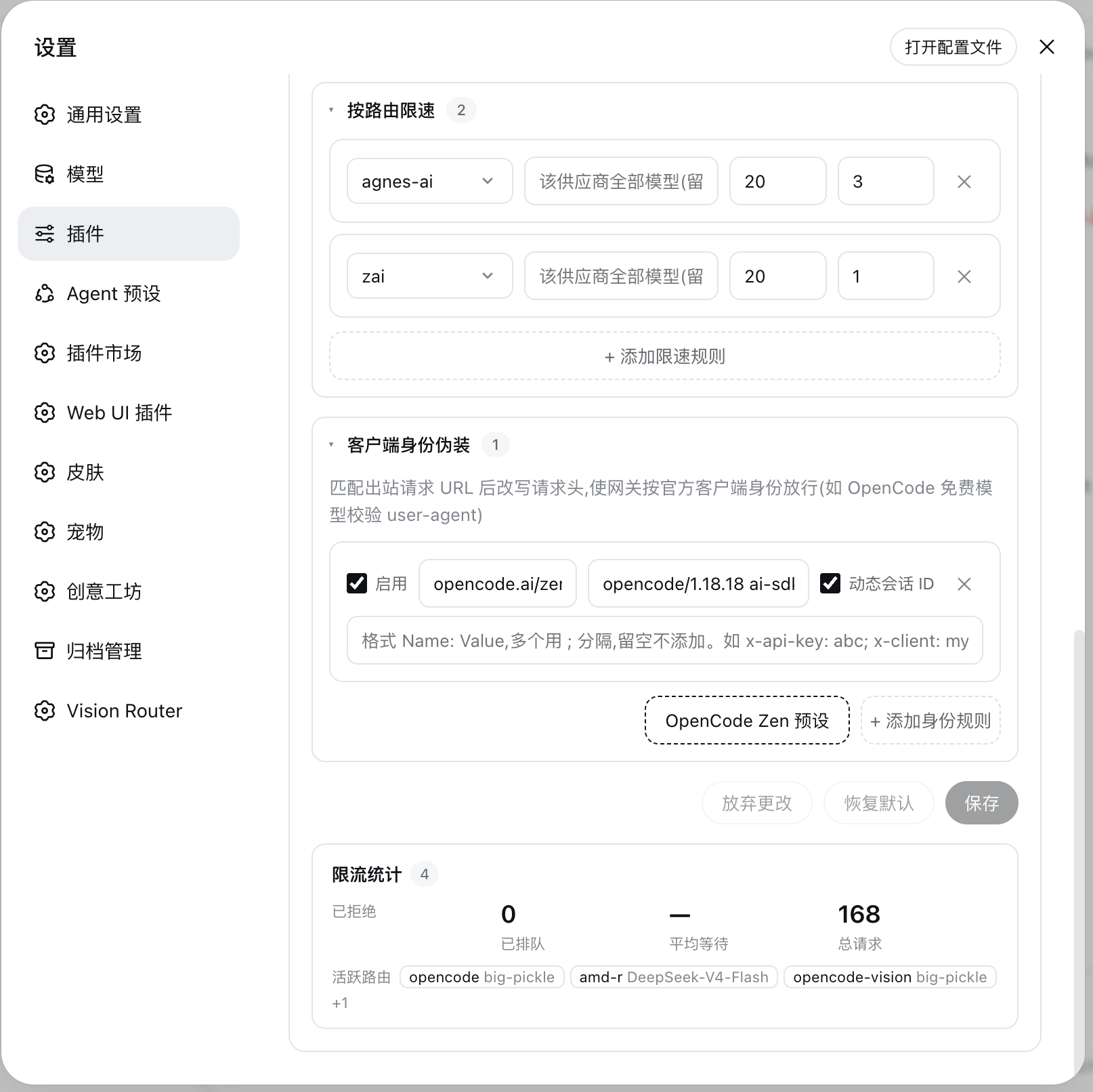
Live Stats
The plugin renders a compact stats line in the composer dock (below the chat input):
限流统计 已拒绝 0 · 当前排队 0 · 累计排队 0 · 平均等待 — · 总请求 153 · 活跃路由 3
Hover over the line to see a per-route breakdown (provider·model + request count). The data is pushed in real time over SSE — the dock subscribes to the reactive stats store, so numbers jump the moment a request queues, rejects, or completes. No polling timers are involved; a 30 s fallback poll only kicks in if the SSE connection drops.
Push Endpoint (SSE)
GET /api/provider-rate-limit.events
A Server-Sent Events stream. Each frame is a complete stats snapshot:
data: {"aggregate":{"reserved":153,"waited":0,"totalWaitMs":0,"rejected":0,"queuedNow":0,"avgWaitMs":0,"routes":3},"routes":{...}}
A snapshot is sent immediately on connect, then again whenever counters move (request reserved, queue depth changed, request rejected or completed). The server also emits a : ping comment every 15 s to keep the connection alive through proxies.
Stats HTTP API
GET /api/provider-rate-limit.stats
Returns:
{
  "ok": true,
  "value": {
    "aggregate": { "reserved": 153, "waited": 0, "totalWaitMs": 0, "rejected": 0, "queuedNow": 0, "avgWaitMs": 0, "routes": 3 },
    "routes": {
      "opencode\u0000big-pickle": { "reserved": 117, "waited": 0, "queuedNow": 0, ... },
      "opencode-vision\u0000big-pickle": { "reserved": 34, ... },
      "amd-r\u0000DeepSeek-V4-Flash": { "reserved": 2, ... }
    }
  }
}
queuedNow is the live queue depth — how many requests are currently waiting in the rate-limit queue this instant (back to 0 as soon as the wait ends). waited remains the cumulative counter; the settings card shows both.
Cross-Plugin Stats API
Other plugins can query rate-limit statistics:
// In a plugin's apply(ctx):
const stats = ctx.get("provider-rate-limit/stats");

// Per-route stats
const routeStats = stats.getStats("opencode", "deepseek-v4-flash-free");
// → { reserved, waited, totalWaitMs, rejected, queuedNow, avgWaitMs, peekWaitMs }

// All routes
const all = stats.getAllStats();
// → { "opencode\u0000deepseek-v4-flash-free": {...}, ... }

// Aggregate across all routes
const agg = stats.getAggregateStats();
// → { reserved, waited, totalWaitMs, rejected, queuedNow, avgWaitMs, routes }

// Reset counters (for per-window accounting)
stats.resetStats();              // all routes
stats.resetStats("opencode", "v3"); // specific route
Development
pnpm install
npm test   # 31 tests: bucket behavior, FIFO, abort/reject, identity patch,
           # dispose, master switch, ULID format & uniqueness, stats service,
           # multi-provider, maxWaitMs timeout, hot-update retune, queuedNow
           # gauge, error handling, concurrency FIFO, legacy settings provider
Screenshots
Settings Card
Settings Configuration
 |  |
Composer Dock Live Stats

License
Plugins relacionados
dsh-routing-suite
yjh051108/dsh-routing-suite
dsh-plugin-subscriptions
v1ki/dsh-plugin-subscriptions
dsh-commandcode-provider
mars-sea/dsh-commandcode-provider
dsh-workbuddy-connect
corrinehu/dsh-workbuddy-connect