dsh-status-rotator
01virex/dsh-status-rotator
Циклически меняет метку статуса хода dsh среди 1059 двуязычных фраз с выводом в стиле печатной машинки, анимированным радужным градиентом, данмаку, 12 переключаемыми наборами тем, живыми подстановками и ротацией заголовка вкладки. Два звёздных набора по умолчанию отключены; набор stargazer содержит по одной фразе на каждого stargazer и еженедельно обновляется workflow.
Установка
dsh plugin --profile web add github:01virex/dsh-status-rotatorREADME
dsh-status-rotator
Give DSH's running status your own voice: custom phrases, typewriter output, day/night gradients, danmaku and an optional animated whale tail. Includes 1221 phrases across 14 theme packs.
English | 中文 · Quick start · Features · Whale-tail animations · Configuration · Changelog


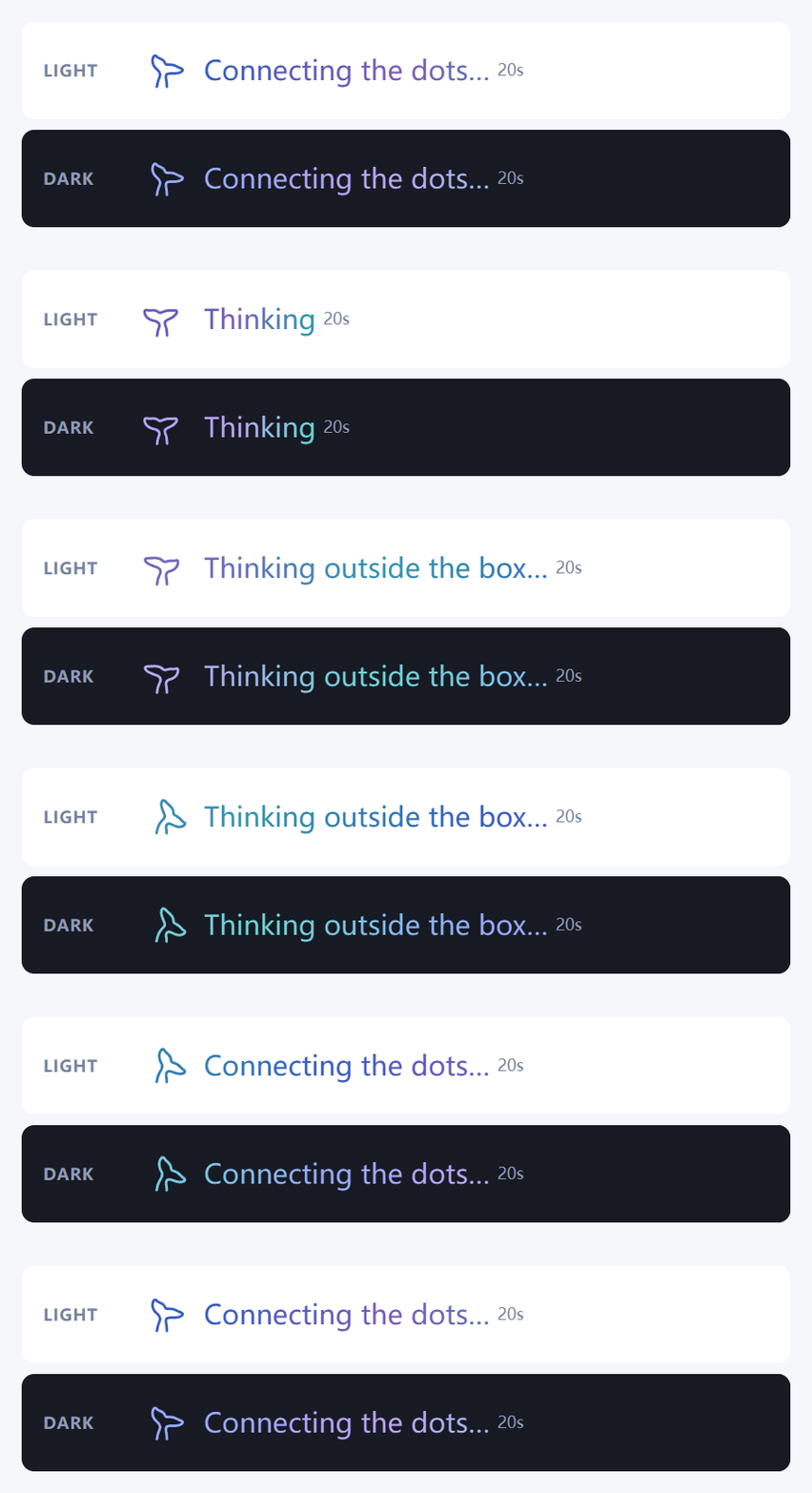
The actual plugin running in a minimal DSH host, with sample phrases and an enlarged status row. Phrase rotation · Typewriter · Day/night gradients · Optional whale tail. Static preview.
Quick start
dsh plugin --profile web add dsh-status-rotator   # 1. install (the package ships its own bundle manifest)
dsh plugin --profile desktop add dsh-status-rotator   # for desktop: same, just use the desktop profile
dsh web                                            # 2. restart once, first install only
- Open Settings → Status Texts (bottom left): toggle theme packs, edit phrases, tune the gradient and danmaku — every change saves and applies live, no refresh.
A DeepSeek Harness (dsh) client plugin that replaces Deep diving... / 深度求索中... with phrases you can edit. Choose theme packs, match phrases to the current phase, and tune the appearance from Settings. The host's elapsed-time clock is preserved.
Host version details and isolated testing
Status line as of dsh 0.1.7: the host moved it into the turn's fold header
button[data-turn-process](Deep diving for 12s), which scrolls out of view in a long turn. The plugin moves the line back above the input box, styled like dsh ≤0.1.6's.turnStatus(26px, shimmer, 13px clock) and pinned with the composer; the header copy is hidden and returns when the turn ends. Duration and phase come from reading the header label (never writing into it). On 0.1.6 and older therole="status"line already sits there and behaves as before.Status line as of dsh 0.2.0: while a turn runs the host no longer keeps the text inside the fold header — it renders a separate row in the conversation flow,
div[data-chat-running](hidden announcement + divider + DeepSeek whale-tail icon + shimmer text), andbutton[data-turn-process]now only renders once the turn is closed. The plugin gained a matching host path: it adopts that row (writes its phrase into it, hides the host's own shimmer text, still reads the duration from the host text) with the same position and look, and leaves the screen-reader announcement untouched.whaleTail(off by default) keeps the whale tail in that row, next to the plugin's phrase, and animates it with the rainbow-gradient palette. The separate tail-wagging switch can follow tok/s or use a fixed speed; enabling that switch explicitly opts in to the wag.
Starting an isolated test instance (without touching your daily profile): install a dsh version into a temp dir and boot a profile with its own
DSH_HOME—DSH_HOME=/tmp/dsh-test node /tmp/dsh-test/node_modules/.bin/dsh test020 --from-default-profile web --no-open --port 3081, thendsh plugin --profile test020 add <this plugin dir>. That instance's config store, bank and settings live inside its ownDSH_HOME, so your daily instance is untouched.
Never a blank line:
config.labelSource(default"phrases") decides the text; with an empty bank the plugin's line falls back to the host text instead of rendering an empty row. Set it to"host"to drop rotation and get the verbatim 0.1.6.turnStatuslook (weight 500, inline-flex, 26px, shimmer, clock after 15s).
Feature Overview
Core
- Status text replacement — swaps the host line (
Deep diving.../Deep diving for 12son 0.1.7) for your phrases, rotating everyintervalMsand typed out (typeSpeedMs, 0 disables); - Phase awareness —
thinking/running/longgroups switch on turn duration, no need to wait for a rotation; - Weighted random — phrase entries may carry a weight (
weightedRandom: false= fully uniform); - Anti-repeat shuffle bag — a phrase never comes back until the bag is empty, remembered per language + phase and optionally across page reloads;
- Optional whale tail —
whaleTail(off by default) keeps the DeepSeek whale-tail icon of the 0.2.0 running row and animates it with the rainbow gradient; a separate switch can wag it in step with tok/s or at a fixed speed; - Non-invasive targeting — located by
role="status"+aria-live="polite"(old hosts),button[data-turn-process](0.1.7+) ordiv[data-chat-running](0.2.0+); never touches chat code blocks, other aria-live regions or the host clock.
Content
- Phrases separate from code, modular packs — everything lives in JSON, grouped into named packs (
packs[]/enabledPacks[]) that the settings page toggles and edits; - Conditional phrases & easter eggs — a
whenrule (tool/retry/pending/phase/hour/firstTurn) shows a phrase only in the state it describes, andraritylets one in on a fraction of draws; - Template placeholders —
{elapsed}{phase}{phaseLabel}{locale}{date}{time}plus live fields{model}{provider}{tps}{pending}{tools}{running}— see Template Placeholders; - Observation channel — shows the structured
llm/retrysignals of the host as a small badge (⟳ 3/5by default) with{retry}{retryMax}{retryProvider}{retryCode}{detail}; nothing is shown on hosts without an event window; - Multilingual — follows Settings → Language live, unknown languages fall back to Chinese;
- Community phrase bot — issue form + validation + auto-PR, with branches rebuilt on
mainautomatically (see Contributing Phrases).
Visuals & live engine
- Rainbow gradient — day / night palettes follow the interface theme (or force one with
mode); colors and speed configurable, one switch off; - Danmaku — phrases fly across the page (including bilibili-style top/bottom), with size, color, opacity and z-index options; optional hover-pause, click-to-copy, per-phase colours, adaptive density and pointer avoidance;
- Appearance themes — font, size, glow, text animation (breathe / glitch) and a status-line activity indicator, bundled into one-click theme packs;
- Tab title — rotates
document.titlethrough your templates (off by default; only writes back a title it took over); - Presets & schedule — multiple named banks, switched by hand or by weekday/time window.
Workflow
- Auto-loading + push — the node half serves the config over HTTP and pushes a change notification over SSE the moment anything changes, so open pages apply edits without a refresh or restart (hosts without SSE keep the polling fallback);
- Conflict-safe writes — the config route hands out an
ETagand requiresIf-Matchon writes, so two tabs cannot silently overwrite each other; - Persistence — saved settings go to
$DSH_HOME/status-rotator/config.json, which belongs to no package and survives upgrades; - Settings page — edit everything from Settings → Status Texts, applied on save;
- Extendable from other plugins —
ctx.statusRotatorlets another plugin register packs, placeholders and dynamic phrase sources without touching this plugin's source (see Extending it from another plugin).
Installation
Two ways to install: the recommended dsh plugin add command, or the manual copy. Either way, restart dsh web once after the first install.
Option A: dsh plugin add (recommended)
The plugin's package.json declares a dsh.bundle.patch manifest, so it is recognized automatically after install — no extra flags needed. The command syntax is dsh plugin --profile <name> add <package> (e.g. --profile web):
- From npm (easiest):
dsh plugin --profile web add dsh-status-rotator← always installs the latest release - For DSH Desktop:
dsh plugin --profile desktop add dsh-status-rotator(the desktop build's profile isdesktop) - From a clone:
dsh plugin --profile web add ./dsh-status-rotator - From a release package: download
dsh-status-rotator-<version>.zipfrom the Release page (it contains a ready-to-use plugin directory withconfig.json— not an npm tarball), unzip it, thendsh plugin --profile web add /path/to/dsh-status-rotator.
Option B: manual install
-
Put this project directory under your profile's node_modules (default
C:\Users\<you>\.dsh\profiles\node_modules\dsh-status-rotator\); -
Insert the following into the profile's
cordis.patch.yml:- insert: - id: status-rotator name: dsh-status-rotator -
Run
node gen-config.cjsto initialize the localconfig.json(copied fromconfig.example.json); -
Restart
dsh weband hard-refresh the browser with Ctrl+F5.
First run
On first start the plugin serves, in order: your saved settings ($DSH_HOME/status-rotator/config.json) → the package config.json → config.example.json (what an npm install has: all 1221 default phrases live inside it, see Phrase Bank). Two more layers join in: the auto-updated bank (every 6 hours, see Auto-updating the bank) and the optional external bank ($DSH_HOME/status-rotator/phrases.json, highest priority, see Hot-reloadable external bank). Edit files directly (hot-reloaded while a page is open) or use the Settings → Status Texts page of DSH.
How It Works
Phase Awareness
Phrases are split into three groups based on turn progress (determined by whether a clock has appeared in the status element and its reading):
| Phase | Trigger | Default duration |
|---|---|---|
thinking | Turn just started, no clock | 0 ~ 15s |
running | Clock visible, under the limit | 15s ~ longAfterMs |
long | Clock past longAfterMs | ≥ 60s |
Phase changes swap the phrase immediately without waiting for the rotation interval. If a phase has no phrase group, it falls back automatically (running → thinking → any non-empty group).
Zero-Intrusion Targeting
The status label is located by role="status" + aria-live="polite" (dsh ≤0.1.6) or button[data-turn-process] (0.1.7+), so code snippets in the chat history and other aria-live regions are never touched. On 0.1.7+ the plugin does exactly three things: insert its own line in the composer seat, hide the header copy, and read the header label for the duration — the host clock is only read, while phase and elapsed come from the session snapshot.
Status line text source (label source)
config.labelSource decides what the status line says; both host generations honour it:
| Value | Status line text | When to use it |
|---|---|---|
"phrases" (default) | one phrase from the bank, rotating per phase | the plugin's normal behaviour |
"host" | the host text only: Deep diving... / 深度求索中 | when you want the pure 0.1.6 look with no meme phrases |
- Never a blank line: when the bank is empty (no
config.json, or a preset cleared the texts),"phrases"mode falls back to the host text instead of leaving an empty row with only the clock; "host"copies the 0.1.6 look as well: the plugin line matches.turnStatusproperty for property (weight 500,height: calc(26px + …),inline-flex, same shimmer andprefers-reduced-motionfallback) and.turnStatusClock(13px, tabular-nums, 8px gap, weight 400), with the clock on the old schedule (elapsedMs >= 15s) and the text written in one go rather than typed; old hosts (≤0.1.6) are not touched at all in"host"mode;- A matching dropdown lives on the settings page (Status line text source), and
{"labelSource": "host"}can be written intoconfig.jsonor a preset.
Phrase Bank
The default bank ships 1221 phrases, split into 14 theme packs (the core phrases table is empty — everything lives in packs). Ten packs are enabled by default; the two star packs are shipped but off by default — turn them on from Settings → Status Texts → Phrase packs:
| Pack | zh | en | Total | Default |
|---|---|---|---|---|
deepseek DeepSeek 专场 | 107 | 111 | 218 | on |
coding 写代码日常 | 87 | 81 | 168 | on |
daily 日常 | 77 | 64 | 141 | on |
internet-memes 网络梗 | 57 | 34 | 91 | on |
sysadmin 系统管理 | 41 | 38 | 79 | on |
slacking 摸鱼 | 40 | 33 | 73 | on |
math-physics 数学与物理 | 35 | 22 | 57 | on |
western-ai 西方 AI 圈 | 20 | 22 | 42 | on |
reverse-proxy 反代 | 19 | 21 | 40 | on |
china-ai 中国 AI 圈 | 22 | 14 | 36 | on |
star-ask 求 star | 11 | 12 | 23 | off |
star-route 星标者路由 | 92 | 92 | 184 | off |
| total | 674 | 547 | 1221 | 945 on / 276 off |
- Most entries are zh/en mirrored pairs; recent community submissions are often zh-only — choose zh + en (both) in the submission form to get each phrase in both languages;
- 5 weighted showcase entries (see Weighted Random) — most phrases are plain weight-1 strings;
- The bank grows through the community phrase-submission form: validated and merged submissions are credited in CONTRIBUTORS.md;
- The numbers are computed from
config.example.jsonbynode scripts/sync-bank-counts.cjs(the submission bot and the star-pack refresh call it automatically; run it once after editing the bank by hand); runnode scripts/check-bank-memes.mjslocally to audit the current bank (duplicates, lengths, ellipsis, series share).
The star packs (off by default) — two separate packs, so you can take one without the other:
| Pack | What it is |
|---|---|
star-ask 求 star | pure star-ask phrases, e.g. 正在向你讨一个 star… / Begging for a star… |
star-route 星标者路由 | one phrase per current stargazer — 正在路由 <login> 写代码… / Routing <login> to write code…, so the rotation literally routes every star-giver to work |
They ship disabled because begging is a matter of taste, not because they are broken: flip them on in Settings → Status Texts → Phrase packs. The Star packs workflow refreshes the stargazer list (weekly, when its own files change, or on demand) with the repo GITHUB_TOKEN, landing through a bot PR that is merged automatically once Test is green; the job is skipped in forks (their token cannot read stargazers of this repository) and STAR_TOKEN overrides it. Locally: node scripts/update-star-pack.cjs --token <pat>.
Phrase Packs
The bank is composable from named packs layered on top of the core phrases table:
{
    "packs": [
        { "id": "community",
          "label": { "zh": "社区投稿", "en": "Community" },
          "phrases": { "zh": { "running": ["正在试用词库包…"] } } }
    ],
    "enabledPacks": ["community"]   // absent = all packs enabled; [] = core bank only
}
- Enabled packs merge into the effective bank in order, deduped by text — an entry already present in the core bank (or an earlier pack) is skipped, keeping its weight;
enabledPacksabsent/null= all packs on;[]= core bank only. Unknown ids in the list are ignored;- Packs support the exact same entries as the core bank (strings or
{text, weight}, per-phase groups, placeholders); - The settings page shows every pack with a per-pack enable toggle and a pack editor target: pick a pack and the phrase library editor reads/writes that pack's phrases;
- The default config ships 12 packs (
deepseek/western-ai/china-ai/coding/reverse-proxy/sysadmin/math-physics/slacking/internet-memes/daily/star-ask/star-route);communityis created with the first submission, andenabledPackspins which packs start enabled. - The phrase-submission form has a 目标词库包 picker (same pack ids plus
communityas the default landing spot): submissions land in the chosen pack, and acommunitypack is created on first use — the core bank stays untouched, so you can disable or prune community content in one place; - Old configs without packs keep working untouched.
Weighted Random
Entries are picked by weight. Write a phrase as "text | 3" (or { "text": "text", "weight": 3 }) for weight 3; no weight = 1, capped at 1000, invalid values count as 1. weightedRandom: false goes back to fully uniform. Five showcase entries in the bank use weights.
Anti-repeat (shuffle bag)
Since v0.31.0 the status line remembers what it just said per language + phase, with a shuffle bag instead of the old "avoid the previous phrase" rule:
- A phrase is never repeated until the bag is empty — with 40 phrases in a phase you get 40 different lines in a row, not a lottery that can hand you the same one twice;
- When the bag is refilled, the last
recentLimitphrases are held back, so a cycle boundary cannot repeat either; - Weights still apply inside the bag (a weight-9 phrase tends to come up early in each cycle);
persist: truekeeps the memory in browser storage, so a page reload does not immediately show the same line again.
"antiRepeat": { "recentLimit": 3, "persist": false }
recentLimit is 0–50 (0 = bag only, no cross-cycle memory). Everything is editable from Settings → Status Texts → Behavior → Anti-repeat.
Conditional phrases (when) and rarity
A phrase can be restricted to the state it actually describes, so it appears exactly when it is true instead of competing with the other 1200 lines. Add a when object (or the | when:… suffix in the settings editor):
"phrases": { "zh": { "running": [
    "正在写代码…",
    { "text": "正在敲命令…", "weight": 2, "when": { "tool": "bash" } },
    { "text": "正在满世界翻…",     "when": { "tool": "web_search" } },
    { "text": "又失败了,再试一次…", "when": { "retry": true } },
    { "text": "等你点头…",         "when": { "pending": true } },
    { "text": "夜深了…",           "when": { "hour": [22, 6] } },
    { "text": "初次见面…",         "when": { "firstTurn": true } },
    { "text": "传说级的一句…",      "rarity": 0.01 }
] } }
| Condition | Type | Meaning |
|---|---|---|
tool | string / string[] / "*" | a tool with that name is running ("*" = any tool) |
retry | boolean | a retry is in flight |
pending | boolean / number | dsh is waiting for your answer (number = at least that many) |
phase | string / string[] | thinking / running / long / idle |
hour | [from, to] | local hour window, may cross midnight ([22, 6]) |
firstTurn | boolean | the first turn of this session |
- All listed conditions must hold (AND).
{ "tool": "bash", "phase": "long" }needs both; - A matching conditional phrase wins the draw: if any phrase's conditions hold, the pick is made from those — otherwise a
bashphrase would be buried under a thousand unconditional ones. When nothing matches, the unconditional phrases are used as usual, so the line is never empty; rarity(0, 1] is an easter egg: the phrase only takes part in that fraction of draws.0.01= 1%;- Conditions are judged from the live engine (
{tools}/ retry /{pending}/ phase); on a host without those APIs the conditional phrases simply never appear and the unconditional ones carry on.
In the settings editor (one phrase per line; modifiers go at the end in any order):
正在写代码…
正在敲命令… | 2 | when:tool=bash
正在满世界翻… | when:tool=web_search
又失败了,再试一次… | when:retry
夜深了… | when:hour=22-6
传说级的一句… | rarity:0.01
when: takes tool=bash (join several with +, * = any tool), retry, pending, phase=long, hour=22-6, firstTurn; separate several conditions with , to require all of them. A | inside the phrase itself is left alone, and the round trip is exact — opening and saving the settings page never drops a condition.
Template Placeholders
Any phrase (and any title template) may contain placeholders, replaced at render time:
| Placeholder | Meaning | Example |
|---|---|---|
{elapsed} | elapsed time of the current turn, localized like the clock | 正在写代码 1分02秒… |
{phase} | phase id: thinking / running / long / idle | running |
{phaseLabel} | localized short label of the phase | 运行中 |
{model} | model of the current session (live engine, — when unknown) | deepseek-chat |
{provider} | provider route of the current session (live engine) | deepseek |
{tps} | streaming tokens/s estimate (live engine) | 12 |
{pending} | interactions waiting for an answer — approvals and questions share this one counter (live engine) | 1 |
{tools} | running tool names joined with + (live engine) | bash+web_search |
{running} | run / idle (live engine) | run |
{retry} | retry attempt in the current step (live engine; empty when none) | 3 |
{retryMax} | the retry policy's cap (may be empty on older hosts / always mode) | 5 |
{retryProvider} | provider that triggered the retry (provider-neutral, passed through verbatim) | deepseek-official |
{retryCode} | short failure code (safe token ≤32 chars; URLs, paths and raw messages are never rendered) | sampling_error |
{retryStarted} | 1 once the retried attempt is actually running (after llm/retry-started), else empty | 1 |
{detail} | the whole observation badge, rendered from config.details.badge | ⟳ 3/5 |
{locale} | current UI language (zh / en) | zh |
{date} | local date YYYY-MM-DD | 2026-08-07 |
{time} | local time HH:MM:SS | 12:34:56 |
Placeholders that change over time ({elapsed} {date} {time} {tps} {pending} {tools} {model} {provider} {retry} {detail}) refresh live every liveTickMs (default 1000 ms; 0 = once per rotation). Unknown placeholders are left as-is, so {...} is safe in a phrase. Values come from a real-time status engine subscribing to the session snapshot, the pending list, model RPC and the session event window, with a DOM clock fallback — without the session API, {model} / {provider} / {tps} / {tools} stay — and {pending} stays 0. The current session id is resolved as sessions.list.current (≤0.1.6) → localStorage['dsh.sessions.current'] (0.1.7+) → the DOM's [data-sidebar-right-session].
Observation channel (see deepseek-harness discussion #3669): that thread points out that subagent retries and transport fallback hide behind Deep diving…, and that the missing half is a structured data channel. The plugin consumes protocol events only (llm/retry / llm/retry-started from binding.eventSource) — no log scraping, no wording inference; the vocabulary stays provider-neutral (provider / code passed through, never enumerating product-specific codes); with no event window it simply shows nothing. The badge template lives in config.details.badge (empty string = placeholders only, no badge):
"details": { "enabled": true, "badge": "⟳ {retry}/{max}" }
"phrases": { "zh": { "thinking": ["正在写代码 {elapsed}…", "正在{phaseLabel}中 ({elapsed})…"] } }
{pending} and the session's approval policy
{pending} counts the session's pending interactions — the same list the UI renders as composer takeovers — with approvals and questions sharing one counter, so either one makes it 1 while it waits. dsh publishes at most one interaction per session, so in practice this is a 0 / 1 flag, not a queue length; it is event-driven, re-rendering the label the moment an interaction appears or disappears.
What approvals contribute depends entirely on the session's own permission preset (sandbox mode + approval policy, switched with /permission) — the plugin neither reads nor changes that setting:
ask— a sensitive action asks first, and its approval request counts while it waits:{pending}turns1as the approval panel appears and back to0once you click;never— approval prompts are disabled: dsh rejects such an action up front, the client never builds a panel, and approvals contribute nothing. Note what the counter does not say: a rejection is not a pending interaction, so{pending}can never report "an action was rejected";- questions are a different domain and stay pending regardless of the policy, so
{pending}can still show1underneverwhile dsh waits for an answer (a plan review, for instance).
So {pending} answers exactly one question — is dsh waiting for me right now? — and under never the only thing that can make it non-zero is a question. On a dsh build that exposes no pending-interaction list at all, the value simply stays 0.
Rainbow Gradient
Status text is drawn with an animated rainbow gradient by default (text only, not the clock). Since v0.22.0 there are two palettes — night (dark) and day (light) — following the interface theme (mode: "auto"; "day" / "night" forces one) and re-coloring live; direction is "rtl" (default) or "ltr" to match the typewriter (issue #41). Disable or recolor it in the config:
"gradient": {
    "enabled": false,                          // false to disable; true for default colors
    "mode": "auto",                            // auto follows the interface light/dark theme; day / night forces one
    "direction": "rtl",                        // rtl right-to-left (default); ltr left-to-right (matches the typewriter)
    "colors": ["#ff5f6d", "#00ff88", "#4da6ff"], // night (dark theme) color sequence (at least 2, first/last cycle)
    "dayColors": ["#d92b4b", "#0e7490", "#6d28d9"], // day (light theme) color sequence (at least 2, first/last cycle)
    "speed": 4                                 // animation speed (seconds per cycle)
}
Existing configs that only set colors keep using it in both themes (nothing changes on upgrade); add dayColors to get a separate light-theme palette.
Appearance themes
Everything that used to be limited to the gradient and the font weight now has a full set of ingredients, plus a theme gallery that sets them all in one click (Settings → Status Texts → Appearance → Appearance theme).
"appearance": {
    "fontFamily": "",        // empty = follow the interface; letters/digits/spaces/commas/quotes/hyphens only
    "fontSize": 0,           // px; 0 = follow the host; 1-96 is clamped in px
    "glow": false,           // soft halo around the text
    "glowColor": "",         // empty = first colour of the gradient palette
    "animation": "none",     // none | breathe | glitch
    "spinner": "none"        // none | ring | bar
}
- Every default means "change nothing" — a config without this block renders exactly as before;
- The theme gallery ships five packs (
classic/neon/terminal/candy/glitch); picking one writes both the appearance and the gradient palette, and every field stays editable afterwards; animationandspinnerare attached to the plugin's own text span as CSS classes, so the host's own text and clock are never touched;breatheandglitchare dropped underprefers-reduced-motion;- The activity indicator shows "work is happening", not a percentage - the host exposes no turn progress;
fontFamilyis written into CSS, so it is validated against a strict whitelist (letters, digits, spaces, commas, quotes, hyphens) and anything else is rejected rather than escaped.
Danmaku
Optional: every phrase can also spawn as video-site-style bullet-screen comments flying from right to left across the page (by default behind the UI — the layer is squeezed between the app background and the chat content, visible in the gaps):
"danmaku": {
    "enabled": true,
    "intervalMs": 2500,        // spawn interval (ms); smaller = more of a flood
    "speedMs": 18000,          // time to cross the screen, right → left (ms); larger = slower
    "fontSizeMin": 14,         // min random font size (px)
    "fontSizeMax": 30,         // max random font size (px)
    "rainbow": true,           // rainbow mode: each bullet picks a random color from `colors`
    "colors": ["#ff5f6d", "#00ff88", "#4da6ff"], // palette (at least 1)
    "color": "#ffffff",        // solid color used when rainbow = false
    "opacity": 0.3,            // global opacity (0.05 ~ 1); each bullet jitters between 75% and 100% of it
    "maxCount": 12,            // max concurrent bullets on screen
    "zIndex": -1,              // negative = behind the UI (default), non-negative = above the UI
    "scope": "all",            // "all" = every phrase of the current language; "phase" = current phase only (with fallback)
    "marginTop": 16,           // top padding of the bullet band (px)
    "marginBottom": 160,       // bottom padding (px), keeps the input area clear
    // ── new in v0.19: top / bottom (bilibili-style) danmaku ──
    "types": {                  // per-type switch + relative weight; scroll = the original type
        "scroll": { "enabled": true, "weight": 2 },
        "top":    { "enabled": true, "weight": 1 },
        "bottom": { "enabled": true, "weight": 1 }
    },
    "mode": "scroll",           // optional: force ONE type for every bullet (scroll/top/bottom, or 1/4/5); omit = weighted
    "fixed": {                  // top/bottom style — the single place to change them all
        "fontSize": 25,          // px
        "color": "#ffffff",      // solid colour used when rainbow = false
        "shadow": "1px 0 1px rgba(0,0,0,.85),-1px 0 1px rgba(0,0,0,.85),0 1px 1px rgba(0,0,0,.85),0 -1px 1px rgba(0,0,0,.85)",
        "marginTop": 16,         // distance from the top edge of the play area (px)
        "marginBottom": 160,     // distance from the bottom edge (px)
        "gap": 4,                // stacking gap between bullets (px)
        "durationMs": 4500,      // how long one bullet stays on screen (ms)
        "maxCount": 3,           // max bullets of the SAME type at once
        "zIndex": 10,            // front layer: 10 sits above the chat, below the shell overlay (20)
        "reserveBands": true,     // scrolling bullets keep out of the top/bottom lanes (no overlapping text)
        "anchorBottomToHost": true, // bottom bullets sit above the input area (its status line), not merely marginBottom away
        "overflow": "drop"       // full → drop this spawn (same strategy as scrolling danmaku)
    }
}
- With
zIndex < 0(default) the layer is mounted inside the element painting the app background (normally the conversation surface), so bullets sit between that background and the chat content — visible in the gaps and behind the conversation, never covering bubbles or the sidebar. Hidden by an opaque theme background? Set a non-negativezIndexto float above the UI; the layer never intercepts pointers. - Mount point is re-resolved on every spawn (the fix behind v0.15.2 / v0.16.1): the app frame is found through the shell marker
data-shell-overlay, and the innermost element inside it that paints an opaque background and covers most of the conversation column becomes the host (it getsisolation: isolate). Before the shell renders, the layer briefly falls back todocument.bodyat a visible z-index and moves into place as soon as the target appears. Still invisible? Turn ondebugand look fordanmaku layer mounted inside the background panel. - Bullets support the same placeholders as phrases (
{elapsed}{model}{phase}…), rendered with live values at spawn time;danmaku: falsedisables the feature, andfontSizeMin/fontSizeMaxset the random size range (auto-corrected, clamped to 8–96 px). danmaku: falsedisables it entirely.fontSizeMin/fontSizeMaxset the random size range (auto-corrected if reversed, clamped to 8–96 px).
Danmaku extras
Five optional behaviours, all off by default (Settings → Status Texts → Appearance → Danmaku):
| Option | What it does |
|---|---|
hoverPause | Hovering a scrolling bullet freezes it; moving away resumes it from where it stopped (the remaining flight time is recomputed) |
clickCopy | Clicking a bullet copies its text; with no clipboard API nothing happens rather than pretending it worked |
phaseColors | { "thinking": "#5fd4ff", "running": "#7dff7d", "long": "#ffc371" } - colour each bullet by the current phase |
adaptDensity | Spawns get sparser as the on-screen count approaches maxCount, and almost stop while the page is hidden |
avoidPointer | Bullets land away from the pointer's height band |
:warning:
hoverPauseandclickCopyturn the danmaku layer into a pointer target, which is the opposite of the "the layer never intercepts pointers" guarantee. They are therefore opt-in, and only the bullets themselves take pointer events - the layer keepspointer-events: none.
Sending your own line - ctx.statusRotator.sendDanmaku(text) (the registration API) flies a line across immediately, and the settings page has an input for it. While the settings dialog mask is up the danmaku layer is paused, so the line is queued and sent once the mask goes away instead of being silently lost.
Coexisting with host dialogs: pause behind the mask (since v0.25)
The dsh settings dialog mask is a full-viewport backdrop-filter: blur(2px) layer: with the danmaku layer still translating behind it, the browser recomputes a full-screen blur every frame and the dialog flickers (issue #60). With pauseBehindMask (default true) a hit stops the danmaku outright — layer and in-flight bullets torn down, spawn timer cleared, host isolation restored — rebuilding everything the moment the mask goes away. Detection hit-tests the four corners plus the centre (one probe per 250 ms, rescanAll every 2 s as a safety net); small backdrop-filter surfaces (menus, cards, tooltips) never match.
Top / bottom danmaku (bilibili-style, since v0.19)
danmaku.types gives the three types (scrolling / top / bottom) an enabled flag and a relative weight, and danmaku.fixed collects their styling (font size, single color, stroke, gap, hold time, same-type cap, z-index, reserveBands to keep scrolling bullets out of the top/bottom lanes, anchorBottomToHost to pin bottom bullets above the input area).
modeforces every bullet to one type (scroll/top/bottom, or bilibili 1 / 4 / 5); leave it out to distribute by weight;- Top/bottom bullets default to white text with a stroke and their own size and hold time — all of it lives in
danmaku.fixed; - ⚠️ The default distribution changed: with no
typesin your config all three are on (scroll 2 : top 1 : bottom 1); for the pre-v0.19 look set"top": { "enabled": false }and"bottom": { "enabled": false }(or flip them off on the settings page).
Browser Tab Title
Optional and off by default. When on, the browser tab title rotates through your templates while a turn is running:
"title": {
    "enabled": true,
    "templates": ["⏳ {phaseLabel} {elapsed}", "🤔 {phaseLabel}… {elapsed}"], // rotated every intervalMs
    "idleTemplate": "💤 dsh 空闲",   // "" = hand the title back to the host when idle
    "intervalMs": 8000
}
Templates support the same placeholders as phrases. When no turn is active the title shows idleTemplate; with idleTemplate: "" (or enabled: false) the plugin hands the title back to the host. title: false disables it entirely.
Editable from the settings page (since v0.27.0): DSH → Settings → Status Texts → Behavior has a Tab title group — an on/off switch, the templates (one per line), the idle title and the rotation interval. Saving writes it into the plugin's config store with everything else, so it survives plugin upgrades and you never have to hand-edit config.json.
It only writes a title it took over itself: the plugin touches document.title only while that title is its own. If it never took one over — or already handed it back — it does not touch it at all, including the session title the host writes (<session> — DeepSeek Harness) and titles written by other plugins. Turning the switch off hands back the last host-written title and stops touching the title for good.
Fixed in v0.27.0. The old rule was "if the current title differs from the value cached at start-up, write it back", which overwrote any other writer — classically oh-my-dsh's brand rename (it rewrites a trailing
DeepSeek HarnesstoOh My DSH). The value read back could never equal the value written, so the title was rewritten every tick (scripts/title-coexistence-test.htmlmeasures 10 rewrites in 2.6 s with the session title wiped off the tab; 1 write after the fix).
Presets & Scheduling
A preset is a named bank snapshot (optionally with its own config), switched from the settings page or automatically by schedule rules:
"presets": [{ "id": "night", "name": "Night", "phrases": { "zh": { "thinking": ["夜深了…"] } } }],
"activePreset": null,
"schedule": [{ "preset": "night", "days": [1,2,3,4,5], "from": "22:00", "to": "06:00" }]
daysruns0(Sunday) to6(Saturday);from/tomay cross midnight (22:00→06:00);- While a window matches, that preset is active; outside it the plugin returns to
activePreset. The Automation tab has a visual editor and shows the effective preset live; - Keys a preset leaves out fall back to the global config.
Extending it from another plugin
Since v0.31.0 the browser half publishes a registration API on the host context, so another plugin can contribute content without touching this plugin's source:
// in the other plugin's client half
export const inject = ["statusRotator"];   // or ctx.get("statusRotator") when it is optional

export function apply(ctx) {
    const api = ctx.statusRotator;
    api.registerPack({ id: "my-pack", label: { zh: "我的词库", en: "My pack" },
                       phrases: { zh: { running: ["正在替我干活…"] } } });
    api.registerPlaceholder("myState", () => "3 项");
    api.registerPhraseProvider({ id: "my-provider", provide: (site) => (
        site.phase === "long" ? [{ text: "第三方条件句…", when: { phase: "long" } }] : []
    ) });
}
| Call | Adds |
|---|---|
registerPlaceholder(name, resolve, { live }?) | a {name} placeholder usable in phrases and title templates |
registerPhraseProvider(fn | { id, provide }) | a dynamic phrase source, re-read on every rotation |
registerPack({ id, label?, phrases }) | a named bank, merged exactly like a document pack |
sendDanmaku(text) | fly one of your own lines across as a scrolling bullet (queued while the host mask pauses the layer) |
- All three return an unregister function — call it when your plugin unloads, and your content goes away with it;
- Registering the same name/id twice, or claiming a built-in placeholder name (
elapsed,pending,phase, …), throws; a provider that throws on its first call, or returns something that is not entries, throws at registration. Failures are explicit — never "silently nothing appears"; - A provider that only breaks later is recorded in
status().failures, warned about once, and skipped for that pick; the status line keeps running; - Providers receive
{ locale, phase }and return an array of entries (the same shapes as the bank: a plain string or{ text, weight, when, rarity }), or a{ thinking, running, long }table. An empty array is a valid "nothing right now"; - External content goes through the same pipeline as the shipped bank — pack dedup by text,
when/rarity, the shuffle bag — and never enters the config document: registering writes no config, and a settings save neither persists nor drops it; api.status()reports what is registered and which keys have failed;api.versionis currently1and would increment on a breaking change.
ctx.provide is the cordis mechanism (the built-in locale service is published the same way). On a host without it the rest of the plugin works unchanged and third-party registration is simply unavailable.
Configuration
Phrases are fully separated from the source code and live in JSON config files. There are two config files at the project root:
config.example.json— the complete template committed to the repo: default config + all phrases (bilingual, split into three phases);config.json— your local personalized config, initialized bynode gen-config.cjs(only created when missing, never overwrites your changes). It's in.gitignore, so edit freely without polluting git.
Auto-loading + push (default): the plugin's node half registers two HTTP routes —
/plugins/dsh-status-rotator/config.json (the document) and /plugins/dsh-status-rotator/events (an SSE channel). The browser opens the SSE channel on start and the channel, not the page, is what triggers a re-read: as soon as anything changes — a settings save, a hand-edited config.json, a bank update — the server pushes a notification and open pages re-read immediately. While the channel is connected the reloadIntervalMs poll is suspended (near-zero cost for a page left open); if the channel is unavailable or drops, polling comes back automatically, and because the server re-sends the current ETag on every (re)connect, a client that missed changes while disconnected syncs the moment it reconnects. The only restart of dsh web needed is on first install.
Writing the config from outside (ETag / If-Match)
Every GET carries an ETag; send it back as If-Match and a write based on a stale copy is rejected instead of clobbering the other writer:
| Request | Result |
|---|---|
PUT without If-Match | 200 — an unconditional write. Preconditions are the client's choice in HTTP, so existing scripts keep working; they simply get no concurrency protection |
PUT with a stale If-Match | 409 conflict, with the current ETag in the body — the write is rejected instead of clobbering the other writer |
PUT with the current If-Match | 200, and the response carries the new ETag |
PUT with If-Match: * | 200 — an explicit "overwrite whatever is there" for scripts |
GET with If-None-Match | 304 when nothing changed (no body) |
Read → write with the ETag you were given; on 409 re-read and re-apply. The settings page always sends it, so two tabs of the settings page can never silently overwrite each other; on a conflict it tells you the save was rejected and reloads the latest config instead of leaving the editor showing an edit the server never accepted.
Hot-reloadable external bank
Since v0.20.0 the node half also reads an optional phrase bank file outside the package — $DSH_HOME/status-rotator/phrases.json by default, overridable with the DSH_STATUS_ROTATOR_BANK environment variable (absolute path, or relative to the process working directory). It is plain JSON with the same shape as config.example.json, but you only need the keys you want to override — the minimal file is one pack and one phase:
{ "packs": [{ "id": "china-ai", "phrases": { "zh": { "thinking": ["正在飞唐杰马…"] } } }] }
The node half inspects the file on every request: when it changes it is re-read and re-parsed (an mtimeNs + size fast path, then a content comparison, so a rewrite within the same timestamp tick is still caught), and the server-side change detector turns that into a push within a couple of seconds — no process restart, no reinstall, no republished npm package, and no waiting for a client poll. Rules:
- only
packs/phrasesare taken from that file; aconfigkey inside it is ignored, so runtime options stay under the settings page /config.json; - the bank is the highest-precedence phrase layer: the effective document is merged as bundled
config.example.json→config.json→ auto-updated bank → user config store → external bank, and packs are merged perid, so declaring one pack leaves the other 11 untouched. To hand a pack back to the settings page, delete that pack from the bank file (bank content is never recorded as your change in the config store or the compatibility mirror, so the bundled / upstream copy comes straight back); - the built-in bank stays the fallback: with no such file the plugin behaves exactly as before, and a corrupt file keeps the last successfully loaded copy in service while recording the error (
externalBankStatus()); - verify it on a single process:
node scripts/verify-phrase-hot-reload.cjsapplies the plugin, starts a real HTTP server, GETs the route, rewrites the bank file twice and GETs again — all without a restart.
Auto-updating the bank
Since v0.21.0 the node half fetches the repo main config.example.json every 6 hours (jsDelivr by default, for reachability) and caches it at $DSH_HOME/status-rotator/bank.remote.json. The response is validated like any other layer, only packs / phrases are kept, and the cache is rewritten atomically only when the content actually changed — so merged submissions and the weekly star-pack refresh reach a running install without a restart, a reinstall or another npm release.
DSH_STATUS_ROTATOR_BANK_URL— upstream address (your own mirror works);offor empty disables it;DSH_STATUS_ROTATOR_BANK_INTERVAL_MS— interval in ms (0disables); unset = 6 hours.
Upstream changes apply only to packs you have not explicitly customized: a pack edited on the settings page (or declared in the local bank file) keeps winning, and a new pack added upstream stays off until an enabledPacks entry ships with a release (the auto-updated layer deliberately carries no config). Failures (unreachable CDN, HTTP error, invalid JSON, empty document) only land in remoteBankStatus() while the last good copy keeps serving. By default this is a periodic request to jsDelivr — set the URL to off (or the interval to 0) to stay fully local.
Persistent storage (v0.6.1, and since v0.26.1 really in the plugin data directory): saved edits go to $DSH_HOME/status-rotator/config.json (path overridable with DSH_STATUS_ROTATOR_CONFIG) — next to the bank files, belonging to no package, so upgrades never touch it.
- Two silent failures came before: the config once lived in the plugin directory (replaced on upgrade), and the official dsh settings store turned out to have no
register()on 0.1.7-rc.1, which killed that path and reset settings again (issue #51). Since v0.26.1 persistence no longer depends on the shape of the host settings API. - The plugin-directory
config.jsonstays as a compatibility mirror (written on save, and hand edits are absorbed into the store while the file still exists — checked on every GET, at the latest onereloadIntervalMs). - The store holds only the diff against the bundled defaults; loading merges bundled default →
config.json→ auto-updated bank → user config store → external bank. Arrays withid(packs, presets) are compared per id and every save recomputes the diff from scratch, so reverting a value to its default simply removes it from the store (old installs converge too: 82,966 B → 1,586 B measured, no entries lost).
Version history lives in CHANGELOG.md. After upgrading, restart
dsh webonce so the node half picks up new code; a page refresh is enough on the client side.
{
    "config": { "intervalMs": 10000, "typeSpeedMs": 30, "longAfterMs": 60000, "reloadIntervalMs": 15000, "liveTickMs": 1000, "labelSource": "phrases", "weightedRandom": true, "debug": false, "fontWeight": "inherit", "gradient": { "enabled": true, "colors": ["#ff5f6d", "#ffc371", "#ffdd55", "#7dff7d", "#5fd4ff", "#a78bfa", "#ff8adb"], "speed": 4 }, "title": { "enabled": false, "templates": ["⏳ {phaseLabel} {elapsed}", "🤔 {phaseLabel}… {elapsed}"], "idleTemplate": "💤 dsh 空闲", "intervalMs": 8000 }, "danmaku": { "enabled": true, "pauseBehindMask": true, "intervalMs": 2500, "speedMs": 18000, "fontSizeMin": 14, "fontSizeMax": 30, "rainbow": true, "colors": ["#ff5f6d", "#ffc371", "#ffdd55", "#7dff7d", "#5fd4ff", "#a78bfa", "#ff8adb"], "color": "#ffffff", "opacity": 0.3, "maxCount": 12, "zIndex": -1, "scope": "all", "marginTop": 16, "marginBottom": 160 } },
    "phrases": { "zh": { "thinking": ["…"], "running": ["…"], "long": ["…"] }, "en": { "thinking": ["…"], "running": ["…"], "long": ["…"] } },
    "packs": [],            // optional, see "Phrase Packs" (default config ships 14 theme packs)
    "enabledPacks": null,   // null/absent = all packs; the shipped default pins the ten non-star ids
    "presets": [],          // optional, see "Presets & Scheduling"
    "activePreset": null,   // optional preset id
    "schedule": []          // optional time rules
}
| Key | Default | Description |
|---|---|---|
intervalMs | 10000 | Rotation interval (ms) |
typeSpeedMs | 30 | Typewriter delay per character (ms), 0 disables the typewriter |
longAfterMs | 60000 | Threshold for entering the long phase |
reloadIntervalMs | 15000 | Interval for auto re-reading config.json while the page is open (ms), 0 disables |
liveTickMs | 1000 | Refresh interval for live placeholders ({elapsed} / {date} / {time} / {tps}…) in phrases and titles (ms), 0 disables |
weightedRandom | true | Weighted random picking. false = fully uniform over phrases. Phrase entries may be "text" or { "text": "...", "weight": 3 } (weight > 0, capped at 1000, invalid/missing = 1) |
debug | false | Console diagnostic logs |
fontWeight | "inherit" | Font weight of the status text and the danmaku: a number (1–1000; typical 100–900) or a CSS keyword (normal/bold/bolder/lighter); "inherit" follows the UI (default; danmaku keeps its built-in 600) |
labelSource | "phrases" | Status line text source: "phrases" rotates the phrase bank; "host" uses the host text only (Deep diving... / 深度求索中) with the 0.1.6 .turnStatus look. With an empty bank both modes fall back to the host text — see Status line text source |
gradient | see above | Rainbow gradient: false / true / {enabled, mode, direction, colors, dayColors, speed} (mode: auto follows light/dark, day / night forces one; direction: rtl default / ltr left-to-right) |
whaleTail | false | Keep the whale-tail icon in the DSH 0.2.0 running row; enable it on the Appearance page |
whaleTailMotion | {enabled:false, mode:"tps", animation:"wag", fixedSpeed:1.5, tpsTiers:0} | Tail action and speed. animation: wag original wag, sway side-to-side sway, twist twisting tail, random randomly switch. Estimated tps uses tok/s ÷ 16 (2–6 cycles/s) unless tpsTiers is 2–5, which quantises it into that many discrete steps capped at 4 cycles/s; fixed uses fixedSpeed (0.25–6 cycles/s). Enabling this switch explicitly opts into motion |
title | see above | Tab title rotation: false / {enabled, templates, idleTemplate, intervalMs} |
danmaku | see above | Bullet-screen comments: false / {enabled, pauseBehindMask, intervalMs, speedMs, fontSizeMin, fontSizeMax, rainbow, colors, color, opacity, maxCount, zIndex, scope, marginTop, marginBottom, types, fixed}; pauseBehindMask defaults to true — see "Coexisting with host dialogs" |
phrases | from config file | The phrases (Chinese/English × three phases; partial entries allowed, missing ones fall back to other sources) |
packs | none | Modular phrase packs: [{ id, label?, phrases? }], merged into the effective bank in order (deduped by text) |
enabledPacks | null (all) | Which packs are enabled; null/absent = all, [] = core bank only. The shipped default lists the ten non-star ids, so star-ask / star-route start off |
presets | none | Named phrase banks, each with optional config / phrases |
activePreset | null | Which preset is active (null = use the top-level config/phrases) |
schedule | none | Time rules that switch the active preset automatically |
Value guards: numeric fields are clamped on save and on load (rotation ≥ 250 ms, typewriter ≤ 1000 ms/char, danmaku spawn ≥ 200 ms, concurrent bullets ≤ 60, z-index ±1000 …); colors accept only #rrggbb / rgb() / hsl() / CSS names, and invalid values are dropped and flagged in the settings page. The guards exist because colors go into an injected <style> and numbers feed setInterval.
Same-origin writes only: PUT/POST /plugins/dsh-status-rotator/config.json requires content-type: application/json and an origin matching Host (sec-fetch-site must be same-origin / none); cross-site requests get 403. Without this, any web page could rewrite your local config.
Phrase source priority, highest first:
- localStorage single-text override
dsh-status-rotator.texts[.<locale>]/texts; - localStorage full config
dsh-status-rotator.config(paste JSON, applies after refresh); - External JSON:
dsh-status-rotator.url>EXTERNAL_URLconstant > local auto-load (/plugins/dsh-status-rotator/config.json); - Built-in defaults: only
DEFAULT_CONFIGat the top oflib/client.js(no phrases).
If a localStorage override matches, the external config.json is silently suppressed; the new version logs a [status-rotator] ⚠ localStorage override active warning in the browser console — when you see it, clear the corresponding key.
Old phrase-only external JSON ({ "zh": [...], "en": [...] } or { "thinking": [...] }) is still supported and treated as a "phrases-only config" (a flat array lands in the thinking group).
Phrases switch live between Chinese and English following Settings → Language; unknown languages fall back to Chinese.
Whale-tail animations
Development branch preview: sway, twist, random switching and tool-call triggers are available on this branch and have not yet been released to npm. The original wag is available in v0.29.0.

Left to right: Original wag → Sway → Twist, all at 0.5 cycles/s to make the contours easier to compare. Captured from the actual plugin in a minimal host; the icon container stays in place. Static comparison.
Under Appearance → Whale tail, enable both Keep the whale tail and Tail motion, then choose the original wag, 24-frame sway, 36-frame twist, or random switching. Existing configurations without animation keep the original wag.
Speed tiers. In tok/s mode the mapping is tok/s ÷ 16 capped at 6 cycles/s — at that top end the tail is little more than a blur. Set Speed tiers to 2–5 and the speed is quantised into that many discrete steps spanning 2–4 cycles/s: it changes only when it crosses a tier boundary, and the top tier still leaves the flip visible. 0 keeps the original continuous mapping, so existing configurations are untouched.
Random mode selects a different action every 4–8 seconds, waits for the current action's matched pose, and switches through six contour bridge frames. The junctions are original frame 16, sway frame 1, and twist frame 30 (one-based). All actions retain tok/s or fixed speed control and gradient colors without moving the icon container. Hidden pages pause the tail; disabling motion, ending a turn, or unloading releases contours and listeners.
Speed changes preserve animation progress to avoid jumping frames. Rebuilt host icons recover the current action, speed, and gradient; random mode also retains its switching schedule. These ideas were inspired by dsh-whale-sway; see the adaptation notes.
Rebuilt icons restore their within-cycle progress. A six-frame bridge already in flight also resumes its original target and progress. Temporary icon gaps retain a playback snapshot until the row is released, without holding the old DOM nodes.
Tool-call triggers: enable “Randomly switch on tool calls” in the same settings group. It defaults to off with a 35% chance, configurable from 0–100%. Each new tool/call in the current session is checked once; history, paging, repeated notifications, and streamed arguments do not trigger it. Hits switch to a different action at the junction through six bridge frames; consecutive hits share one pending request. This works with fixed actions and timed random mode. A tool-triggered replacement of a fixed action remains until another trigger, an action selection change, or disabling this option. Disabling it restores the selected action at a junction. Hosts without the event source simply skip this feature.
"whaleTail": true,
"whaleTailMotion": {
    "enabled": true,
    "animation": "random",
    "toolSwitchEnabled": true,
    "toolSwitchChance": 0.35,
    "mode": "tps",
    "fixedSpeed": 1.5,
    "tpsTiers": 3
}
For local development, open the action preview to try all actions, random switching, and fixed speed using the actual plugin. Run npm test, npm run test:browser:turn-process, and npm run test:browser:settings to check configuration, bridges, speed, persistence, and cleanup.
The preview also has a “Simulate a tool call” button. Select a fixed action and set the chance to 100% to inspect tool-triggered switches, then use 0% as a no-trigger comparison.
Below the tool-trigger controls, connection status and live counts show new calls, probability hits, and switches started. Counts begin when the plugin connects to the current session; history is not replayed. New hosts use the main conversation's data-conversation-session, including when the right sidebar is closed. Delayed or replaced bindings are retried. Hits while the page is hidden stay queued and play at a junction after the page becomes visible.
Pending requests belong to the current session: calls arriving before the icon still undergo the probability check and are consumed when the icon appears. Same-session reconnects retain the tool-selected action and pending requests. Ending the corresponding turn, disabling the feature, changing logical sessions, or unloading clears the queue so requests cannot leak into a later turn.
Settings Page
Open Settings in the bottom-left of DSH and a new Status Texts page appears in the navigation. The page is split into four tabs and follows the official plugin settings-page spec (760px column, the same tab / field / input language):
Content
- Edit target — one selector covering the base library, any preset (
preset:<id>) and any phrase pack (pack:<id>); saving writes to that target. A target that no longer exists (preset or pack deleted) falls back to the base library; - 中文 / English tabs, each with three text boxes for
thinking/running/long, one phrase per line, blank lines ignored; a linetext | weightsets that phrase's weight; each phase shows its phrase count; - Pack toggles — enable or disable each phrase pack (the ten non-star packs ship enabled);
- Presets — pick a preset, New to create one, edit its name inline (stored per editing language), Delete to remove it (schedule rules referencing it go with it), and "Set active" to write
activePreset.
Appearance
- Font weight, shared by the status line and danmaku;
- Rainbow gradient: enable toggle, palette mode (follow the interface light/dark, or force day/night), flow direction (right-to-left / left-to-right), separate day + night color sequences, flow speed;
- Danmaku: enable toggle, spawn interval, cross duration, random font-size range, rainbow mode + palette, opacity, max concurrent bullets, layer z-index and phrase scope.
Behavior
- Rotation interval, typewriter speed, long-task threshold, auto-reload interval, placeholder refresh interval, weighted-random toggle.
Automation
- Schedule editor: add/remove weekday + time-window rules that switch presets automatically; the currently effective preset (schedule included) is shown live.
Across the page:
- Changes save themselves: toggles and selects write immediately, text/number fields 400ms after you stop typing (a preset rename on blur) — no save button, and only a failed write turns the toolbar red;
- Every write PUTs the full JSON to
/plugins/dsh-status-rotator/config.json; the node half validates and writes it back atomically, and open pages hot-apply it — invalid content returns 400 and shows an error instead of corrupting the file; - Switching the edit target or hitting Reload flushes drafts first (nothing is silently dropped); numeric fields are validated as you type with a Reset action when a value differs from its default; the footer links back to the source repo.
After upgrading to a version with the settings page, restart dsh web once (so the node half registers the write endpoint); everything after that can be done from the page.
QQ Group Member Phrase Generator
To turn every member of a QQ group into a phrase like 正在路由(群成员)写代码... (meaning "routing (group member) to write code..."), use scripts/fetch-qq-group.cjs to generate a standalone config file in one go — no need to type out the member list by hand.
Prerequisites: the bot is in the target group and you have a OneBot v11 compatible HTTP API (e.g. NapCat / LLOneBot / go-cqhttp / OpenShamrock).
# The default group is a placeholder (0) — always pass your own with -g; generates config.qq0.json otherwise
node scripts/fetch-qq-group.cjs --group 123456789 --url http://localhost:3000 --token your-token

# Directly replace the config.json the plugin actually uses (the old one is backed up as config.backup-<timestamp>.json)
node scripts/fetch-qq-group.cjs --group 123456789 --url http://localhost:3000 --token your-token --activate

# No bot API? Save the member list as members.txt (one nickname per line) and generate from it
node scripts/fetch-qq-group.cjs --input members.txt
| Option | Default | Description |
|---|---|---|
-g, --group | 0 (placeholder) | QQ group ID (also reads the QQ_GROUP_ID env var). 0 is meaningless on purpose — always pass a real group id, e.g. --group 123456789 |
-u, --url | http://localhost:3000 | OneBot HTTP URL (also reads ONEBOT_HTTP_URL) |
-t, --token | empty | Access token (also reads ONEBOT_ACCESS_TOKEN) |
-a, --action | get_group_member_list | Action path (also reads ONEBOT_ACTION); frameworks with a prefix use /api/... |
-i, --input | none | Local member list: txt (one per line) / json (array) / csv (first column) |
-o, --output | config.qq0.json | Output file |
--activate | off | Write back to config.json directly and back up the old file |
--dry-run | off | Preview only, writes nothing |
The display name prefers the group card name, falling back to the nickname. The generated file contains only the zh.thinking group: per this plugin's fallback rules, the thinking phase uses it directly and the other phases fall back to the same group. The generated config.qq*.json is gitignored.
Project Structure
dsh-status-rotator/
├── .github/
│   ├── workflows/
│   │   ├── phrase-submit.yml   # phrase-submission bot (issue opened → validate → auto-PR)
│   │   ├── release.yml         # GitHub Release on tag push
│   │   ├── star-pack.yml       # refreshes star-ask / star-route with the repo's GITHUB_TOKEN
│   │   └── test.yml            # npm test on every push / PR
│   └── ISSUE_TEMPLATE/
│       └── phrase-submit.yml   # "Phrase Submission" form (auto-applies the 词库投稿 label)
├── lib/
│   ├── index.js            # node half: registers the HTTP route for config.json (GET/PUT, validated)
│   └── client.js           # client half: status text replacement / placeholders / gradient / title / danmaku / presets
├── config.example.json     # complete template (default config + all 1221 phrases in 14 packs, committed)
├── config.json             # local personalized config (gitignored)
├── gen-config.cjs          # script that initializes config.json
├── cordis.patch.yml        # dsh bundle patch manifest (referenced by package.json dsh.bundle.patch)
├── scripts/
│   ├── fetch-qq-group.cjs  # fetches QQ group members and generates the phrase config
│   ├── check-bank-memes.mjs # dev-only bank audit (dups / length / ellipsis / series share)
│   ├── danmaku-mount-test.html # dev-only browser regression page for the danmaku mount point
│   ├── label-layout-test.html  # dev-only: status-line layout (width lock / clipping / color fallback / settings render)
│   ├── live-pending-test.html  # dev-only: {pending} live refresh (pending-interaction events → label)
│   ├── title-coexistence-test.html # dev-only: tab-title ownership / coexisting with oh-my-dsh's brand rename (v0.27.0)
│   ├── run-danmaku-mount-test.cjs # dev-only: drives any regression page (--page=danmaku|label|pending|title)
│   ├── turn-process-017-test.html # dev-only: 0.1.7+ status line (header takeover / simple turn / host-text fallback / 0.1.6 look)
│   ├── run-turn-process-test.cjs # dev-only: drives the 0.1.7+ status-line page
│   ├── probe-danmaku-live.cjs # dev-only: inspects the live dsh web page (mount point / paint order)
│   ├── package-release.cjs # packages release files
│   ├── phrase-bot.cjs      # phrase-submission bot (parse form / validate / apply / open PR)
│   ├── smoke-test.cjs      # pure-function smoke tests (npm test)
│   ├── sync-bank-counts.cjs # keeps README/package.json counts in sync with the bank (bot + star-pack call it)
│   ├── update-star-pack.cjs # rebuilds star-ask / star-route from the stargazer list
│   ├── verify-phrase-hot-reload.cjs # dev-only: proves the external bank hot-reloads in one process
│   ├── verify-bank-auto-update.cjs # dev-only: proves the bank auto-updates from a local upstream in one process
│   ├── verify-settings-survive-upgrade.cjs # dev-only (also runs in CI): settings survive an upgrade for hand-edited config.json and settings-page saves (#51)
│   └── unify-ellipsis.cjs  # default-bank ellipsis normalization / integrity check
├── package.json
├── README.md               # English docs
├── README_ZH.md            # Chinese docs
├── CHANGELOG.md            # changelog
├── CONTRIBUTORS.md         # English contributors
├── CONTRIBUTORS_ZH.md      # Chinese contributors
└── LICENSE
Local-only artifacts (never committed):
demo-wallpapers/,.dsh-web-restart/,dist-release/,config.qq*.jsonandconfig.backup-*.json— all listed in.gitignore.
Contributing Phrases via GitHub Issues
Ads are welcome too: pick the
adstarget pack in the submission form — one line per ad, written as a progressive phrase plus its source, e.g.正在优化提示词 github.com/WestFox-AwA/dsh-prompt-optimizer…; the bot validates and opens the PR as usual. The ads pack is off by default; users can enable it in the settings page.
Pick the 「词库投稿」 form on the Issues page: language (zh / en / both), group (thinking / running / long), target pack (community by default), phrases (one per line, up to 60, ≤200 chars each) and an optional signature.
What gets rejected: an in-line semicolon — ; ; ﹔ ; (a semicolon-joined line only renders as one unreadable run-on; Chinese colon :, comma , and enumeration comma 、 are fine) — plus HTML / links / control characters, duplicates of the existing bank, and an unticked submission checklist. A rejection comes with a ❌ comment listing the reasons; fix and resubmit.
The bot then validates and normalizes (... → …, trailing … appended), replies on the issue with a preview table and a "try it now" JSON (paste it into the settings page to see it immediately), and opens a PR editing config.example.json (tagged 词库投稿) — the maintainer clicks Merge and it ships with the next npm release.
- Branches follow
main: whenevermainmoves (and every 6 hours, or on demand) the bot rebuilds every open submission branch on the currentmain, so PRs stay mergeable — nobody has to hand-resolve aconfig.example.jsonconflict (which easily produces duplicate keys thatJSON.parsesilently collapses, losing entries); - Rule changes are re-checked: a submission that no longer complies gets the reasons on the PR and the issue and its PR is closed automatically; the bot also checks for duplicate keys on every bank read and after every write, and
npm testassertsconfig.example.jsonhas none; - Submissions only append to the target pack — no code changes, no touching the core bank — and merged ones are credited in CONTRIBUTORS.md. Implementation: .github/workflows/phrase-submit.yml and
scripts/phrase-bot.cjs.
Testing
npm test (node scripts/smoke-test.cjs) loads lib/client.js in a Node sandbox and asserts the pure logic: placeholder interpolation, duration formatting, clock parsing, config / preset / schedule normalization, schedule matching, the config validation of the node half, and that the documented counts match the bank; CI runs it on every push / PR (.github/workflows/test.yml).
node scripts/verify-settings-page.cjs uses the same sandbox to check the settings page as a standalone unit: it is instantiated from the module-level createSettingsPage(deps) factory with eight explicit dependencies, renders its four tabs, registers its dictionaries through the injected locale / effect, and releases its own stylesheet on dispose(). It fails if the factory ever reaches back into apply's scope, so the extraction cannot silently regress into a closure capture.
node scripts/verify-phrase-selection.cjs pins the phrase-selection engine: the shuffle bag (no repeat within a cycle, none across the refill boundary, memory keyed by language + phase, snapshot round trip), the when conditions and rarity rolls, the exact round trip of the settings editor's line syntax, and the node half's validation / comparison key. These are the failures you cannot spot by eye: a phrase silently skipped, a conditional line appearing at the wrong moment, or one settings save dropping a condition.
Everything that needs a live DOM (danmaku mounting, status-line width lock / clipping / color fallback, the live {pending} refresh, tab-title ownership) has four real-browser regression pages, driven headlessly through CDP by npm run test:browser (needs a local Edge/Chrome):
| Page | Covers |
|---|---|
danmaku-mount-test.html | mount timing, top/bottom bullets, pause and recovery behind a full-screen host blur mask |
label-layout-test.html | typewriter width lock, clipping, invalid-color fallback, settings render |
live-pending-test.html | pending 0 → 1 → 0 → 1 through the real plugin, plus the no-service fallback |
title-coexistence-test.html | tab-title ownership: coexisting with oh-my-dsh brand rename |
external-api-test.html | a real third-party plugin registering through ctx.statusRotator: pack / placeholder / provider actually render, invalid registrations throw, a provider that breaks later is recorded, and nothing is written to the config document |
appearance-danmaku-test.html | appearance themes land on real CSS (font, size, glow, animation classes, ::before indicator), the danmaku layer only becomes a pointer target when asked, hover-freeze holds its position, click-to-copy reaches the clipboard, per-phase colours apply, and sendDanmaku flies |
Besides the browser pages, node scripts/verify-push-and-conflict.cjs drives the node half over real HTTP and a real SSE connection: ETag / 304 / 409 / * (and an unconditional write when If-Match is absent), the two-tab timeline (A writes, B's stale write is rejected, A's content survives), a push after a save, a push after a hand-edited bank file, and the reconnect case (the hello carries the current ETag).
Run one alone with npm run test:browser:label / :pending / :title / :external / :appearance; the 0.1.7+ status line has its own page via node scripts/run-turn-process-test.cjs (15 scenarios: header takeover, hand-back, no-seat fallback, observation badge, labelSource: "host" compared against 0.1.6). Open a page by hand to switch scenarios with URL parameters (?modes=1, ?mask=1, ?case=…, --page=danmaku|label|pending|title|external).
Uninstall
Remove the status-rotator line from cordis.patch.yml and restart dsh web.
Contributing
Issues and pull requests are welcome — read the contributing guide first; participation means agreeing to the Code of Conduct, and security problems go through the private channel in SECURITY.md rather than a public issue. The easiest way to add phrases: edit the phrases field in config.json or config.example.json directly — no code changes needed. Or use the phrase-submission form and let the bot validate and open the PR for you.
Credits
This project wouldn't exist without the help of its contributors — see CONTRIBUTORS.md.
License
Star history
Chart generated by star-history.com; it updates as stars come in.
Похожие плагины
dsh-web (dsh-task-board)
zhu1090093659/dsh-web
dsh-web (dsh-web-all)
zhu1090093659/dsh-web
dsh-web-ui (dsh-task-board)
zhu1090093659/dsh-web-ui
dsh-web-ui (dsh-web-ui-all)
zhu1090093659/dsh-web-ui