dsh-model-garden
mrdevlorx/dsh-model-garden
Просматриваемый, сортируемый выбор моделей для веб-интерфейса DeepSeek Harness — группы провайдеров, избранное, цены models.dev, окна контекста, стоимость токенов на задачу в реальном времени и фильтр локальных моделей. Установка одной командой: dsh plugin add dsh-model-garden.
Установка
dsh plugin --profile web add github:mrdevlorx/dsh-model-gardenREADME
dsh-model-garden
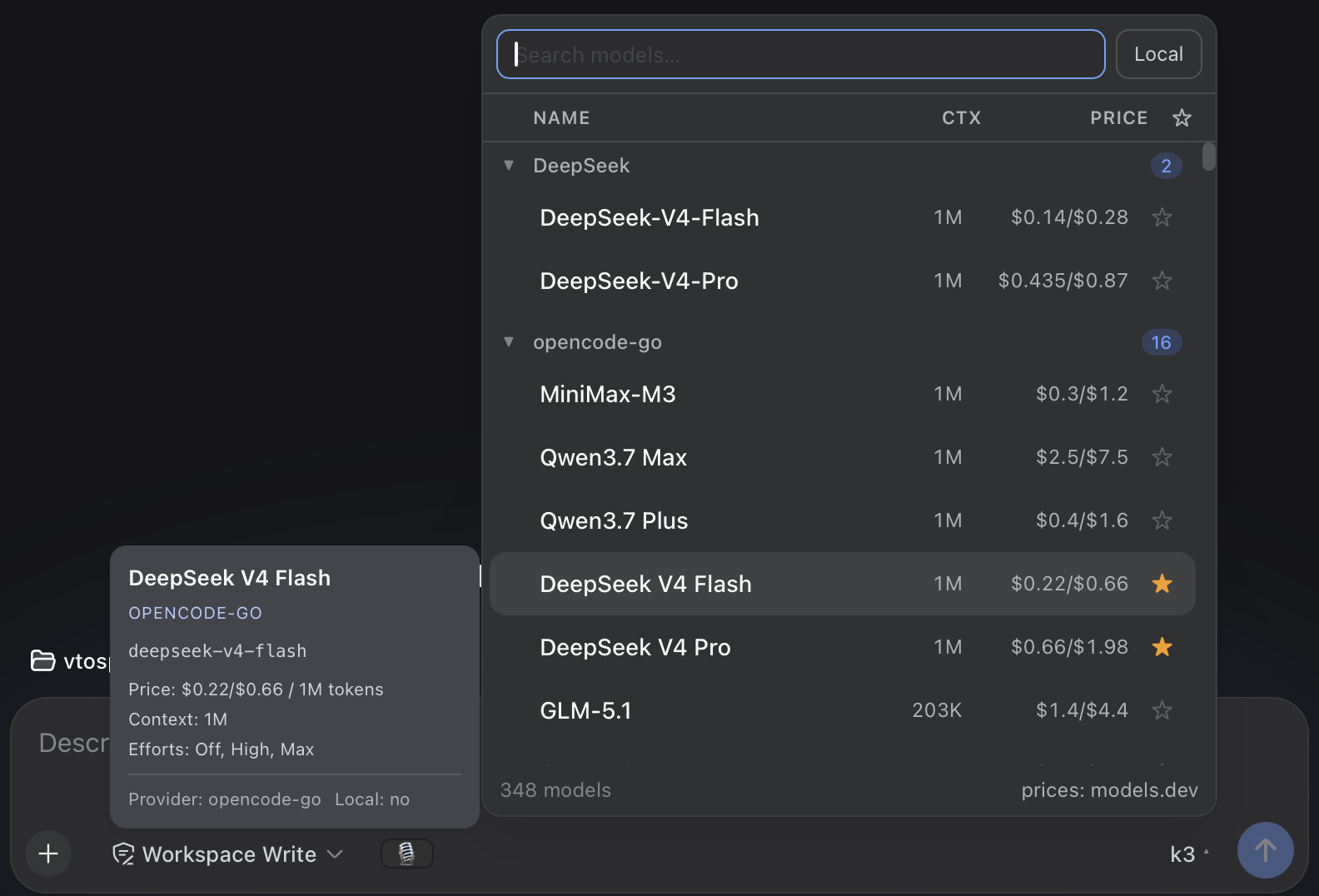
A searchable, sortable model picker for the DeepSeek Harness Web UI (dsh web). It replaces the native composer model seat with a table-style picker that adds everything the stock selector is missing:


Features
- 🔍 Instant search across model names and descriptions
- 📊 Sortable table columns — click
Name,CtxorPriceto sort asc/desc; a third click returns to the provider-grouped view - ⭐ Favorites — star models, toggle favorites-only from the table header; persisted in
localStorage - 🏠 Local tag — providers are flagged local by their real endpoint (baseURL from settings: loopback / RFC1918 / LAN hostnames), never by price guesswork; the Local box next to the search input filters to them
- ▾ Collapsible provider groups — collapse state is persisted per provider
- 💰 Model prices from models.dev (the same source OpenCode uses), shown as
$input/$outputper 1M tokens, cached for 24 h. Subscription routes (all-zero cost in the catalog, e.g. coding-plan providers) resolve a reference price from their pay-as-you-go provider viaPROVIDER_ALIASES, so plan models still show what their tokens would cost at API rates; only true local models stay unpriced - 🧠 Context windows — read live from the host
llmservice (adapter-owned data, works for local providers like llama.cpp / Ollama-style gateways too), with models.dev as fallback - 💸 Live per-task usage & cost — real provider-reported token usage (from the session log) is always shown while the panel is open (
in / out / cache), multiplied by the (reference) price when one is known — the same math OpenCode uses (usage × price, not a heuristic) - 🖱️ Detail tooltip that opens beside the panel (never covers the list): description, price, context window, max output, reasoning efforts
- 🎨 Native look — built entirely on the harness design tokens (
--dsw-alias-*), matches light & dark theme automatically
How it works
The package is a static profile plugin with two halves:
| Half | File | Role |
|---|---|---|
| Client | client.js | Registers the conversation.input.model slot (priority -1, shadowing the native seat) and renders the picker |
| Host | index.js | Serves two same-origin JSON routes on the harness webServer service |
Host endpoints
GET /model-garden/cost?session=<sessionId>
  → { inputTokens, outputTokens, cacheReadTokens, cacheWriteTokens, reasoningTokens, steps }

GET /model-garden/catalog
  → { "provider::model": { local, context?, maxOutput? } }   (cached 10 min)
The cost endpoint aggregates the real usage payloads of assistant/message events from the durable session log — no estimation. The catalog endpoint resolves contextWindow / defaultMaxTokens per model through the host llm service (resolveModelInfo), so local/self-hosted providers report their real limits.
Installation
One command — the official plugin CLI installs the package and mounts it (the package carries a dsh.bundle.patch layer, so the CLI automatically appends it to the profile's bundle stack):
dsh plugin --profile <profile> add dsh-model-garden
Then restart the DSH server and hard-refresh the browser (Cmd/Ctrl+Shift+R).
The host half needs the web stack (
webServerservice). In minimal/TUI profiles without it the plugin stays inert by design — boot is never blocked.
Upgrading from a manual install? Remove the old
model-gardendependency and any manual- insert:row for it from your profile'scordis.patch.ymlfirst — otherwise the plugin mounts twice.
Verify
curl -s http://127.0.0.1:3080/model-garden/catalog | head -c 200
# → {"deepseek::deepseek-chat":{"local":false,"context":...}, ...}  (JSON, not HTML)
Manual install (without the CLI)
If you manage the profile with plain npm: add the dependency, list dsh-model-garden in dsh.profile.bundles in the profile package.json, reinstall, restart. The bundle patch inside the package inserts the loader row for you — no cordis.patch.yml edit needed.
Configuration
No configuration is required. Two behaviors can be adjusted at the top of the respective file:
- Hidden provider routes —
HIDDEN_PROVIDER_PREFIXESinclient.js(andSKIP_PREFIXESinindex.js). Some plugins mirror providers as internal routes (e.g. a vision toolkit duplicating every provider asvision-toolkit-<id>); such prefixes are excluded from the picker and the catalog. - Price aliases —
PROVIDER_ALIASES/MODEL_ALIASESinclient.jsmap DSH route ids to models.dev catalog ids. They serve two cases: renamed routes (deepseek-official→deepseek) and subscription routes whose catalog entry is all-zero (kimi-for-coding→moonshotai,alibaba-tp→alibaba-cn,oneprovider→anthropic), giving plan models their pay-as-you-go reference price. - Price cache TTL —
PRICE_TTL(default 24 h) and catalog TTL —CATALOG_TTL(default 10 min).
Favorites, collapsed providers and the price cache live in the browser's localStorage under dsh.modelgarden.*.
Compatibility
Developed against DeepSeek Harness 0.1.0-rc.6 (@deepseek-ai/dsh-host-webserver, dsh-session, dsh-llm, dsh-client-ui-model-selection). The client half is plain React via window.__ModuleLoader__ — no build step, no dependencies.
Credits
- Pricing data: models.dev API (also used by OpenCode)
- Design tokens & slot API: DeepSeek Harness
License
Похожие плагины
DeepSeek-Balance-Whale-Widget
meteornox/deepseek-balance-whale-widget
dsh-context
bowenliang123/dsh-context
dsh-cost-meter
han-1413141/dsh-cost-meter
dsh-damage-pulse
wssfk12138/dsh-damage-pulse