dsh-vantage
regrevia/dsh-vantage
A read-only overview tab beside the conversation: what this round asked, what was observed, what still needs checking, and a bounded history you can step through round by round.
Установка
dsh plugin --profile web add github:regrevia/dsh-vantageREADME
dsh-vantage
A read-only task overview view for DeepSeek Harness. It sits next to the conversation and answers one question: where does this task actually stand?
Nothing in this view schedules, stops, or completes work. It observes session events that already happened and renders them: the current round's work topics, the evidence behind each one, and a bounded history of earlier rounds.
Preview
| Live session | Saved session | Saved history |
|---|---|---|
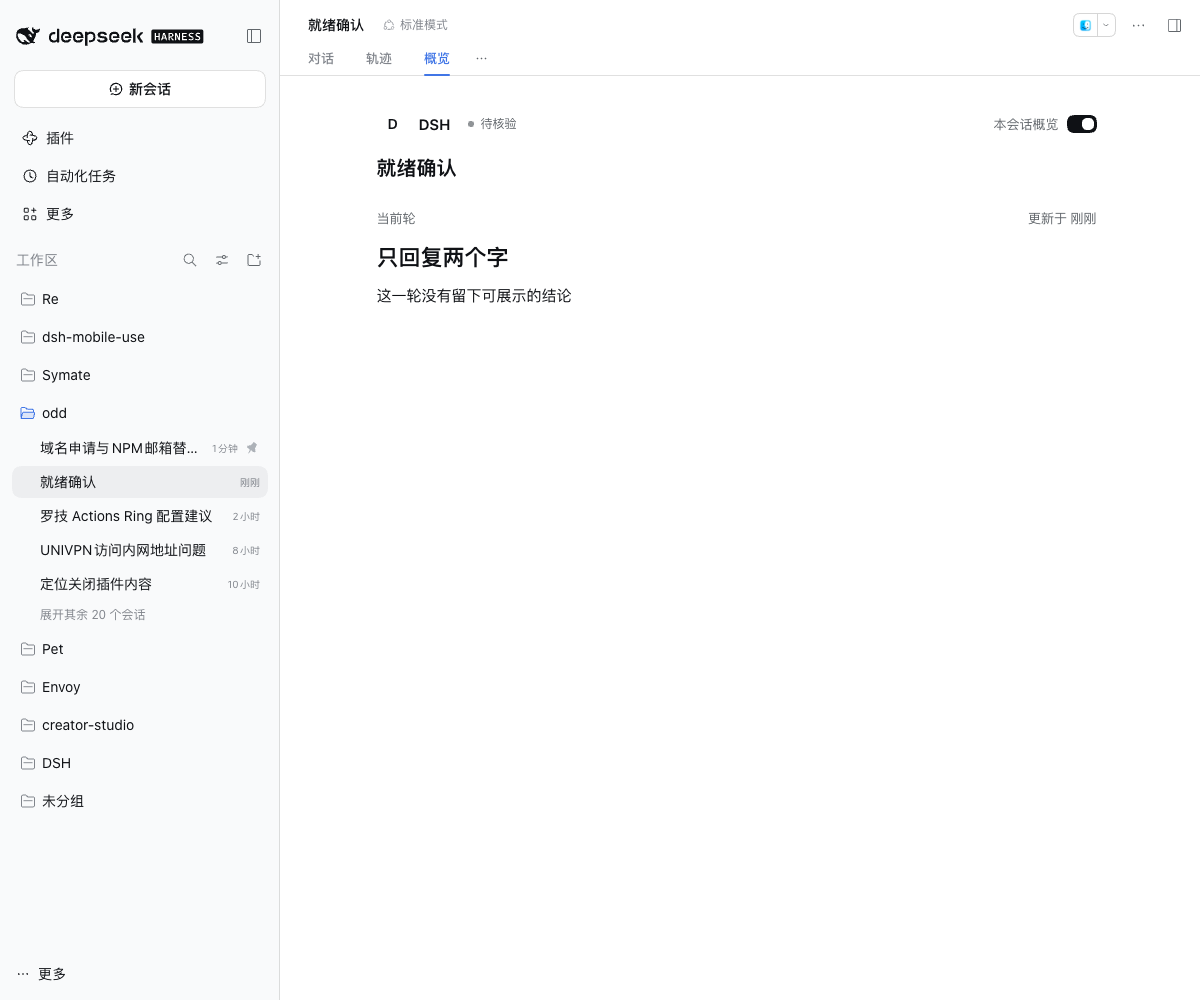 | 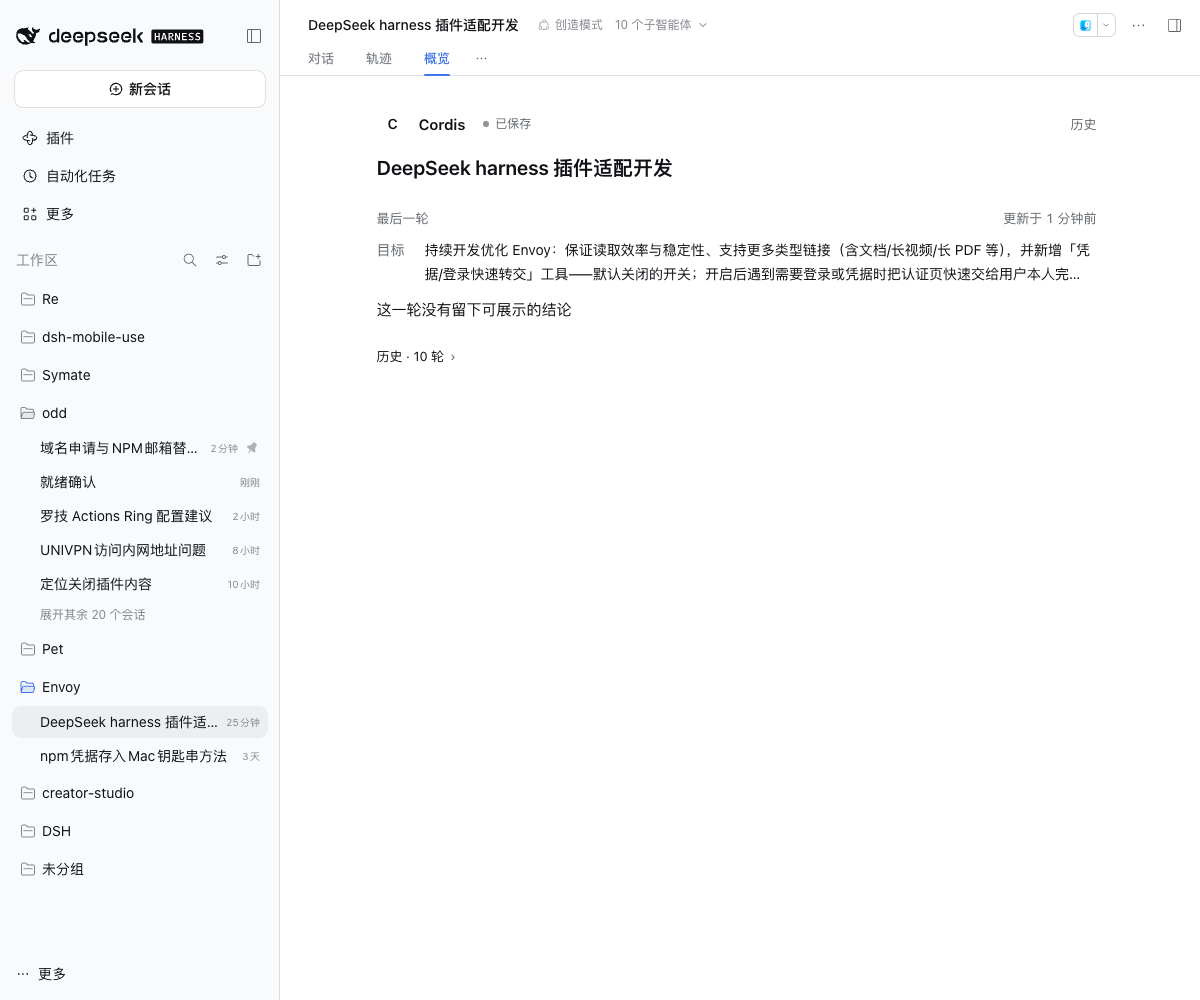 | 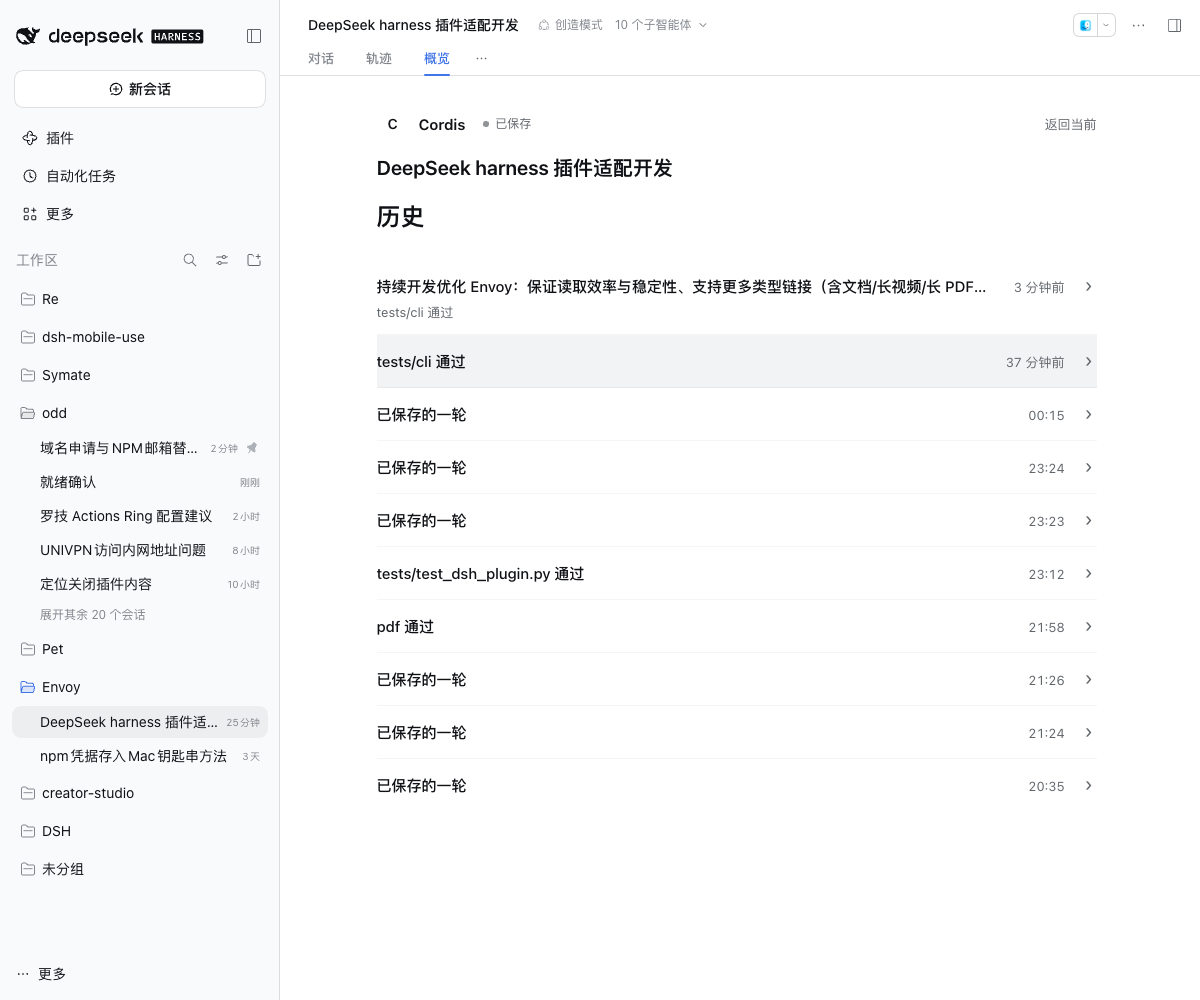 |
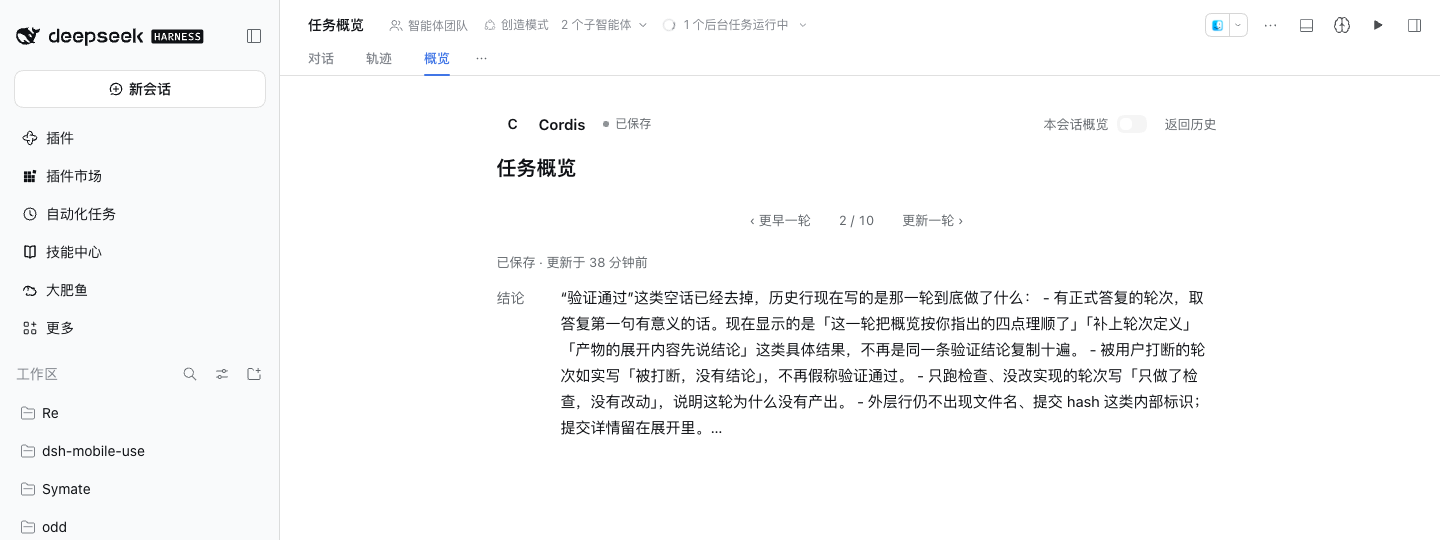
Captured from a real installed profile: the live session is a fresh turn, the saved sessions are existing archives opened without turning the switch on.
The last image below is the same saved session opened inside the user's own
running Harness window (localhost:62741), not a fixture:
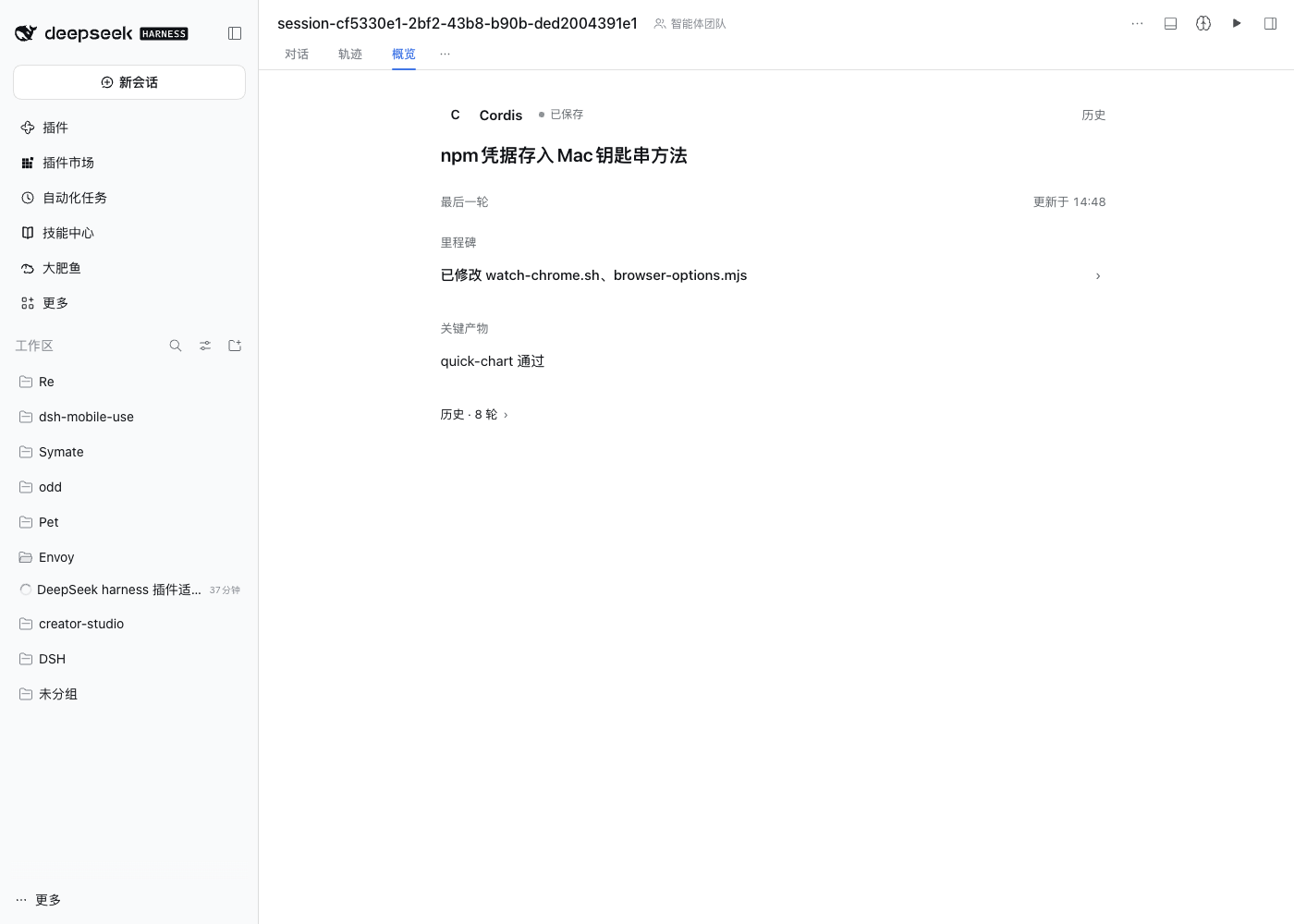
A saved round keeps its own reading position: the pager stays at the top while the detail scrolls, and going back returns to the same place in the history list.
What it shows
- One to three work topics — what changed, what is still being checked, what blocks the task. A topic is a unit of work, never a tool name, and never a test/lint/build list.
- Evidence — each topic expands to its own explanation and the facts behind it: plan, report, or observation. Raw command output stays collapsed inside that row and is fetched only when opened.
- Verification — whether the closing check passed, failed, or is still open. A passing check is evidence, not a topic.
- History — earlier rounds that ended with a real reply, newest first. The list and the round detail never appear at the same time. Inside a round, the pager and the ←/→ keys move one round at a time; the newest saved round turns the forward step into 「回到本轮」.
- Saved sessions — a session that is no longer live opens read-only: its last round, delivered items, and history come from the saved log, and the switch is hidden so viewing it cannot start recording or a model call.
- Per-session switch — off by default. While it is off the plugin neither folds events, nor builds snapshots, nor sends anything to a model. Turning it on starts recording from that moment; saved rounds stay readable in history.
The overview is a reading surface, so the message composer stays out of the way: while this view is mounted the plugin hides the composer seat, and it returns the moment you switch back to the conversation. That is a scoped attribute plus one CSS rule on the host's own seat, not a DOM rewrite — the host keeps ownership of its chrome.
When the first read fails
The view reads one GET /snapshot when it mounts and then polls. A cold plugin
load, a Host route that is still mounting, or a dropped request used to leave the
panel on 「正在读取」 until someone pressed the retry button. The client now retries
by itself: four attempts at 400 ms, 1.6 s, 3.6 s and 6.4 s, reset on the first
success and on a session switch, and cleaned up when the view unmounts. After the
fourth failure it stays on the manual retry state instead of spinning forever.
Controls follow the prototype's text language rather than browser defaults: one
32 px-tall switch with a 30×18 track and a 12 px knob, text links with a 32 px
hit area, one 2 px focus ring from --dsw-focus-ring-*, and no filled pill
buttons. The panel takes its colors from host --dsw-* tokens, so light, dark
and narrow layouts need no separate rules.
A round is a product-level unit, not a turn or a step. A reply closes a round, but "replied" never means "verified". An empty verification list reads 「尚未明确」 and never passes by default.
Install
The plugin is a single package; a Host half (index.js) folds session events and
serves seven exact routes, and a client half (client.js) registers the vantage
view in the conversation's view switcher.
Install the folder with the plugin manager (install_bundle), which links it
into your profile and asks Cordis to apply its bundle patch. Applying the patch
inserts one id, dsh-vantage; no existing entry is modified. The view appears
after the next plugin reload — press the refresh button, or restart the app once.
To wire it by hand, add the checkout to your profile's dependencies and put
dsh-vantage at the end of dsh.profile.bundles.
Requires DSH >=0.2.1-rc.3.
Configuration
All options are optional. The defaults are deliberately quiet.
| key | default | meaning |
|---|---|---|
enabled | true | serve snapshots at all; the per-session switch still starts off |
summary.enabled | true | allow model summaries for sessions whose switch is on |
summary.cadenceMs | 180000 | minimum gap between summaries, floored at 60 s |
summary.firstEligibleMs | 60000 | earliest first summary after a round starts |
summary.maxInputTokens | 2400 | cap on the whole request, system prompt included |
summary.maxOutputTokens | 400 | cap on the answer |
summary.maxTopics | 3 | topics a summary may return |
summary.requestDeadlineMs | 25000 | hard deadline for one summariser call |
summary.provider | "" | model provider; empty uses the session default |
summary.model | "" | model name; empty uses the session default |
Without a model configured, the view degrades to a factual summary built from the folded facts. A failed summary keeps the last valid one and its real update time; it never falls back to a checklist of commands.
Wire
The Host serves four GET reads and three POST calls under
/api/dsh-vantage: snapshot, history, round, evidence; then
summaryRequest, enable, and open, which hands a delivered file to the
system viewer and refuses every path no round delivered. Envelopes, codes, watermarks and the switch state
are documented in WIRE.md. Every route is owner-only: a caller that
is not the session owner receives 403 forbidden; a request without the Harness
auth cookie is rejected with 401 before the plugin runs.
Privacy
Everything is local. The plugin stores at most 20 rounds per session and 200 rounds globally, never copies the full trajectory, and sends the summariser only a bounded fact pack — no credentials, environment variables, or replay data. The view never takes part in scheduling or completion decisions, and a disabled session causes no model call and no stored round.
Development
node test/run.mjs      # 107 tests: reducer, summaries, storage, routes
node scripts/lint.mjs  # tests, zh-lint, style-lint, ui-copy-lint

# Boot a throwaway profile with this checkout installed, then check that the
# Host lists and serves the client module and that its route answers.
node scripts/accept-installed.mjs
The copy linter reads JS object literals as key: value status dumps, so a line
it flags on purpose carries the ui-copy-ignore marker it documents. The three
linters are vendored under scripts/vendor/; scripts/lint.mjs resolves them
from the repository, so a clean checkout needs no files outside itself.
zh-ellipsis is waived in .zh-lint.json because the rule fires on JavaScript
spread syntax, not on prose.
Design constraints live in the source: the panel uses only host --dsw-*
tokens, a single 720 px column (32/32/48 px desktop padding, 24/20/36 px under
560 px), scoped .ov- classes, no remote fonts, at most two radii, no shadows,
and no gradients.
License
MIT
Похожие плагины
dsh-web (dsh-task-board)
zhu1090093659/dsh-web
dsh-web (dsh-web-all)
zhu1090093659/dsh-web
dsh-web-ui (dsh-task-board)
zhu1090093659/dsh-web-ui
dsh-TUI
ccch1mneyyy/dsh-tui