dsh-plugin-auto-review
delef/dsh-plugin-auto-review
由 provider 驱动的自动审批复核:用 Codex Guardian、Grok 等策略自动审查 DSH 的工具调用审批请求
安装
dsh plugin --profile web add github:delef/dsh-plugin-auto-reviewREADME
Auto Review
dsh-plugin-auto-review reproduces provider-specific approval-review behavior
inside DeepSeek Harness. Each policy implements the review logic of a supported
provider—for the first release, Codex Guardian and Grok escalation—while the
model itself can be supplied through any compatible DSH LLM adapter.
The underlying Codex or Grok model comes from a DSH LLM adapter. A provider
plugin such as dsh-plugin-subscriptions can expose codex/codex-auto-review
or grok/grok-4-fast-reasoning; an API adapter can expose a compatible route
instead. The adapter owns authentication and transport, while Auto Review calls
its registered route through ctx.llm.stream().
Install
The package is published on npm
as dsh-plugin-auto-review. Install it into each DSH profile where automatic
review should be available:
dsh plugin --profile web add dsh-plugin-auto-review
dsh plugin --profile headless add dsh-plugin-auto-review
Restart the corresponding DSH process after installation so the profile loads the plugin. To update an npm installation later:
dsh plugin --profile web update --latest dsh-plugin-auto-review
dsh plugin --profile headless update --latest dsh-plugin-auto-review
The same release is also mirrored to
GitHub Packages
as @delef/dsh-plugin-auto-review. That distribution requires GitHub Packages
authentication; npm is the recommended installation source.
How it works
flowchart LR
    A[Tool call] --> B[Native DSH approval/request]
    B --> C{Auto Review}
    C -->|none| D[Manual DSH approval]
    C -->|Configured reviewer| E[Provider-specific review policy]
    F[dsh-plugin-subscriptions or API adapter] -->|provider + model route| G[DSH ctx.llm]
    E --> G
    G --> H{Review result}
    H -->|allow| I[allowed-once]
    H -->|deny, unavailable, or invalid| J[rejected]
Runtime example
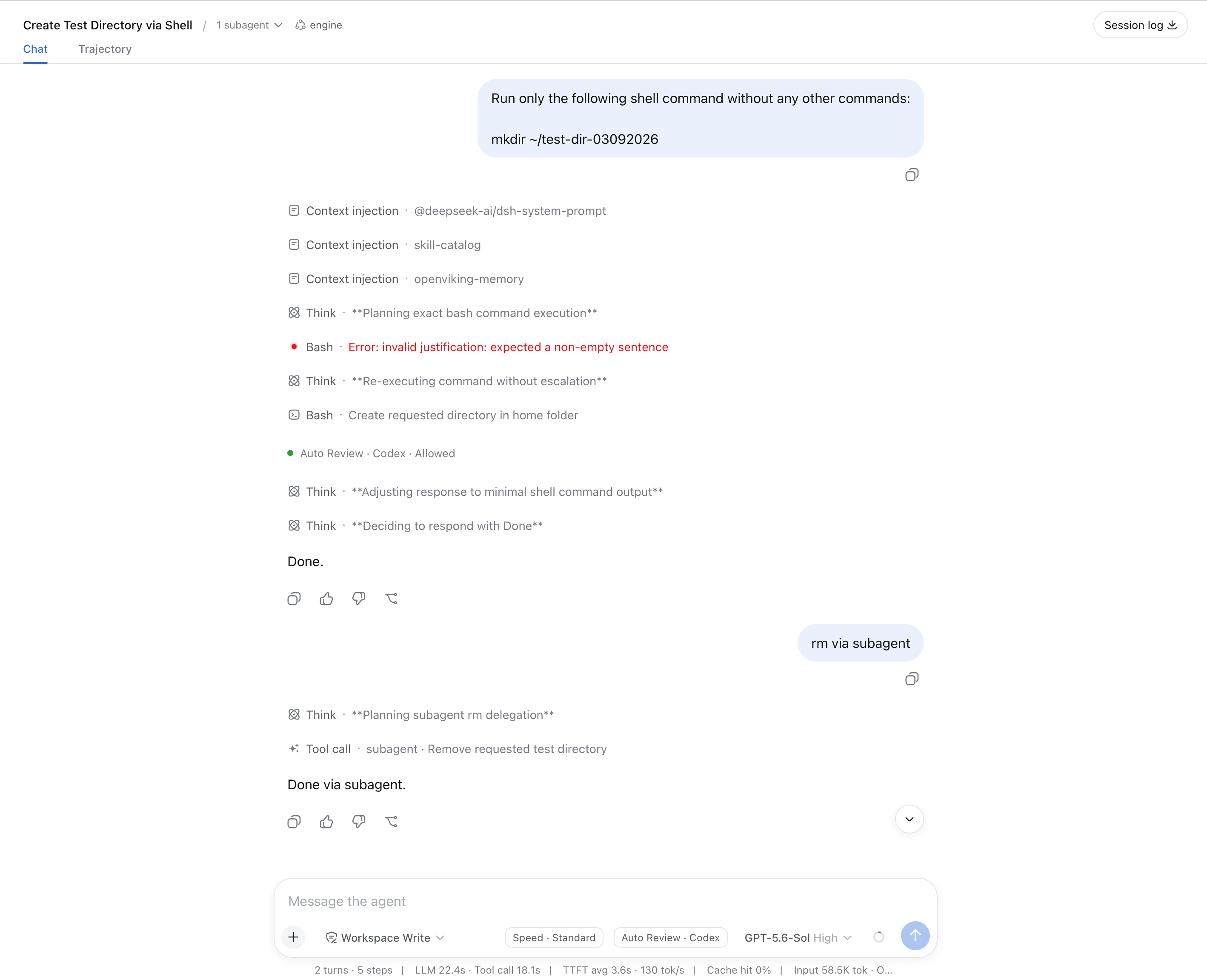
Codex Auto Review approves a sandboxed shell operation in the parent session:
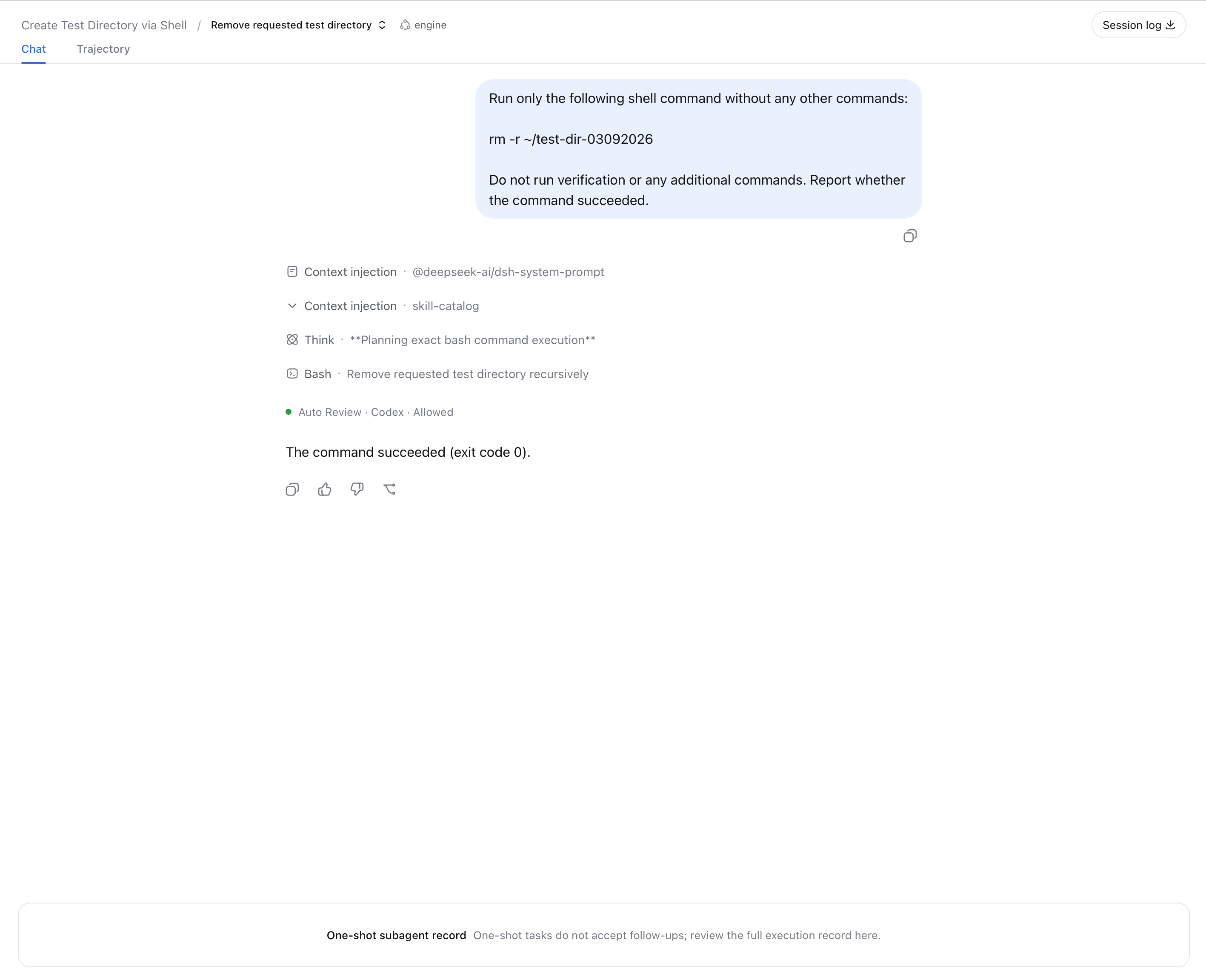
The selected reviewer is inherited by a delegated subagent and handles its approval without opening an unattended human prompt:
Quick start
The plugin registers Codex Guardian and Grok escalation policies and starts in manual mode. Once the corresponding DSH LLM route is available, select the reviewer in Web or set a default:
autoReview: codex
Web exposes both a global selection in Settings and a per-session selection
beside the conversation input. Only currently usable routes are offered; an
already selected route that disappears remains visible as unavailable and
fails closed. Select none to use native manual approval.
| Reviewer | Policy | Default DSH route |
|---|---|---|
| Codex | Codex Guardian | codex/codex-auto-review |
| Grok | Grok escalation review | grok/grok-4-fast-reasoning |
Custom routes
policy selects the review logic. provider and model select the DSH LLM
route that supplies the model:
autoReview: api-guardian
reviewers:
  - policy: codex
    reviewerId: api-guardian
    label: Company API Guardian
    provider: openai-api
    model: gpt-5
    reasoningEffort: low
reviewerId must be unique. Entries without policy retain Codex Guardian
behavior. The global selection is stored at
plugins/auto-review/auto-review.json; session selections are in-memory and
inherited by child sessions.
Safety
The model runs only after the exact tool call reaches a real
approval/request; ordinary allowed calls remain model-free. With a reviewer
selected, denial, unavailability, timeout, interruption, or malformed output is
rejected. With none, DSH keeps its native manual flow. Delegated subagents do
not open unattended human prompts: they may inherit a machine reviewer, but
manual approval remains disabled for delegation.
Auto Review does not bypass DSH permissions. If the sandbox denies a Bash call, the plugin may retry that exact call with the next sandbox mode, but the retry passes through the same approval boundary. Tool actions are matched by call id and name and consumed once. Review transcripts are bounded and exclude injected plugin context from user authorization anchors.
Compatibility and development
Requires Node.js >=22.13.0. The declared DSH target is 0.1.2-alpha.3,
matching the pinned development service contracts and browser client slots.
Other DSH releases have not been validated; no exact-release runtime acceptance
is claimed by this range declaration.
Git installs use the committed lib/ output and run no preinstall, install,
postinstall, or prepare scripts. Maintainers build before committing source
changes. prepublishOnly builds and tests only when publishing to npm.
The lockfile pins the development toolchain; legacy peer resolution prevents npm
from mixing newer transitive DSH peers into the pinned alpha service contracts.
From a checkout:
npm ci --ignore-scripts --legacy-peer-deps
npm run build
npm test
git diff --exit-code -- lib
Permissions and external services
This is an approval-policy plugin with elevated capabilities, not a low-risk
utility. DSH STORE may require user-reviewed status or keep installation blocked.
- Files: reads and writes the reviewer selection under the DSH home at
plugins/auto-review/auto-review.json, using a temporary file and atomic rename. Session selections remain in memory. It does not read credential stores. - Model traffic: sends bounded conversation context and the proposed tool action through the configured DSH LLM route. That context can contain private project data or credentials already present in the conversation/tool arguments. The selected adapter owns authentication, endpoints, network transport, and billing; Auto Review itself has no API key configuration or direct HTTP client.
- Approval and commands: handles native approval requests and can request a retry of the same Bash call with the next sandbox mode. DSH executes the tool through its approval boundary; this plugin does not spawn a shell itself.
- Dependencies: official DSH services are peer dependencies supplied by the host, including LLM, Tools, User Approval, Home Paths, and Web client services. A separately configured LLM adapter is required for machine review. No adapter or credentials are installed by this package.
- Failure bounds: machine review rejects denied, unavailable, interrupted,
timed-out, or malformed results.
noneretains manual approval. A model decision is not a security guarantee; review sensitive actions and provider data handling before enabling automatic approval.
MIT licensing applies to the source and shipped package; LICENSE is included
in the distribution. Packaging and validation evidence is in
docs/distribution-validation.md.