dsh-plugin-magic-context
elvisw/dsh-plugin-magic-context
Magic Context 帮你在 DSH 的长会话中腾出上下文,也把重要的项目背景留到下一次对话。它将旧对话整理为摘要,回收暂时用不到的工具输出,需要时仍能按标签取回,减少重开会话后反复交代背景的麻烦。
安装
dsh plugin --profile web add github:elvisw/dsh-plugin-magic-contextREADME
Magic Context for DeepSeek Harness — elvisw fork


English | 简体中文
Anyone who has run long sessions knows the symptoms: the project details you worked out yesterday are gone today, so the same pit gets re-dug; tool outputs bloat the context window; and every compaction busts the cache prefix, so the expensive part re-runs.
Magic Context's answer: knowledge should persist, context should be managed. This plugin gives DeepSeek Harness (DSH) sessions a persistent, project-aware memory — knowledge distilled from your sessions survives restarts, is searchable with hybrid full-text + local vector search, and is re-injected right where the model reads it — while the context window itself is run as an asset: tool results become tagged, reclaimable history, digests come back as four-level summaries, and none of it ever breaks the live KV-cache prefix.
- Memory that outlives the session — a project corpus in the plugin's own SQLite store;
historian facts auto-promote into it,
ctx_memoryreads/writes/maintains it, and project identity is auto-derived (git root or directory). - Local-first retrieval — MiniLM embeddings via WebAssembly (no native build, no API keys), hybrid full-text 0.7 / vector 0.3 ranking, fail-open to full-text on any failure.
- Sharing with a human gate — machine/org global domains: staging can be automated,
publishing is always yours (approval cards,
/ctx-global approve); a user-profile layer rides on top with read / collect / review as separate switches. - Reversible reclaim, cache-aware compaction —
ctx_reduceonly queues; drops land as[dropped §N§]placeholders andctx_expandreturns the original as a new result; history digests into p1–p4 summaries published as range replacements — never a spontaneous prefix bust. - Conservative by default — the host
compaction-basicengine stays in place unless you explicitly opt in; in DSH 0.2.2-rc.1, Web and Desktop agent presets own their own compaction engine, soregisterCompactionEngineis a flat/headless-host seam, not a Web/Desktop preset override.
Requires Node ≥ 22.19 and a DSH 0.2.x host with the Web client (the desktop app or
a web profile). The quick start below uses the Web profile; the Desktop profile is not
separately verified. The optional compaction takeover is for flat/headless compositions
and is not effective on DSH Web or Desktop. The package ships compiled — install
straight from the npm registry:
dsh plugin --profile web add @elvisw/dsh-magic-context
Package identity: the unscoped
dsh-magic-contexton npm is an unrelated implementation by another maintainer, not this fork or its upstream. This fork is published only as@elvisw/dsh-magic-context; keep the@elvisw/scope in every install command.
0.13.0 introduced this package name; the current release is 0.17.0, which adds
the manual /ctx-wrapup live-history command (0.16.0 added remote vector search
and the host-native Settings redesign; 0.15.0 added the telemetry v2 panel;
0.14.0 added the top-level Settings page). If you installed
@elvisw/dsh-plugin-magic-context (0.12.x) or the upstream
dsh-plugin-magic-context, remove it first: all three use the same loader row id
(magic-context-dsh), so co-install is unsupported: the loader keeps one row and
settings may disappear. Upgrading from 0.12.x also
needs the one-time profile patch migration described in
docs/independent-package-release.md; the helper is
shipped in the npm tarball and the hand-out bundle.
New to the plugin? A five-minute tour follows in Quick start; configuration, tools and architecture are covered in full below. A complete Chinese translation is at README.zh-CN.md. Contributions are welcome — see CONTRIBUTING.md and SECURITY.md.
Quick start
After installing, restart the profile unless it has HMR enabled; with HMR the new version hot-loads. In your next session:
- Tool results carry
§N§tags; a telemetry badge appears in the overlay showing live context occupancy, with a panel of host token composition, estimated message breakdown, localized sections and an operation record behind it. - A Settings → Magic Context page edits the options the card exposes. The legacy
Plugins-page card is removed; a host without the
settings.sectionslot has no Magic Context configuration card. - The
ctx_reduce/ctx_expand/ctx_memorytools are registered for the agent; project memory is on by default — facts distilled by the historian persist across sessions and surface where the model reads them.
Context reclaim, in one exchange (real parameter names):
you:   ctx_reduce {"drop": "4-7"}      # four tool outputs are no longer worth the tokens
agent: queued 4 item(s) — the drops land as placeholders in the next reclaim band
…later in the transcript…
[dropped §4§] [dropped §5§] [dropped §6§] [dropped §7§]
you:   ctx_expand {"tag": "5"}         # wait — what was in §5 again?
tool:  the original text of §5, as a new result — the §5 placeholder stays dropped
The only opt-in surface is the compaction takeover (registerCompactionEngine, off by
default — see Configuration); in DSH 0.2.2-rc.1 it applies to
flat/headless profiles whose root compaction-basic row is disabled, not to Web or Desktop
agent presets.
What it does
Memory first, context management second — the first five rows are the memory system, the last five manage the context window (full design in Architecture and PARITY.md):
| Capability | Mechanism |
|---|---|
| Project memory (own corpus) | Plugin's own SQLite store (memories.db), hard-split from upstream — no shared storage, no compatibility duty. Project identity auto-derived (git:<root-sha> / dir:<hash>); injected into the m[0] baseline and served to ctx_memory for read/write; historian facts auto-promote; FTS 0.7 / vector 0.3 hybrid retrieval |
| Local vector lane | MiniLM embeddings run locally via the bundled onnxruntime-web WASM backend — no native build, no API keys; the model download is pinned by revision + sha256 (mirror fallback), cached in the plugin data dir; retrieval candidates get inline + maintenance-tick backfill; any failure fails open to full-text search |
| m[0]/m[1] memory baseline | A synthetic notice node carries the frozen baseline plus incremental lanes (<new-memories> / <memory-updates> / <user-profile>); each lane keeps its own watermark, so new memory never rebuilds the cached prefix — unchanged content produces zero diff |
| Global domains + user profile | machine/org domains: staging can be automated (maintenance tick, LLM classification), publishing is always human (approval cards, /ctx-global approve); the user profile's render / collect / review are separate switches |
| Maintenance tick (MC dreamer slice) | Every 30 min: TTL archiving → batched LLM verify (keep / update / archive) → vector backfill → global-domain candidate staging |
| Reversible context reclaim | Tool results get §N§ tags; ctx_reduce only queues — drops land in the execute band as [dropped §N§] placeholders referencing the originals; ctx_expand returns the original text as a new result while the placeholder stays dropped. The cached prefix is never busted spontaneously |
| Pressure scheduling | Persistent usage (incl. cache reads/writes) → pressure score → execute/defer decisions (65% threshold, 5 min cache TTL, 85% force band); CONTEXT_WINDOW_EXCEEDED triggers emergency reclaim + retry; tiered reduce-guidance nudges |
| Historian (out-of-band digest) | One LLM call replays the real prefix (KV cache preserved) → four-tier p1–p4 summary + facts/events, writes the store only, never touches the wire; published in the execute band as a [compacted §C<n>§] range replacement; /ctx-recomp redoes compacted history in place |
| Compaction seam | registerCompactionEngine can take over root ctx.compaction (real compaction/start|summary|replace|end protocol); off by default — the host compaction-basic (root or preset) stays in place. Flat/headless only: in DSH 0.2.2-rc.1, Web and Desktop agent presets mount their own compaction engine, so this switch does not replace a preset engine |
| UI integration | Top-level Settings → Magic Context page (the legacy Plugins-page card is removed; volatile fields, save = live); catalog-backed Historian reasoning-effort picker; shell.overlay telemetry badge + capsule panel (host token composition, estimated message breakdown, localized sections, operation record); session-notice rows in the session stream; Chinese/English instant switching for card labels and panel section/empty-state copy (operation detail values stay as recorded) |
Installation
From the npm registry — recommended; the package ships compiled lib/ and vendor/, no
local build needed:
dsh plugin --profile web add @elvisw/dsh-magic-context
Registry versions are published automatically by tag pushes (with npm provenance signatures); see the "Releasing" section of CONTRIBUTING.
From source (development)
git clone https://github.com/elvisw/dsh-plugin-magic-context
cd dsh-plugin-magic-context
npm install
npm run build     # tsc → lib/ (multi-file ESM) + browser half copied to lib/client.js
dsh plugin --profile web add <path to this repo>   # the CLI ships with the app; the spec can be a Git URL, a local path, or a registry version
Installing does three things: pnpm add into the profile (link: for local paths),
appends the package name to dsh.profile.bundles, and the loader composes it. When the
profile has HMR enabled, changes take effect immediately (no restart; running sessions
start tagging right away); otherwise reload the page or restart the profile.
- All
@deepseek-ai/*inpeerDependenciesare declared"*"— the compatibility precheck passes on any DSH 0.2.x; the host packages actually imported at runtime are also listed as exact-version dependencies (resolved with the package;link:dev installs are served by this repo's own node_modules). - Node ≥ 22.19 required: the stores build on the built-in
node:sqlite, no native modules. A CLI/webprofile runs on Node; the desktop app supplies an Electron RunAsNode runtime; both need thenode:sqliteversion that Node 22.19 provides. - Tool-constructor resolution:
config.defineTool(host-injected, used by in-tree glue) first, then dynamicimport('@deepseek-ai/dsh-tools')(a hard dependency, physically resolvable in every install shape). If both are unavailable the mount fails loudly — the ctx_* tools are the only entry point for reclaim tags; no silent half-boot. - Two loading modes: patch-overlay / file URL (development: overlay yml +
config.defineToolinjection) and profile install (production: package-name line + link dependency). The production path is thedsh plugin addabove.
Uninstall / disable: disable the bundle on the GUI Plugins page (writes disabled into
the profile patch), or dsh plugin --profile web remove @elvisw/dsh-magic-context.
Configuration
Two ways to change configuration, with different semantics (see the Settings UI contract):
- GUI settings page (Settings → Magic Context): exposes
policy.*(incl. historian generation cap / ceiling / timeout),historianEnabled,registerCompactionEngine,journal.*,maintenance.*,historian.*,embedding.*and other volatile fields. The two provider/model route pins (maintenance verify, historian generation) prefer a dropdown fed by the host's configured model catalog (clientremote.session.modelCatalog()), with "Auto = follow the session route" and clearing; shells without that RPC fall back to plain text (values remain hand-editable). Theembeddingmodel list comes from the plugin's own/mc-embedding/modelsendpoint, not the host catalog. The Historian reasoning-effort field is the same catalog-backed picker:Default, the routed model's advertised ids, andCustomfor legacy/unknown values; an Auto route keeps the text input. Writes go through the settings chain: non-volatile keys are preserved untouched, untouched fields never materialize into override rows — saving takes effect immediately (the host side always reads throughliveNumber/liveBoolean/liveString/liveRouteat the decision point). - Hand-written profile override rows:
configreplaces the package patch's config wholesale — it is not a deep merge. Writing onlymemory:erasesregisterCompactionEngine: false. When hand-writing overrides you must spell out every key you want to keep.
The bundle's built-in config is one line: registerCompactionEngine: false — a
conservative first install that keeps the host compaction engine in place (memory, reclaim
and historian are on by default).
Scope: the GUI switch only controls the root
ctx.compactionseam. In DSH 0.2.2-rc.1, Web and Desktop agents run inside per-agent presets; each preset mounts its owncompactiongroup, so a profile-patch top-levelcompaction-basicrow does not replace the preset engine. The switch is therefore flat/headless-host only, and it only takes effect after the rootcompaction-basicrow in that composition is disabled. The upstream 0.11.2 README's two-row recipe has the same flat-only limitation; see upstream issue #16.
For a flat/headless profile that does not mount a preset-owned compaction engine, a manual profile override can take over compaction:
- id: magic-context-dsh
  name: '@elvisw/dsh-magic-context'
  config:
    registerCompactionEngine: true
- id: compaction-basic
  name: '@deepseek-ai/dsh-compaction-basic'
  disabled: true          # flat/headless only; not a DSH Web/Desktop preset override
Configuration reference (full types in src/dsh/config.ts; all keys writable as profile override rows unless noted):
| Group | Keys (defaults) | Notes |
|---|---|---|
| Master switches | enabled (true) · registerTools (true) · registerStatusCommand (true) · sessionNotices (true) · reduceGuidance (true) · searchHint (true) | enabled: false stays loaded but fully inert; sessionNotices controls the management notice rows in the session stream |
| Compaction seam | registerCompactionEngine (code default: mount when resolvable; ships false in the bundle) · compactionBase (host-injected base class) | Flat/headless root seam only; that composition must disable its root compaction-basic row. In DSH 0.2.2-rc.1, Web and Desktop agent presets own their own compaction engine, so this key does not replace a preset engine. Pre-step reconcileEngine mounts/unmounts dynamically every step |
| Pressure policy | policy.*: executeThreshold (65) · forceThreshold (85) · ttlMs (5 min) · assumedContextWindow (256k) · protectedToolResults (8) · historianTimeoutMs (120 s) · historianMaxTokens (8192, raised to 8192 if set lower) · historianMaxTokensCeiling (32768) · baselineTokens (2000) · memoryBudgetTokens (8000) · memoryLimit (40) · forceWaitReadyMs (0) | Thresholds take effect at the next decision point (incl. /ctx-status and the compaction-engine paths). compartmentGuardMode / compartmentEntrantTokens (publish guards) were retired and are no longer configurable |
| historian | historianEnabled (true) · historian.{provider, model} (pinned as a pair; empty = follow the session's last route) · historian.reasoningEffort (optional, blank = model default) | Generation route for out-of-band digests and /compact summaries; the GUI Settings page has "Historian provider/model" dropdowns (Auto = follow session, recommended) and a catalog-backed reasoning-effort picker: Default, the routed model's advertised ids, and Custom for legacy/unknown values. The Auto route keeps a text input because the session model is unknown there; an unadvertised id is never silently remapped or clamped. A provider-level OUTPUT_TOKEN_LIMIT empty completion is retried with the normal cap escalation. The only LLM spend besides verify |
| Project memory | memory.{}: enabled (true, on by default since 0.9.0 — opt out with enabled: false) · dbPath · project (omitted = session cwd) · domainProjects · shareCategories · autoPromote (true) · write (true) | write: false makes ctx_memory read-only |
| Retrieval / vectors | memory.embedBackfill (true, query-side inline backfill) · memory.vectorBackfill (true, maintenance-tick backfill) · memory.vectorBackfillLimit (24 rows/tick) | Any vector-lane failure fails open to FTS |
| Remote embeddings (T20) | embedding.provider (local) · embedding.preset (siliconflow) · embedding.endpoint · embedding.authHeader (authorization) · embedding.model · embedding.apiKeyEnv (empty = no auth for custom; SiliconFlow falls back to SILICONFLOW_API_KEY) · embedding.dimensions (0 = probe) · embedding.queryInstruction · embedding.documentPrefix · embedding.timeoutMs (8000) · embedding.queryTimeoutMs (2500) · embedding.batchSize (16) | Optional OpenAI-compatible remote space. Model IDs are discovered through /models or typed manually; dimensions are probed, never compiled in. The block is declared user-level; the current host does not expose a project/tier source, so project-level rejection is not enforced at runtime. The key is read from the named environment variable, and remote space is namespaced embedding-remote:…. Saving remote config does not spend quota; Start rebuild arms the target, Pause/Resume and rollback (via the normal Save) manage it. Remote search never mixes local vectors and fails open to FTS |
| S(t) decay | memory.scoring.{enabled (true), alpha (0.4), beta (0.2), archiveThreshold (2), halfLives} | Stats are always collected; the distribution default enabled=true takes over ranking; profile-JSON only, not on the settings card |
| Global domains | memory.global.machine.{enabled (true), excludeProjects, autoStage (true)} · memory.global.user.{render (true), collect (true), review (true)} · memory.global.review.batchLimit (50) | Defaults all on: staging can be automated (≤3/pass, paused at ≥10 pending candidates), publishing is always human; LLM classification failure is fail-closed |
| User profile | memory.global.user.{render (true), collect (false), review (false)} | Read / collect / review are independent halves; the two halves that write to the shared store are off by default |
| Domain resolution | memory.domains.source (adapter | contract) | contract is a fallback pole for comparison, not a supported end state |
| Maintenance | maintenance.{enabled, intervalMs (30 min), verifyProvider, verifyModel} | LLM verify needs an explicit route (unpinned = follow the conversation's latest route); the GUI card offers host-catalog dropdowns, Auto = unpinned (same picker for both pins) |
| Observability | journal.{enabled (true), level (info), retentionDays (30), mirror (true)} | level/mirror apply to the next write; a journal that was off at mount needs a restart to turn on at runtime; retentionDays has a min(1) floor against accidental pruning. §N§ tag rows have no age-based TTL; this adapter has no automatic message/session deletion path today |
Remote embedding (optional)
The default vector lane stays local MiniLM. To use an OpenAI-compatible embedding
API (for example SiliconFlow), open Settings → Magic Context → Embedding
search, choose OpenAI-compatible API, load the model list, select a model and
press Test connection. The server probes one short input to learn the
dimension; model IDs and dimensions are not compiled into the plugin. The API
key is read from the environment variable you name — the value is never written
to config, logs, the database or the browser.
Press Start rebuild to arm the target space and begin a bounded backfill.
Until then, remote search is full-text only and saving the config sends no
embedding request. Old local vectors are kept, and Roll back to local stages
the provider change through the normal revision-fenced Save. Remote failures
degrade to full-text search; they never fall back to local vectors. The target
space is namespaced, and coverage covers active plus permanent memories.
This is a local-first plugin: enabling a remote endpoint sends the memory text you search to that endpoint. Use a trusted or self-hosted endpoint, and prefer HTTPS (plain HTTP is only expected for localhost/LAN servers). Model availability and pricing change; check the vendor's current pages, for example the SiliconFlow API docs and embeddings docs.
Tools & commands
Agent tools (registered at mount; registerTools: false turns them off):
| Tool | What it does |
|---|---|
ctx_reduce | Parses MC range syntax ("3-5,8") → queues only; landing is a priced bust that waits for the reclaim band, never spontaneous |
ctx_expand | Returns the original text as a new result, read from the persisted log by tag (single), the deprecated tags alias, or message (a DSH log event seq in the current session for an already dropped item; [compacted §C…§] nodes are not accepted) — the old placeholder and its spent tag stay in place. Tag is primary; message is a fallback, not a general history browser. start/end (inclusive DSH log event seq, not upstream message ordinals) read a read-only user/assistant/tool/result transcript without requiring a drop; verbose previews 200 characters per part under the shared 15k budget. [compacted §C…§] bookkeeping is excluded while [dropped §N§] stays literal when the range reads raw history; a range whose readable events are all still live returns a live-surface sentence instead of duplicating them. No recovery is promised once the raw event is gone |
ctx_memory | The shared memory store's read/write port. Reads: list / search / get; writes: write / update / archive / merge (with MC's normalized content hashing, mutation log and authority guards in the loop throughout); review_global (surfaces machine/org domain candidates one by one as approval cards; publishes only on approval); promote (stages a single project memory instantly — a manual lane with no recurrence gate). Every action accepts project (absolute path or git root) to operate on another project |
Slash commands (registerStatusCommand: false disables this command surface):
| Command | What it does |
|---|---|
/ctx-status | pressure / decisions / reclaim ledger / compartments / baseline / policy |
/ctx-flush | mark this session's pending ctx_reduce drops for landing on the next message; reports requested/already/pending counts; when the queue is empty, reports the last landed drop count/time for this session; starts no historian, recomp, summary, or model call |
/ctx-recomp all | last:<n> | <startSeq>-<endSeq> | re-runs the historian and replaces the stored digest in place (ranges snap to compartments, never split; identity and landed placeholders unchanged, the next pre-step rebuilds the baseline) |
/ctx-wrapup [messages_to_keep] | queues a manual historian pass for the next pre-step; keeps the newest N eligible surface entries (default 20), lands pending drops first, and publishes through the normal execute lane with the force band skipped for that pass |
/ctx-profile confirm | reject | retire | confirm / reject / retire user-profile candidates; promotion into the shared profile happens at the next maintenance tick |
/ctx-global add | remove | status | promote | approve | reject | the manual lane for global-domain membership and candidate approval (same gate→publish path as the approval cards, source_type=user) |
Compared with cortexkit v0.49.59, /ctx-dream and /ctx-embed are not
registered. /ctx-dream needs the full dreamer task set; /ctx-embed targets
session-history compartments, memories and git commits, while this adapter's
embedding controls cover the memory vector lane. /ctx-wrapup is supported as
a queued manual pass over the live tail. The exact command-by-command
matrix is in PARITY.md.
UI & telemetry
Both UI capabilities ride the same browser half (src/client/index.js, copied verbatim to
lib/client.js at build time):
-
Settings → Magic Context (top-level Settings page): a five-section layout with a four-metric summary, jump row, advanced disclosures and a text-only status strip above the host footer. Volatile options are saved through the host footer. The legacy Plugins-page card is removed; a host without the
settings.sectionslot has no card.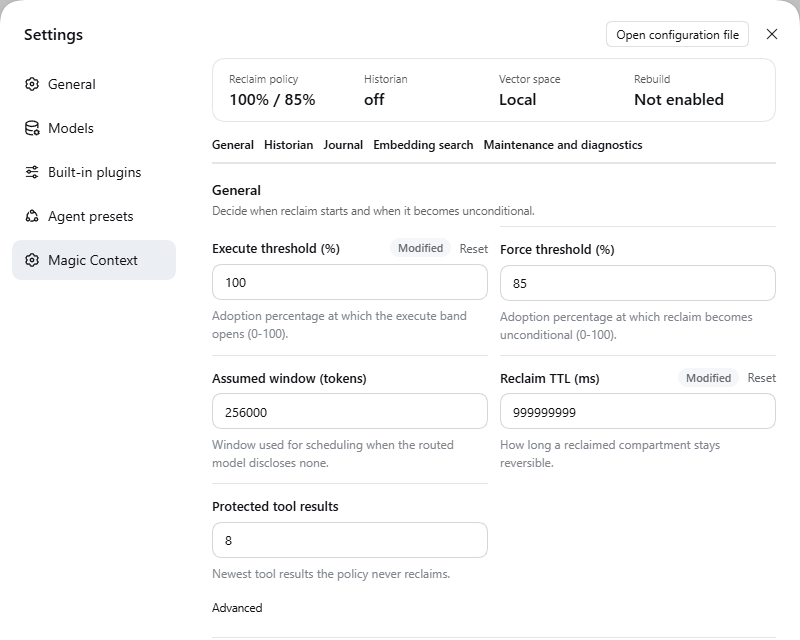
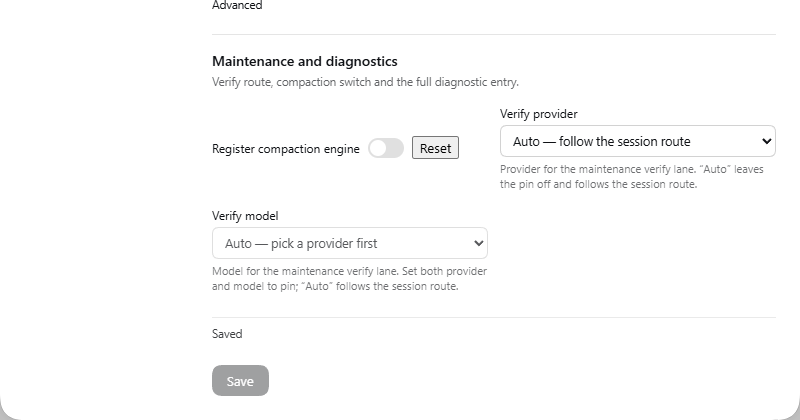
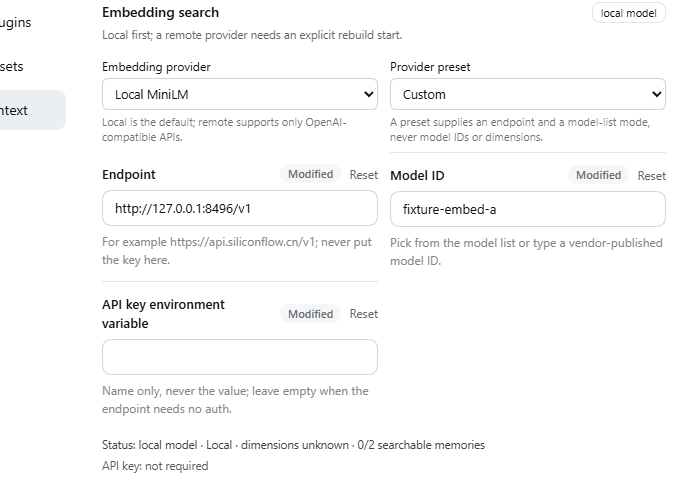
-
shell.overlaytelemetry badge + capsule panel: the collapsed pill keeps the live pressure, token pair, Historian state and reclaim queue (H/Q<n>) visible, and switches to an icon-width variant on narrow composers. The panel shows:- a 100% host token bar split into System / Tool definitions / Messages, with the
absolute token pair (
11.8k / 1M); - an estimated message composition (Conversation, Tool calls, Compartments, Memories,
Profile, Other); rows with no estimate are omitted rather than shown as
0; - Historian / Memory / Queue / Maintenance / Hygiene / Warnings sections, using
—/empty/never runfor values the host did not report; - the live operation record (up to 12 entries, adjacent identical operations folded
as
×N): 🧠 memory write · 🔎 memory load · 🗑️ reclaim queued · 🧭 original restored · ✂️ context compacted · 🗑️ context dropped · 🧭 archived-stored · 🧰 maintenance sweep · ⚠️ failure.
Focus stays inside the panel while it is open; clicking outside the panel/badge, Esc, window blur, or the close button closes it and returns focus to the pill. The footer offers
/ctx-statusfor the full diagnostic view.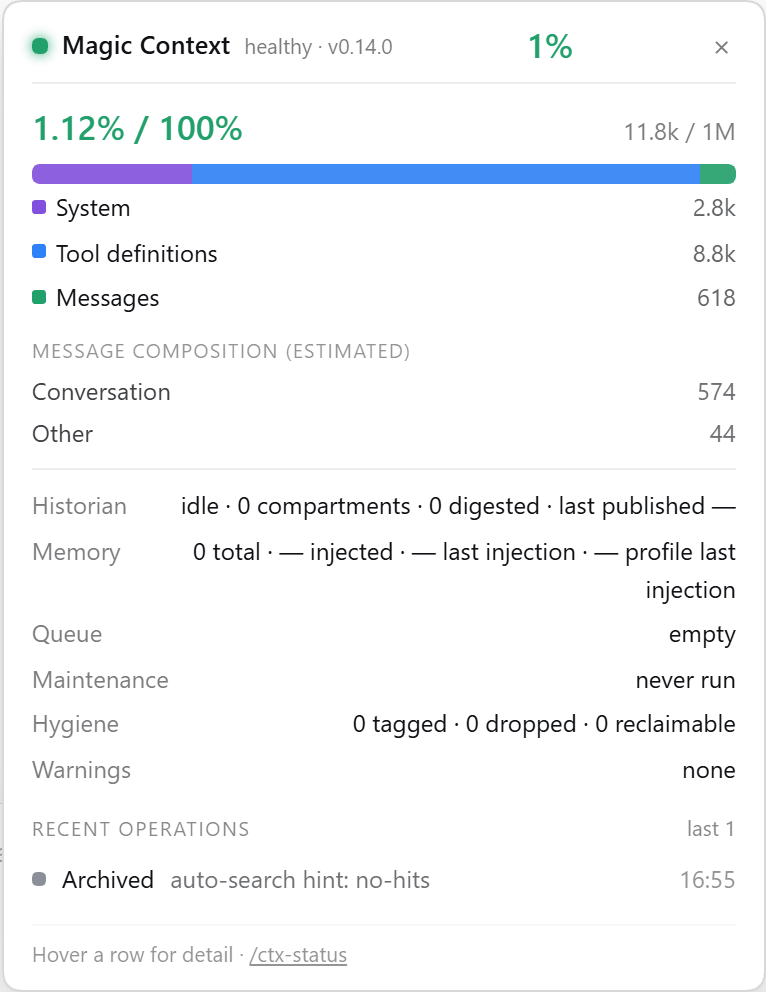
- a 100% host token bar split into System / Tool definitions / Messages, with the
absolute token pair (
-
Data comes from the plugin's own HTTP routes (the harness's Remote event whitelist is a compile-time constant; the supported seam for third-party bundles is
ctx.webServer.register):GET /mc-telemetry/summary— one-shot snapshot (adapter / project / health + recent events). The v2 payload addsadapterVersion,policy,contextBreakdown,messageComposition,historian,queue,memoryandsurface.GET /mc-telemetry/events— SSE live tail
-
Security: the routes are loopback-only with no token auth, so they emit counts and one-line summaries only — no message bodies, no file paths, no credentials.
-
Languages: browser-side
magic-contextnamespace dictionaries (zh/en); every card-owned label, hint, route placeholder, summary, form frame and picker caption follows Settings → General instantly without a refresh. The telemetry pill and panel use the same dictionary, so their labels, section names and empty-state copy switch with the host language too. Host catalog values (provider/model/effort names) stay as the host sends them. Thesession-noticerows written into the session stream (model-visible) stay English constants (to avoid cached-prefix churn from mid-session language switches). Mechanics in the Settings UI contract and the historical UI telemetry host analysis.
Observability & operations
Desktop does not persist ctx.logger output, so the plugin writes its decisions and
outcomes into its own append-only journal:
~/.local/share/cortexkit/magic-context-dsh-poc/dsh-magic-context.db→journaltable (structured, SQL-queryable)~/.local/share/cortexkit/magic-context-dsh-poc/activity.log→ single-line text mirror (tail/grep friendly, auto-rotates to.1past 5 MiB)
Privacy: message bodies are never logged. Only counts, tag numbers, token
estimates, reasons and durations; strings truncate at 300 chars, arrays cap at 20 items
(redactData as the backstop).
Journal coverage (by group): lifecycle (boot / config-drift / session-first-seen);
reclaim & compaction (pass — every execute recorded, with tokensBefore→After
net-reclaim proof and defer reasons, drop-landed, compartment-published/-recomp/
-guard, force-path, emergency-reclaim, context-pressure); historian & baseline
(historian — start/done/failed pairs with LLM usage, baseline, session-notice,
wire-repair); memory (memory-recall / profile-recall / memory-promote /
memory-stats / vector-lane / search-hint / project-drift / global-review);
maintenance (maintenance); tools & engine (tool-call / engine / error — every
exception swallowed fail-open).
Operations commands
npm test               # vitest run
npm run gate           # full gate: typecheck + suite + build + acceptance + memory audit + records
npm run doctor         # read-only health report: corpus fence / event-lane heartbeat / dangling runs / embedding lane

node scripts/mc-report.mjs --days 7 [--json] [--session <id>]   # journal retrospective report
node scripts/mc-acceptance.mjs [--hours 72 --json]              # corpus acceptance, exit 1 on failure
npm run phase          # phase gate: run one phase's suite with verdict and blind spots
The retrospective report includes: stores and status, per-kind/per-day counts, key metrics (execute/defer ratio and reason distribution, net reclaim, historian failure rate and duration, emergency reclaims, tool calls), recent event details and health hints ("no execute pass in the window" / "historian never ran" / "errors present" / "latest journal event older than 24h", …).
scripts/ specialists: retrieval-weight A/B (retrieval-eval), S(t) ranking offline diff
(score-diff), dilution & fold dashboard (report-dilution), domain-hit stats
(report-hits), historian failure classification (report-classify), embedding-model
precheck (embedder-precheck), reference-seed rebuild (npm run build:seeds),
panel-category validation (mc-records-check), i18n check (npm run check:i18n).
Architecture
src/
  dsh/     # ← the ONLY directory allowed to import @deepseek-ai/* (the
           #    anti-corruption layer). Event names, payload shapes and the
           #    surface vocabulary all live here; a DSH upgrade touches this
           #    directory only.
  core/    # Neutral logic and storage: policy/stores/journal/memory-*/domains.
           #    No DSH dependency.
  client/  # Browser half (settings card + telemetry badge), plain JS,
           #    copied verbatim to lib/client.js at build time.
  index.ts # Composition root: boot probe (fail-loud) → seam listeners →
           #    neutral stores.
Isolation discipline (DSH is in developer preview; breaking changes are expected — this package's structural answer):
- Fail-loud capability probing:
probeDshSeamsvalidates seam availability at boot and throws when absent — never silently pretends to manage context; - Version fences: the adapter DB schema chain is at v11 (forward migrations; a
newer DB refuses to open); the own corpus
memories.dbinherits the v95 starting point (switched 2026-10-13, numbering owned by this plugin;MEMORY_SCHEMA_MAX_VERSIONguards the migration line) — beyond it, reads refuse and writes degrade to read-only with a loud warning; - Tests as probes: the integration tests double as seam-contract tests — rerun after a
DSH upgrade and breakage localizes to
src/dsh/; - Two-database layout:
- Adapter DB
~/.local/share/cortexkit/magic-context-dsh-poc/dsh-magic-context.db(tags / usage / pending_drops / compartments / baseline / domains / queues / journal…, schema v11); - Own corpus
~/.local/share/cortexkit/magic-context-dsh-poc/memories.db(project memories + global-domain rows + profile + vectors; the legacycontext.dbis sealed and unread — the 2026-10-13 hard split; the upstream relationship is feature-following only, no storage-compat duty);
- Adapter DB
- Upstream parity ledger: effective-behavior alignment and deliberate differences against the OpenCode / Pi adapters are tracked in PARITY.md (aligned / host-imposed / intentional verdicts, each citing host files).
Documentation index
The linked documents are maintained in this repository; most are written in Chinese and a few are English.
Current documentation maintained by this fork
- Magic Context Settings UI contract (English) — the current top-level Settings page, zh/en copy, and catalog-backed effort picker.
- Operations runbook — daily/weekly checks, thresholds, recovery, and backup commands.
- Upgrade follow-up — the current re-alignment procedure. Its §1 baseline is v0.49.30 and is not a v0.49.55 parity claim.
- Independent package release — package identity, migration,
and release procedure for
@elvisw/dsh-magic-context.
Historical research and upstream snapshots
These are preserved for provenance. They are not current guarantees; each file has its own
> Status: header with the evidence baseline.
Historical contracts
- Memory write contract — mixed 2026-10 storage snapshot;
the current corpus is
memories.db, and §8 authority is historical. - Memory promotion contract — upstream promotion research.
- Memory acceptance — 2026-10 evidence (v6/v94 era).
- Config UI contract — historical; its plugin-specific conclusions are superseded by the current Settings UI contract.
- UI telemetry contract — historical host-seam analysis.
- Hooks coverage (2026-10-08) — historical coverage audit.
Design decisions
- Port feasibility (seam map)
- Platform takeover & global domains
- Dreamer vector decision
- Memory mechanisms inventory
- Upstream source analysis
- Global-domain source finding
- Memory architecture challenge
- Domain naming decision (2026-10-25)
Audits & retrospectives
Reports
Upstream handoffs
Known limits
- Historian triggering and budgeting use chars/4 estimates, not a real tokenizer (retrieval vectorization does use a real one); the four-tier digest is produced in one call (MC accumulates across calls);
review_globalapproval cards must be raised inside an agent turn; headless without a responder it refuses explicitly with zero state change;- A journal that was off at mount needs a restart to turn on at runtime (all other journal / threshold changes apply immediately);
- Desktop does not persist the harness logger — observability rests entirely on the self-kept journal.
Contributing
- Contributing guide: CONTRIBUTING.md (environment, code conventions, PR flow)
- Security reports go through the private channel: SECURITY.md
- Code of conduct: CODE_OF_CONDUCT.md
- Changelog: CHANGELOG.md
This repo uses npm as its only package manager (package-lock.json is the truth); CI runs
typecheck → test → build → check:i18n on Node 22.x / 24.x.
Provenance & license
Difference from the upstream DSH adapter
This repository is a fork of wk544863858/dsh-plugin-magic-context
(npm dsh-plugin-magic-context). The upstream's last public release is dsh-plugin-magic-context@0.11.2
(2026-11-11); this fork published as @elvisw/dsh-plugin-magic-context from 0.12.0 through 0.12.3,
and publishes as @elvisw/dsh-magic-context from 0.13.0. Its versions and tags belong to the
fork. The upstream repository and npm package remain under their original maintainer; this fork does
not modify them.
Differences from upstream 0.11.2, accumulated through 0.17.0:
- Recovery semantics:
ctx_expandno longer rewrites placeholders in place. It reads the persisted originaltool/result, returns it as a new tool result, and assigns a new tag. The old placeholder is unchanged, the old tag stays dropped, and reducing it again is a no-op (already dropped). This is a breaking change. - Raw reads after Historian:
ctx_expandaccepts amessagelocator (the current session's DSH log event seq, including an originaltool/resultshadowed by a Historian compartment). It does not rerun the original tool and does not rewrite summaries or compartments. - Manual flush:
/ctx-flushmarks the current session's pending drops for the next pre-step to land; it does not start Historian, recomp, summarization, or a model call. - Durable drop state:
ctx_reduce/ctx_expanddecide from thepending_dropsnone/pending/landedstate instead of whether a placeholder is still on the current surface; a restored old tag no longer produces a fake “Queued” receipt. - Tag retention: the mount-time 30-day tag prune, the
tags.retentionDaysconfig, andAdapterStores.pruneTagsare removed. An old profile's key is kept but ignored, with at most one warning per process. - Settings UI: the plugin registers only a top-level
settings.section(Magic Context) with zh/en copy and a catalog-backed Historian reasoning-effort picker. The legacy GUI Plugins-page card is removed; a host withoutsettings.sectionhas no card. - Telemetry v2: the overlay pill keeps pressure, the token pair, Historian state and queue
visible; the panel adds a 100% host token composition bar, an estimated message breakdown,
Historian/Memory/Queue/Maintenance/Hygiene/Warnings sections, and localized chrome. Missing
host values render as
—/empty/never run, never as fabricated zeroes. - Schema and package name: the plugin DB moves to v11 (
pending_drops.flush_requested, automatic v10 migration). The npm package was@elvisw/dsh-plugin-magic-contextin0.12.x;0.13.0renames it to@elvisw/dsh-magic-contextwithout changing the loader row idmagic-context-dsh, the settings namespace, the plugin data directorymagic-context-dsh-poc, the schema, or the stored format. - Upgrade migration: a
0.12.xprofile patch row still says the old package name; the DSH loader matches by bothidandnameand skips a mismatched row, so runtools/migrate-profile-package-name.mjs --patch <cordis.patch.yml>once before opening Settings. Plugin memories, journal, schema and a customdataDirstay at the same paths; the rename performs no data migration. The0.13.0host gate is config-effective only and did not open the old database.
Because the row id is shared, co-installing upstream dsh-plugin-magic-context, the 0.12.x fork
package, and this package is unsupported; remove the old package before installing the new one. The
gate observed only that a config dump accepts both rows and keeps both names. The loader keeping one
duplicate-id row and the settings editor hiding duplicate ids are source-level inferences, not
gate observations. This fork guarantees its own plugin behavior and data migration, not long-term
UX/API compatibility with upstream 0.11.x; compatibility semantics target the original
cortexkit/magic-context, with DSH as the host.
Copyright and third parties
- Upstream DSH adapter (
wk544863858/dsh-plugin-magic-context, npmdsh-plugin-magic-context@0.11.2, MIT, Copyright (c) 2026 wukai — the DeepSeek Harness adapter in this repository): the direct upstream of this fork. Fork modifications are Copyright (c) 2026 elvisw, also under MIT. - magic-context (MIT, Copyright (c) 2025 Ufuk Altinok — magic-context): the derivative origin of this
repo. Extracted from upstream tag v0.46.0 (
651c105a9); the adapter's own commits were replayed verbatim frome34eda955(2026-10-08) on the localdshbranch. - DeepSeek Harness (MIT): consumed as a dependency, not vendored. Code written against 0.2.1-rc.1
(checkout
1600d8a1e, npm dist-tagnext; note theirlatesttag trails a release line — exact pins are the devDependencies). - Vendored third-party:
vendor/onnx/(onnxruntime-web WASM subset, MIT © Microsoft),tests/helpers/mock-adapter.ts(DSH test tree, verbatim). Details in NOTICE; license in LICENSE.