dsh-gemini-parameter
fatbadger217/dsh-gemini-parameter
为 DSH 上使用的 Google Gemini 添加 Google 官方支持的自定义参数透传(Gemini 请求体修复),可用于调整官方安全参数、延长超时时长以增强长周期任务稳定性等。
安装
dsh plugin --profile web add github:fatbadger217/dsh-gemini-parameterREADME
dsh-gemini-parameter


A host plugin for DSH (DeepSeek Harness) that adds the official Gemini API parameter passthrough missing from DSH's native google route. On demand, it attaches officially supported request fields to every Gemini request (streaming included): safetySettings, X-Server-Timeout, and a whitelist of serviceTier / cachedContent / maxOutputTokens (long-decode budget) / mediaResolution and more.
DSH's native Google adapter (pi-ai + @google/genai) only populates a small subset of the fields the official API accepts, and most official parameters have no setting entry. This plugin wraps globalThis.fetch inside the host process and applies a strict whitelist passthrough only to JSON requests against :generateContent / :streamGenerateContent on generativelanguage.googleapis.com. All other traffic passes through untouched, and nothing in the DSH / pi-ai / @google/genai installations is modified.
0. Purpose, scope & disclaimer (read this first)
This plugin is NOT a jailbreak.
- What it does: uses
safetySettings, a parameter explicitly supported by the official Google API (thresholdsBLOCK_NONE/BLOCK_ONLY_HIGH/BLOCK_MEDIUM_AND_ABOVE/BLOCK_LOW_AND_ABOVE/OFF), to let the official model relax its filters on sensitive content. This is an officially supported configuration item — not a bypass, crack, or modification of the model itself. - What it is not: "jailbreaking" usually means tricking the model with prompts, role-play, encoding tricks and the like. This plugin does none of that; it only sends official fields. Using this plugin as a substitute for jailbreak prompts does not work.
- Jailbreak prompts get cut off cloud-side: jailbreak-style prompts easily trip Google's cloud-side abuse/safety detection, and the request gets terminated outright (interrupted streams, abnormal
finishReason,429/safety refusals). That is upstream behavior, unrelated to this plugin, and this plugin cannot make such requests pass reliably. - What it does not solve:
stream ended without a finish reasonis a compatibility issue between Google's response format and DSH's parsing layer — a missing parameter is not the cause, and passthrough fields will not fix it. Use TikaFlow/dsh-model-fix for that (seedocs/使用说明.md§4, in Chinese). - Lower safety ≠ anything goes:
BLOCK_NONEonly lowers the safety-filter threshold; it absolutely does not mean Gemini can be used to generate any seriously illegal or harmful content. CSAM (child sexual abuse material), terrorism and severe violence are intercepted by Google's enforced filters at any threshold; attempting to generate such content leads to account bans and possible legal liability. - Disclaimer: this plugin only passes official parameters through. Anyone who uses this plugin to attempt any illegal activity bears all consequences themselves; the author is not responsible.
1. Features
- Three independent groups of passthrough options: timeout header only, no lowered safety thresholds — or long-decode budget only — each group can be configured separately.
- Zero runtime dependencies, plain JS. The injection core is a single
lib/index.js; the config panel adds a few small modules alongside it. Nothing in any official installation is modified. - Idempotent: repeated installs / hot reloads never double-inject; on unload only its own
fetchwrapper layer is restored. officialParamsaccepts whitelist keys only — a typo fails loudly at mount time instead of silently sending a wrong field to Google.- Optional debug dump (records URL / status / what was injected — never prompt content).
- Config panel on the plugin's detail page: open DSH settings → Plugins →
dsh-gemini-parameterand use the config section below the description to view / edit / save / reset defaults. Saves are written back to the package's owncordis.patch.yml(takes effect after restartingdsh web). If the config section fails to open or a save fails, the parameter-injection core keeps working.
2. Requirements
- DSH >= 0.2.2-rc.1, < 0.3.0 (declared in
engines.dsh; the plugin manager enforces this at install time). - DSH's native Google route (a
GOOGLE_API_KEYcredential) — the plugin only ever touchesgenerativelanguage.googleapis.comrequests made by that route. - The config panel needs the DSH web GUI. On a headless profile the injection still works; there is simply no panel to click.
3. Installation, config location, upgrades
# recommended: the npm release (on npmjs.com since 0.1.1)
dsh plugin --profile web add dsh-gemini-parameter

# alternative: install from the GitHub source
dsh plugin --profile web add github:FatBadger217/dsh-gemini-parameter
Restart dsh web after installing. The package lands in ~/.dsh/profiles/<profile>/node_modules/dsh-gemini-parameter (Windows: <user folder>\.dsh\profiles\<profile>\...).
Where the config lives: in the package's own cordis.patch.yml (inside the install folder above) — not in the profile's patch. The recommended way to change it is the config panel, which validates on the host side, writes atomically, and keeps timestamped backups in .config-backups\ next to it. Manual edits are possible too; either way, restart dsh web to apply. The panel shows a "restart needed" hint whenever the on-disk config differs from the running one.
Upgrade note: upgrading or reinstalling replaces the package directory (pnpm virtual store), so manual edits inside cordis.patch.yml and the .config-backups\ history are lost in the process. Copy your config out before upgrading (the panel's file-reveal button opens the folder for you), then re-apply it afterwards.
# upgrade (re-add from npm, or from GitHub the same way)
dsh plugin --profile web remove dsh-gemini-parameter
dsh plugin --profile web add dsh-gemini-parameter
4. Configuration
Keys inside the config block of the package's cordis.patch.yml:
| Key | Default | Description |
|---|---|---|
hosts | ["generativelanguage.googleapis.com"] | Hostnames to match; exact domains, optional *. wildcard (matches the domain itself or any subdomain) |
endpoints | [":generateContent", ":streamGenerateContent"] | URL path suffix match, each entry starts with :; countTokens, files, etc. are never touched |
relayUnwrap | [] (off) | Relay compat prefixes: when a proxy such as billion-context rewrites model requests to <loopback>/bili/<original-url>, add ["/bili/"] to match the embedded original URL and keep injecting (see below) |
safetySettings | 4 categories at BLOCK_NONE | Array of {category, threshold} or an object map; false disables the whole group |
serverTimeoutSeconds | 1200 | X-Server-Timeout value, integer 1..1200; 0/null/false = don't send the header |
officialParams | {} | Whitelisted official fields: top-level generationConfig / serviceTier / cachedContent / labels / toolConfig; 19 sub-keys inside generationConfig (maxOutputTokens, thinkingConfig, mediaResolution, responseModalities, …) |
mode | merge | safetySettings merge semantics: merge / replace / insert-only |
debugDumpTo | null | Debug: append URL, status and injection result per processed request as JSONL (no prompt content) |
log | false | Print one host-log line per injection |
onUnsupportedBody | skip | When the request body isn't parseable JSON: skip (pass through) or error (throw, for troubleshooting) |
The config panel exposes all of the above as a form (the 19 generationConfig sub-keys included); complex values are edited as JSON and validated before anything is written.
Three independent-group examples:
# X-Server-Timeout only, no lowered safety thresholds
safetySettings: false
serverTimeoutSeconds: 1200

# Long-decode budget only, no lowered safety thresholds
safetySettings: false
officialParams:
  generationConfig:
    maxOutputTokens: 131072

# Cost first
safetySettings: false
officialParams:
  serviceTier: flex
The full field manual — data types, enums, injection/merge rules, common errors and upstream 400 signatures — is docs/使用说明.md §3 (in Chinese; English translation welcome via PR).
Coexistence with URL-rewriting plugins (relayUnwrap)
Some in-host plugins (compression proxies, gateways, …) rewrite model requests to
<loopback>/<prefix>/<original-url> before handing them down the fetch chain. The
original hostname is then no longer in the host position, so plain hosts matching
silently stops injecting. relayUnwrap restores matching: for each configured path
prefix, the plugin unwraps the embedded original URL and matches against it.
General recipe for any such plugin:
-
Spot it — while the compat is off, the panel counts relay-rewritten requests and shows a warning card; the "matched" counters stay at 0 although the model itself works fine.
-
Find the prefix — check the rewriting plugin's docs or logs for the URL shape it produces, and take the path prefix it inserts (for billion-context:
/bili/). -
Enable — panel → Edit config → Network matching → add that prefix as a
relayUnwraprow, then save and restartdsh web(hand-editing the YAML below is equivalent):relayUnwrap: - /bili/ -
Verify — after the restart the warning card disappears and the request counters resume. The overview card lists the active prefixes and annotates known ones (
/bili/→ billion-context).
Worked example — billion-context:
it rewrites requests to <loopback>/bili/<original-url>
(upstream discussion billion-context#7527),
so the prefix to add is /bili/. Note that this URL shape is currently an internal
convention of billion-context, not a documented contract — if a future release
changes it, the prefix may need updating.
The config panel
Open settings → Plugins → dsh-gemini-parameter; the config section below the description shows what is currently in effect and edits it as a form.
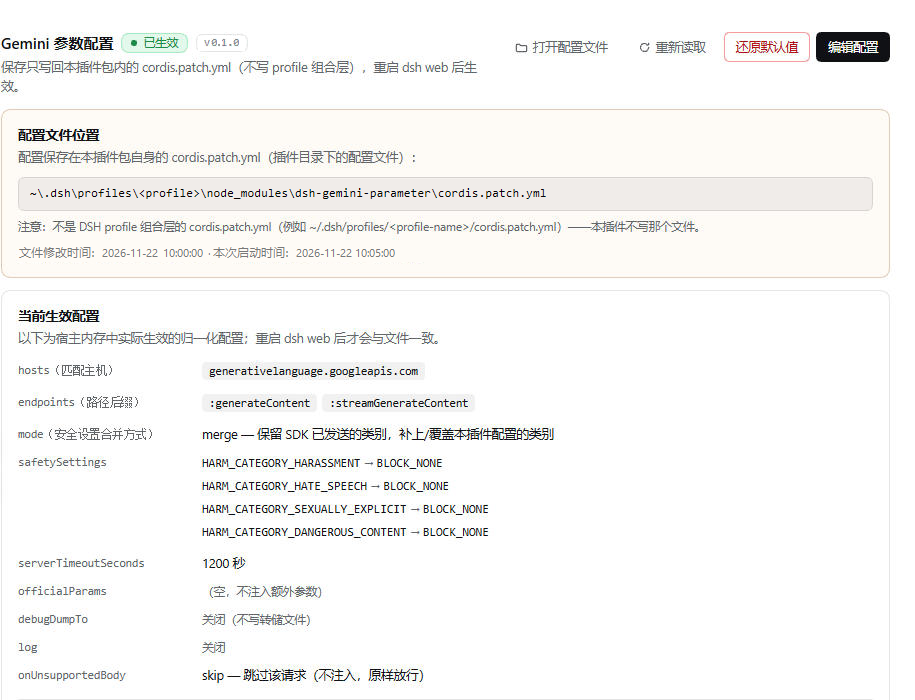
Read-only overview: an "applied" status badge and version, the configuration file location, the currently effective settings (hosts, endpoint suffixes, relayUnwrap prefixes with known-target annotations such as /bili/ → billion-context, safety thresholds, timeout), and per-session request counters.
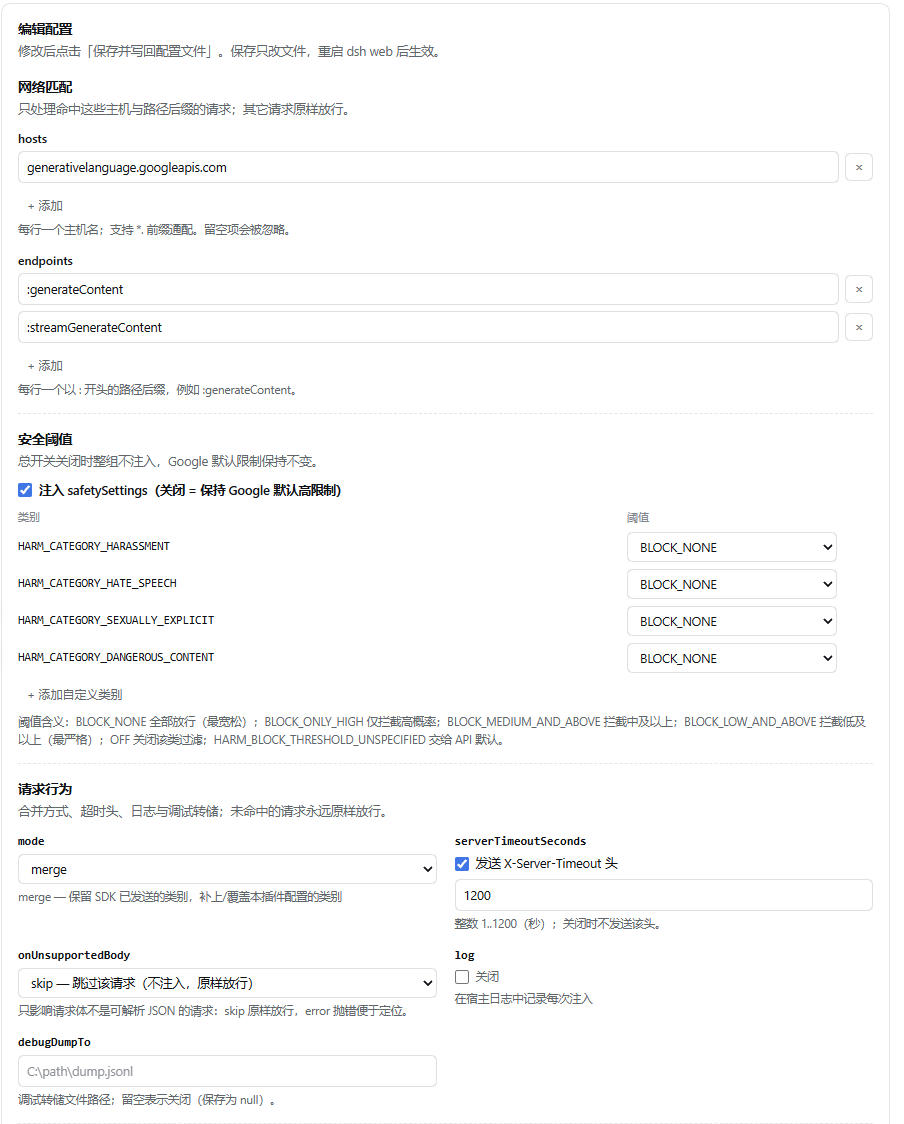
Edit form: host and endpoint-suffix matching, per-category safety thresholds, and request behavior options including merge mode, the X-Server-Timeout header, and the debug dump path. The full editor also covers the whitelisted officialParams fields; clicking Save validates on the host side, writes the package's cordis.patch.yml atomically (timestamped backup kept), and asks you to restart dsh web to apply.
UI shown in Simplified Chinese — the panel follows the DSH locale and falls back to English for non-Chinese locales.
5. Verifying it works
# unit tests (local mock fetch, no network)
npm test

# installed-profile config dump (PowerShell)
dsh --profile web --dump-config | Select-String -Pattern 'gemini-parameter' -Context 0,20
Additionally, set log: true or debugDumpTo: <path> to get one host-log line / one JSONL record per processed request. Seeing about two dump lines per agent step is normal — the main conversation request plus DSH's session-title generation request.
6. Uninstall / temporary disable
dsh plugin --profile web remove dsh-gemini-parameter
To temporarily disable without touching files, override the bundle line in the profile patch (- id: gemini-parameter + disabled: true), or use plugin_manager set_plugin.
7. Versioning
Semantic Versioning. While the version is 0.x, the public surface is still settling: minor bumps may contain breaking changes (config shape, panel behavior). From 1.0.0 on, strict semver applies. See CHANGELOG.md.
8. Development
git clone https://github.com/FatBadger217/dsh-gemini-parameter
cd dsh-gemini-parameter
npm test   # node --test, fully offline
No build step: lib/client.js is a hand-written module consumed directly by DSH's client ModuleLoader — keep it dependency-free (only react provided by the loader shell). Keep the zero-runtime-dependency rule for lib/ when contributing.
9. License
MIT — Copyright (c) 2026 FatBadger217