dsh-tavily (dsh-tavily)
moguiyu/dsh-tavily/packages/dsh-tavily
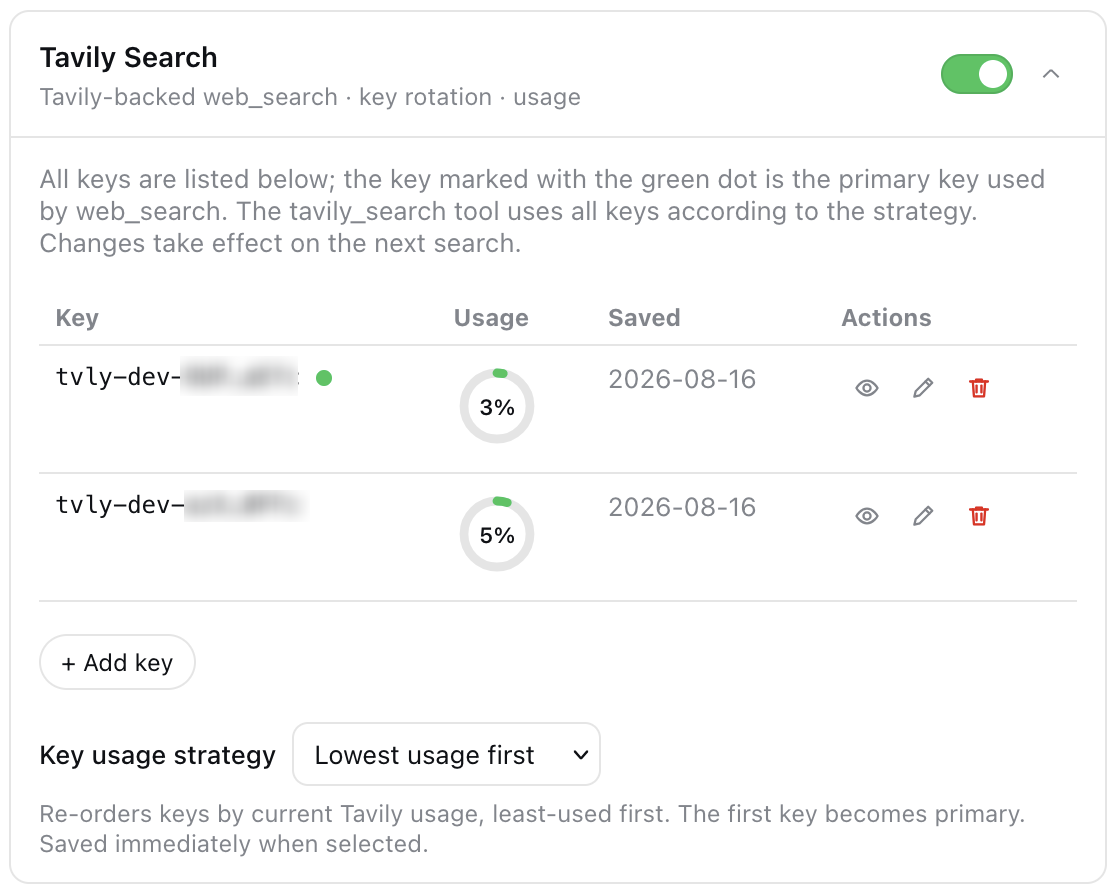
Tavily 搜索、提取、站点地图与爬取工具:多 Key 轮换,HTTP 401/429/432/433 故障转移,并提供按账号限制并发请求的负载均衡模式;插件配置页含密钥与用量卡片。内置 web_search 永不替换。
安装
dsh plugin --profile web add github:moguiyu/dsh-tavily该插件位于仓库的 packages/dsh-tavily 子路径下。
README
dsh-tavily
English | 简体中文


Tavily web search for DeepSeek Harness (DSH) — multiple API keys, rotation and failover, a live usage gauge, the direct extract / map / crawl tools, research for synthesized reports, and a key-management card on the Plugins page.
The built-in web_search tool is never replaced: Tavily is an addition to the native search, not a swap-in for it. This plugin registers no web-search provider and never rewrites web.searchProvider.
Highlights
- 🔑 Multiple Tavily API keys — manage a flat key list from the DSH UI.
- 🔁 Key rotation & failover — round-robin across keys; automatically retries on HTTP 401/429/432/433, and a load-balance mode caps in-flight requests per Tavily account.
- 📊 Live usage gauge — per-key Tavily usage and totals, fetched server-side without exposing keys.
- ⚡ Direct Tavily tools —
tavily_extractreads a known URL's content,tavily_mapdiscovers a site's links, andtavily_crawlpulls an entire site, all under the same key rotation. - 📝 Research reports —
tavily_researchruns Tavily's Research endpoint (mini/pro/auto), waits for the task and returns a synthesized, cited report;tavily_get_researchcollects one that was still running. Research costs far more credits than search (mini 4–110, pro 15–250), so it stays opt-in per call.
Install
From the Plugins page
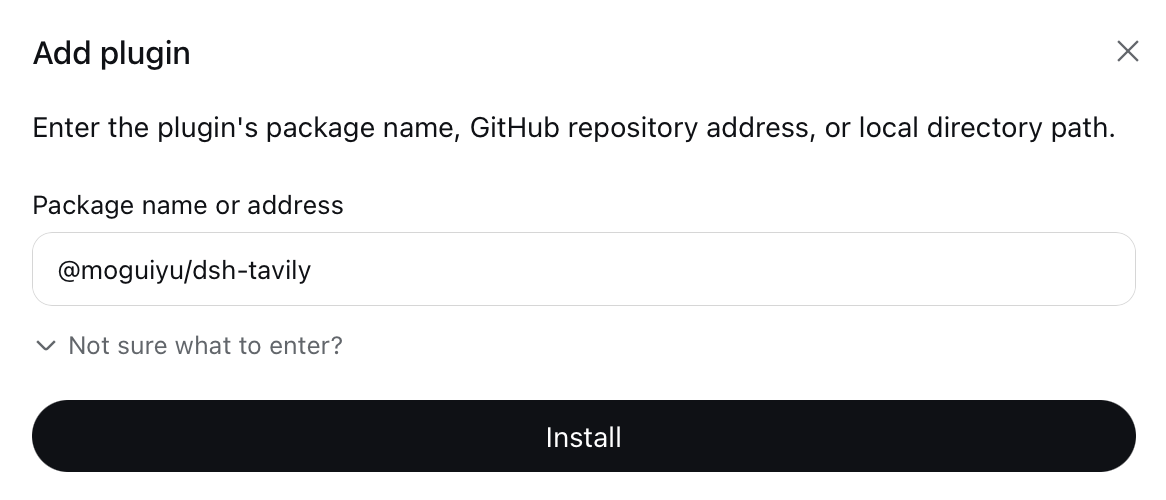
- Open Plugins in the DSH sidebar and choose Add plugin.
- Enter the npm package name
@moguiyu/dsh-tavily, or the GitHub addresshttps://github.com/moguiyu/dsh-tavilyfor the source. The field also takes a tarball or an absolute local path. - Press Install, then Enable now. A freshly installed bundle stays switched off until you enable it.
The card then renders on the dsh-tavily bundle's own page — between its description and its rows.
From the CLI
The dialog accepts exactly what dsh plugin add accepts, so either route works:
# from the npm release — the stable, marketplace-counted version
dsh plugin --profile web add @moguiyu/dsh-tavily

# from the repository — always the latest source
dsh plugin --profile web add github:moguiyu/dsh-tavily
--profile <name> picks the profile to install into; both forms resolve to the same plugin.
Requirements — DSH is a development preview (
0.1.x-rc/alpha,0.2.x-rc/alpha). The tools and the key/usage routes are verified on0.1.6-alpha.2,0.1.7-rc.2,0.2.0-rc.2and the0.2.1-alphaline, and are expected to work on every declared line back to0.1.0-rc.7— the peer range is deliberately wider than the verified store matrix. Both the card and the Plugins-page install route need0.1.6-alpha.2or newer, the release that added the Plugins page and moved plugin configuration there; on older lines the plugin is fully functional and installs from the CLI, it simply has no card. The npm name is the scoped@moguiyu/dsh-tavily, not the similarly-named communitydsh-tavilyprovider-swap plugin.
Compatibility —
0.3.xis a single self-contained package: the tools, the routes and the card all live in@moguiyu/dsh-tavily, which uses only the long-stablectx.tools/ctx.webServer/ctx.credentials/ctx.systemPromptseams. There is no version-specific code path left to feature-detect. Peer ranges list one comparator per host tuple (^0.1.0-rc.7,^0.1.1-rc.1,^0.1.2-alpha.2,^0.1.3-alpha.1,^0.1.5-0,^0.1.6-0,^0.1.7-0,^0.2.0-0,^0.2.1-0), because prerelease comparators never cascade — a new host line means a new comparator, not a widened old one.dsh.compatibility.dshReleasesis the narrower, actually-verified store matrix: a rolling window over the last few host lines, not a historical ledger. Both are generated from one file,compatibility.json, so they cannot drift apart.
Packages
One package. Earlier releases also shipped @moguiyu/dsh-tavily-backend and @moguiyu/dsh-tool-tavily-search. From 0.3.0 both are folded into @moguiyu/dsh-tavily, which is now self-contained; the two old packages are deprecated and no longer updated.
| Package | Role |
|---|---|
@moguiyu/dsh-tavily | Everything: tavily_search + tavily_extract / tavily_map / tavily_crawl + tavily_research / tavily_get_research, the key/usage routes, and the Plugins-page card |
Credentials
TAVILY_API_KEYS— comma-separated key list; the tools rotate through it, retrying on HTTP 401/429.TAVILY_API_KEY— primary key auto-synced to the first key.
Both are managed automatically by the card. Keys never leave the server unmasked, and no state file holds key material.
Key usage strategy
- Rotate each key — round-robin; on HTTP 401/429/432/433 the next key is tried.
- Lowest usage first / Highest usage first — re-order keys by live Tavily usage on save.
- Load balance — keep at most N requests in flight per Tavily account (1 by default) and spread concurrent calls across accounts, so one free account is never hit in parallel. Tavily's 100 requests/minute applies per account, and several keys can share one account; the grouping is inferred from each key's
accountblock on/usage, and any key can be pinned or split off by hand in the card's Account column.
Keys that cannot serve a request are skipped rather than failing the call: 401, 429, 432 (plan limit) and 433 (pay-as-you-go limit) all fail over to the next key, and every key is tried at most once per call.
Tavily tools
tavily_search plus the direct tools and the research pair, all independent of web_search:
tavily_search— full search surface (search_depth,topic,days, domain filters,include_answer,include_raw_content);tavily_extract— pull the complete content of known HTTP(S) URLs;tavily_map— discover a site's links without fetching page content;tavily_crawl— crawl a site and return the extracted content of its pages;tavily_research— queue Tavily's Research endpoint and wait for a synthesized, cited report (model:mini/pro/auto, pluscitation_format,output_length, domain filters and an optionaloutput_schema);tavily_get_research— collect a research task byrequest_idwhen it outlived the first call.
tavily_research polls the task and returns the report when it finishes; timeout_seconds: 0 queues it
and returns the id immediately. mini suits narrow questions (observed live: ~11 s, 9 credits) and
pro broad ones (minutes). Because research is billed dynamically and far above search — mini
4–110 credits, pro 15–250 — it is a per-call choice, not a default.
Composing the plugin registers them; there is no separate tool-level switch. To turn them off, disable the plugin with the toggle on its Plugins page — the built-in web_search keeps its native provider either way, and its schema is never touched.
State files
~/.dsh/tavily-manager.json— saved key dates, strategy, per-account concurrency cap, and the inferred/pinned account grouping (masked names only)
Mode 600, no secrets stored.
Development
pnpm install
pnpm test
pnpm build
License
MIT