session-watcher (dsh)
nomadop/session-watcher/dsh
显示继续携带会话上下文何时比重启更贵,并支持只带选定的文件与技能原地交接。
安装
dsh plugin --profile web add github:nomadop/session-watcher该插件位于仓库的 dsh 子路径下。
README
Session Watcher
LLM context economics, in your terminal.
Session Watcher treats your prompt cache as inventory — it uses EOQ theory to measure whether the current context is still worth carrying, tracking restart pressure so you can decide when to hand off.



Documentation · npm · Paper · llms.txt
Quick Start · Install · DSH · How It Works · Context Buckets · Handoff · MCP Tools · Agents · Cite
What it does
Session Watcher reads your Claude Code transcript in real time and answers one question: is this session still worth carrying?
Most context tools optimize how you consume tokens — Headroom compresses, /compact shrinks, RTK filters. Session Watcher tracks when the cost curve is drifting, giving you the data to decide. They compose: run any pruning strategy you like, SW measures the cost curve so you can decide when to hand off.
SW reads from the transcript, never writes to it. The dashboard and statusline are pure observers; MCP tools return data for you to act on.
How it works
Your coding agent (Claude Code)
        │  writes session transcript
        ▼
┌───────────────────────────────────────────────────────┐
│  Session Watcher (in-process MCP server)              │
│  ───────────────────────────────────────────────────  │
│  harness/claude-code  — read rows, emit observations  │
│  measurement/engine   — B (context belief), epochs    │
│  session-watcher      — apply frames, run operations  │
│  rate-lamp            — rent ledger + wallet clock    │
│  server.js            — Express + SSE dashboard       │
│  statusline           — one-line shell client         │
└───────────────────────────────────────────────────────┘
        │  dashboard  ·  statusline  ·  MCP
        ▼
   Your browser / terminal status bar
The harness layer is the only part that knows Claude Code: it reads transcript rows, decides the active branch, and emits normalized observations. Everything below it — measurement, dialogue history, handoff — consumes those observations and carries no transcript format, no row shape, and no tool name of any particular agent.
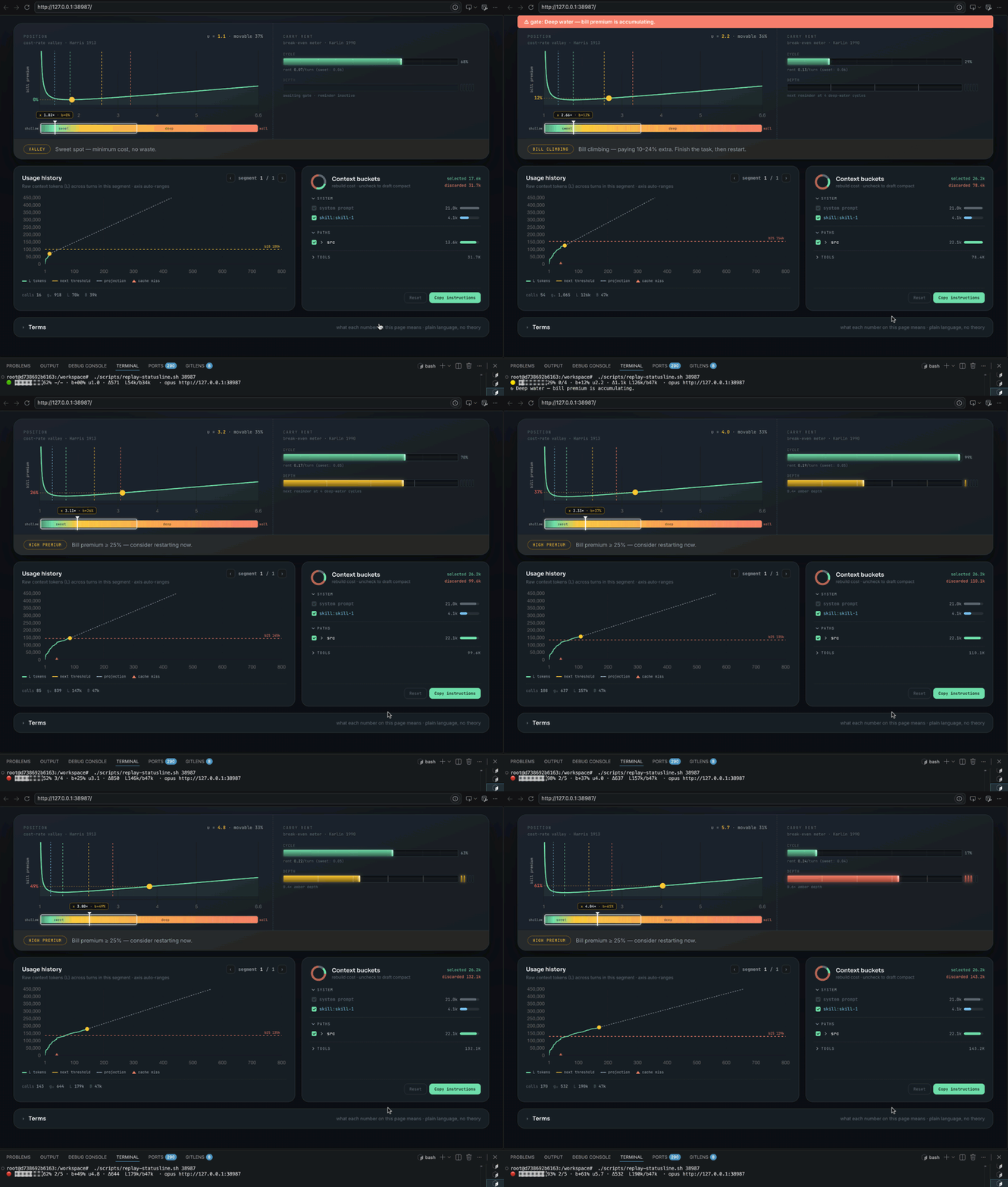
Core model: L = cache_read_input_tokens — the context stock you are renting. B is the rebuild baseline: the session's overhead floor plus the tokens of every file, skill and tool it has pulled in, which is what a restart would have to re-read. g is the growth no path accounts for, a smoothed ΔtotalStock − ΔB. x = L / B is the raw position ratio; the authoritative position is u, which every call advances by its own fraction of the restart interval that held while it ran, so the position records the path travelled rather than a ratio of today's numbers, and each landmark on the x axis is read off the reference skeleton fitted across that path. br = mf × pp is the bill premium — how much you are overpaying relative to ideal restart timing. The restart reminder is separate: it reads the rent the ledger has accumulated, so no revision of the position can withdraw one.
Lamp thresholds are the named constants BR_AMBER and BR_RED in lib/bill-regret.js: below the amber one the lamp is green, between them amber, at or above the red one red. See the paper for the full derivation — EOQ inventory theory mapped to LLM prompt caching.
Quick Start
Requires Node.js ≥ 22.16.
# Try without installing — self-contained demo
npx -y @nomadop/session-watcher demo

# Replay your own transcript
npx -y @nomadop/session-watcher replay ~/.claude/projects/<project>/<session>.jsonl
Opens a browser dashboard. The demo uses a pre-built anonymized session; replay uses your real transcript. Both are read-only — nothing is modified or uploaded.
Install
Plugin (recommended)
# 1. Add the marketplace (one-time)
claude plugin marketplace add nomadop/session-watcher

# 2. Install the plugin
claude plugin install session-watcher@session-watcher
Or from within a Claude Code session:
/plugin marketplace add nomadop/session-watcher
/plugin install session-watcher@session-watcher
/reload-plugins
This registers:
- MCP tools — available in every session
- SessionStart hook — points the running watcher at a new session and announces pending handoffs
If you installed or updated in an already-running session, run /reload-plugins to activate.
DSH plugin
@nomadop/session-watcher-dsh runs Session Watcher inside DeepSeek Harness (DSH), with a tab, a composer dock, the MCP tools, skills and handoff commands. Its README has the install command, screenshots and limits; the DSH plugin docs cover the rest, including replay of a DSH session log.
Statusline
The plugin system does not yet support declaring a statusline. Add to your ~/.claude/settings.json:
{
  "statusLine": {
    "type": "command",
    "command": "<plugin-install-path>/dist/statusline.js"
  }
}
Find your plugin path with:
find ~/.claude/plugins/cache -path '*/session-watcher/*/dist/statusline.js' -print
Or check via claude plugin details session-watcher@session-watcher.
Note: the plugin cache path changes on version update. After updating, re-run the command above and update your statusline path.
One compact line:

Context Buckets
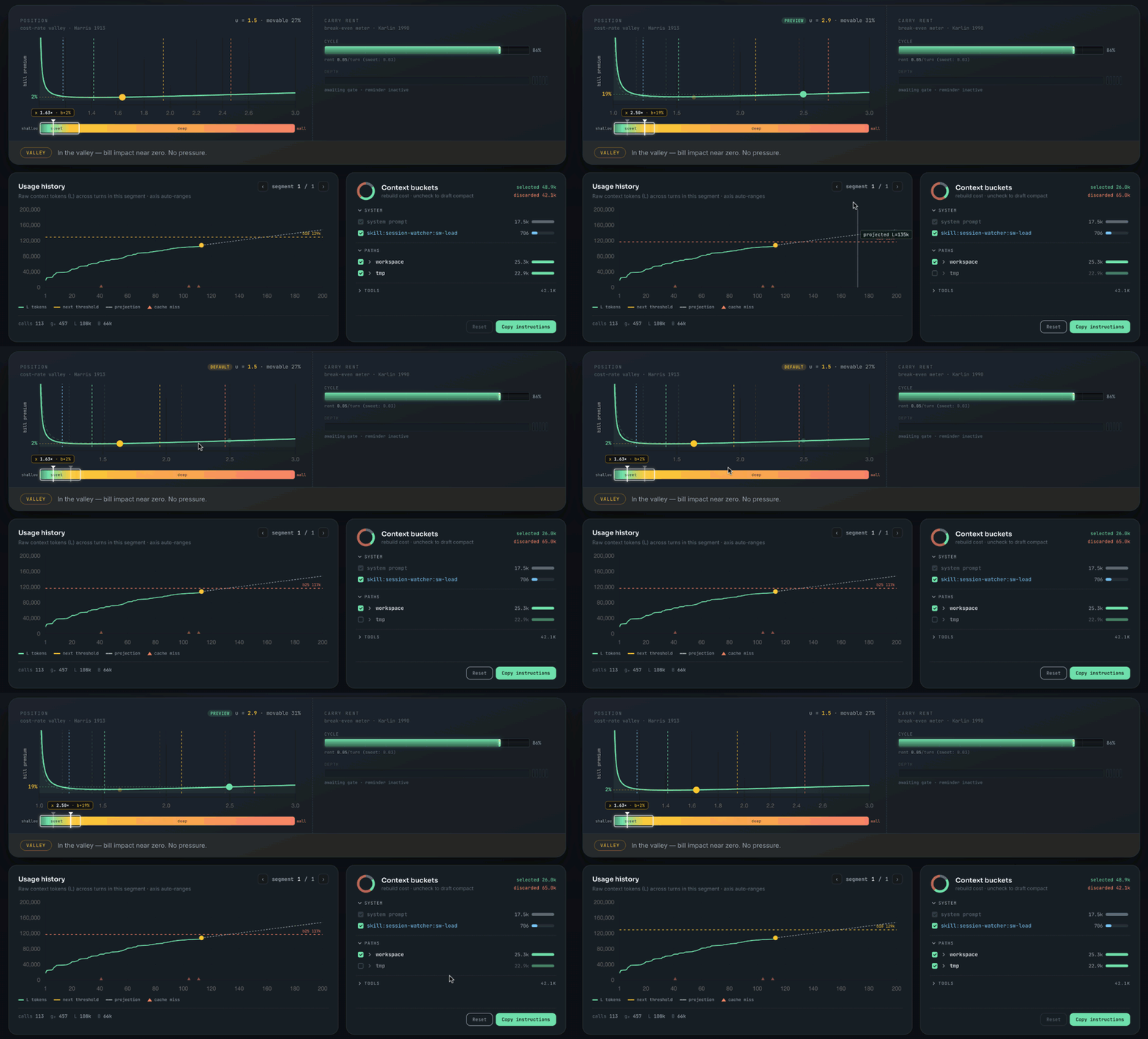
The bucket panel shows exactly which files, skills, and tools are consuming your context budget. Each path carries a token count — check or uncheck to preview how the restart cost changes. The U-curve ghost line updates in real time as you toggle.
Handoff
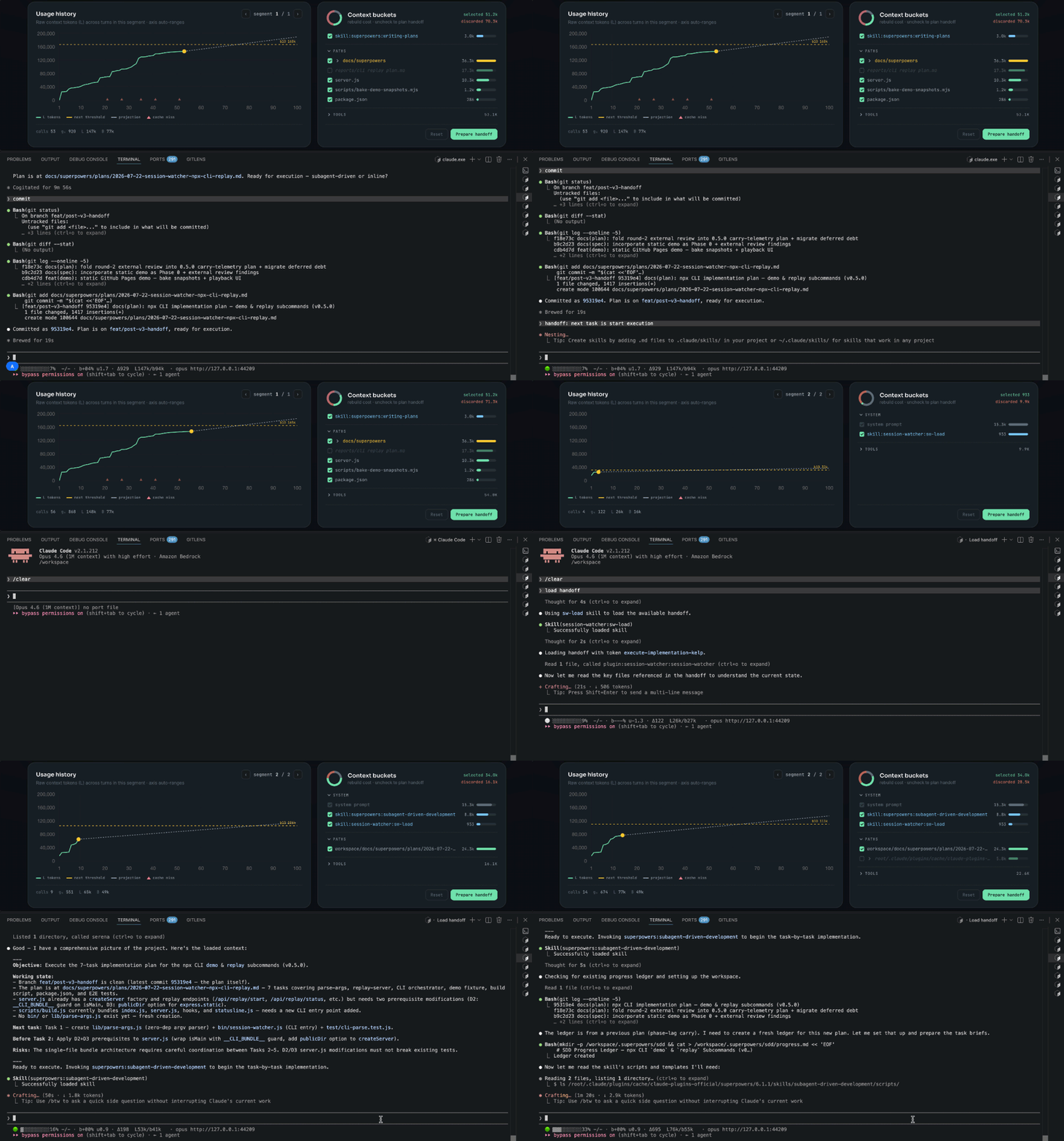
When it's time to restart, handoff preserves the state you want to keep. Run /sw-handoff to prepare a package — selected paths, working summary, next task. Then /clear, and in the fresh session run /sw-load to restore. Only what you chose is rebuilt — less ramp-up, less waste.
MCP Tools
Both plugins register the same tools, except for rotate_session and load_handoff, which only Claude Code registers. The Guarantees page tables them once, with where the two hosts differ.
Agent support
Session Watcher is agent-agnostic. Everything below the harness layer consumes normalized observations, so it never learns which agent produced the session.
| Agent | Driver | Status |
|---|---|---|
| Claude Code | JSONL tail (native) | ✅ |
| DSH (DeepSeek Harness) | session event log (native) | harness ✅ · plugin ✅ |
| OpenCode | adapter-ready | pending |
| OpenClaw | adapter-ready | pending |
| Hermes | adapter-ready | pending |
| Aider | adapter-ready | pending |
Adding a new agent means writing a harness for it under lib/harness/<agent>/: a source driver that turns that agent's own session evidence into normalized observations, a thin measurement projection adapter over the shared lib/measurement-projection.js, a tool-evidence profile that names the agent's residual calls, its handoff-loading tool and any resource that is not a file (the interpreter that matches tool output against the files on disk is shared), the dialogue source and history turn rules that read its conversation, and the recovery sentences that tell a reader how to open a turn it cites. The engine, dialogue history, handoff, and every product surface are shared and need no change. See lib/harness/claude-code/ for the reference harness and lib/harness/dsh/ for a second one. PRs welcome.
Paper
Context Is Inventory: A Rent-or-Buy Model for Prompt-Cached LLM Sessions Longju Cheng (2026) · DOI:
10.5281/zenodo.21236704
The paper derives the full theoretical specification: EOQ→LLM mapping, the 41.4% movable-cost bound, the ski-rental restart strategy, and measurements on 1,016 real session transcripts. Read it at the DOI above.
Uninstall
claude plugin uninstall session-watcher@session-watcher
# Remove state directory (optional):
rm -rf ~/.session-watcher
Test
npm test              # unit + integration (node:test)
npx playwright test   # E2E (requires running server)
Citation
@unpublished{cheng2026context,
  author = {Longju Cheng},
  title  = {Context Is Inventory: A Rent-or-Buy Model for Prompt-Cached LLM Sessions},
  year   = 2026,
  doi    = {10.5281/zenodo.21236704},
  url    = {https://doi.org/10.5281/zenodo.21236704},
  note   = {Preprint}
}
Privacy
- No remote telemetry.
- Transcripts are read locally and never uploaded.
- Files a transcript names are read locally to attribute tool output to their lines; their content stays in memory and is never uploaded.
- Local aggregate usage and handoff records are stored under
~/.session-watcher. - No transcript prose or file contents are stored in telemetry.
- Each tool call's file attribution is stored with its session as paths, line numbers, character counts and a hash of each line, plus the name of the tool or command that made the call (for a shell command, also its main argument) — no file contents.
- Removing
~/.session-watcherdeletes all local state, except the Turn Notes a DSH session prepared and has not yet submitted successfully, which sit under the system temp directory.
License
MIT