dsh-manuscript-check
perrylink/dsh-manuscript-check
DeepSeek Harness 的投稿前检查清单:稿件结构与声明语句、基于关键词的 CONSORT/STROBE/PRISMA 起步条目覆盖(含位置与建议)、投稿包扫描(稿件、投稿信、编号图、表、补充材料、声明,并检测缺号),输出 JSON/Markdown 报告。只是检查清单,不是合规结论。
安装
dsh plugin --profile web add github:perrylink/dsh-manuscript-checkREADME

dsh-manuscript-check
当前版本 0.1.5。
A pre-submission checklist — not a compliance verdict.
Sections and declarations with character locators, starter CONSORT / STROBE / PRISMA item coverage (14–18 items), and a submission-directory scan with JSON + Markdown reports.
简体中文 · Español · Português · हिन्दी


What it does
manuscript_check— detects title/abstract/introduction/methods/results/discussion/conclusion, the usual declarations (ethics, consent, funding, conflicts, data availability, contributions, registration), and checks one guideline (manuscriptdefault,consort,strobe,prisma, orautofrom the wording). Missing items come with advice; present items carry the character range that matched.reporting_check— several guidelines at once, a flat missing-item list ready to paste into a submission checklist.submission_pack— scans a submission directory for manuscript, cover letter, numbered figures (detects numbering gaps), tables, supplements and declarations; writes a JSON + Markdown pack report.

Structure: analyze → check → record; missing[] and analysis are the two outputs, the pack scan writes JSON + Markdown under root, and a keyword match is presence, not adequacy. The token labels inside the diagram are the real function, tool and field names, so the same picture serves all five languages.
What it does not do
- No compliance verdict. Presence is detected by keyword patterns. A statement written in different words can be missed, and a present keyword does not mean the content is adequate. The README and tool descriptions say this; so does every report.
- No PDF/DOCX parsing. Convert to
.md/.txt/.tex, or extract PDF text withdsh-doc-anchor. - No full guideline reproduction. These are starter checklists (14–18 items), not the certified CONSORT/STROBE/PRISMA checklists.
- No upload, no conversion, no renaming. The pack scan reports; it never moves a file.
- No journal-specific rules (word limits, reference styles): those belong to a journal profile, not this plugin.
Coverage targets
| Guideline | Items | Target |
|---|---|---|
manuscript (structure + declarations) | 14 | 80% |
consort (starter) | 18 | 75% |
strobe (starter) | 16 | 75% |
prisma (starter) | 17 | 75% |
Coverage below the target is flagged as "below target"; it is not an error.
Tools
manuscript_check
{ text? | path?, guideline?, persist? } → { ok, analysis, evidenceId?, recordPath? }.
analysis = { sections, missingCoreSections, wordCount, results[], notes }.
reporting_check
{ text? | path?, guidelines?: string[] } → { ok, analysis, missing[], evidenceId? }.
submission_pack
{ path?, recursive? } → { ok, pack, exports: {json, markdown} }.
Error codes
INVALID_INPUT · NOT_FOUND · PATH_ESCAPE · NOT_A_FILE · NOT_A_DIRECTORY · TOO_LARGE · UNSUPPORTED_FILE · STORE_ERROR
Compatibility & install
| DeepSeek Harness | dsh-v0.2.3-alpha.1 (verified 2026-11-22); peer >=0.2.1-0 <0.3.0 || >=0.2.2-0 <0.3.0 |
| Node | ^22.19.0 || >=24.9.0 (tested 24.22.1), ESM only |
| Peers | @perrylink/dsh-research-core ^0.1.0, @deepseek-ai/cordis ^4.0.5-alpha.1, @deepseek-ai/dsh-tools, @deepseek-ai/schemastery ^3.18.5-alpha.1 |
| Runtime dependencies | zero |
dsh plugin --profile <name> add @perrylink/dsh-research-core dsh-manuscript-check
dsh --profile <name> --dump-config | grep dsh-manuscript-check
Configuration
| Key | Default | Meaning |
|---|---|---|
enabled | true | false mounts nothing |
root | .manuscript-check | store, records and exports root |
workspaceRoot | process.cwd() | manuscript paths must resolve inside it |
maxChars | 2000000 | hard cap (fails; never truncates) |
persist | true | store the checked text as REP evidence + record |
Security boundaries
- Read-only on the manuscript; the only writes are under
root. - Path containment with
realpath(symlink escapes rejected). - Character cap fails loudly instead of truncating; a file is byte-capped before it is read, so an oversized file cannot exhaust memory.
- PDF/DOCX are rejected with a clear message rather than parsed unsafely.
Evaluation
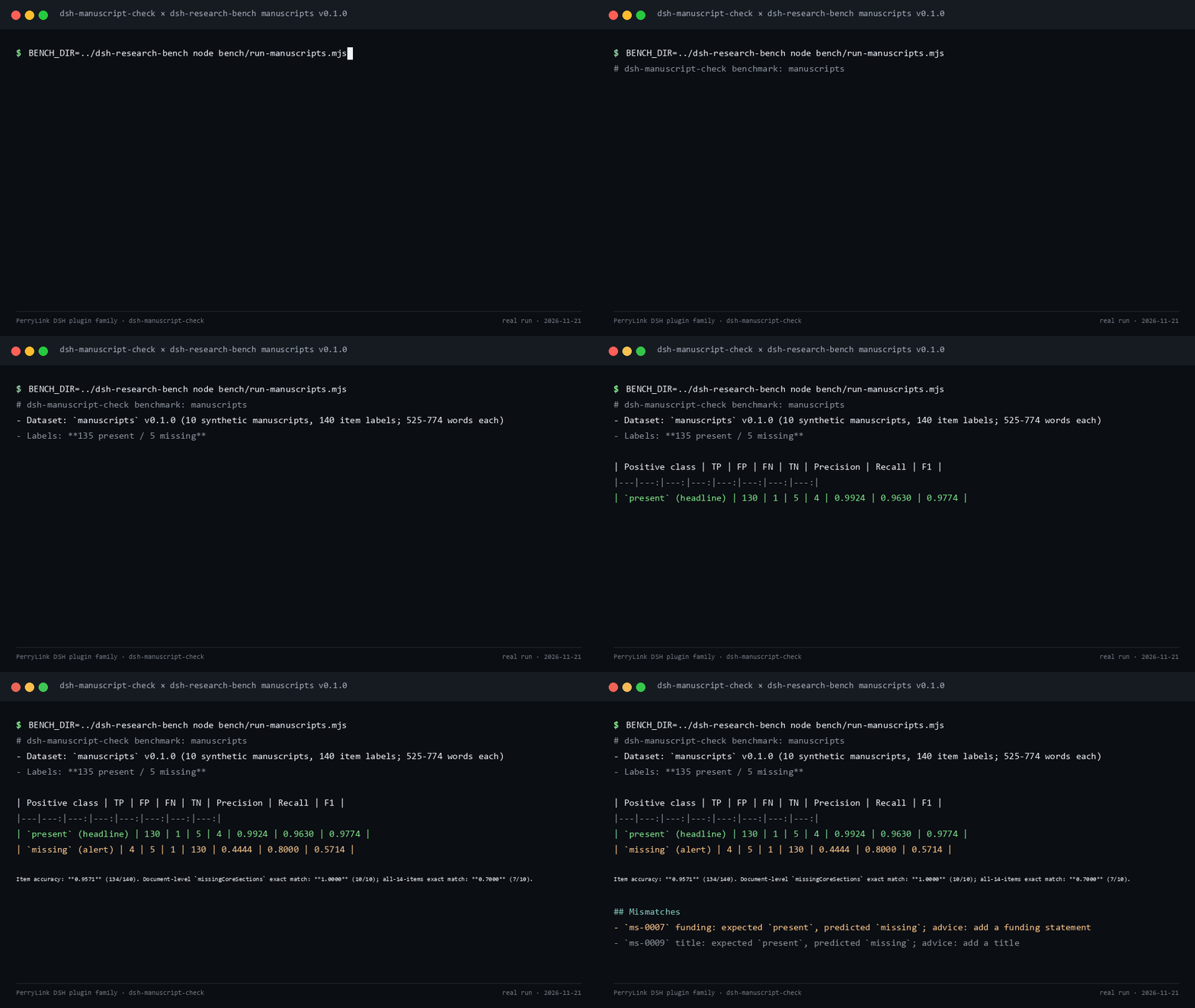
Animated: the real stdout of node bench/run-manuscripts.mjs over the frozen dsh-research-bench manuscripts dataset (BENCH_DIR points at the sibling checkout; no network, deterministic output; re-run 2026-11-21). The last two lines are two of the six measured item misses — four of them are in the content-complete STROBE manuscript — and they are reported, not hidden.
22 tests: section splitting (markdown + plain + mixed markdown-title/plain-section), guideline coverage (complete CONSORT-style fixture ≥90%, missing items with advice, locators), auto-detection, guideline catalogue, pack scanning (complete pack, figure gap, missing declarations, not-ready without a manuscript), runtime (REP record validity, auto guideline + file reading, traversal/binary/oversize rejection including a pre-read byte cap, pack exports), tools (schemas, flat missing list, failure branch), package contract.
Synthetic manuscript benchmark
A separate deterministic benchmark (dataset manuscripts v0.1.0, frozen) lives in the sibling dsh-research-bench repository under data/manuscripts; it is not vendored into this package. Ten 300–800-word synthetic manuscripts (525–774 words each; 6,361 total) carry 140 item labels from the 14-item manuscript guideline (135 present / 5 missing), plus a document-level missingCoreSections label.
Coverage: complete CONSORT-style trial, missing ethics/consent, missing data availability, missing randomization/registration, missing abstract, missing statistical methods, STROBE-style cohort, PRISMA-style review, a plain-text title without markdown #, and a mixed Chinese-English title.
The adapter calls analyzeManuscript(text, [guidelineOf('manuscript')], ['manuscript']) once per manuscript and writes bench/results-manuscripts.json and bench/results-manuscripts.md (no timestamps; re-running is byte-identical).
pnpm run bench:manuscripts # builds, then reads ../dsh-research-bench/data/manuscripts (BENCH_DIR overrides)
| Metric | TP | FP | FN | TN | Precision | Recall | F1 |
|---|---|---|---|---|---|---|---|
Item presence (positive = present, headline) | 130 | 1 | 5 | 4 | 0.9924 | 0.9630 | 0.9774 |
Missing-item alert (positive = missing) | 4 | 5 | 1 | 130 | 0.4444 | 0.8000 | 0.5714 |
- Item accuracy 0.9571 (134/140); per-document accuracy ranges from 0.7143 to 1.0000.
- Document-level
missingCoreSectionsexact match 10/10 (1.0000). - All 14 items are exact on 7/10 documents.
Measured misses (labels were not changed). Four of the five presence misses are in the content-complete STROBE manuscript: funding ("supported by"), conflicts ("competing financial interests"), data ("dataset is deposited"), and contributions (a roles line with no "Author contributions" or CRediT cue). The fifth is the plain-text title: the title cue requires # or Title:, so a standalone plain title line is missed. The single false present is abstract in the missing-abstract manuscript, where "In summary" in the discussion matches summary. Because missing alerts are what a user acts on, the alert row matters: four missed present items plus the plain title become five false alarms, so alert precision is 0.4444 even though presence coverage is high.
Label-space limit. The 14-item manuscript guideline has no statistical-methods or randomization item. ms-0004 (no randomization/registration) and ms-0006 (no statistical methods) exercise those content gaps, but only ms-0004's missing registration is scored; ms-0006 is all-14-present by construction. Do not cite this benchmark as evidence that those two gaps are detected.
Validity caveat. The ten synthetic manuscripts and the keyword rules were authored by the same project. This is a regression baseline, not an unbiased estimate of real-manuscript accuracy. Labels are fixed by the generator; none was changed after seeing the detector.
Known limitations (v0.1)
- Keyword detection: different wording → false "missing"; keyword present → not an adequacy check.
- English cues only; Chinese manuscripts need their own cue lists.
- No journal-specific requirements (word count, reference style, ORCID, submission-system metadata).
- Pack scan is depth-limited and filename-based; embedded tables are not detected.
License
Apache-2.0. No third-party runtime code.