skillroute
erichare/skillroute
DeepSeek Harness (dsh)-Bundle, das den Skill-Router von SkillRoute in Ihre Agenten einbindet.
Installation
dsh plugin --profile web add github:erichare/skillrouteREADME


15 harnesses · 3 MCP tools · 4 retrieval backends · full SKILL.md bundle indexing · zero runtime dependencies
Install · What you get · Skill Atlas · Trust · Observability · How it works · Docs
Built on the Agent Skills open standard. Every bundle SkillRoute indexes is checked against the specification, and the standalone validator doubles as a CI gate for skill authors.
Most agents choose a skill from a one-line description and hope for the best. SkillRoute treats your
skill library like a real corpus: it parses complete SKILL.md bundles — headings, triggers,
templates, relationships — ranks them with confidence and source evidence, returns a
clarification question instead of a guess when the route is uncertain, and serves the whole thing to
any agent over MCP. One SQLite file, no services to run; add the Astra DB backend when you outgrow it.
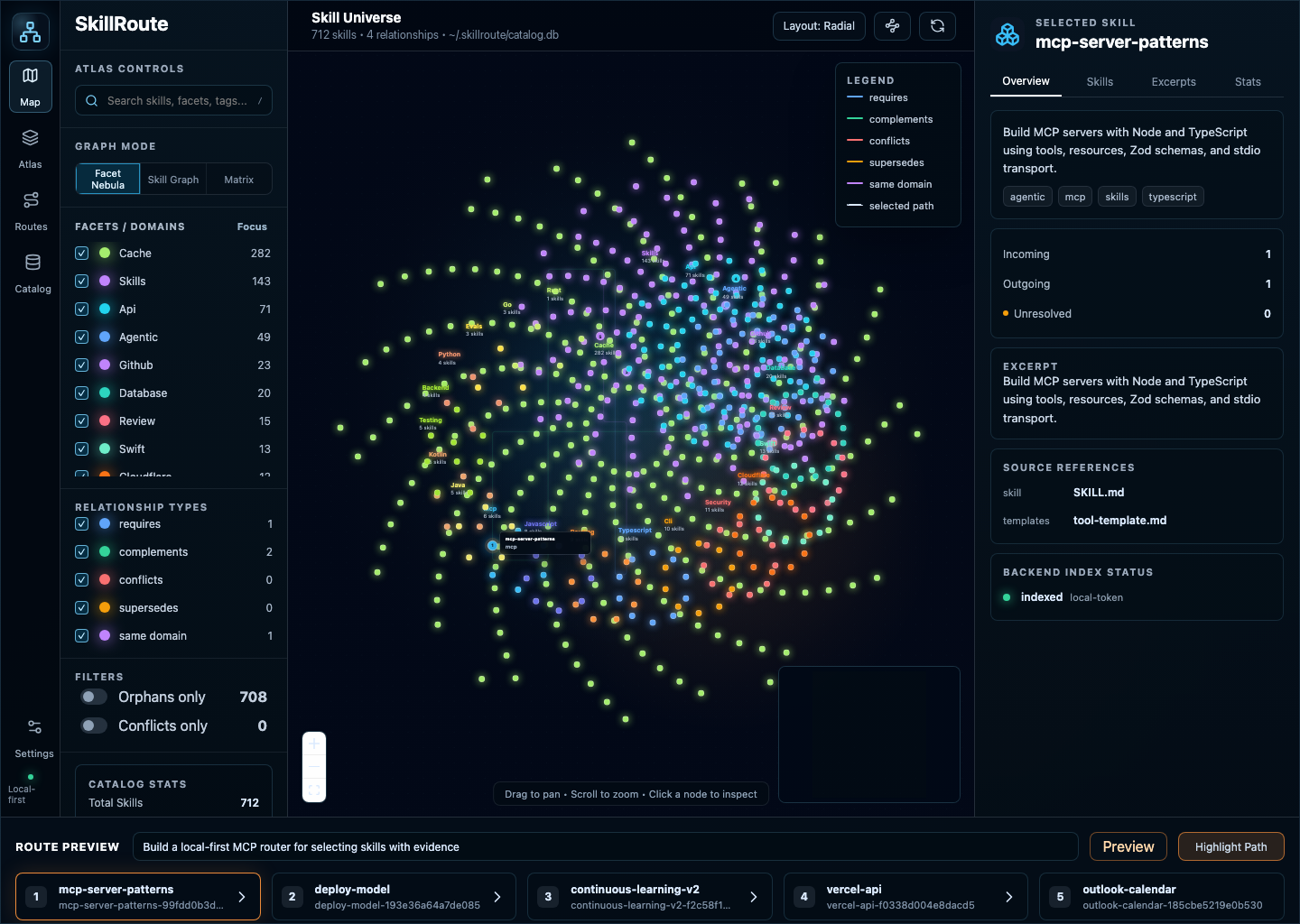
Skill Atlas — every skill in your library on one interactive map, with live route previews.
Install
Three ways in — pick one.



One-line installer
curl -fsSL https://raw.githubusercontent.com/erichare/skillroute/main/scripts/install.sh | bash
Confirms each step before it runs: clones or updates SkillRoute, installs dependencies, builds the
MCP server and Skill Atlas, indexes starter skills, then detects your agent clients and offers setup
for each one (JSON edits are backed up first). Add -s -- --yes for unattended installs.
From PyPI or npm
uv tool install "skillroute[ui]"     # or: pipx install "skillroute[ui]"
skillroute index --root ./skills
skillroute route "Build an MCP server that exposes routing tools"
Zero-install works too — uvx --from skillroute skillroute route "…". The MCP server is published
separately as @skillroute/mcp-server if you
want to run it straight from npm.
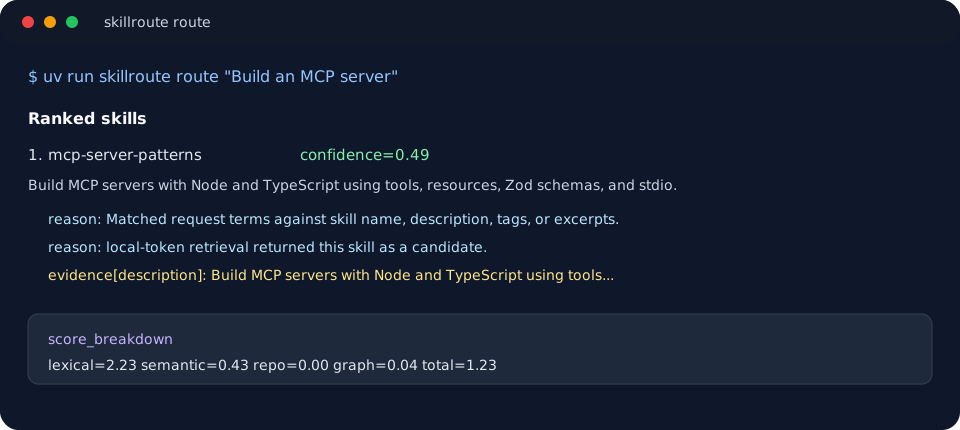
Actual text output
Ranked skills:
1. mcp-server-patterns (mcp-server-patterns-99fdd0b3d944c32a) confidence=0.3563
   Build MCP servers with Node and TypeScript using tools, resources, Zod schemas, and stdio transport.
   reason: Matched request terms against skill name, description, tags, or excerpts.
   reason: local-token retrieval returned this skill as a candidate.
   reason: Skill graph relationships provide supporting context.
   evidence[description]: Build MCP servers with Node and TypeScript using tools, resources, Zod schemas, and stdio transport.
   evidence[headings]: MCP Server Patterns; When to Use
2. python-testing (python-testing-19ef6ae9ced445b2) confidence=0.1373
   Test Python applications with pytest fixtures, parametrization, temporary paths, and regression coverage.
   ...
The default catalog lives at ~/.skillroute/catalog.db. A .skillroute/catalog.db in the working
directory is used instead when one already exists, so existing project catalogs keep working; point
elsewhere with --catalog <path> or SKILLROUTE_CATALOG_PATH.
Wire up your agent
The bundled MCP server exposes three tools over stdio — skillroute.route, skillroute.search, and
skillroute.inspect_skill. One command writes the config for your harness:
skillroute harness install claude-code
skillroute harness detect        # what is installed here
skillroute harness list          # everything SkillRoute knows about
amp · claude-code · claude-desktop · codex · cursor · deepseek · gemini-cli · goose ·
hermes · ibm-bob · opencode · pi · vscode · windsurf · zed
Each one is a single declarative manifest in harnesses/, so adding a new tool is
usually a data change with no Python — see Harness Packs.
DeepSeek Harness — installs as a bundle instead
dsh plugin --profile web add @skillroute/dsh-plugin
The bundle registers SkillRoute's MCP server through dsh's built-in @deepseek-ai/dsh-mcp-client,
giving agents mcp__skillroute__route, mcp__skillroute__search, and
mcp__skillroute__inspect_skill. The Python core is zero-install when uv is present (the bridge
runs uvx --from skillroute); otherwise pipx install skillroute once. See
dsh-plugin/README.md.
What you get
| Component | What it does | Ships in |
|---|---|---|
CLI skillroute | Index, route, search, inspect, validate, traces, evals, harness setup | PyPI wheel |
| MCP server | Three stdio tools: route · search · inspect_skill | npm @skillroute/mcp-server, bundled in the wheel |
| Skill Atlas | FastAPI + React Flow graph explorer, facet nebula and matrix views | wheel, [ui] extra |
| Harness packs | 15 declarative manifests, 6 install modes (mcp · acp · skills · hook · extension · router_skill) | wheel |
| Retrieval backends | local token · SQLite FTS5 (BM25) · Astra DB Data API · LangChain adapter | wheel |
| Spec validator | Agent Skills compliance check, usable as a CI gate | wheel |
| DeepSeek bundle | dsh plugin wiring the MCP server into DeepSeek Harness | npm @skillroute/dsh-plugin |
Zero runtime dependencies. Routing, indexing, search, and harness setup are stdlib-only. FastAPI
and uvicorn live in the ui extra, so an install that never opens the Skill Atlas never fetches a
Rust extension.
Spec compliance
skillroute validate examples/skills               # report
skillroute validate --strict                      # fail on warnings too
skillroute index --root examples/skills --strict  # refuse non-compliant bundles
Spec check (https://agentskills.io/specification): 4 bundles, 0 errors, 0 warnings
See Spec Compliance for the full rule set.
Trust
Spec compliance is a correctness check, not a security one — a bundle can be perfectly valid and
still tell your agent to read ~/.aws/credentials. A skill's body is instructions the model obeys,
so a skill library is a supply chain, and the nastiest failure is the rug-pull: a bundle you
reviewed is edited later, its name and description untouched, and nothing in the index looks
different.
toolprint closes that gap. It hashes each bundle — frontmatter and body — into a committed lockfile, and scans the prose for injection patterns:
npx toolprint pin  --skills ./skills     # commit toolprint.lock
npx toolprint scan --skills ./skills     # a body-only edit now fails
SkillRoute gates itself the same way: toolprint.lock pins this repo's own MCP server and example
skill library, and CI verifies both on every pull request. See Security.
Skill Atlas
Your whole library, mapped. Facet nebula, skill graph, and matrix views; filters for domains, relationship types, orphans, and conflicts; a detail panel with excerpts and source references; and a route preview bar that highlights the chosen path through the graph.
skillroute ui
Route observability
Every route is a trace you can replay: inputs, candidates, scores, and the evidence behind each decision. Golden-route evals keep your catalog honest as it grows.
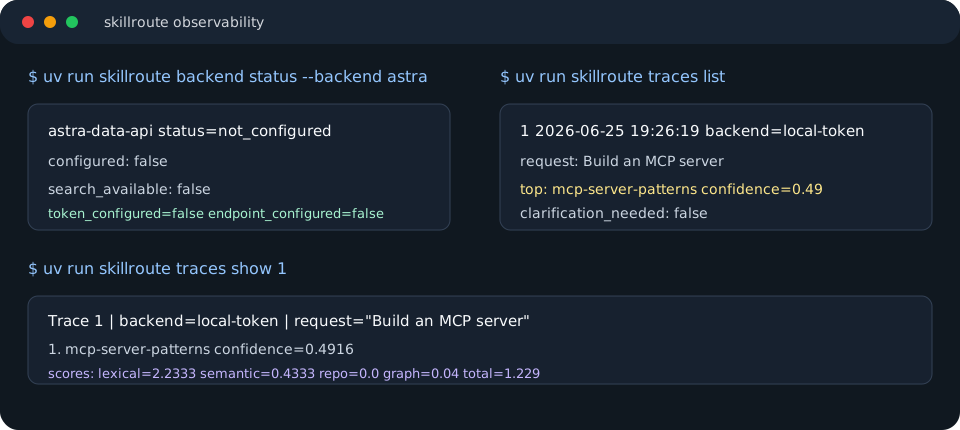
skillroute traces list
skillroute eval run --fresh --index-root examples/skills --cases examples/evals/golden_routes.json
How it works
flowchart LR
    A["SKILL.md bundles"] --> B["Indexer<br/>parser + metadata review"]
    B --> C[("SQLite catalog<br/>skills · excerpts · graph · traces")]
    C --> D["Router<br/>lexical + retrieval + graph signals"]
    D --> E["CLI"]
    D --> F["Skill Atlas UI"]
    D --> G["MCP server"]
    G --> H["Your agent"]
- Python core — parsing, catalog persistence, hybrid routing, evals, CLI.
- Skill Atlas — FastAPI server + React Flow frontend, bundled into the Python wheel.
- MCP server — TypeScript stdio transport around the Python bridge.
- Backends — local token retrieval by default; SQLite FTS5 (BM25) for larger local libraries, Astra DB Data API and a LangChain-compatible adapter when you want more.
CLI at a glance
| Command | What it does |
|---|---|
skillroute index --root <dir> | Parse and index SKILL.md bundles |
skillroute route "<request>" | Ranked skills with confidence and evidence |
skillroute search "<query>" | Hybrid search across the catalog |
skillroute inspect <skill> | Metadata, relationships, excerpts, sources |
skillroute validate [paths] | Check bundles against the Agent Skills spec |
skillroute traces list | Inspect past routing decisions |
skillroute eval run | Golden-route evals against expected outcomes |
skillroute stats | Routing quality and skill-library health |
skillroute backend status | Retrieval backend health |
skillroute harness list | Every harness SkillRoute supports, and its modes |
skillroute harness install <harness> | Configure a harness to use SkillRoute |
skillroute ui | Launch the Skill Atlas |
Docs
| Guide | |
|---|---|
| Getting Started | Index, route, and inspect in five minutes |
| Spec Compliance | Validate bundles against the Agent Skills spec |
| Security | Threat model, and pinning skills against rug-pulls |
| Harness Packs | Supported harnesses, install modes, and how to add one |
| Agent Setup | Wire SkillRoute into your agent clients |
| MCP Server | Tools, transport, and configuration |
| Skill Atlas UI | The graph explorer in depth |
| Route Observability | Traces and debugging routes |
| Golden Route Evals | Keep routing quality measurable |
| Metadata Overlays | Curate tags without editing sources |
| Astra Data API Backend | Remote vector retrieval |
| Changelog | Release history |
Development — dev setup, checks, contributing
uv sync --extra dev   # dev includes the `ui` extra
uv run --extra dev pytest --cov=skillroute
uv run --extra dev ruff check . && uv run --extra dev mypy
In a checkout, every skillroute … command above becomes uv run skillroute …. See
CONTRIBUTING.md for the full dev setup (web UI, MCP server) and the release
process, and SECURITY.md for reporting vulnerabilities.
MIT © Eric Hare — for people who take their skill libraries seriously.
Ähnliche Plugins
auto-claude-code-research-in-sleep
wanshuiyin/auto-claude-code-research-in-sleep
archify
tt-a1i/archify
dsh-web (dsh-skill-explorer)
zhu1090093659/dsh-web
dsh-web-ui (dsh-skill-explorer)
zhu1090093659/dsh-web-ui