dsh-omni-workstation
huashenglian/dsh-omni-workstation
Estación de trabajo omnimodal para DSH: analyze_image sobre una cadena ordenada de conmutación por error VLM de varias tarjetas, un conjunto de seis herramientas de visión (zoom, muestreo de color, diferencia de píxeles, OCR, detección de elementos y visualización en línea) que comparten el mismo resolutor de imágenes, generate_image mediante los protocolos OpenAI/DashScope/ComfyUI, generate_video asíncrono con varias tarjetas y un constructor /build-video-tool, y speak/clone_voice TTS en siete proveedores, todo gobernado por una única página de ajustes con autoguardado.
Instalar
dsh plugin --profile web add github:huashenglian/dsh-omni-workstationREADME
dsh-omni-workstation



English | 中文
An omni-modal workstation plugin for DeepSeek Harness (dsh). It gives the AI eyes, a brush, a camera and a voice: image analysis backed by an ordered multi-card VLM failover chain, a 6-tool local vision toolkit, image generation (incl. ComfyUI workflows), multi-card async video generation with an AI tool builder, and TTS / voice cloning across 3 cloud + 4 local providers — all configured from one auto-saving settings page (English / 中文).
Feature Overview
| Module | Tool | Highlights |
|---|---|---|
| VLM | analyze_image | Ordered API card list, single-request failover, per-card timeout, JPEG→PNG fallback, 28 built-in providers, mirror models, dynamic multimodal adaptation |
| Vision Toolkit | zoom_image · sample_colors · image_diff · ocr_image · detect_elements · show_image | 4 tools are pure-local (zero tokens); shared image resolution + card chain; artifact paths only |
| Image Gen | generate_image | OpenAI / DashScope / ComfyUI protocols, multi-workflow management with role mapping, reference-image support, auto verify reminder |
| Video | generate_video (+ per-card names) | Multi-card (limit 10), 7 protocols, /build-video-tool AI builder with custom-adapter runtime |
| Voice | speak · clone_voice | MiMo / MiniMax / Doubao + IndexTTS / GPT-SoVITS / VoxCPM / TTS-WebUI; zero-registration inline & persisted cloning |
Every module has its own switch — turning one off unregisters its tools completely (0 token cost) while keeping your configuration.
Why a plugin instead of a Skill or a fixed script
| Approach | Typical pain | What this plugin does |
|---|---|---|
| Long Skill text (official-API recipes) | A big instruction dump every turn — expensive tokens | Config lives only in the settings page / omni-vision.json; tool schemas inject only when a module is on |
| Fixed scripts (hand-written API calls) | Locked in a project folder; you must restate path and usage each time | Tools register into the harness — the AI finds and reuses them automatically |
| Changing config / switching models | Edit scripts or re-paste the Skill body | Change a field in Settings; it takes effect immediately |
In short: less context, ready to use, config without code.
Custom tools (video)
Today you can AI-build a custom video tool: type /build-video-tool in chat. The plugin injects a build guide (card limit, existing tools, hard constraints); the AI collects the platform details and writes a new card plus a callable tool — no hand-written script, no re-pasting API docs.
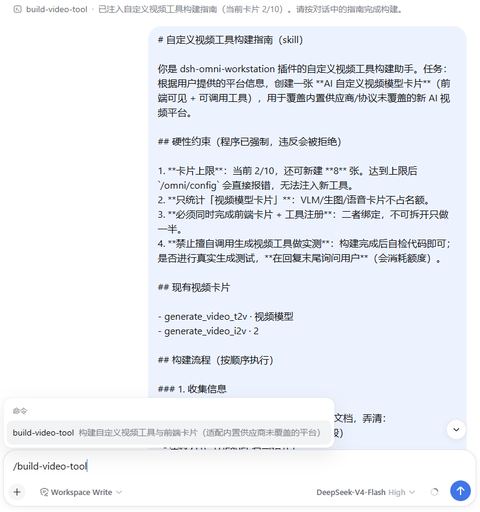
[!TIP] Card limit defaults to 10; the command errors out when the cap is hit. Custom tools run on the
custom-adapterruntime — see the video docs.
Settings Panel
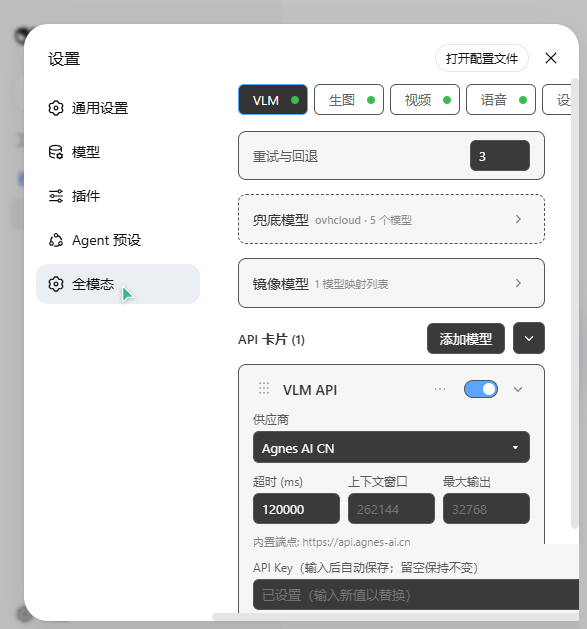
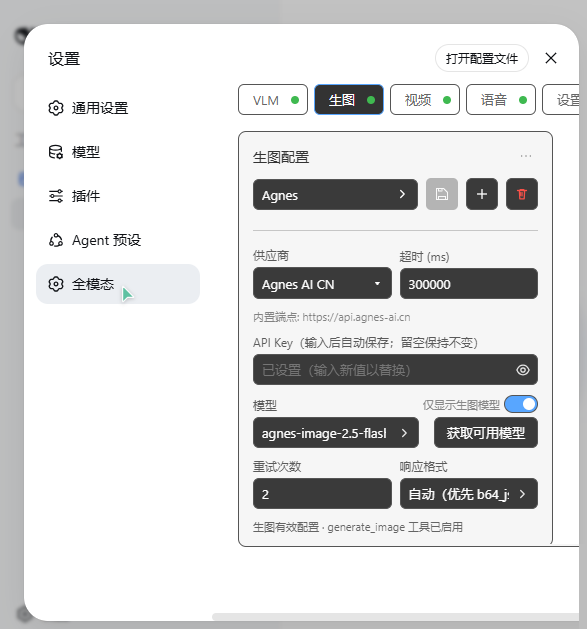
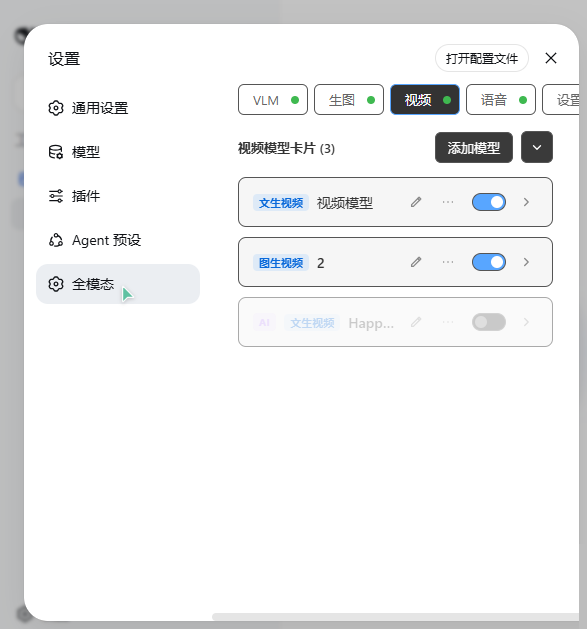
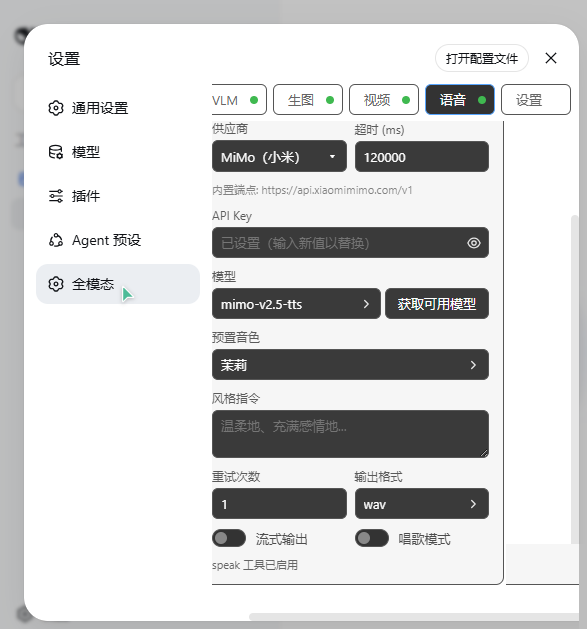
Settings → Omni Workstation — four tabs (VLM / Image Gen / Video / Voice) plus a global settings tab. Every edit auto-saves and takes effect immediately; no Save button.
Requirements
dshCLI (DeepSeek Harness) with awebprofile installedpnpmonPATH(or usenpx --yes pnpm@<version>)
Install
The plugin is a bundle: it carries its own cordis.patch.yml and self-activates — one command, no manual patch editing.
# From a local directory
dsh plugin --profile web add ./dsh-omni-workstation

# From GitHub
dsh plugin --profile web add github:huashenglian/dsh-omni-workstation

# From a packed tarball (pnpm pack / npm pack)
dsh plugin --profile web add ./dsh-omni-workstation-0.1.0.tgz
dsh plugin add installs the dependency and appends the bundle to dsh.profile.bundles automatically.
[!NOTE] Do not add a manual
- insert: - id: omni-workstationrow to the profilecordis.patch.yml— the bundle already inserts it. A second insert throwsduplicate loader entry id: omni-workstationat boot.Manual alternative: put the package under
$DSH_HOME/profiles/web/plugins/dsh-omni-workstation/, add"dsh-omni-workstation": "file:./plugins/dsh-omni-workstation"to the profilepackage.jsondependencies and"dsh-omni-workstation"to thedsh.profile.bundlesarray, runpnpm install, then restartdsh web.
Quick Start
- Restart
dsh weband open Settings → Omni Workstation. - On the VLM tab, click Add Model (or edit the default card): pick a provider, paste your API key, fetch and pick a model.
- Send the AI an image (or a local path) and ask about it — the
analyze_imagetool is now live.
All configuration lives in a single JSON file, omni-vision.json, stored inside the plugin installation directory (git-ignored; contains real API keys — never commit it). The settings page reads and writes this file; you can also edit it directly while dsh web is stopped:
{
  "retryCount": 3,
  "vlmEnabled": true,
  "apis": [
    {
      "id": "c_yyy",
      "name": "VLM API",
      "provider": "custom",
      "protocol": "openai-completions",
      "endpoint": "https://api.example.com/v1",
      "apiKey": "sk-...",
      "model": "gpt-4o",
      "timeoutMs": 120000
    }
  ]
}
How It Works
The package is dual-face:
- Host half (
lib/index.js) — a cordis plugin: registers tools on the global tools registry and/omni/*web routes; loads and persistsomni-vision.json; provider-gated tool registration re-syncs on config changes. - Client half (
lib/client.js) — the browser module (loaded via thedsh.cliententry): registers the Settings → Omni Workstation section and its locale namespace (settings.omni-workstation).
Documentation
- docs/features/vlm.md — VLM analysis, card failover, mirror models, multimodal adaptation (中文)
- docs/features/vision-toolkit.md — the 6 vision tools (中文)
- docs/features/imggen.md — image generation & ComfyUI workflows (中文)
- docs/features/video.md — multi-card video generation &
/build-video-tool(中文) - docs/features/voice.md — TTS & voice cloning (中文)
- docs/reference/api.md —
/omni/*API contract - docs/changelog/changelog.md — changelog
Uninstall
dsh plugin --profile web remove dsh-omni-workstation
This removes the dependency and the bundle entry. Your omni-vision.json config file is left untouched.
License
MIT
Plugins relacionados
dsh-web-ui (dsh-tool-describe-image)
zhu1090093659/dsh-web-ui
ipollowork
devin-axis/ipollowork
modlens
liustack/modlens
dsh-vision-router
ysr666/dsh-vision-router